Species · Fishes
Demon Cavefish Demogorgonichthys arcanus
The scientific name of the Demon Cavefish is Demogorgonichthys arcanus. It is a species of fish in the family Amblyopsidae (cavefishes), order Percopsiformes. The name dates from 2026.
- Scientific name
- Demogorgonichthys arcanus Hart, Niemiller, Sandel & Armbruster, 2026
- Common name
- Demon Cavefish
- Genus
- Demogorgonichthys
- Family
- Amblyopsidae (Cavefishes)
- Order
- Percopsiformes
- Class
- Teleostei
- Environment
- freshwater
- Recorded in
- 1 country
- Name status
- accepted in the Catalogue of Life
Overview
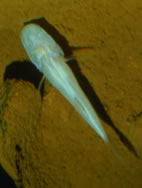
The Demon Cavefish (Demogorgonichthys arcanus) is a fish known from a single cave and its connected aquifer. It lacks visible eyes and pigmentation and has pale, translucent skin, a pronounced hump behind its head, and a long, flattened snout.
Written 26 November 2026 from the sources listed below. Each statement was checked against the passage it cites; statements that could not be supported were removed.
Appearance
The Demon Cavefish lacks visible eyes and pigmentation. Its skin is pale and translucent, and living individuals are faintly electric blue.[1][2][3]
The fish has a pronounced hump behind its head and a long, flattened snout. Its scales are deeply embedded in its skin.[4][5][6]
All of its fin rays are unbranched. The species lacks pelvic fins.[7][8]
The holotype measured 42.1 mm in standard length.[9]
Habitat
The species is known from Bobcat Cave and its connected aquifer, on the northern side of the Tennessee River valley in southwestern Madison County, Alabama.[10][11][12]
Diet
The diet of the Demon Cavefish remains poorly known.[13]
Behaviour
Individuals probably spend much of their lives in inaccessible parts of the aquifer.[14]
Reproduction and life cycle
The reproductive biology of the Demon Cavefish remains poorly known. No egg-bearing female had been documented when the species was described.[15][16]
Conservation
The Demon Cavefish had not received a formal IUCN Red List assessment when it was described. Its known distribution meets the thresholds for critically endangered status under IUCN criterion B, according to its describers.[17][18]
The describers considered a provisional NatureServe global rank of G1, or critically imperiled, appropriate for the species.[19]
Cadmium, chromium, and lead have previously been detected at elevated concentrations in the cave system. Contaminants, sediment, and fluctuations in water levels from the surrounding recharge area can reach the species.[20][21]
Restricted access to Redstone Arsenal helps protect the cave from direct disturbance.[22]
Similar species
The southern cavefish (Typhlichthys subterraneus) shares the same cave pools as the Demon Cavefish. The two species are not closely related despite their similar cave-adapted features.[23][24]
The two species independently evolved the loss of eyes and pigmentation. Their independently developed similar cave-adapted features represent convergent evolution.[25][26]
Classification of the Demon Cavefish
| Kingdom | Animalia |
|---|---|
| Phylum | Chordata |
| Subphylum | Vertebrata |
| Infraphylum | Gnathostomata |
| Parvphylum | Osteichthyes |
| Gigaclass | Actinopterygii |
| Superclass | Actinopteri |
| Class | Teleostei (Teleost) |
| Order | Percopsiformes |
| Family | Amblyopsidae (Cavefishes) |
| Genus | Demogorgonichthys (Demon Cavefishes) |
| Species | Demogorgonichthys arcanus Hart, Niemiller, Sandel & Armbruster, 2026 |
Where the Demon Cavefish is found
Checklists and occurrence records place Demogorgonichthys arcanus in 1 country. GBIF holds 4 georeferenced records of it.
Countries
Regions and cities with the most records
A number beside a place is its count of GBIF occurrence records. A place without a number comes from a checklist alone. Records show where a species has been observed or collected, which can include escapes and vagrants.
Common names
English
- Demon Cavefish
Related species
-
 Alabama CavefishSpeoplatyrhinus poulsoni
-
 Northern CavefishAmblyopsis spelaea
-
 Hoosier CavefishAmblyopsis hoosieri
-
 Southern CavefishTyphlichthys subterraneus
-
 SwampfishChologaster cornuta
-
 Spring CavefishForbesichthys agassizii
- Karst CavefishForbesichthys papilliferus
- Ozark CavefishTroglichthys rosae
Compare
Questions and answers
What is the scientific name of the Demon Cavefish?
The scientific name of the Demon Cavefish is Demogorgonichthys arcanus. Written with its author, the full name is Demogorgonichthys arcanus Hart, Niemiller, Sandel & Armbruster, 2026.
Which family does the Demon Cavefish belong to?
Demogorgonichthys arcanus belongs to the family Amblyopsidae, in the order Percopsiformes and the class Teleostei.
Where is the Demon Cavefish found?
Checklists and occurrence records place Demogorgonichthys arcanus in 1 country: United States.
What is the demon cavefish?
The Demon Cavefish (Demogorgonichthys arcanus) is a fish in the family Amblyopsidae and order Percopsiformes. It is known exclusively from Bobcat Cave and its associated aquifer in northern Alabama, United States.[10][12]
How did the cavefish lose its eyes?
The Demon Cavefish and the southern cavefish independently evolved the loss of eyes and pigmentation. Genetic analyses identified a large deletion in the rhodopsin gene causing a frameshift and premature stop codons, as well as a second smaller deletion. These mutations differ from those found in other amblyopsid cavefish.[25][27][28][26]
Are cave fish rare?
The Demon Cavefish is known from only one cave and its connected aquifer. Its known distribution meets the thresholds for critically endangered status under IUCN criterion B, and its describers considered a provisional NatureServe global rank of G1, or critically imperiled, appropriate.[12][18][19]
Did scientists discover an eyeless demon cavefish in Alabama?
Yes. The species was first documented during biological surveys of Bobcat Cave in February 2025, and the holotype was collected there on February 10, 2025. Anatomical examinations, CT scans, and genetic analyses established that the specimens represented a new genus and species, formally described in 2026.[29][30][31][32]
Sources
Passages the profile rests on
- The species lacks visible eyes and pigmentation. Source passage: “The demon cavefish lacks visible eyes and pigmentation” — English Wikipedia
- The species has pale, translucent skin. Source passage: “has pale, translucent skin.” — English Wikipedia
- Living individuals are faintly electric blue. Source passage: “faintly electric blue in life.” — uah.edu
- The fish has a pronounced hump behind its head. Source passage: “It has a pronounced hump behind the head” — English Wikipedia
- The species has a long, flattened snout. Source passage: “a long and flattened snout” — English Wikipedia
- Its scales are deeply embedded in its skin. Source passage: “deeply embedded scales” — English Wikipedia
- All of the species' fin rays are unbranched. Source passage: “fins composed entirely of unbranched rays.” — English Wikipedia
- The species lacks pelvic fins. Source passage: “Pelvic fins are absent.” — English Wikipedia
- The holotype measured 42.1 mm in standard length. Source passage: “The holotype, measuring 42.1 mm (1.66 in) in standard length” — English Wikipedia
- The species is known exclusively from Bobcat Cave and its associated aquifer at Redstone Arsenal in northern Alabama, United States. Source passage: “known only from Bobcat Cave and its associated aquifer at Redstone Arsenal in northern Alabama, United States.” — English Wikipedia
- The known distribution includes Bobcat Cave on the northern side of the Tennessee River valley in southwestern Madison County, Alabama. Source passage: “on the northern side of the Tennessee River valley in southwestern Madison County, Alabama.” — English Wikipedia
- The species is known from a single cave and its connected aquifer. Source passage: “currently known from only a single cave and its connected aquifer” — uah.edu
- The species' diet remains poorly known. Source passage: “Little is known about its diet” — English Wikipedia
- Individuals probably spend much of their lives in inaccessible parts of the aquifer. Source passage: “Individuals probably spend much of their lives in parts of the aquifer that cannot be reached by researchers.” — English Wikipedia
- No egg-bearing female had been documented when the species was described. Source passage: “No egg-bearing female had been documented when the species was described.” — English Wikipedia
- The species' reproductive biology remains poorly known. Source passage: “Little is known about its diet, reproduction or population size.” — English Wikipedia
- The species had not received a formal IUCN Red List assessment when the document was written. Source passage: “The demon cavefish has not received a formal assessment on the IUCN Red List.” — English Wikipedia
- Its known distribution meets the thresholds for critically endangered status under IUCN criterion B, according to its describers. Source passage: “its known distribution would meet the thresholds for critically endangered status under IUCN criterion B” — English Wikipedia
- Its describers considered a provisional NatureServe global rank of G1, or critically imperiled, appropriate. Source passage: “would support a provisional NatureServe global rank of G1, or critically imperiled.” — English Wikipedia
- Cadmium, chromium, and lead have previously been detected at elevated concentrations in the cave system. Source passage: “Elevated concentrations of cadmium, chromium and lead have previously been detected in the cave system.” — English Wikipedia
- Contaminants, sediment, and fluctuations in water levels from the surrounding recharge area can reach the species. Source passage: “contaminants, sediment and fluctuations in water level from the surrounding recharge area can all reach the fish.” — uah.edu
- Restricted access to Redstone Arsenal helps protect the cave from direct disturbance. Source passage: “the restricted access of Redstone Arsenal helps protect the cave from direct disturbance” — uah.edu
- The southern cavefish (Typhlichthys subterraneus) shares the same cave pools with this species. Source passage: “The species inhabits the same cave pools as the southern cavefish (Typhlichthys subterraneus)” — English Wikipedia
- The southern cavefish is not closely related to this species despite their similar cave-adapted features. Source passage: “although genetic analyses indicate that the two species are not closely related.” — English Wikipedia
- The southern cavefish and this species independently evolved the loss of eyes and pigmentation. Source passage: “including the loss of eyes and pigmentation – millions of years apart.” — uah.edu
- The independent evolution of similar cave-adapted features in this species and the southern cavefish represents convergent evolution. Source passage: “Their similar cave-adapted features therefore represent an example of convergent evolution.” — English Wikipedia
- Genetic analyses of the rhodopsin gene identified a large deletion causing a frameshift and premature stop codons, as well as a second smaller deletion. Source passage: “Analysis of the vision-related rhodopsin gene revealed a large deletion that causes a frameshift and premature stop codons, together with a second smaller deletion.” — English Wikipedia
- The mutations in the rhodopsin gene differ from those found in other amblyopsid cavefish. Source passage: “These mutations differ from those found in other amblyopsid cavefish” — English Wikipedia
- The species was first documented during biological surveys of Bobcat Cave in February 2025. Source passage: “The fish was first documented during biological surveys of Bobcat Cave in February 2025.” — English Wikipedia
- The holotype was collected from Bobcat Cave on February 10, 2025. Source passage: “was collected from Bobcat Cave on February 10, 2025.” — English Wikipedia
- Anatomical examinations, CT scans, and genetic analyses established that the specimens represented a new genus and species. Source passage: “Subsequent anatomical examinations, CT scans and genetic analyses showed that the specimens represented both a new genus and a new species.” — English Wikipedia
- The genus and species were formally described in 2026. Source passage: “The genus and species were formally described in 2026.” — English Wikipedia
Data
- Catalogue of Life, 2026-10-16 XR cc by
- Global Biodiversity Information Facility CC BY 4.0
- Wikidata CC0
- GeoNames CC BY 4.0
- Within the Catalogue of Life, this name comes from World Register of Marine Species cc by
This species in other databases
- Catalogue of Life VR3QW
- Wikidata Q141099118
- iNaturalist 1691545
- WoRMS urn:lsid:marinespecies.org:taxname:1905028
Page built on 29 November 2026. See how the catalog is made and all sources and licences.
Cite this page
ScientificNames.org. (2026). Demogorgonichthys arcanus (Demon Cavefish). Retrieved November 29, 2026, from https://scientificnames.org/species/demogorgonichthys-arcanus
“Demogorgonichthys arcanus (Demon Cavefish).” ScientificNames.org, 2026, scientificnames.org/species/demogorgonichthys-arcanus. Accessed 29 Nov. 2026.
ScientificNames.org. “Demogorgonichthys arcanus (Demon Cavefish).” Accessed November 29, 2026. https://scientificnames.org/species/demogorgonichthys-arcanus.
@misc{scientificnames_demogorgonichthys_arcanus_demon_cavefish,
  author = {{ScientificNames.org}},
  title = {Demogorgonichthys arcanus (Demon Cavefish)},
  year = {2026},
  url = {https://scientificnames.org/species/demogorgonichthys-arcanus},
  note = {Accessed 2026-11-29}
}