Species · Flowering plants
Mountain Shadbush Amelanchier bartramiana
The scientific name of the Mountain Shadbush is Amelanchier bartramiana. It is a species of flowering plant in the family Rosaceae (rose family), order Rosales.
- Scientific name
- Amelanchier bartramiana (Tausch) M.Roem.
- Common name
- Mountain Shadbush
- Genus
- Amelanchier
- Family
- Rosaceae (Rose Family)
- Order
- Rosales
- Class
- Magnoliopsida
- Red List category
- LC Least Concern
- Recorded in
- 3 countries
- Name status
- accepted in the Catalogue of Life

Overview
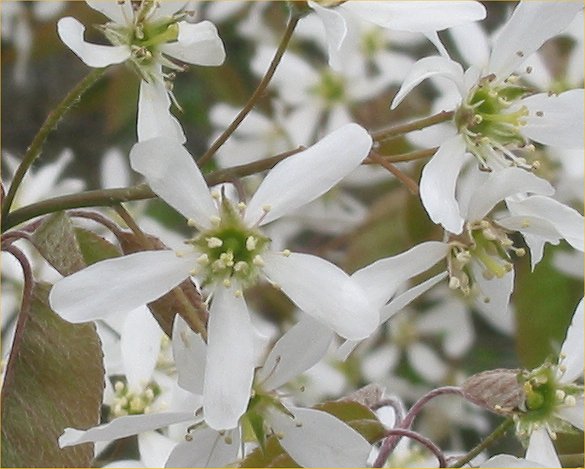
Amelanchier bartramiana occurs in northern hardwood forests, mixed hardwood-coniferous forests and along forest edges. It has five-petaled white flowers and pear-shaped fruits that ripen from red to dark purple.
Written 26 November 2026 from the sources listed below. Each statement was checked against the passage it cites; statements that could not be supported were removed.
Appearance
Its leaves are brown or green and egg-shaped, tapering at both ends. The leaf blades are ovate or elliptic, with 6–12 teeth and 10–16 pairs of lateral veins.[1][2][3]
The leaf petioles measure 2–10 millimetres in length.[4]
Its flowers have five white petals and occur singly or in clusters of up to four blossoms.[5][6]
Its fruits are pear-shaped pomes that are red before ripening to dark purple.[7]
Habitat
The mountain shadbush occurs in northern hardwood forests and mixed hardwood-coniferous forests. It also grows along forest edges.[8][9][10]
Diet
Its fruits are edible and can be consumed raw or cooked.[11]
Classification of the Mountain Shadbush
| Kingdom | Plantae |
|---|---|
| Subkingdom | Pteridobiotina |
| Phylum | Tracheophyta |
| Class | Magnoliopsida |
| Order | Rosales |
| Family | Rosaceae (Rose Family) |
| Subfamily | Amygdaloideae |
| Tribe | Maleae |
| Subtribe | Malinae |
| Genus | Amelanchier (Shadbush) |
| Species | Amelanchier bartramiana (Tausch) M.Roem. |
Where the Mountain Shadbush is found
Checklists and occurrence records place Amelanchier bartramiana in 3 countries across North America. GBIF holds 4,361 georeferenced records of it.
Countries
Regions and cities with the most records
- Quebec, Canada 1,623
- Ontario, Canada 152
- Newfoundland and Labrador, Canada 151
- Nova Scotia, Canada 122
- New Hampshire, United States 121
- New Brunswick, Canada 119
- Vermont, United States 93
- Lévis, Canada 91
- Québec, Canada 89
- Michigan, United States 88
- L'Ancienne-Lorette, Canada 78
- Neufchâtel-Est–Lebourgneuf, Canada 77
- Maine, United States 73
- Minnesota, United States 68
- Saint-Augustin-de-Desmaures, Canada 63
- Rimouski, Canada 35
- New York, United States 21
- Rivière-du-Loup, Canada 20
- Massachusetts, United States 19
- Saguenay, Canada 18
- Saint-Hyacinthe, Canada 15
- West Virginia, United States 15
- Wisconsin, United States 15
- Baie-Comeau, Canada 13
- Beloeil, Canada 13
- Mont-Saint-Hilaire, Canada 13
- Sept-Îles, Canada 13
- Sherbrooke, Canada 11
- Amos, Canada 10
- Saint-Jérôme, Canada 10
- Thetford-Mines, Canada 10
- Chambly, Canada 9
- Magog, Canada 9
- Holden, United States 8
- Mount Pearl, Canada 8
- Paradise, Canada 8
1 more country has a few records outside this range
These countries hold a few records of Amelanchier bartramiana but lie outside the range the checklists give for it. Such records are often zoo or garden specimens, museum material or vagrants, so the species is not counted as occurring there.
Range as the checklists state it
Canada (Labrador, New Brunswick, Newfoundland, Nova Scotia, Ontario, Prince Edward Isl., Québec); St. Pierre et Miquelon; USA (Massachusetts, Maine, Michigan, Minnesota, New Hampshire, New York, Pennsylvania, Vermont, Wisconsin, West Virginia)
A number beside a place is its count of GBIF occurrence records. A place without a number comes from a checklist alone. Records show where a species has been observed or collected, which can include escapes and vagrants.
Common names
English
- Mountain Shadbush
- Bartram Shadbush
- Bartram's Chuckleypear
- Bartram's Serviceberry
- Bartram's Shadbush
- Few-flowered Shadbush
- Mountain Juneberry
- Mountain Serviceberry
- Oblong-fruited Juneberry
- Oblong-fruited Serviceberry
- Oblongfruit Serviceberry
Names in 6 other languages
- Chinese
- 巴川姆唐棣
- Czech
- muchovník Bartramův
- Finnish
- pohjantuomipihlaja
- French
- amélanchier de Bartram
- Polish
- Świdośliwa Bartrama
- Slovak
- muchovník Bartramov
Synonyms
8 other scientific names have been used for this species and are now treated as synonyms of Amelanchier bartramiana.
- Amelanchier arguta Nutt. ex Britton
- Amelanchier canadensis var. oligocarpa (Michx.) Torr. & A.Gray
- Amelanchier oligocarpa (Michx.) M.Roem.
- Amelanchier quebecensis M.Bertrand
- Aronia praecox J.C.Neumann ex Tausch.
- Mespilus canadensis var. oligocarpa Michx.
- Pyrus bartramiana Tausch
- Amelanchier sanguinea Decne. ambiguous synonym
Related species
-
 SaskatoonAmelanchier alnifolia
-
 Downy ServiceberryAmelanchier arborea
-
 Canada ServiceberryAmelanchier canadensis
-
 JuneberryAmelanchier × lamarckii
-
 Allegheny ServiceberryAmelanchier laevis
-
 Snowy MespilusAmelanchier ovalis
-
 Utah ServiceberryAmelanchier utahensis
-
 Low JuneberryAmelanchier × spicata
Compare
Questions and answers
What is the scientific name of the Mountain Shadbush?
The scientific name of the Mountain Shadbush is Amelanchier bartramiana. Written with its author, the full name is Amelanchier bartramiana (Tausch) M.Roem..
Which family does the Mountain Shadbush belong to?
Amelanchier bartramiana belongs to the family Rosaceae, in the order Rosales and the class Magnoliopsida.
Where is the Mountain Shadbush found?
Checklists and occurrence records place Amelanchier bartramiana in 3 countries: Canada, United States and Saint Pierre and Miquelon.
What is the conservation status of the Mountain Shadbush?
The IUCN Red List category recorded for Amelanchier bartramiana is Least Concern (LC).
What other names does the Mountain Shadbush have?
Amelanchier bartramiana is also known in English as Bartram Shadbush, Bartram's Chuckleypear, Bartram's Serviceberry, Bartram's Shadbush, Few-flowered Shadbush and Mountain Juneberry.
Are Amelanchier berries edible?
The fruits of the mountain shadbush are edible and can be consumed raw or cooked.[11]
Sources
Passages the profile rests on
- The leaves of this species are brown or green and egg-shaped, tapering at both ends with fine teeth extending almost to the base. Source passage: “The leaves of A. bartramiana are either brown or green coloured, are egg-shaped and tapered at both ends with fine teeth almost to the base.” — English Wikipedia
- Its leaves have 6–12 teeth and 10–16 pairs of lateral veins. Source passage: “It has 6–12 teeth while its lateral veins comes 10–16 pairs.” — English Wikipedia
- Its leaf blades are ovate or elliptic. Source passage: “while its blades are ovate and elliptic.” — English Wikipedia
- Its leaf petioles measure 2–10 millimetres in length. Source passage: “Its petioles are 2–10 millimetres (0.079–0.394 in) long” — English Wikipedia
- Its flowers have five white petals. Source passage: “The flowers have five white petals” — English Wikipedia
- Its flowers occur singly or in clusters containing up to four blossoms. Source passage: “appearing singly or in clusters of up to four blossoms.” — English Wikipedia
- Its fruits are pear-shaped pomes that are red before ripening to dark purple. Source passage: “The pomes are red, ripening to dark purple and are pear-shaped.” — English Wikipedia
- This species occurs in northern hardwood forests. Source passage: “Habitat: Northern hardwood and mixed hardwood-coniferous forests, forest edges, ...” — newyork.plantatlas.usf.edu
- This species occurs in mixed hardwood-coniferous forests. Source passage: “Habitat: Northern hardwood and mixed hardwood-coniferous forests, forest edges, ...” — newyork.plantatlas.usf.edu
- This species occurs along forest edges. Source passage: “Habitat: Northern hardwood and mixed hardwood-coniferous forests, forest edges, ...” — newyork.plantatlas.usf.edu
- The fruits of this species are edible and can be consumed raw or cooked. Source passage: “The fruits are edible and can be eaten raw or cooked.” — English Wikipedia
Data
- Catalogue of Life, 2026-10-16 XR cc by
- Global Biodiversity Information Facility CC BY 4.0
- Wikidata CC0
- GeoNames CC BY 4.0
- Wikimedia Commons per image; credit shown with each image
- Within the Catalogue of Life, this name comes from Synonymic Checklists of the Vascular Plants of the World cc by
References
- M.Roem. Fam. Nat. Syn. Monogr. [Syn. Rosifl.] 145 (1847). where the name was published
This species in other databases
- Catalogue of Life CQN3
- Wikidata Q693732
- iNaturalist 155002
- World Flora Online wfo-0001009230
- GRIN 104431
Page built on 29 November 2026. See how the catalog is made and all sources and licences.
Cite this page
ScientificNames.org. (2026). Amelanchier bartramiana (Mountain Shadbush). Retrieved November 29, 2026, from https://scientificnames.org/species/amelanchier-bartramiana
“Amelanchier bartramiana (Mountain Shadbush).” ScientificNames.org, 2026, scientificnames.org/species/amelanchier-bartramiana. Accessed 29 Nov. 2026.
ScientificNames.org. “Amelanchier bartramiana (Mountain Shadbush).” Accessed November 29, 2026. https://scientificnames.org/species/amelanchier-bartramiana.
@misc{scientificnames_amelanchier_bartramiana_mountain_shadbush,
  author = {{ScientificNames.org}},
  title = {Amelanchier bartramiana (Mountain Shadbush)},
  year = {2026},
  url = {https://scientificnames.org/species/amelanchier-bartramiana},
  note = {Accessed 2026-11-29}
}