Species · Flowering plants
Coastal Serviceberry Amelanchier obovalis
The scientific name of the Coastal Serviceberry is Amelanchier obovalis. It is a species of flowering plant in the family Rosaceae (rose family), order Rosales.
- Scientific name
- Amelanchier obovalis (Michx.) Ashe
- Common name
- Coastal Serviceberry
- Genus
- Amelanchier
- Family
- Rosaceae (Rose Family)
- Order
- Rosales
- Class
- Magnoliopsida
- Recorded in
- 1 country
- Name status
- accepted in the Catalogue of Life

Overview
Coastal Serviceberry is a deciduous shrub in the Rosaceae family. It is native to the Atlantic coastal plain of the United States, with a documented native range extending from New Jersey to Georgia. It produces small white flowers with five petals, dull green leaves, and dark blue to purple-black edible fruits.
Written 26 November 2026 from the sources listed below. Each statement was checked against the passage it cites; statements that could not be supported were removed.
Appearance
Coastal Serviceberry is a deciduous shrub that typically reaches a height of 1–2 metres. It has dull green leaves that can reach 50 mm in length.[1][2][3][4]
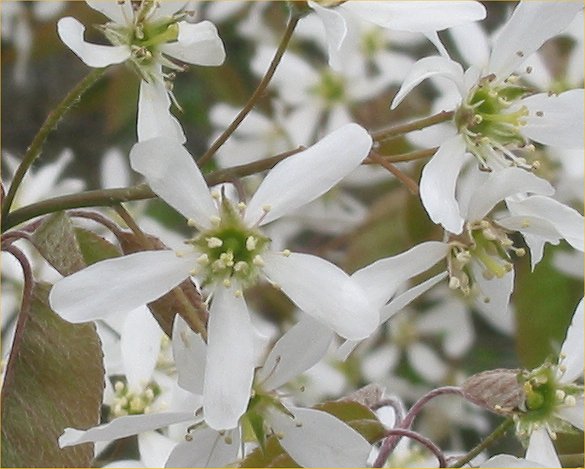
The plant produces small white flowers with five petals and dark blue to purple-black fruits.[5][6]
Habitat
Coastal Serviceberry typically grows in pine barrens and other dry woodlands. It is native to the Atlantic coastal plain of the United States, with a documented native range extending from New Jersey to Georgia.[7][8][9]
Diet
Coastal Serviceberry produces edible fruits.[10]
Classification of the Coastal Serviceberry
| Kingdom | Plantae |
|---|---|
| Subkingdom | Pteridobiotina |
| Phylum | Tracheophyta |
| Class | Magnoliopsida |
| Order | Rosales |
| Family | Rosaceae (Rose Family) |
| Subfamily | Amygdaloideae |
| Tribe | Maleae |
| Subtribe | Malinae |
| Genus | Amelanchier (Shadbush) |
| Species | Amelanchier obovalis (Michx.) Ashe |
Where the Coastal Serviceberry is found
Checklists and occurrence records place Amelanchier obovalis in 1 country across North America. GBIF holds 485 georeferenced records of it.
Countries
Regions and cities with the most records
- North Carolina, United States 44
- Maryland, United States 41
- New Jersey, United States 39
- Virginia, United States 12
- Pinehurst, United States 11
- Salisbury, United States 11
- South Vineland, United States 10
- Vineland, United States 10
- Sicklerville, United States 9
- Williamstown, United States 8
- Jackson, United States 7
- Marlboro, United States 7
- Millville, United States 7
- Easton, United States 6
- Glassboro, United States 6
- Pennsylvania, United States 6
- South Carolina, United States 6
- Bridgeton, United States 5
- Brick, United States 4
- East Brunswick, United States 4
- Georgia, United States 4
- Lakewood, United States 4
- Lindenwold, United States 4
- North Brunswick, United States 4
- Old Bridge, United States 4
- Sayreville, United States 4
- Sayreville Junction, United States 4
- Sewell, United States 4
- South Old Bridge, United States 4
- South River, United States 4
- Delaware, United States 3
- Alabama, United States
- Massachusetts, United States
1 more country has a few records outside this range
These countries hold a few records of Amelanchier obovalis but lie outside the range the checklists give for it. Such records are often zoo or garden specimens, museum material or vagrants, so the species is not counted as occurring there.
Range as the checklists state it
USA (Alabama, Delaware, Georgia, Massachusetts, Maryland, North Carolina, New Jersey, Pennsylvania, South Carolina, Virginia)
A number beside a place is its count of GBIF occurrence records. A place without a number comes from a checklist alone. Records show where a species has been observed or collected, which can include escapes and vagrants.
Common names
English
- Coastal Serviceberry
Names in 2 other languages
- Czech
- muchovník výběžkatý
- Polish
- Świdośliwa rozłogowa
Synonyms
5 other scientific names have been used for this species and are now treated as synonyms of Amelanchier obovalis.
- Amelanchier canadensis subsp. obovalis (Michx.) P.Landry
- Amelanchier canadensis var. obovalis (Michx.) Britton, Sterns & Poggenb.
- Amelanchier canadensis var. obovalis (Michx.) Sarg.
- Mespilus canadensis var. obovalis Michx.
- Amelanchier oblongifolia Wiegand ambiguous synonym
Related species
-
 SaskatoonAmelanchier alnifolia
-
 Downy ServiceberryAmelanchier arborea
-
 Canada ServiceberryAmelanchier canadensis
-
 JuneberryAmelanchier × lamarckii
-
 Allegheny ServiceberryAmelanchier laevis
-
 Snowy MespilusAmelanchier ovalis
-
 Utah ServiceberryAmelanchier utahensis
-
 Low JuneberryAmelanchier × spicata
Compare
Questions and answers
What is the scientific name of the Coastal Serviceberry?
The scientific name of the Coastal Serviceberry is Amelanchier obovalis. Written with its author, the full name is Amelanchier obovalis (Michx.) Ashe.
Which family does the Coastal Serviceberry belong to?
Amelanchier obovalis belongs to the family Rosaceae, in the order Rosales and the class Magnoliopsida.
Where is the Coastal Serviceberry found?
Checklists and occurrence records place Amelanchier obovalis in 1 country: United States.
Is there another name for serviceberry?
Coastal Serviceberry is the English name recorded for this species.[1]
Can humans eat service berries?
Coastal Serviceberry produces edible fruits.[10]
Sources
Passages the profile rests on
- Amelanchier obovalis is a deciduous shrub. Source passage: “A deciduous shrub that grows to 3–5 ft (1–2 m) tall” — English Wikipedia
- The plant has dull green leaves. Source passage: “has dull green leaves” — English Wikipedia
- The leaves can reach 50 mm in length. Source passage: “leaves that can grow up to 2 in (50 mm) long.” — English Wikipedia
- The shrub typically reaches a height of 1–2 metres. Source passage: “grows to 3–5 ft (1–2 m) tall” — English Wikipedia
- The plant produces small white flowers with five petals. Source passage: “with small five-petaled white flowers.” — English Wikipedia
- The plant produces dark blue to purple-black fruits. Source passage: “It produces edible dark blue to purple-black fruits” — English Wikipedia
- The species typically grows in pine barrens and other dry woodlands. Source passage: “typically in pine barrens and other dry woodlands.” — English Wikipedia
- The species is native to the Atlantic coastal plain of the United States. Source passage: “It is native to the Atlantic coastal plain of the United States” — English Wikipedia
- The documented native range extends from New Jersey to Georgia. Source passage: “from New Jersey to Georgia” — English Wikipedia
- The plant produces edible fruits. Source passage: “It produces edible dark blue to purple-black fruits” — English Wikipedia
Data
- Catalogue of Life, 2026-10-16 XR cc by
- Global Biodiversity Information Facility CC BY 4.0
- Wikidata CC0
- GeoNames CC BY 4.0
- Wikimedia Commons per image; credit shown with each image
- Within the Catalogue of Life, this name comes from Synonymic Checklists of the Vascular Plants of the World cc by
References
- Ashe. (1903). Bot. Gaz. 35: 434 (1903). where the name was published
This species in other databases
- Catalogue of Life 66BQF
- Wikidata Q17270054
- iNaturalist 158276
- World Flora Online wfo-0001009258
- GRIN 318580
Page built on 27 November 2026. See how the catalog is made and all sources and licences.
Cite this page
ScientificNames.org. (2026). Amelanchier obovalis (Coastal Serviceberry). Retrieved November 27, 2026, from https://scientificnames.org/species/amelanchier-obovalis
“Amelanchier obovalis (Coastal Serviceberry).” ScientificNames.org, 2026, scientificnames.org/species/amelanchier-obovalis. Accessed 27 Nov. 2026.
ScientificNames.org. “Amelanchier obovalis (Coastal Serviceberry).” Accessed November 27, 2026. https://scientificnames.org/species/amelanchier-obovalis.
@misc{scientificnames_amelanchier_obovalis_coastal_serviceberry,
  author = {{ScientificNames.org}},
  title = {Amelanchier obovalis (Coastal Serviceberry)},
  year = {2026},
  url = {https://scientificnames.org/species/amelanchier-obovalis},
  note = {Accessed 2026-11-27}
}