Species · Flowering plants
Roundleaf Serviceberry Amelanchier sanguinea
The scientific name of the Roundleaf Serviceberry is Amelanchier sanguinea. It is a species of flowering plant in the family Rosaceae (rose family), order Rosales.
- Scientific name
- Amelanchier sanguinea (Pursh) DC.
- Common name
- Roundleaf Serviceberry
- Genus
- Amelanchier
- Family
- Rosaceae (Rose Family)
- Order
- Rosales
- Class
- Magnoliopsida
- Red List category
- LC Least Concern
- Recorded in
- 2 countries
- Name status
- accepted in the Catalogue of Life

Overview
Amelanchier sanguinea is native to eastern and central North America. Its fruits are red when young and turn purple or dark blue as they ripen.
Written 26 November 2026 from the sources listed below. Each statement was checked against the passage it cites; statements that could not be supported were removed.
Appearance
The shrub can reach a height of 3 metres. Its fruits resemble berries but are botanically classified as pomes.[1][2]
The fruits are red when young and turn purple or dark blue as they ripen.[3]
Habitat
Roundleaf Serviceberry occurs in forest understories, along forest edges, on sand plains and rocky outcrops, and beside fencerows.[4]
It is native to eastern and central North America, with a range extending from New Brunswick west to Saskatchewan and south to northern Georgia. It is most common in eastern Canada, the northeastern United States, and the Great Lakes region.[5][6][7]
Diet
Roundleaf Serviceberry produces edible fruits with a sweet flavour.[8]
Classification of the Roundleaf Serviceberry
| Kingdom | Plantae |
|---|---|
| Subkingdom | Pteridobiotina |
| Phylum | Tracheophyta |
| Class | Magnoliopsida |
| Order | Rosales |
| Family | Rosaceae (Rose Family) |
| Subfamily | Amygdaloideae |
| Tribe | Maleae |
| Subtribe | Malinae |
| Genus | Amelanchier (Shadbush) |
| Species | Amelanchier sanguinea (Pursh) DC. |
Where the Roundleaf Serviceberry is found
Checklists and occurrence records place Amelanchier sanguinea in 2 countries across North America. GBIF holds 3,927 georeferenced records of it.
Countries
Regions and cities with the most records
- Quebec, Canada 476
- Ontario, Canada 423
- Minnesota, United States 266
- Wisconsin, United States 197
- Michigan, United States 180
- Dollard-Des Ormeaux, Canada 59
- Cartierville, Canada 57
- Pointe-Claire, Canada 57
- Pierrefonds-Roxboro, Canada 56
- Dorval, Canada 53
- L'Île-Bizard–Sainte-Geneviève, Canada 52
- Laval-des-Rapides, Canada 52
- Laval, Canada 51
- Pierrefonds, Canada 51
- Beaconsfield, Canada 50
- Kirkland, Canada 50
- Châteauguay, Canada 49
- Deux-Montagnes, Canada 49
- Mont-Royal, Canada 48
- Val-des-Arbres, Canada 48
- Côte-Saint-Luc, Canada 46
- Saint-Eustache, Canada 44
- Boisbriand, Canada 42
- New York, United States 40
- Vaudreuil-Dorion, Canada 40
- Sainte-Thérèse, Canada 36
- New Brunswick, Canada 34
- Vermont, United States 34
- Chambly, Canada 33
- Saint-Vincent-de-Paul, Canada 33
- Montréal-Nord, Canada 32
- Saint-Michel, Canada 32
- Rimouski, Canada 30
- Rivière-des-Prairies–Pointe-aux-Trembles, Canada 30
- Villeray–Saint-Michel–Parc-Extension, Canada 30
- Blainville, Canada 29
5 more countries have a few records outside this range
These countries hold a few records of Amelanchier sanguinea but lie outside the range the checklists give for it. Such records are often zoo or garden specimens, museum material or vagrants, so the species is not counted as occurring there.
Range as the checklists state it
Canada (New Brunswick, Ontario, Québec); USA (Connecticut, Georgia, Iowa, Illinois, Indiana, Massachusetts, Maryland, Maine, Michigan, Minnesota, North Carolina, North Dakota, New Hampshire, New Jersey, New York, Ohio, Pennsylvania, Tennessee, Virginia, Vermont, Wisconsin, West Virginia)
A number beside a place is its count of GBIF occurrence records. A place without a number comes from a checklist alone. Records show where a species has been observed or collected, which can include escapes and vagrants.
Common names
English
- Roundleaf Serviceberry
- Huron Serviceberry
- New England Serviceberry
- Red-twig Shadbush
- Round-leaf Juneberry
- Round-leaf Serviceberry
- Round-leaf Shadblow
- Round-leaved Juneberry
- Round-leaved Serviceberry
- Shore Shadbush
Names in 2 other languages
- French
- amélanchier sanguin, petites poires
- German
- Vermont-Felsenbirne
Synonyms
13 other scientific names have been used for this species and are now treated as synonyms of Amelanchier sanguinea.
- Amelanchier amabilis Wiegand
- Amelanchier canadensis var. rotundifolia (Michx.) Torr. & A.Gray
- Amelanchier grandiflora (Wiegand) Wiegand
- Amelanchier huronensis Wiegand
- Amelanchier pallida var. arguta Greene
- Amelanchier sanguinea f. grandiflora Wiegand
- Amelanchier sanguinea var. arguta (Greene) P.Landry
- Amelanchier sanguinea var. grandiflora (Wiegand) Rehder
- Amelanchier sanguinea var. sanguinea
- Aronia sanguinea (Pursh) Nutt.
- Mespilus canadensis var. rotundifolia Michx.
- Pyrus sanguinea Pursh
- Amelanchier rotundifolia (Michx.) M.Roem. ambiguous synonym
Subspecies and varieties
Related species
-
 SaskatoonAmelanchier alnifolia
-
 Downy ServiceberryAmelanchier arborea
-
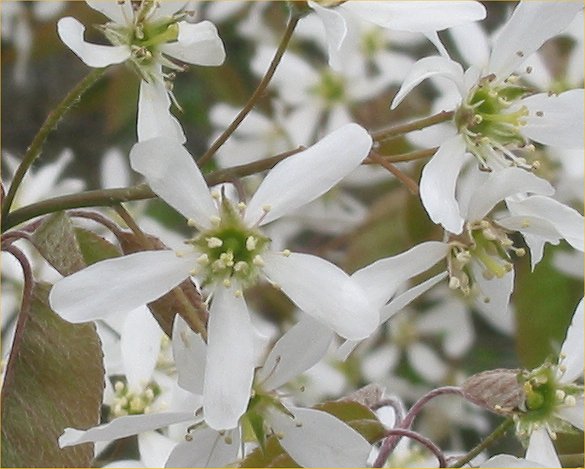 Canada ServiceberryAmelanchier canadensis
-
 JuneberryAmelanchier × lamarckii
-
 Allegheny ServiceberryAmelanchier laevis
-
 Snowy MespilusAmelanchier ovalis
-
 Utah ServiceberryAmelanchier utahensis
-
 Low JuneberryAmelanchier × spicata
Compare
Questions and answers
What is the scientific name of the Roundleaf Serviceberry?
The scientific name of the Roundleaf Serviceberry is Amelanchier sanguinea. Written with its author, the full name is Amelanchier sanguinea (Pursh) DC..
Which family does the Roundleaf Serviceberry belong to?
Amelanchier sanguinea belongs to the family Rosaceae, in the order Rosales and the class Magnoliopsida.
Where is the Roundleaf Serviceberry found?
Checklists and occurrence records place Amelanchier sanguinea in 2 countries: United States and Canada.
What is the conservation status of the Roundleaf Serviceberry?
The IUCN Red List category recorded for Amelanchier sanguinea is Least Concern (LC).
What other names does the Roundleaf Serviceberry have?
Amelanchier sanguinea is also known in English as Huron Serviceberry, New England Serviceberry, Red-twig Shadbush, Round-leaf Juneberry, Round-leaf Serviceberry and Round-leaf Shadblow.
Where do serviceberry trees grow naturally?
Roundleaf Serviceberry is native to eastern and central North America. Its native range extends from New Brunswick west to Saskatchewan and south to northern Georgia. It is most common in eastern Canada, the northeastern United States, and the Great Lakes region.[5][6][7]
Can humans eat service berries?
Roundleaf Serviceberry produces edible fruits with a sweet flavour.[8]
Sources
Passages the profile rests on
- The fruits resemble berries but are botanically classified as pomes. Source passage: “Like all Amelanchier fruit, these resemble berries, but are technically pomes.” — English Wikipedia
- The shrub can reach a height of 3 metres. Source passage: “can grow up to 3 metres (9.8 ft) tall” — English Wikipedia
- The fruits are red when young and turn purple or dark blue as they ripen. Source passage: “fruits that are red when young and become purple or dark-blue when they ripen.” — English Wikipedia
- The species occurs in forest understories, along forest edges, on sand plains and rocky outcrops, and beside fencerows. Source passage: “In the forest understory, at forest edges, on sand plains and rocky outcrops, and along fencerows” — tidcf.nrcan.gc.ca
- The species is native to eastern and central North America. Source passage: “a shrub native to eastern and central North America.” — English Wikipedia
- The native range extends from New Brunswick west to Saskatchewan and south to northern Georgia. Source passage: “Its native range stretches from New Brunswick to Saskatchewan south as far as northern Georgia.” — English Wikipedia
- The species is most common in eastern Canada, the northeastern United States, and the Great Lakes region. Source passage: “It is most common in eastern Canada, the northeastern United States, and the Great Lakes region.” — English Wikipedia
- The species produces edible fruits with a sweet flavour. Source passage: “edible sweet-flavored fruits” — English Wikipedia
Data
- Catalogue of Life, 2026-10-16 XR cc by
- Global Biodiversity Information Facility CC BY 4.0
- Wikidata CC0
- GeoNames CC BY 4.0
- Wikimedia Commons per image; credit shown with each image
- Within the Catalogue of Life, this name comes from Synonymic Checklists of the Vascular Plants of the World cc by
References
- DC. (1825). Prodr. [A.P. de Candolle] 2: 633 (1825). where the name was published
This species in other databases
Page built on 29 November 2026. See how the catalog is made and all sources and licences.
Cite this page
ScientificNames.org. (2026). Amelanchier sanguinea (Roundleaf Serviceberry). Retrieved November 29, 2026, from https://scientificnames.org/species/amelanchier-sanguinea
“Amelanchier sanguinea (Roundleaf Serviceberry).” ScientificNames.org, 2026, scientificnames.org/species/amelanchier-sanguinea. Accessed 29 Nov. 2026.
ScientificNames.org. “Amelanchier sanguinea (Roundleaf Serviceberry).” Accessed November 29, 2026. https://scientificnames.org/species/amelanchier-sanguinea.
@misc{scientificnames_amelanchier_sanguinea_roundleaf_serviceberry,
  author = {{ScientificNames.org}},
  title = {Amelanchier sanguinea (Roundleaf Serviceberry)},
  year = {2026},
  url = {https://scientificnames.org/species/amelanchier-sanguinea},
  note = {Accessed 2026-11-29}
}