Species · Birds
Scaled Fruiteater Ampelioides tschudii
The scientific name of the Scaled Fruiteater is Ampelioides tschudii. It is a species of bird in the family Cotingidae (contingas), order Passeriformes. The name dates from 1846.
- Scientific name
- Ampelioides tschudii (G. R. Gray, 1846)
- Common name
- Scaled Fruiteater
- Genus
- Ampelioides
- Family
- Cotingidae (Contingas)
- Order
- Passeriformes
- Class
- Aves
- Red List category
- LC Least Concern
- Recorded in
- 6 countries
- Name status
- accepted in the Catalogue of Life

Overview
The Scaled Fruiteater is a bird belonging to the family Cotingidae, order Passeriformes, and class Aves. It inhabits high-elevation tropical forests in the Andes Mountains. It is distinguished by mossy-green and black plumage with a scaly pattern.
Written 26 November 2026 from the sources listed below. Each statement was checked against the passage it cites; statements that could not be supported were removed.
Appearance
The Scaled Fruiteater has olive-green plumage with fine scale-like markings on its chest and belly. Its plumage also has a mossy-green and black scaly pattern.[1][2]
The species has a short, sharp beak adapted for consuming fruits, seeds, and insects. It measures approximately 19–20 cm in length.[3][4]
Adult males have entirely black heads, brighter green bodies, and longer tails than females.[5]
Habitat
The Scaled Fruiteater inhabits high-elevation tropical forests in the Andes Mountains, including dense montane rainforests. It generally remains below the forest canopy.[6][7]
The species occurs at elevations between 1,000 and 3,500 metres above sea level.[8]
Diet
The Scaled Fruiteater feeds on fruits and berries found in South American mountain ranges.[9]
The species supplements its fruit-based diet with insects during the breeding season.[10]
Behaviour
The Scaled Fruiteater uses its green-scaled plumage to camouflage itself among dense vegetation. It is non-migratory and remains in the Andes throughout the year.[11][12]
During the breeding season, males establish territories and attract females using vocalizations and aerial displays.[13]
Reproduction and life cycle
The species constructs shallow cup-shaped nests using plant fibres. Females typically lay two eggs per clutch.[14][15]
The eggs are incubated for approximately two weeks.[16]
Both parents participate in feeding and caring for their chicks until the young develop sufficiently large wings for flight.[17]
Conservation
The Scaled Fruiteater is classified as Least Concern by the International Union for Conservation of Nature. It was most recently assessed for the IUCN Red List in 2024.[18][19]
The species may experience population declines associated with deforestation and human development.[20]
Similar species
Ampelioides tschudii is the only species belonging to the genus Ampelioides.[21]
Classification of the Scaled Fruiteater
| Kingdom | Animalia |
|---|---|
| Phylum | Chordata |
| Subphylum | Vertebrata |
| Infraphylum | Gnathostomata |
| Parvphylum | Osteichthyes |
| Megaclass | Tetrapoda |
| Class | Aves (Bird) |
| Order | Passeriformes (Passerine) |
| Family | Cotingidae (Contingas) |
| Genus | Ampelioides (Scaled Fruiteater) |
| Species | Ampelioides tschudii (G. R. Gray, 1846) |
Where the Scaled Fruiteater is found
Checklists and occurrence records place Ampelioides tschudii in 6 countries across South America. GBIF holds 6,612 georeferenced records of it.
Countries
Regions and cities with the most records
- Pichincha, Ecuador 3,952
- Risaralda Department, Colombia 952
- Valle del Cauca Department, Colombia 444
- Belén de Umbría, Colombia 403
- Anserma, Colombia 316
- Quinchía, Colombia 302
- Cali, Colombia 301
- Yumbo, Colombia 292
- Nariño, Colombia 165
- Napo, Ecuador 154
- El Oro, Ecuador 132
- Piñas, Ecuador 131
- San Martín Department, Peru 118
- La Paz Department, Bolivia 102
- Darien, Colombia 75
- Imbabura, Ecuador 69
- Antioquia, Colombia 59
- Chocó, Colombia 53
- Ciudad Bolívar, Colombia 45
- Zamora Chinchipe, Ecuador 30
- Amazonas, Peru 25
- Lara, Venezuela 23
- Putumayo Department, Colombia 23
- Escuque, Venezuela 22
- Trujillo, Venezuela 22
- Zulia, Venezuela 22
- Mocoa, Colombia 19
- Motatán, Venezuela 19
- Sabana de Mendoza, Venezuela 19
- Valera, Venezuela 19
- Riosucio, Colombia 18
- Ucayali, Peru 18
- Sanare, Venezuela 17
- Cajamarca Department, Peru 15
- Carchi, Ecuador 14
- Cauca Department, Colombia 12
Range as the checklists state it
South America
A number beside a place is its count of GBIF occurrence records. A place without a number comes from a checklist alone. Records show where a species has been observed or collected, which can include escapes and vagrants.
Common names
English
- Scaled Fruiteater
Names in 25 other languages
- Arabic
- آكل الفاكهة الحرشفي
- Catalan
- cotinga escatós
- Chinese
- 鱗斑食果雀, 鳞斑食果伞鸟
- Croatian
- ljuskasta kotinga
- Czech
- kotinga šupinkatá
- Danish
- Hvidstrubet Frugtæder
- Dutch
- Groengeschubde Cotinga
- Esperanto
- skvama kotingo
- Finnish
- suomukotinga
- French
- Cotinga écaillé
- German
- Schuppenkotinga, Schuppenschmuckvogel
- Italian
- Fruttaio squamato
- Japanese
- ウロコカザリドリ
- Lithuanian
- žvynuotasis vaislesys
- Norwegian
- skjellfrukteter
- Polish
- owocojad kusy
- Portuguese
- anambé-escamoso, fruteiro-escamoso
- Russian
- Чешуйчатый плодоед, Чешуйчатый ягодоед
- Serbian
- Krljuštasta voćarka
- Slovak
- ovociar šupinatý
- Spanish
- Frutero escamado, Frutero escamoso
- Swedish
- fjällig fruktätare
- Turkish
- Pullu Meyveyiyen
- Ukrainian
- плодоїд строкатий
- Welsh
- cotinga cennog
Synonyms
3 other scientific names have been used for this species and are now treated as synonyms of Ampelioides tschudii.
- Ampelioides flavitorques Verreaux, JP, 1867
- Ampelis cincta Tschudi, JJ, 1843
- Cotinga tschudii G. R. Gray, 1846
Related species
-
 CapuchinbirdPerissocephalus tricolor
-
 Andean Cock-of-the-rockRupicola peruvianus
-
 White BellbirdProcnias albus
-
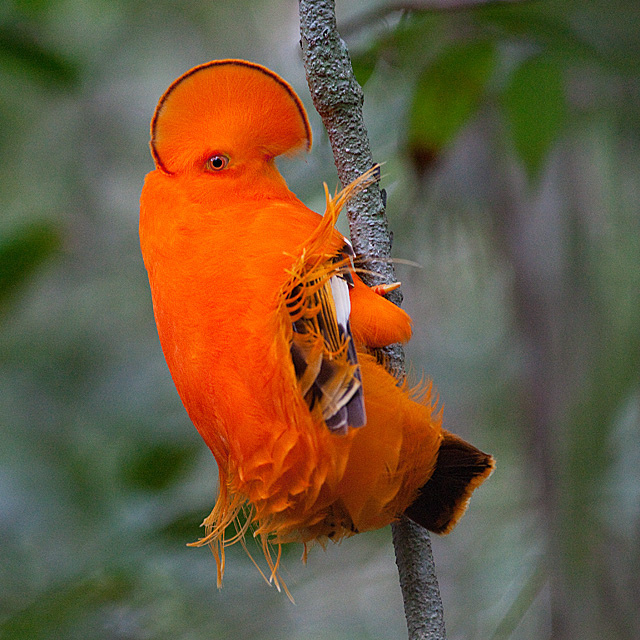 Guianan Cock-of-the-rockRupicola rupicola
-
 Screaming PihaLipaugus vociferans
-
 Bare-throated BellbirdProcnias nudicollis
-
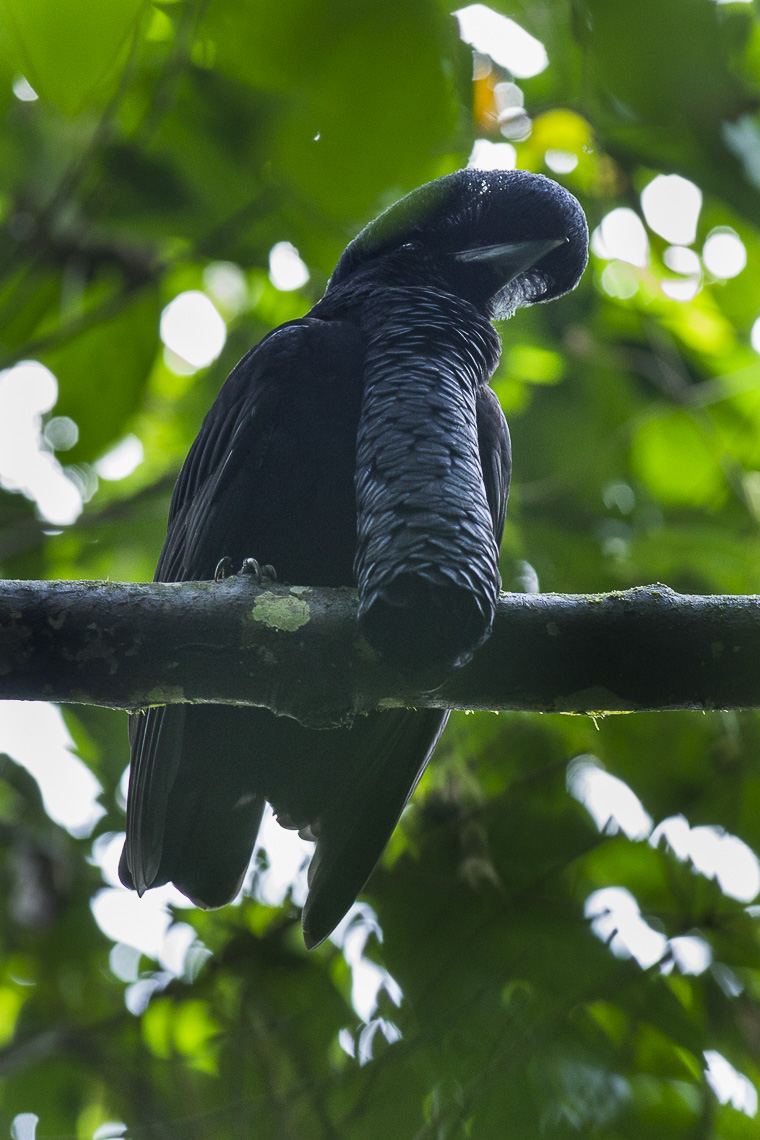 Long-wattled UmbrellabirdCephalopterus penduliger
-
 Three-wattled BellbirdProcnias tricarunculatus
Compare
Questions and answers
What is the scientific name of the Scaled Fruiteater?
The scientific name of the Scaled Fruiteater is Ampelioides tschudii. Written with its author, the full name is Ampelioides tschudii (G. R. Gray, 1846).
Which family does the Scaled Fruiteater belong to?
Ampelioides tschudii belongs to the family Cotingidae, in the order Passeriformes and the class Aves.
Where is the Scaled Fruiteater found?
Checklists and occurrence records place Ampelioides tschudii in 6 countries: Ecuador, Colombia, Peru, Bolivia, Venezuela and Brazil.
What is the conservation status of the Scaled Fruiteater?
The IUCN Red List category recorded for Ampelioides tschudii is Least Concern (LC).
Where is the Scaled Fruiteater found?
The Scaled Fruiteater occurs in Bolivia, Colombia, Ecuador, Peru, and Venezuela.[22]
Is the Scaled Fruiteater migratory?
No. The species is non-migratory and remains in the Andes throughout the year.[12]
How many eggs does the Scaled Fruiteater lay?
Females typically lay two eggs per clutch.[15]
How long are the eggs incubated?
The eggs are incubated for approximately two weeks.[16]
What is the conservation status of the Scaled Fruiteater?
The species is classified as Least Concern by the International Union for Conservation of Nature.[18]
What threats may affect the Scaled Fruiteater?
The species may experience population declines associated with deforestation and human development.[20]
What is the genus of the Scaled Fruiteater?
Ampelioides tschudii is the only species belonging to the genus Ampelioides.[21]
Sources
Passages the profile rests on
- The Scaled Fruiteater has olive-green plumage with fine scale-like markings on its chest and belly. Source passage: “The scaled fruiteater is characterized by its olive-green plumage with fine scaling on the chest and belly.” — English Wikipedia
- The species has mossy-green and black plumage with a scaly pattern. Source passage: “Chunky, short-tailed, flat-headed bird patterned in mossy green and black. Scaly.” — ebird.org
- The species has a short, sharp beak adapted for consuming fruits, seeds, and insects. Source passage: “The Scaled Fruiteater has a short and sharp beak, specialized for eating fruits, seeds, and insects.” — English Wikipedia
- The Scaled Fruiteater measures approximately 19–20 cm in length. Source passage: “The scaled fruiteater is a chunky, short-tailed, flat-headed bird measuring 19–20 cm (7.5–7.9 in) in length.” — English Wikipedia
- Adult males have entirely black heads, brighter green bodies, and longer tails than females. Source passage: “Males have an all-black head, display a more vibrant green color on their bodies, and have longer tails than females.” — English Wikipedia
- The species inhabits high-elevation tropical forests in the Andes Mountains. Source passage: “where its natural habitat is the high elevation tropical forests of the Andes mountains.” — English Wikipedia
- The Scaled Fruiteater inhabits dense montane rainforests and generally remains below the forest canopy. Source passage: “They inhabit dense rainforests where they stay below the canopy, often near streams or other water sources.” — English Wikipedia
- The species occurs at elevations between 1,000 and 3,500 metres above sea level. Source passage: “This species is found at high elevations, ranging from 1,000 to 3,500 meters (3,300 to 11,500 ft) above sea level.” — English Wikipedia
- The Scaled Fruiteater feeds on fruits and berries found in South American mountain ranges. Source passage: “Scaled fruiteaters feed on a variety of fruits and berries that are unique to the South American mountain ranges.” — English Wikipedia
- The species supplements its fruit-based diet with insects during the breeding season. Source passage: “They supplement their diet with insects during the breeding season when protein-rich food is essential for raising young.” — English Wikipedia
- The species uses its green-scaled plumage to camouflage itself among dense vegetation. Source passage: “These birds are known for their camouflage ability, utilizing their green scales to remain hidden within the dense vegetation.” — English Wikipedia
- The Scaled Fruiteater is non-migratory and remains in the Andes throughout the year. Source passage: “The Scaled Fruiteater is non-migratory and will stay in the Andes region year-round.” — English Wikipedia
- Males establish territories during the breeding season and attract females using vocalizations and aerial displays. Source passage: “During the breeding season, males establish territories and attract female mates through vocalizations and aerial displays.” — English Wikipedia
- The species constructs shallow cup-shaped nests using plant fibres. Source passage: “The nest is a shallow cup constructed from plant fibers” — English Wikipedia
- Females typically lay two eggs per clutch. Source passage: “Females will typically lay two eggs, which are incubated for about two weeks.” — English Wikipedia
- The eggs are incubated for approximately two weeks. Source passage: “Females will typically lay two eggs, which are incubated for about two weeks.” — English Wikipedia
- Both parents participate in feeding and caring for their chicks until the young develop sufficiently large wings for flight. Source passage: “Both parents participate in feeding and caring for the chicks until they develop wings large enough for flight.” — English Wikipedia
- The Scaled Fruiteater is classified as Least Concern by the International Union for Conservation of Nature. Source passage: “The scaled fruiteater is considered a species of least concern by the International Union for Conservation of Nature (IUCN).” — English Wikipedia
- The species was most recently assessed for the IUCN Red List in 2024. Source passage: “Scaled Fruiteater Ampelioides tschudii has most recently been assessed for The IUCN Red List of Threatened Species in 2024.” — iucnredlist.org
- The species may experience population declines associated with deforestation and human development. Source passage: “populations may be declining due to habitat loss caused by deforestation and human development.” — English Wikipedia
- Ampelioides tschudii is the only species belonging to the genus Ampelioides. Source passage: “It is the only member of the genus Ampelioides.” — English Wikipedia
- The Scaled Fruiteater occurs in Bolivia, Colombia, Ecuador, Peru, and Venezuela. Source passage: “This bird is found in Bolivia, Colombia, Ecuador, Peru, and Venezuela” — English Wikipedia
Data
- Catalogue of Life, 2026-10-16 XR cc by
- Global Biodiversity Information Facility CC BY 4.0
- Wikidata CC0
- GeoNames CC BY 4.0
- Wikimedia Commons per image; credit shown with each image
- Within the Catalogue of Life, this name comes from The Integrated Taxonomic Information System cc0
References
- Gill, Frank, & and Minturn Wright. (2006). Birds of the World: Recommended English Names.
This species in other databases
Page built on 28 November 2026. See how the catalog is made and all sources and licences.
Cite this page
ScientificNames.org. (2026). Ampelioides tschudii (Scaled Fruiteater). Retrieved November 28, 2026, from https://scientificnames.org/species/ampelioides-tschudii
“Ampelioides tschudii (Scaled Fruiteater).” ScientificNames.org, 2026, scientificnames.org/species/ampelioides-tschudii. Accessed 28 Nov. 2026.
ScientificNames.org. “Ampelioides tschudii (Scaled Fruiteater).” Accessed November 28, 2026. https://scientificnames.org/species/ampelioides-tschudii.
@misc{scientificnames_ampelioides_tschudii_scaled_fruiteater,
  author = {{ScientificNames.org}},
  title = {Ampelioides tschudii (Scaled Fruiteater)},
  year = {2026},
  url = {https://scientificnames.org/species/ampelioides-tschudii},
  note = {Accessed 2026-11-28}
}