Species · Amphibians
Geminis' Dart Frog Andinobates geminisae
The scientific name of the Geminis' Dart Frog is Andinobates geminisae. It is a species of amphibian in the family Dendrobatidae (poison dart frog), order Anura. The name dates from 2014.
- Scientific name
- Andinobates geminisae Batista, Jaramillo, Ponce & Crawford, 2014
- Common name
- Geminis' Dart Frog
- Genus
- Andinobates
- Family
- Dendrobatidae (Poison Dart Frog)
- Order
- Anura
- Class
- Amphibia
- Red List category
- CR Critically Endangered
- Recorded in
- 1 country
- Name status
- accepted in the Catalogue of Life

Overview
The species inhabits lush rainforest and is endemic to west-central Panama. It is distinguished by its smooth, chrome-orange skin and buzz-like call.
Written 27 November 2026 from the sources listed below. Each statement was checked against the passage it cites; statements that could not be supported were removed.
Appearance
The frog has smooth, chrome-orange skin and unwebbed feet. Its snout is rounded and slender, with outward-facing external nostrils. Darker pigmentation occurs on the lower jaw and between the eyes.[1][2][3][4]
The frog measures 11 to 13 mm in length. Females are slightly larger than males.[5][6]
Habitat
The species inhabits lush rainforest. Individuals can be found beneath rocks and logs, near tree roots, and on leaf litter on dry, elevated ridges.[7][8]
The species is endemic to west-central Panama and has been recorded in a portion of the Río Belén basin in the Donoso region.[9][10]
Behaviour
The frog produces a buzz-like call with many pulses per note and a relatively low dominant frequency.[11]
Reproduction and life cycle
The species lays eggs in water-filled cupped leaves and tree hollows. Bromeliads and pitcher plants are preferred egg-laying sites.[14][15]
Conservation
The species was classified as critically endangered by the IUCN in June 2018. Habitat loss and illegal pet trading are identified as threats.[16][17]
Deforestation has recently affected the province where the species occurs. Its habitat in the Donoso region faces risks from copper mining, agriculture, and human settlement.[18][19]
The species may be vulnerable to the fungus responsible for chytridiomycosis, which has been detected in some wild individuals.[20]
A captive-bred population is maintained by the Amphibian Rescue and Conservation Project.[21]
Classification of the Geminis' Dart Frog
| Kingdom | Animalia |
|---|---|
| Phylum | Chordata |
| Subphylum | Vertebrata |
| Infraphylum | Gnathostomata |
| Parvphylum | Osteichthyes |
| Megaclass | Tetrapoda |
| Class | Amphibia (Amphibians) |
| Order | Anura (Frogs) |
| Superfamily | Dendrobatoidea |
| Family | Dendrobatidae (Poison Dart Frog) |
| Subfamily | Dendrobatinae |
| Genus | Andinobates |
| Species | Andinobates geminisae Batista, Jaramillo, Ponce & Crawford, 2014 |
Origin of the name. Etymology. The specific epithet of this beautiful new species is dedicated to Geminis Vargas, the beloved wife of Marcos Ponce, for her unconditional support of his studies of Panamanian herpetology.
Where the Geminis' Dart Frog is found
Checklists and occurrence records place Andinobates geminisae in 1 country. GBIF holds 6 georeferenced records of it.
Countries
Regions and cities with the most records
A number beside a place is its count of GBIF occurrence records. A place without a number comes from a checklist alone. Records show where a species has been observed or collected, which can include escapes and vagrants.
Common names
English
- Geminis' Dart Frog
- Río Belén Poison Frog
Names in 1 other language
- Spanish
- Rana veneno de Geminis
Related species
-
 Blue-bellied Poison FrogAndinobates minutus
-
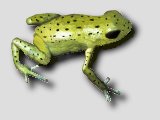 Alto de Buey Poison FrogAndinobates altobueyensis
- Green Poison FrogAndinobates viridis
-
 Yellow-bellied Poison FrogAndinobates fulguritus
-
 Doris Swanson's Poison-dart FrogAndinobates dorisswansonae
- Collins' Poison FrogAndinobates abditus
-
 Cassidy's Poison Dart FrogAndinobates cassidyhornae
-
 Santander Poison FrogAndinobates virolinensis
Compare
Questions and answers
What is the scientific name of the Geminis' Dart Frog?
The scientific name of the Geminis' Dart Frog is Andinobates geminisae. Written with its author, the full name is Andinobates geminisae Batista, Jaramillo, Ponce & Crawford, 2014.
Which family does the Geminis' Dart Frog belong to?
Andinobates geminisae belongs to the family Dendrobatidae, in the order Anura and the class Amphibia.
Where is the Geminis' Dart Frog found?
Checklists and occurrence records place Andinobates geminisae in 1 country: Panama.
What is the conservation status of the Geminis' Dart Frog?
The IUCN Red List category recorded for Andinobates geminisae is Critically Endangered (CR).
What other names does the Geminis' Dart Frog have?
Andinobates geminisae is also known in English as Río Belén Poison Frog.
Sources
Passages the profile rests on
- The frog has smooth, chrome-orange skin. Source passage: “This small frog is 11 to 13 mm long and smooth chrome orange skin.” — English Wikipedia
- The frog has unwebbed feet. Source passage: “The feet do not have any webbing” — English Wikipedia
- The frog has a rounded, slender snout and outward-facing external nostrils. Source passage: “It possesses a rounded, slender snout with outward facing external nares.” — English Wikipedia
- Darker pigmentation occurs on the lower jaw and between the eyes. Source passage: “Darker pigmentation is observed on the lower mandible and betwixt the eyes.” — English Wikipedia
- The frog measures 11 to 13 mm in length. Source passage: “This small frog is 11 to 13 mm long” — English Wikipedia
- Females are slightly larger than males. Source passage: “females are slightly larger than the males.” — English Wikipedia
- The species inhabits lush rainforest. Source passage: “The habitat of A. geminisae is lush rainforest.” — English Wikipedia
- Individuals can be found beneath rocks and logs, near tree roots, and on leaf litter on dry, elevated ridges. Source passage: “It can be spotted under rocks, logs, near tree roots, and atop leaf litter on dry, elevated ridges.” — English Wikipedia
- The species has been recorded in a portion of the Río Belén basin in the Donoso region. Source passage: “Up to 15 individuals have been recorded at populated sites in the Donoso region, specifically in a slight portion of the Rio Belén basin.” — English Wikipedia
- The species is endemic to west-central Panama. Source passage: “This animal is endemic to West Central Panama” — English Wikipedia
- The frog produces a buzz-like call with many pulses per note and a relatively low dominant frequency. Source passage: “The call of this amphibian is buzz-like, with a relatively high amount of pulses per note and lower dominant frequency” — English Wikipedia
- Males carry tadpoles on their backs. Source passage: “There is photographic evidence that the male Geminis' dart frogs carries its tadpoles on its back” — English Wikipedia
- Males transport tadpoles on their backs. Source passage: “the male Geminis' dart frogs carries its tadpoles on its back” — English Wikipedia
- The species lays eggs in water-filled cupped leaves and tree hollows. Source passage: “Cupped leaves and tree hollows full of water are used as areas to lay their eggs.” — English Wikipedia
- Bromeliads and pitcher plants are preferred egg-laying sites. Source passage: “Bromeliads and pitcher plants have been shown preference.” — English Wikipedia
- The species was classified as critically endangered by the IUCN in June 2018. Source passage: “The Geminis' dart frog has been classified as critically endangered by the International Union of Conservation (IUCN) as of June 2018.” — English Wikipedia
- Habitat loss and illegal pet trading are identified as threats to the species. Source passage: “Limited range, illegitimate pet trading, and loss of natural habitat are the most pertinent threats to the survival of this species.” — English Wikipedia
- Deforestation has recently affected the province where the species occurs. Source passage: “Deforestation has recently impacted this province specifically.” — English Wikipedia
- The species' habitat in the Donoso region faces risks from copper mining, agriculture, and human settlement. Source passage: “Their home in the Donoso region is at risk of human settlement due to copper mining and agricultural interests” — English Wikipedia
- The species may be vulnerable to the fungus responsible for chytridiomycosis, which has been detected in some wild individuals. Source passage: “this species may be made more vulnerable by the presence of Batrachochytrium dendrobatidis, the fungus causing chytridiomycosis which has been found in some wild individuals.” — English Wikipedia
- A captive-bred population is maintained by the Amphibian Rescue and Conservation Project. Source passage: “the captive bred population currently under the care of the Amphibian Rescue and Conservation Project shows promise of growth.” — English Wikipedia
Data
- Catalogue of Life, 2026-10-16 XR cc by
- Global Biodiversity Information Facility CC BY 4.0
- Wikidata CC0
- GeoNames CC BY 4.0
- Wikimedia Commons per image; credit shown with each image
- Within the Catalogue of Life, this name comes from The Integrated Taxonomic Information System cc0
References
- A new species of Andinobates (Amphibia: Anura: Dendrobatidae) from west central Panama. (2014). Zootaxa, 3866(3), 333–352. https://doi.org/10.11646/zootaxa.3866.3.2 Link where the name was published
This species in other databases
Page built on 28 November 2026. See how the catalog is made and all sources and licences.
Cite this page
ScientificNames.org. (2026). Andinobates geminisae (Geminis' Dart Frog). Retrieved November 28, 2026, from https://scientificnames.org/species/andinobates-geminisae
“Andinobates geminisae (Geminis' Dart Frog).” ScientificNames.org, 2026, scientificnames.org/species/andinobates-geminisae. Accessed 28 Nov. 2026.
ScientificNames.org. “Andinobates geminisae (Geminis' Dart Frog).” Accessed November 28, 2026. https://scientificnames.org/species/andinobates-geminisae.
@misc{scientificnames_andinobates_geminisae_geminis_dart_frog,
  author = {{ScientificNames.org}},
  title = {Andinobates geminisae (Geminis' Dart Frog)},
  year = {2026},
  url = {https://scientificnames.org/species/andinobates-geminisae},
  note = {Accessed 2026-11-28}
}