Species · Amphibians
Blue-bellied Poison Frog Andinobates minutus
The scientific name of the Blue-bellied Poison Frog is Andinobates minutus. It is a species of amphibian in the family Dendrobatidae (poison dart frog), order Anura. The name dates from 1935.
- Scientific name
- Andinobates minutus (Shreve, 1935)
- Common name
- Blue-bellied Poison Frog
- Genus
- Andinobates
- Family
- Dendrobatidae (Poison Dart Frog)
- Order
- Anura
- Class
- Amphibia
- Red List category
- LC Least Concern
- Recorded in
- 3 countries
- Name status
- accepted in the Catalogue of Life

Overview
The Blue-bellied Poison Frog is an amphibian in the family Dendrobatidae. It occurs in Colombia and Panama. It has a specialized diet that includes mites, springtails, and holometabolous larvae.
Written 27 November 2026 from the sources listed below. Each statement was checked against the passage it cites; statements that could not be supported were removed.
Appearance
Habitat
The species inhabits tropical moist lowland forests and occurs in mature secondary forests. It is absent from degraded habitats and is terrestrial.[3][4][5][6]
In Panama, it occurs around El Valle and Cerro Campana, in central regions, eastern lowlands, and eastern cordilleras. Its southern distribution extends into Colombia as far as the Río Saija.[7][8]
The species occurs below 1,000 metres elevation.[9]
Diet
The species has a specialized diet that includes mites (Acari) and holometabolous larvae. It preferentially consumes springtails (Collembola).[10][11][12]
Behaviour
The species is locally abundant and belongs to the diverse group of diurnal frogs found in the Neotropics.[13][14]
Reproduction and life cycle
The species deposits its eggs in leaf litter. Males transport the tadpoles to bromeliads, where they complete their development.[15][16]
Conservation
Habitat loss through deforestation and pollution threatens the species. Agricultural development, illegal crops, logging, and human settlement are identified as causes of deforestation.[17][18]
Pollution from spraying illegal crops is also a threat to the species.[19]
Uses
The species is not collected for the pet trade.[20]
Classification of the Blue-bellied Poison Frog
| Kingdom | Animalia |
|---|---|
| Phylum | Chordata |
| Subphylum | Vertebrata |
| Infraphylum | Gnathostomata |
| Parvphylum | Osteichthyes |
| Megaclass | Tetrapoda |
| Class | Amphibia (Amphibians) |
| Order | Anura (Frogs) |
| Superfamily | Dendrobatoidea |
| Family | Dendrobatidae (Poison Dart Frog) |
| Subfamily | Dendrobatinae |
| Genus | Andinobates |
| Species | Andinobates minutus (Shreve, 1935) |
Where the Blue-bellied Poison Frog is found
Checklists and occurrence records place Andinobates minutus in 3 countries. GBIF holds 835 georeferenced records of it.
Countries
Regions and cities with the most records
- Valle del Cauca Department, Colombia 224
- Chocó, Colombia 108
- Quibdó, Colombia 39
- Buenaventura, Colombia 21
- Panamá, Panama 11
- Cauca Department, Colombia 9
- Panamá Oeste Province, Panama 9
- Colón, Panama 7
- Darién, Panama 7
- Timbiquí, Colombia 7
- Cativá, Panama 3
- Risaralda Department, Colombia 3
- Sabanitas, Panama 3
- Tadó, Colombia 3
A number beside a place is its count of GBIF occurrence records. A place without a number comes from a checklist alone. Records show where a species has been observed or collected, which can include escapes and vagrants.
Common names
English
- Blue-bellied Poison Frog
- Blue-bellied Poison-arrow Frog
- Bluebelly Poison Frog
Names in 3 other languages
- Czech
- pralesnička malá
- Russian
- Синебрюхий древолаз
- Spanish
- Ranita venenosa de vientre azul
Synonyms
5 other scientific names have been used for this species and are now treated as synonyms of Andinobates minutus.
- Dendrobates minutus Shreve, 1935
- Dendrobates minutus minutus Shreve, 1935
- Dendrobates shrevei Dunn, 1940
- Minyobates minutus (Shreve, 1935)
- Ranitomeya minuta (Shreve, 1935)
Related species
-
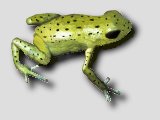 Alto de Buey Poison FrogAndinobates altobueyensis
- Green Poison FrogAndinobates viridis
-
 Yellow-bellied Poison FrogAndinobates fulguritus
-
 Doris Swanson's Poison-dart FrogAndinobates dorisswansonae
- Collins' Poison FrogAndinobates abditus
-
 Cassidy's Poison Dart FrogAndinobates cassidyhornae
-
 Geminis' Dart FrogAndinobates geminisae
-
 Santander Poison FrogAndinobates virolinensis
Compare
Questions and answers
What is the scientific name of the Blue-bellied Poison Frog?
The scientific name of the Blue-bellied Poison Frog is Andinobates minutus. Written with its author, the full name is Andinobates minutus (Shreve, 1935).
Which family does the Blue-bellied Poison Frog belong to?
Andinobates minutus belongs to the family Dendrobatidae, in the order Anura and the class Amphibia.
Where is the Blue-bellied Poison Frog found?
Checklists and occurrence records place Andinobates minutus in 3 countries: Colombia, Panama and Peru.
What is the conservation status of the Blue-bellied Poison Frog?
The IUCN Red List category recorded for Andinobates minutus is Least Concern (LC).
What other names does the Blue-bellied Poison Frog have?
Andinobates minutus is also known in English as Blue-bellied Poison-arrow Frog and Bluebelly Poison Frog.
Sources
Passages the profile rests on
- The species has a snout–vent length of 13–16 mm. Source passage: “only 13–16 mm (0.51–0.63 in) in snout–vent length.” — English Wikipedia
- Adults measure 13–16 mm in snout–vent length. Source passage: “it is a small frog, only 13–16 mm (0.51–0.63 in) in snout–vent length.” — birdnet.cornell.edu
- The species inhabits tropical moist lowland forests. Source passage: “Its natural habitats are tropical moist lowland forests.” — English Wikipedia
- The species occurs in mature secondary forests but is absent from degraded habitats. Source passage: “It is not found in degraded habitats, but does occur in mature secondary forests.” — English Wikipedia
- The species is terrestrial. Source passage: “It is a locally abundant, terrestrial species.” — English Wikipedia
- The species is associated with tropical moist lowland forests. Source passage: “Its natural habitats are tropical moist lowland forests.” — inaturalist.org
- In Panama, the species occurs around El Valle and Cerro Campana, in central regions, eastern lowlands, and eastern cordilleras. Source passage: “from Panama (within El Valle and Cerro Campana, in the central areas of the country and the eastern lowlands and cordilleras)” — English Wikipedia
- The species' southern distribution extends into Colombia as far as the Río Saija. Source passage: “south to Colombia (south to Rio Saija).” — English Wikipedia
- The species occurs below 1,000 metres elevation. Source passage: “It occurs below 1,000m, generally even lower.” — English Wikipedia
- The species has a specialized diet that includes mites (Acari). Source passage: “with preference for Acari (mites)” — English Wikipedia
- The species preferentially consumes springtails (Collembola). Source passage: “Collembola (springtails)” — English Wikipedia
- The species' specialist diet includes holometabolous larvae. Source passage: “and Holometabolous larvae.” — English Wikipedia
- The species is locally abundant. Source passage: “It is a locally abundant, terrestrial species.” — English Wikipedia
- The species is a member of the diverse group of diurnal frogs found in the Neotropics. Source passage: “Dart-poison frogs (Dendrobatidae) form the most diverse group of diurnal frogs in the Neotropics” — English Wikipedia
- The species deposits its eggs in leaf litter. Source passage: “The eggs are deposited in leaf-litter;” — English Wikipedia
- Males transport the tadpoles to bromeliads, where the tadpoles complete their development. Source passage: “the male carries the tadpoles to bromeliads, where they complete their development.” — English Wikipedia
- Habitat loss through deforestation and pollution threaten the species. Source passage: “It is threatened by habitat loss (deforestation) and pollution.” — English Wikipedia
- Agricultural development, illegal crops, logging, and human settlement are identified as causes of deforestation threatening the species. Source passage: “deforestation for agricultural development, illegal crops, logging, human settlement” — English Wikipedia
- Pollution from spraying illegal crops is identified as a threat to the species. Source passage: “pollution resulting from the spraying of illegal crops.” — English Wikipedia
- The species is not collected for the pet trade. Source passage: “This species is not collected for pet trade, unlike many other poison frogs.” — English Wikipedia
Data
- Catalogue of Life, 2026-10-16 XR cc by
- Global Biodiversity Information Facility CC BY 4.0
- Wikidata CC0
- GeoNames CC BY 4.0
- Wikimedia Commons per image; credit shown with each image
- Within the Catalogue of Life, this name comes from The Integrated Taxonomic Information System cc0
This species in other databases
Page built on 28 November 2026. See how the catalog is made and all sources and licences.
Cite this page
ScientificNames.org. (2026). Andinobates minutus (Blue-bellied Poison Frog). Retrieved November 28, 2026, from https://scientificnames.org/species/andinobates-minutus
“Andinobates minutus (Blue-bellied Poison Frog).” ScientificNames.org, 2026, scientificnames.org/species/andinobates-minutus. Accessed 28 Nov. 2026.
ScientificNames.org. “Andinobates minutus (Blue-bellied Poison Frog).” Accessed November 28, 2026. https://scientificnames.org/species/andinobates-minutus.
@misc{scientificnames_andinobates_minutus_blue_bellied_poison_frog,
  author = {{ScientificNames.org}},
  title = {Andinobates minutus (Blue-bellied Poison Frog)},
  year = {2026},
  url = {https://scientificnames.org/species/andinobates-minutus},
  note = {Accessed 2026-11-28}
}