Species · Amphibians
Green Poison Frog Andinobates viridis
The scientific name of the Green Poison Frog is Andinobates viridis. It is a species of amphibian in the family Dendrobatidae (poison dart frog), order Anura. The name dates from 1976.
- Scientific name
- Andinobates viridis (Myers & Daly, 1976)
- Common name
- Green Poison Frog
- Genus
- Andinobates
- Family
- Dendrobatidae (Poison Dart Frog)
- Order
- Anura
- Class
- Amphibia
- Red List category
- CR Critically Endangered
- Recorded in
- 1 country
- Name status
- accepted in the Catalogue of Life
Overview
Andinobates viridis is endemic to the western slope of the Cordillera Occidental in Colombia. It has uniform green coloration, brighter on its back and legs, with a metallic-colored ventral side.
Written 27 November 2026 from the sources listed below. Each statement was checked against the passage it cites; statements that could not be supported were removed.
Habitat
The Green Poison Frog inhabits primary lowland and sub-montane forests and can also occur in good secondary forests. It occurs in forests at elevations between 100 and 1,300 meters where bromeliads are present.[1][2]
The species uses bromeliad plants as hosts and depends on the water contained within them as an essential resource. It selects bromeliads according to specific tank-size and water-quality characteristics.[3][4]
Diet
Recorded food items include Drosophila, micro-crickets, small wax maggots, meadow plankton, and springtails.[5]
Conservation
The species was uplisted from Vulnerable to Critically Endangered (Possibly Extinct) in 2017. It is reported to have fewer than 50 individuals, possibly none.[6][7]
Threats include habitat loss through deforestation, pollution, invasive and other problematic species, and genes and diseases. The species may also be affected by co-extinction associated with the disappearance of certain bromeliad species.[8][9]
Uses
The species is not recorded in the international pet trade.[10]
Classification of the Green Poison Frog
| Kingdom | Animalia |
|---|---|
| Phylum | Chordata |
| Subphylum | Vertebrata |
| Infraphylum | Gnathostomata |
| Parvphylum | Osteichthyes |
| Megaclass | Tetrapoda |
| Class | Amphibia (Amphibians) |
| Order | Anura (Frogs) |
| Superfamily | Dendrobatoidea |
| Family | Dendrobatidae (Poison Dart Frog) |
| Subfamily | Dendrobatinae |
| Genus | Andinobates |
| Species | Andinobates viridis (Myers & Daly, 1976) |
Where the Green Poison Frog is found
Checklists and occurrence records place Andinobates viridis in 1 country. GBIF holds 24 georeferenced records of it.
Countries
Regions and cities with the most records
A number beside a place is its count of GBIF occurrence records. A place without a number comes from a checklist alone. Records show where a species has been observed or collected, which can include escapes and vagrants.
Common names
English
- Green Poison Frog
Names in 2 other languages
- Czech
- pralesnička zelená
- Russian
- Зелёный древолаз
Synonyms
3 other scientific names have been used for this species and are now treated as synonyms of Andinobates viridis.
- Dendrobates viridis Myers & Daly, 1976
- Minyobates viridis (Myers & Daly, 1976)
- Ranitomeya viridis (Myers & Daly, 1976)
Related species
-
 Blue-bellied Poison FrogAndinobates minutus
-
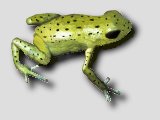 Alto de Buey Poison FrogAndinobates altobueyensis
-
 Yellow-bellied Poison FrogAndinobates fulguritus
-
 Doris Swanson's Poison-dart FrogAndinobates dorisswansonae
- Collins' Poison FrogAndinobates abditus
-
 Cassidy's Poison Dart FrogAndinobates cassidyhornae
-
 Geminis' Dart FrogAndinobates geminisae
-
 Santander Poison FrogAndinobates virolinensis
Compare
Questions and answers
What is the scientific name of the Green Poison Frog?
The scientific name of the Green Poison Frog is Andinobates viridis. Written with its author, the full name is Andinobates viridis (Myers & Daly, 1976).
Which family does the Green Poison Frog belong to?
Andinobates viridis belongs to the family Dendrobatidae, in the order Anura and the class Amphibia.
Where is the Green Poison Frog found?
Checklists and occurrence records place Andinobates viridis in 1 country: Colombia.
What is the conservation status of the Green Poison Frog?
The IUCN Red List category recorded for Andinobates viridis is Critically Endangered (CR).
What diet does a poison dart frog have?
Recorded food items for the Green Poison Frog include Drosophila, micro-crickets, small wax maggots, meadow plankton, and springtails.[5]
Sources
Passages the profile rests on
- The species inhabits primary lowland and sub-montane forests and can also occur in good secondary forests. Source passage: “Its natural habitats are primary lowland and sub-montane forests; it can also been found in good secondary forests.” — English Wikipedia
- The species occurs in forests at elevations between 100 and 1,300 meters where bromeliads are present. Source passage: “They are found in the forest at a 100 meter to 1300 meter altitude, where bromeliads are located.” — English Wikipedia
- The species uses bromeliad plants as hosts and depends on the water contained within them as an essential resource. Source passage: “It is one of many organisms that uses the bromeliad plant as its host. The water inside the plant is an essential resource for the green poison frog as well as other organisms.” — English Wikipedia
- The species selects bromeliads according to specific tank-size and water-quality characteristics. Source passage: “These frogs seek particular characteristics in the plant, like the size of the tank and its water quality.” — English Wikipedia
- The species' recorded food items include Drosophila, micro-crickets, small wax maggots, meadow plankton, and springtails. Source passage: “Small frogs eat drosophila, micro-crickets, small wax maggots, meadow plankton and springtails.” — English Wikipedia
- The species was uplisted from Vulnerable to Critically Endangered (Possibly Extinct) in 2017. Source passage: “the species was uplisted from "Vulnerable" to "Critically Endangered (Possibly Extinct)" in 2017.” — English Wikipedia
- The species is reported to have fewer than 50 individuals, possibly none. Source passage: “It is a very rare frog, numbering at fewer than 50, maybe even no individuals.” — English Wikipedia
- Threats to the species include habitat loss through deforestation, pollution, invasive and other problematic species, and genes and diseases. Source passage: “The green poison frog is threatened by habitat loss (deforestation), pollution, invasive and other problematic species, and genes and diseases.” — English Wikipedia
- The species may be affected by co-extinction associated with the disappearance of certain bromeliad species. Source passage: “Similarly to the green poison frog, certain species of the bromeliad plant are becoming extinct, resulting in co-extinction.” — English Wikipedia
- The species is not recorded in the international pet trade. Source passage: “This species is not recorded in the international pet trade.” — English Wikipedia
Data
- Catalogue of Life, 2026-10-16 XR cc by
- Global Biodiversity Information Facility CC BY 4.0
- Wikidata CC0
- GeoNames CC BY 4.0
- Within the Catalogue of Life, this name comes from The Integrated Taxonomic Information System cc0
This species in other databases
Page built on 28 November 2026. See how the catalog is made and all sources and licences.
Cite this page
ScientificNames.org. (2026). Andinobates viridis (Green Poison Frog). Retrieved November 28, 2026, from https://scientificnames.org/species/andinobates-viridis
“Andinobates viridis (Green Poison Frog).” ScientificNames.org, 2026, scientificnames.org/species/andinobates-viridis. Accessed 28 Nov. 2026.
ScientificNames.org. “Andinobates viridis (Green Poison Frog).” Accessed November 28, 2026. https://scientificnames.org/species/andinobates-viridis.
@misc{scientificnames_andinobates_viridis_green_poison_frog,
  author = {{ScientificNames.org}},
  title = {Andinobates viridis (Green Poison Frog)},
  year = {2026},
  url = {https://scientificnames.org/species/andinobates-viridis},
  note = {Accessed 2026-11-28}
}