Species · Flowering plants
Dill Anethum graveolens
The scientific name of the Dill is Anethum graveolens. It is a species of flowering plant in the family Apiaceae (umbellifer), order Apiales.
- Scientific name
- Anethum graveolens L.
- Common name
- Dill
- Genus
- Anethum
- Family
- Apiaceae (Umbellifer)
- Order
- Apiales
- Class
- Magnoliopsida
- Recorded in
- 132 countries
- Name status
- accepted in the Catalogue of Life
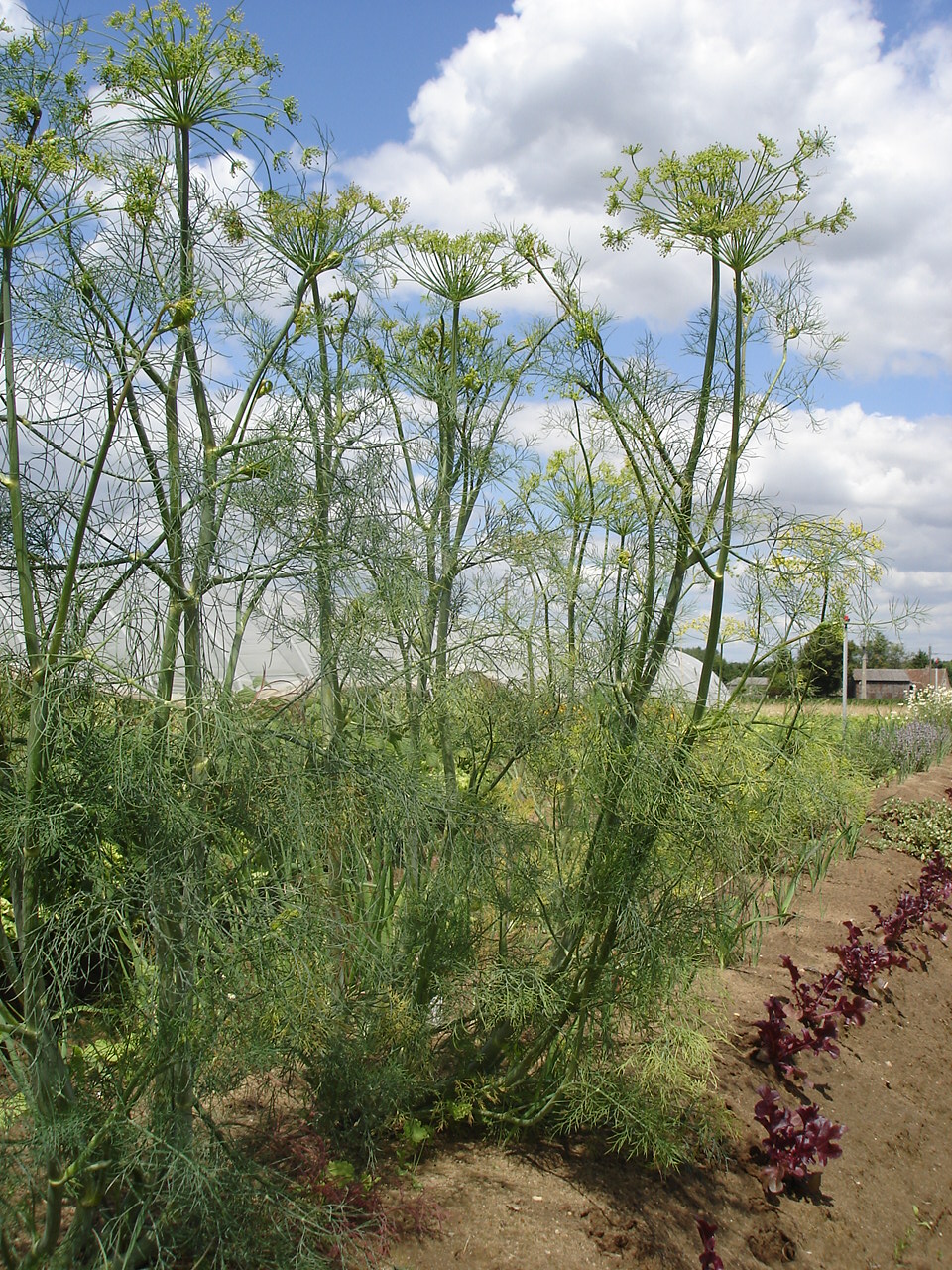
Overview
The species is native to North Africa, Iran, and the Arabian Peninsula and is cultivated widely across Eurasia. Dill has finely divided, threadlike leaves, small yellow flowers arranged in umbels, and aromatic, ridged fruits.
Written 26 November 2026 from the sources listed below. Each statement was checked against the passage it cites; statements that could not be supported were removed.
Appearance
Dill has slender, hollow stems and delicate, blue-green leaves arranged alternately along the stems. The leaves are finely divided into threadlike segments measuring 1–2 millimetres in width.[1][2][3][4]
Its small, scented, yellow flowers grow in flattened terminal umbels measuring 2.5–9 centimetres in diameter.[5][6][7]
The fruits are aromatic, oval, straight or slightly curved, and have longitudinal ridges. They change from green to brown as they ripen and measure 4–5 millimetres in length and approximately 1 millimetre in thickness.[8][9][10]
The plant grows to a height of 0.5–1.5 metres. Its leaves measure 10–20 centimetres in length.[11][12]
Habitat
Dill grows best in rich, well-drained soil and requires warm to hot summers and high levels of sunshine for successful cultivation. It grows in full sun and rich, moist, well-drained soil.[13][14][15]
Reproduction and life cycle
Dill is propagated through seeds, which generally germinate within 10–14 days and remain viable for approximately 3–10 years. The plant can self-sow when growing in suitable conditions.[16][17][18][19]
The flowers are pollinated by insects, including bees and wasps, that visit them for nectar and pollen. The plant's ripe fruits turn brown and shatter.[20][21]
Seeds are harvested by cutting the flower heads when they begin to ripen.[22]
Uses
Dill leaves and seeds are used as herbs or spices to flavour food. The leaves commonly flavour fish dishes, soups, and pickles, while fresh and dried leaves are also used as condiments and in tea.[23][24][25]
Essential oil extracted from the seeds is used as a flavouring in the food industry. Oil from the plant is also used in perfumery to fragrance detergents and soaps.[26][27]
The seeds have traditionally been used in Ayurvedic medicine for carminative, stomachic, and diuretic purposes. The plant has also been used to address abdominal discomfort, colic, and digestive problems.[28][29]
Dill is used as an ingredient in gripe water intended to relieve colic and flatulence in children. Essential oil extracted from the seeds is used to relieve intestinal spasms and colic.[30][31]
Chewing the seeds is reported to improve bad breath. The species has been used in more than 56 Ayurvedic preparations.[32][33]
Behaviour
Hot weather and dry spells cause dill to flower prematurely. The plant attracts beneficial insects, bees, and other pollinators.[34][35]
Black swallowtail caterpillars can eat the plant where that butterfly occurs.[36]
Classification of the Dill
| Kingdom | Plantae |
|---|---|
| Subkingdom | Pteridobiotina |
| Phylum | Tracheophyta |
| Class | Magnoliopsida |
| Order | Apiales |
| Family | Apiaceae (Umbellifer) |
| Subfamily | Apioideae |
| Tribe | Apieae |
| Genus | Anethum (Dill) |
| Species | Anethum graveolens L. |
Where the Dill is found
Checklists and occurrence records place Anethum graveolens in 132 countries across Africa, Asia, Europe, North America, Oceania and South America. GBIF holds 13,516 georeferenced records of it.
Countries where it is native or its origin is not stated
- Aland Islands 3
- Algeria 8
- Armenia 26
- Azerbaijan 70
- Bahrain 3
- Belarus 40
- Bosnia and Herzegovina 5
- Cabo Verde 3
- China 91
- Cyprus 2
- Czechia 95
- Denmark 344
- Egypt 31
- Ethiopia 55
- Finland 329
- Georgia 75
- Germany 1,992
- Ghana 4
- Hong Kong 3
- Indonesia 7
- Iran 29
- Iraq 29
- Isle of Man 6
- Israel 22
- Japan 30
- Kazakhstan 84
- Kenya 6
- Kuwait 3
- Kyrgyzstan 7
- Lebanon 1
- Libya 6
- Luxembourg 21
- Madagascar 10
- Mayotte 6
- Moldova 18
- Morocco 11
- Nepal 9
- Niger 4
- Nigeria 8
- North Macedonia 3
- Norway 178
- Oman 4
- Poland 439
- Reunion 3
- Russia 952
- Saudi Arabia 3
- Serbia 4
- South Africa 8
- Sri Lanka 4
- Sweden 2,842
- Syria 2
- Tanzania 12
- The Netherlands 370
- Tunisia 7
- Turkey 51
- Turkmenistan 4
Countries where it has been introduced
- Afghanistan 34
- Albania 5
- Angola
- Anguilla
- Argentina 12
- Australia 56
- Austria 198
- Bahamas 24
- Bangladesh 3
- Barbados
- Belgium 445
- Belize 1
- Bhutan 1
- Bolivia 1
- Brazil 138
- Bulgaria 40
- Cameroon 1
- Canada 97
- Chad
- Colombia 58
- Costa Rica 6
- Croatia 6
- Cuba 7
- Djibouti
- Dominica 3
- Dominican Republic
- Ecuador 19
- Estonia 119
- France 669
- Greece 46
- Guadeloupe 4
- Guatemala 12
- Haiti 2
- Honduras 2
- Hungary 86
- India 118
- Ireland 2
- Italy 69
- Jamaica 5
- Laos 7
- Latvia 32
- Lithuania 13
- Mali
- Martinique 4
- Mauritius
- Mexico 33
- Mongolia 7
- Montserrat
- Mozambique 2
- Myanmar 1
- New Zealand 16
- Nicaragua 4
- Pakistan 29
- Panama 2
- Paraguay 3
- Peru 2
- Philippines 1
- Portugal 160
- Puerto Rico 4
- Qatar 6
- Romania 107
- Slovakia 53
- Slovenia 3
- Spain 618
- Sudan 9
- Switzerland 230
- Taiwan 18
- Tajikistan 7
- Thailand 45
- Trinidad and Tobago
- Ukraine 212
- United Kingdom 442
- United States 712
- Uzbekistan 47
- Venezuela 3
- Vietnam 13
Regions and cities with the most records
- Bavaria, Germany 1,030
- Skåne, Sweden 531
- Stockholm, Sweden 354
- Västra Götaland, Sweden 336
- England, United Kingdom 297
- Kalmar, Sweden 280
- Catalonia, Spain 255
- Östergötland, Sweden 208
- Solna, Sweden 205
- Sundbyberg, Sweden 204
- Lower Saxony, Germany 201
- Malmö, Sweden 198
- Rinkeby, Sweden 194
- Björlanda, Sweden 193
- Staffanstorp, Sweden 193
- Gothenburg, Sweden 190
- Uppsala, Sweden 185
- Halland, Sweden 180
- Västra Frölunda, Sweden 179
- Partille, Sweden 178
- Huddinge, Sweden 177
- Lund, Sweden 175
- Danderyd, Sweden 173
- Mölndal, Sweden 173
- Schweinfurt, Germany 167
- Limhamn, Sweden 162
- Jakobsberg, Sweden 160
- Sollentuna, Sweden 159
- Stockholm, Sweden 157
- Bad Kissingen, Germany 154
- Trångsund, Sweden 153
- Bad Neustadt an der Saale, Germany 152
- Kalmar, Sweden 152
- Täby, Sweden 148
- Tullinge, Sweden 140
- Nacka, Sweden 137
5 more countries have a few records outside this range
These countries hold a few records of Anethum graveolens but lie outside the range the checklists give for it. Such records are often zoo or garden specimens, museum material or vagrants, so the species is not counted as occurring there.
Range as the checklists state it
England [I] (England [I], Wales [I], Isle of Man [I], Scotland [I]); Ireland [I] (Ireland [I], Northern Ireland [I]); +Netherlands [I]; Belgium [I]; Switzerland [I]; Austria [I]; Slovakia [I]; Hungary [I]; Portugal [I]; Spain [I]; Baleares [I]; France [I]; Italy [I]; Sicily [I]; Slovenia [I]; Croatia [I]; Albania [I]; Romania [I]; Bulgaria [I]; European Turkey [I]; Greece [I] (incl. Kiklades [I]); Crete; Estonia [I]; Latvia [I]; Lithuania [I]; European Russia [I]; Ukraine [I]; Crimea [I]; Morocco; Algeria; Tunisia; Libya; Azores (Faial [I]); Madeira [I] (Porto Santo Isl. [I]); Canary Isl. [I] (Tenerife [I]); Cape Verde Isl. (Ilha de Sao Nicolau, Ilha de Sao Tiago, Ilha Brava); Mali [I]; Cameroon [I]; Chad [I]; Sudan [I]; Djibouti [I]; Angola [I]; Mozambique [I]; Mauritius [I]; La Réunion [I]; Siberia [I] (W-Siberia/Siberian Urals [I], SW-Siberia [I], Altay-Yenisey region [I], Baikal region [I]); Russian Far East [I] (Upper Amur [I], Primorye [I], Sakhalin [I], Okhotsk / Magadan [I], Chukotka [I]); Kazakhstan; Turkmenistan; Uzbekistan [I]; Tajikistan [I]; Northern Caucasus; Georgia [Caucasus]; Armenia; East Aegaean Isl. (Lesvos, Chios, Tilos, Symi, Rhodos); Turkey (N-Anatolia, NW-Anatolia: Bithynia, WN-Anatolia); Iraq (SE-Iraq: Mesopotamia); Iran (EC-Iran, E-Iran, NE-Iran: Mts., Iranian Aserbaijan, W-Iran); Afghanistan [I]; Cyprus (S-Cyprus); Lebanon (Antilebanon); Syria (NW-Syria); Israel (C-Israel, coastal W-Israel, N-Negev Desert); Sinai peninsula (N-Sinai, S-Sinai); Saudi Arabia (NE-Saudi Arabia, Asir, Nejd Desert); Qatar [I]; Mongolia [I]; Taiwan [I]; Pakistan [I]; Nepal [c]; Bhutan [I]; India [I] (widespread); Bangladesh [I]; Andaman Isl. [I]; Nicobar Isl. [I]; Myanmar [I]; Thailand [I]; Laos [I]; Vietnam [I]; Philippines [I]; Jawa [I]; New Guinea [I]; Australia [I] (New South Wales [I]); New Zealand [I]; Society Isl. [I] (Tahiti [I]); Wake Isl. [I]; Hawaii [I] (Midway Isl. [I], Oahu [I], Maui [I]); Canada [I] (Alberta [I], British Columbia [I], Manitoba [I], Ontario [I], Québec [I], Saskatchewan [I]); USA [I] (Arkansas [I], Arizona [I], California [I], Colorado [I], Connecticut [I], Delaware [I], Iowa [I], Illinois [I], Indiana [I], Kansas [I], Kentucky [I], Louisiana [I], Massachusetts [I], Maryland [I], Maine [I], Michigan [I], Minnesota [I], Missouri [I], Montana [I], North Carolina [I], North Dakota [I], Nebraska [I], New Jersey [I], New York [I], Ohio [I], Oklahoma [I], Oregon [I], Pennsylvania [I], Rhode Island [I], South Dakota [I], Texas [I], Virginia [I], Washington State [I], Wisconsin [I], West Virginia [I]); Mexico [I]; Guatemala [I]; Belize [I]; Honduras [I]; Nicaragua [I]; Costa Rica [I]; Panama [I]; Bahamas [I]; Turks & Caicos Isl. [I]; Cuba [I]; Jamaica [I]; Dominican Republic [I]; Haiti [I]; Puerto Rico [I]; Virgin Isl. [I]; Anguilla [I]; Montserrat [I]; Guadeloupe [I]; Dominica [I]; Martinique [I]; St. Vincent [I]; Barbados [I]; Trinidad & Tobago [I]; Colombia [I]; Venezuela [I]; Ecuador [I]; Peru [I]; Bolivia [I]; Brazil [I]; Paraguay [I]; Argentina [I]; Juan Fdz. Isl. [I]
A number beside a place is its count of GBIF occurrence records. A place without a number comes from a checklist alone. Records show where a species has been observed or collected, which can include escapes and vagrants.
Common names
English
- Dill
- Garden Dill
Names in 48 other languages
- Arabic
- شبت, شبث
- Armenian
- Սամիթ, Սամիթ բուրավետ, բաղբակ, տերաղոթի, տերաղոթիկ
- Azerbaijani
- İyli şüyüd
- Belarusian
- Кроп
- Bengali
- শুলফা
- Chinese
- shi luo, 土茴香, 時蘿, 蒔蘿
- Croatian
- Kopar
- Czech
- Kopr vonný
- Danish
- Dild
- Dutch
- Dille
- Estonian
- aedtill
- Finnish
- maustetilli, tilli
- French
- anet, aneth, aneth odorant, fenouil bâtard
- Georgian
- კამა
- German
- Echter Dill, Gurkenkraut
- Greek
- Άνηθος
- Hebrew
- שבת (שמיר)
- Hindi
- sowa
- Hungarian
- Kapor, kerti kapor
- Italian
- Aneto puzzolente, oneto
- Japanese
- イノンド
- Kazakh
- Аскөк
- Korean
- 딜
- Latvian
- Parastā dille
- Lithuanian
- Krapas, Paprastasis krapas
- Mongolian
- Анхилуун зорхдос
- Polish
- Koper, Koper ogrodowy
- Portuguese
- Funcho-bastardo, endro
- Romanian
- Mărar
- Russian
- Укроп душистый, Укроп пахучий
- Serbian
- Мирођија / Mirođija
- Slovak
- kôpor voňavý
- Slovenian
- navadni koper
- Spanish
- Abesón, Hinojo, aneto, anís alemán, eneldo
- Turkish
- dereotu
- Ukrainian
- Кріп запашний
- Welsh
- Ffenigl Trymsawr, Gwewyrllys, Llys y Gwewyr, Llysiau'r Gwewyr
- chm
- ӓнис
- chv
- Укроп
- div
- ދަމުއި
- inh
- Нарсий аьрхI
- lbe
- Гъаран
- myv
- Копёр
- oss
- Хъонтхора
- tat
- Туран уты, Шөет
- tgk
- Шибит
- tyv
- Койнут
- vep
- Ukrop
Synonyms
28 other scientific names have been used for this species and are now treated as synonyms of Anethum graveolens.
- Anethum graveolens f. minus (Gouan) Thell.
- Anethum graveolens f. submarginatum (Lej. & Courtois) Thell.
- Anethum graveolens subsp. australe N.F.Koren'
- Anethum graveolens subsp. sowa (Roxb.) N.F.Koren'
- Anethum graveolens var. anatolicum N.F.Koren'
- Anethum graveolens var. chevallieri Maire
- Anethum graveolens var. copiosum N.F.Koren'
- Anethum graveolens var. hortorum Alef.
- Anethum graveolens var. nanum N.F.Koren'
- Anethum graveolens var. parvifolium N.F.Koren'
- Anethum graveolens var. sowa (Roxb.) Alef.
- Anethum graveolens var. submarginatum Lej.
- Anethum graveolens var. tenerifrons N.F.Koren'
- Anethum sowa Roxb.
- Angelica graveolens (L.) Steud.
- Ferula graveolens (L.) Spreng.
- Ferula marathrophylla Walp.
- Pastinaca anethum (Roth) Spreng.
- Peucedanum anethum Baill.
- Peucedanum anethum (Roth) Jess.
- Peucedanum graveolens (L.) C.B.Clarke
- Peucedanum sowa (Roxb.) Kurz
- Selinum anethum Roth
- Anethum arvense Salisb. ambiguous synonym
- Heracleum graveolens (Benth. & Hook.fil.) S.M.Almeida ambiguous synonym
- Pastinaca graveolens (L.) Bernh. ambiguous synonym
- Peucedanum graveolens (L.) Benth. & Hook.fil. ex Hiern ambiguous synonym
- Selinum graveolens (L.) Vest ambiguous synonym
Related species
- Anethum theurkauffii
-
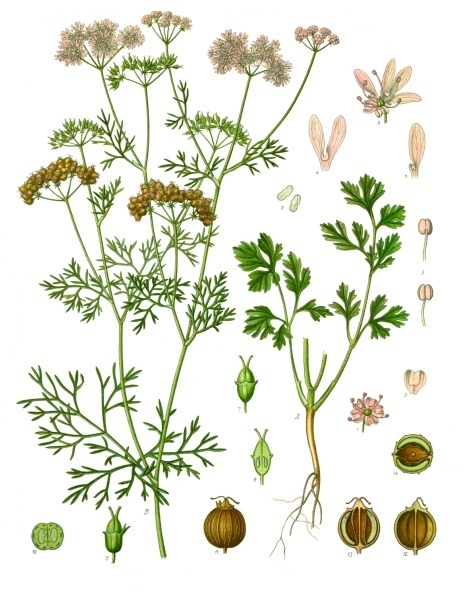 CorianderCoriandrum sativum
-
 Poison HemlockConium maculatum
-
 FennelFoeniculum vulgare
-
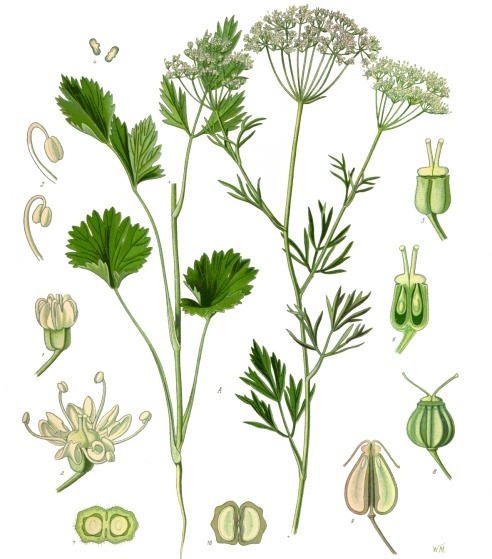 AnisePimpinella anisum
-
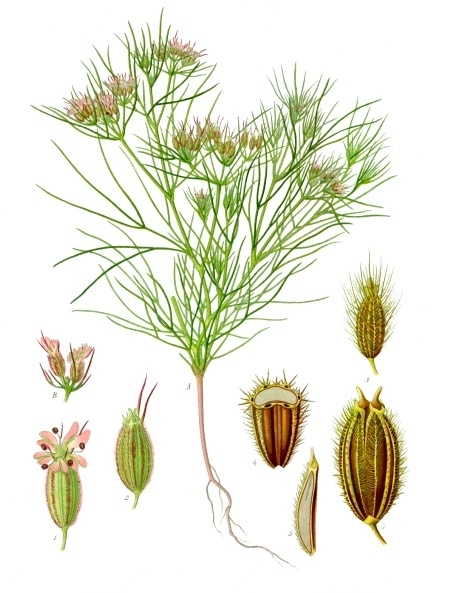 CuminCuminum cyminum
-
 CarawayCarum carvi
-
 ParsnipPastinaca sativa
Compare
Questions and answers
What is the scientific name of the Dill?
The scientific name of the Dill is Anethum graveolens. Written with its author, the full name is Anethum graveolens L..
Which family does the Dill belong to?
Anethum graveolens belongs to the family Apiaceae, in the order Apiales and the class Magnoliopsida.
Where is the Dill found?
Checklists and occurrence records place Anethum graveolens in 132 countries, including Sweden, Germany, Russia, Poland, The Netherlands and Denmark.
What other names does the Dill have?
Anethum graveolens is also known in English as Garden Dill.
Why is dill named dill?
The common name dill derives from the Norse verb dilla, meaning to lull.[37]
What kind of environment does dill like?
Dill grows best in rich, well-drained soil, with full sun, warm to hot summers, and high levels of sunshine. It also grows in rich, moist, well-drained soil.[13][14][15]
Where does dill grow naturally?
Dill is native to North Africa, Iran, and the Arabian Peninsula.[38]
Sources
Passages the profile rests on
- The plant has slender, hollow stems and finely divided, delicate leaves. Source passage: “Its stems are slender and hollow with finely divided, softly delicate leaves” — English Wikipedia
- Its leaves are alternately arranged along the stems. Source passage: “the leaves are alternately arranged” — English Wikipedia
- Its leaves are divided into segments measuring 1–2 millimetres in width. Source passage: “ultimate leaf divisions measuring 1–2 millimetres (1⁄32–3⁄32 in) broad” — English Wikipedia
- The leaves are blue-green, lacy, and divided into threadlike segments. Source passage: “alternate, lacy, blue-green, pinnately divided into threadlike segments” — extension.psu.edu
- Its flowers are small, scented, and white to yellow. Source passage: “small white to yellow scented flowers” — English Wikipedia
- Its flowers grow in umbels measuring 2.5–9 centimetres in diameter. Source passage: “small umbels 2.5–9 cm (1–3+1⁄2 in) in diameter” — English Wikipedia
- The flowers are yellow and grow in flattened terminal umbels. Source passage: “Tiny, scented, yellow flowers grow in flattened, terminal umbels” — extension.psu.edu
- Its fruits are straight or slightly curved and have longitudinal ridges. Source passage: “straight to slightly curved with a longitudinally ridged surface” — English Wikipedia
- Its fruits measure 4–5 millimetres in length and approximately 1 millimetre in thickness. Source passage: “4–5 mm (3⁄16–3⁄16 in) long and 1 mm (1⁄16 in) thick” — English Wikipedia
- The fruits are aromatic, oval, ridged, and change from green to brown as they ripen. Source passage: “aromatic, oval, ¼-inch-long, ridged seeds (fruits) that turn from green to brown” — extension.psu.edu
- The plant grows to a height of 0.5–1.5 metres. Source passage: “dill grows up to 0.5–1.5 metres (1+1⁄2–5 feet) tall.” — English Wikipedia
- Its leaves measure 10–20 centimetres in length. Source passage: “10–20 centimetres (4–8 inches) long” — English Wikipedia
- The plant grows best in rich, well-drained soil. Source passage: “It also prefers rich, well-drained soil.” — English Wikipedia
- Successful cultivation requires warm to hot summers and high levels of sunshine. Source passage: “Successful cultivation requires warm to hot summers with high sunshine levels” — English Wikipedia
- The plant grows in full sun and rich, moist, well-drained soil. Source passage: “Full sun; rich, moist but not constantly wet, well-drained soil” — extension.psu.edu
- The species is propagated through seeds. Source passage: “Propagation is through seeds.” — pmc.ncbi.nlm.nih.gov
- Its seeds remain viable for approximately 3–10 years. Source passage: “Seeds are viable for 3–10 years.” — pmc.ncbi.nlm.nih.gov
- The plant can self-sow when growing in suitable conditions. Source passage: “It often self sows when growing in a suitable position.” — pmc.ncbi.nlm.nih.gov
- The seeds generally germinate within 10–14 days. Source passage: “Seeds germinate in 10-14 days.” — extension.psu.edu
- The flowers are pollinated by insects including bees and wasps that visit them for nectar and pollen. Source passage: “Insects, bees and wasps are attracted to the yellow flowers of Anethum for plant resources like nectar and pollens.” — pmc.ncbi.nlm.nih.gov
- The plant's ripe fruits turn brown and shatter. Source passage: “seeds (fruits) that turn from green to brown and shatter when ripe.” — extension.psu.edu
- The seeds are harvested by cutting the flower heads when they begin to ripen. Source passage: “The seed is harvested by cutting the flower heads off the stalks when the seed is beginning to ripe” — pmc.ncbi.nlm.nih.gov
- The leaves and seeds are used as herbs or spices to flavour food. Source passage: “its leaves and seeds are used as a herb or spice for flavouring food.” — English Wikipedia
- The leaves are commonly used to flavour fish dishes, soups, and pickles. Source passage: “used to flavour many foods such as gravlax (cured salmon) and other fish dishes, borscht, and other soups, as well as pickles” — English Wikipedia
- The seeds are used as a spice, while fresh and dried leaves are used as condiments and in tea. Source passage: “Anethum seeds are used as a spice and its fresh and dried leaves called dill weed are used as condiment and tea.” — pmc.ncbi.nlm.nih.gov
- The plant's essential oil is used in the food industry as a flavouring. Source passage: “Dill oil is extracted from seeds, leaves and stems, which contains an essential oil used as flavoring in food industry.” — pmc.ncbi.nlm.nih.gov
- The plant's oil is used in perfumery for fragrancing detergents and soaps. Source passage: “It is used in perfumery to aromatize detergents and soaps” — pmc.ncbi.nlm.nih.gov
- The seeds have traditionally been used in Ayurvedic medicine for carminative, stomachic, and diuretic purposes. Source passage: “The Ayurvedic uses of dill seeds are carminative, stomachic and diuretic.” — pmc.ncbi.nlm.nih.gov
- The plant has been used in Ayurvedic medicine to address abdominal discomfort, colic, and digestive problems. Source passage: “Its common use in Ayurvedic medicine is in abdominal discomfort, colic and for promoting digestion.” — pmc.ncbi.nlm.nih.gov
- The plant is used as an ingredient in gripe water intended to relieve colic and flatulence in children. Source passage: “Anethum is used as an ingredient in gripe water, given to relieve colic pain in babies and flatulence in young children.” — pmc.ncbi.nlm.nih.gov
- The essential oil extracted from the seeds is used to relieve intestinal spasms and colic. Source passage: “The essential oil in the seed relieves intestinal spasms and griping, helping to settle colic.” — pmc.ncbi.nlm.nih.gov
- Chewing the seeds is reported to improve bad breath. Source passage: “Chewing the seeds improves bad breath.” — pmc.ncbi.nlm.nih.gov
- The species has been used in more than 56 Ayurvedic preparations. Source passage: “Anethum graveolens L. is used in the preparations of more than 56 ayurvedic preparations” — pmc.ncbi.nlm.nih.gov
- Hot weather and dry spells cause the plant to flower prematurely. Source passage: “Hot weather and dry spells cause plants to bolt (flower).” — extension.psu.edu
- The plant attracts beneficial insects, bees, and other pollinators. Source passage: “dill attracts beneficial insects, bees, and other pollinators to the garden” — extension.psu.edu
- The plant can be eaten by black swallowtail caterpillars where that butterfly occurs. Source passage: “often are eaten by black swallowtail caterpillars in areas where that species occurs.” — English Wikipedia
- The common name dill derives from the Norse verb dilla, meaning to lull. Source passage: “The common name from the Norse verb, dilla, means 'to lull'.” — extension.psu.edu
- The species is native to North Africa, Iran, and the Arabian Peninsula. Source passage: “Dill is native to North Africa, Iran, and the Arabian Peninsula.” — English Wikipedia
Data
- Catalogue of Life, 2026-10-16 XR cc by
- Global Biodiversity Information Facility CC BY 4.0
- Wikidata CC0
- GeoNames CC BY 4.0
- Wikimedia Commons per image; credit shown with each image
- Within the Catalogue of Life, this name comes from Synonymic Checklists of the Vascular Plants of the World cc by
References
- L. (1753). Sp. Pl. [Linnaeus] 1: 263 (1753). where the name was published
This species in other databases
Page built on 28 November 2026. See how the catalog is made and all sources and licences.
Cite this page
ScientificNames.org. (2026). Anethum graveolens (Dill). Retrieved November 28, 2026, from https://scientificnames.org/species/anethum-graveolens
“Anethum graveolens (Dill).” ScientificNames.org, 2026, scientificnames.org/species/anethum-graveolens. Accessed 28 Nov. 2026.
ScientificNames.org. “Anethum graveolens (Dill).” Accessed November 28, 2026. https://scientificnames.org/species/anethum-graveolens.
@misc{scientificnames_anethum_graveolens_dill,
  author = {{ScientificNames.org}},
  title = {Anethum graveolens (Dill)},
  year = {2026},
  url = {https://scientificnames.org/species/anethum-graveolens},
  note = {Accessed 2026-11-28}
}