Species · Insects
Anisochelus neglectus
Anisochelus neglectus has no English name on record in the checklists used here. It is a species of insect in the family Scarabaeidae (dung beetles), order Coleoptera. The name dates from 1844.
- Scientific name
- Anisochelus neglectus Burmeister, 1844
- Genus
- Anisochelus
- Family
- Scarabaeidae (Dung Beetles)
- Order
- Coleoptera
- Class
- Insecta
- Recorded in
- 2 countries
- Name status
- accepted in the Catalogue of Life
Overview
The species occurs in South Africa's Western Cape. It is distinguished by a nearly black head and pronotum with a metallic bronze sheen, light chestnut-brown elytra, and dense pale yellowish hairs.
Written 27 November 2026 from the sources listed below. Each statement was checked against the passage it cites; statements that could not be supported were removed.
Appearance
Adults measure approximately 5–5.25 mm in length. The head and pronotum are nearly black with a metallic bronze sheen, while the elytra are light chestnut-brown.[1][2][3]
The legs and underside also have a metallic bronze sheen. The head and pronotum have a strongly wrinkled surface and are covered with dense, long, pale yellowish hairs that lie close to the surface, mixed with upright bristles.[4][5][6]
Upright bristles are denser on the anterior portion and along the outer margins of the head and pronotum. The elytra have dense, flattened, pale yellowish hairs and a few upright bristles near their bases.[7][8]
The propygidium and pygidium are covered with dense, long, flattened, yellowish hairs.[9]
Classification of Anisochelus neglectus
| Kingdom | Animalia |
|---|---|
| Phylum | Arthropoda |
| Subphylum | Hexapoda |
| Class | Insecta (Insect) |
| Order | Coleoptera (Beetle) |
| Suborder | Polyphaga |
| Series | Staphyliniformia |
| Superfamily | Scarabaeoidea |
| Family | Scarabaeidae (Dung Beetles) |
| Subfamily | Melolonthinae |
| Tribe | Hopliini |
| Subtribe | Hopliina |
| Genus | Anisochelus |
| Species | Anisochelus neglectus Burmeister, 1844 |
Where Anisochelus neglectus is found
Checklists and occurrence records place Anisochelus neglectus in 2 countries across Africa. GBIF holds 29 georeferenced records of it.
Countries
Regions and cities with the most records
Range as the checklists state it
Afrotropical(Namibia, Republic South Africa:Western Cape)
A number beside a place is its count of GBIF occurrence records. A place without a number comes from a checklist alone. Records show where a species has been observed or collected, which can include escapes and vagrants.
Related species
- Anisochelus hilaris
- Anisochelus inornatus
-
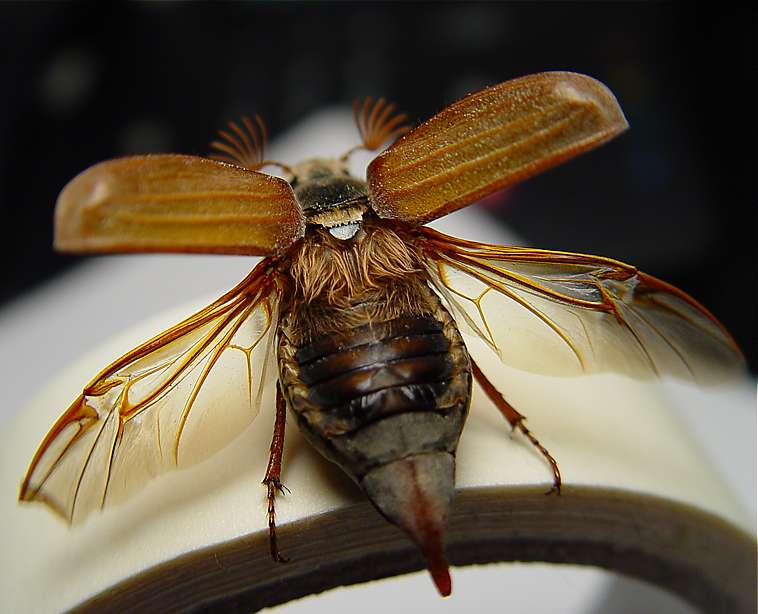 CockchaferMelolontha melolontha
-
 Hercules BeetleDynastes (Dynastes) hercules
-
 Japanese BeetlePopillia japonica
-
 Japanese Rhinoceros BeetleTrypoxylus dichotomus
-
 Sacred ScarabScarabaeus sacer
-
 Figeater BeetleCotinis (Cotinis) mutabilis
Compare
Sources
Passages the profile rests on
- Adults measure approximately 5–5.25 mm in length. Source passage: “Adults reach a length of about 5–5.25 mm (0.197–0.207 in).” — English Wikipedia
- The head and pronotum are nearly black with a metallic bronze sheen. Source passage: “The head and pronotum are nearly black but with an aeneous sheen” — English Wikipedia
- The elytra are light chestnut-brown. Source passage: “The elytra are light chestnut-brown.” — English Wikipedia
- The legs and underside also have a metallic bronze sheen. Source passage: “which is also found on the legs and underside.” — English Wikipedia
- The head and pronotum have a strongly wrinkled surface. Source passage: “The head and pronotum are very rugose” — English Wikipedia
- The head and pronotum are covered with dense, long, pale yellowish hairs that lie close to the surface, mixed with upright bristles. Source passage: “clothed with a dense, long, sub-appressed flavescent pubescence mixed with erect setae” — English Wikipedia
- Upright bristles are denser on the anterior portion and along the outer margins of the head and pronotum. Source passage: “the latter being denser in the anterior part and also along the outer margins.” — English Wikipedia
- The elytra have dense, flattened, pale yellowish hairs and a few upright bristles near their bases. Source passage: “The elytra are covered with dense appressed flavescent hairs and a few erect setae in the basal part.” — English Wikipedia
- The propygidium and pygidium are covered with dense, long, flattened, yellowish hairs. Source passage: “The propygidium and pygidium are clothed with dense, long, appressed flavous hairs.” — English Wikipedia
Data
- Catalogue of Life, 2026-10-16 XR cc by
- Global Biodiversity Information Facility CC BY 4.0
- Wikidata CC0
- GeoNames CC BY 4.0
- Within the Catalogue of Life, this name comes from World Scarabaeidae Database cc by
References
- Burmeister, H. C. C. (1844). Handbuch der Entomologie. Coleoptera Lamellicornia, Anthobia et Phyllophaga systellochela. Berlin 4(1):1-588. http://www.archive.org/download/handbuchderentom41burm/handbuchderentom41burm.pdf Link where the name was published
This species in other databases
Page built on 28 November 2026. See how the catalog is made and all sources and licences.
Cite this page
ScientificNames.org. (2026). Anisochelus neglectus. Retrieved November 28, 2026, from https://scientificnames.org/species/anisochelus-neglectus
“Anisochelus neglectus.” ScientificNames.org, 2026, scientificnames.org/species/anisochelus-neglectus. Accessed 28 Nov. 2026.
ScientificNames.org. “Anisochelus neglectus.” Accessed November 28, 2026. https://scientificnames.org/species/anisochelus-neglectus.
@misc{scientificnames_anisochelus_neglectus,
  author = {{ScientificNames.org}},
  title = {Anisochelus neglectus},
  year = {2026},
  url = {https://scientificnames.org/species/anisochelus-neglectus},
  note = {Accessed 2026-11-28}
}