Species · Insects
Anisopholis clypeata
Anisopholis clypeata has no English name on record in the checklists used here. It is a species of insect in the family Scarabaeidae (dung beetles), order Coleoptera. The name dates from 1913.
- Scientific name
- Anisopholis clypeata Moser, 1913
- Genus
- Anisopholis
- Family
- Scarabaeidae (Dung Beetles)
- Order
- Coleoptera
- Class
- Insecta
- Name status
- accepted in the Catalogue of Life
Overview
The species occurs in Indonesia, specifically on Sumatra. It is distinguished by its raised, deeply arched clypeal edge and scaled punctures on the head, pronotum and elytra.
Written 28 November 2026 from the sources listed below. Each statement was checked against the passage it cites; statements that could not be supported were removed.
Similar species
Anisopholis clypeata resembles Carlschoenherria squamulifera in colour and body shape. It is slightly smaller and differs in the formation of its clypeus.[1]
Appearance
Adult individuals reach approximately 24 mm in length.[2]
The head has moderately dense punctation, with round or egg-shaped scales covering the punctures. The anterior edge of the clypeus is raised and deeply arched across its entire width.[3][4]
The pronotum has sparse punctation centrally and denser punctation toward its sides. The punctures are closely arranged in three longitudinal furrows, and all bear rounded or egg-shaped scales.[5][6][7]
The lateral margins have weak puncture-like notches, with yellowish setae and hairs within the punctures. The scutellum is smooth.[8][9]
Only the medial elytral rib and the adjacent second rib are clearly visible, while two additional ribs are faintly indicated. The elytra have moderately dense punctation, with each puncture bearing a very small scale; some scales are larger and broadly ovate.[10][11][12]
Habitat
The species occurs on Sumatra, Indonesia.[13]
Classification of Anisopholis clypeata
| Kingdom | Animalia |
|---|---|
| Phylum | Arthropoda |
| Subphylum | Hexapoda |
| Class | Insecta (Insect) |
| Order | Coleoptera (Beetle) |
| Suborder | Polyphaga |
| Series | Staphyliniformia |
| Superfamily | Scarabaeoidea |
| Family | Scarabaeidae (Dung Beetles) |
| Subfamily | Melolonthinae |
| Tribe | Melolonthini |
| Genus | Anisopholis |
| Species | Anisopholis clypeata Moser, 1913 |
Where Anisopholis clypeata is found
Range as the checklists state it
Oriental(Indonesia:Sumatra)
A number beside a place is its count of GBIF occurrence records. A place without a number comes from a checklist alone. Records show where a species has been observed or collected, which can include escapes and vagrants.
Related species
- Anisopholis affinis
-
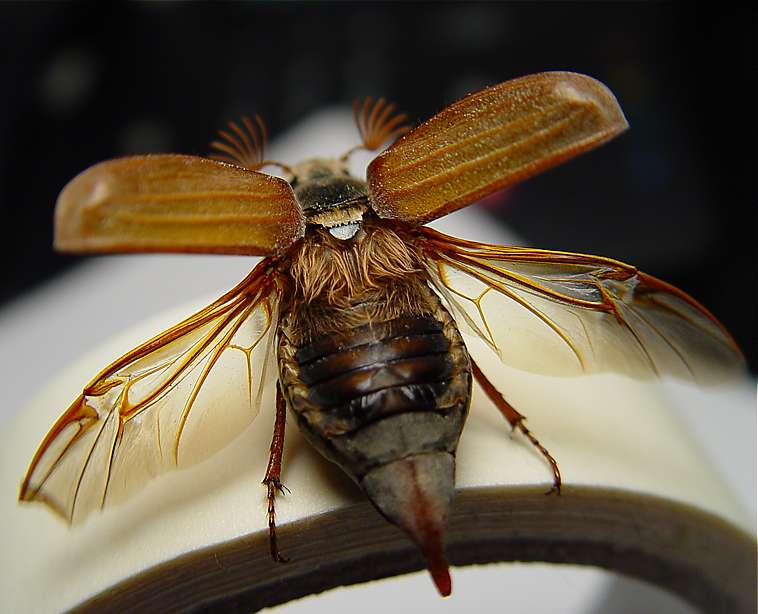 CockchaferMelolontha melolontha
-
 Hercules BeetleDynastes (Dynastes) hercules
-
 Japanese BeetlePopillia japonica
-
 Japanese Rhinoceros BeetleTrypoxylus dichotomus
-
 Sacred ScarabScarabaeus sacer
-
 Figeater BeetleCotinis (Cotinis) mutabilis
-
 Atlas BeetleChalcosoma atlas
Compare
Questions and answers
Where does Anisopholis clypeata occur?
It occurs on Sumatra, Indonesia.[13]
How long are adult individuals?
Adult individuals reach approximately 24 mm in length.[2]
Which species does Anisopholis clypeata resemble?
It resembles Carlschoenherria squamulifera in colour and body shape, but is slightly smaller and differs in the formation of its clypeus.[1]
What characterises the clypeus?
Its anterior edge is raised and deeply arched across its entire width.[4]
Sources
Passages the profile rests on
- Anisopholis clypeata resembles Carlschoenherria squamulifera in colour and body shape but is slightly smaller and differs in the formation of its clypeus. Source passage: “In colour and shape, they are similar to Carlschoenherria squamulifera, but they are slightly smaller and easily distinguished by the different formation of the clypeus.” — English Wikipedia
- Adult individuals reach approximately 24 mm in length. Source passage: “Adults reach a length of about 24 mm (0.94 in).” — English Wikipedia
- The head has moderately dense punctation, with round or egg-shaped scales covering the punctures. Source passage: “The head is moderately densely punctate, the punctures bearing round or egg-shaped scales.” — English Wikipedia
- The anterior edge of the clypeus is raised and deeply arched across its entire width. Source passage: “The anterior margin of the clypeus is, as in males of squamulifera, upturned. However, while in the latter species it is barely imperceptibly emarginate in the middle, in clypeata it is deeply arched across its entire width.” — English Wikipedia
- The pronotum has sparse punctation centrally and denser punctation toward its sides. Source passage: “The pronotum is sparsely punctate in the middle, somewhat more densely punctate at the sides.” — English Wikipedia
- The pronotal punctures are closely arranged in three longitudinal furrows. Source passage: “The punctures are very closely spaced in three longitudinal furrows.” — English Wikipedia
- All pronotal punctures bear rounded or egg-shaped scales. Source passage: “All punctures are covered with rounded or egg-shaped scales.” — English Wikipedia
- The lateral margins have weak puncture-like notches and yellowish setae and hairs within the punctures. Source passage: “The lateral margins are weakly punctate-notched, with yellowish setae and hairs in the punctures.” — English Wikipedia
- The scutellum is smooth. Source passage: “The scutellum is smooth.” — English Wikipedia
- Only the medial elytral rib and the adjacent second rib are clearly visible, while two additional ribs are faintly indicated. Source passage: “On the elytra, only the medial rib and a second rib next to it are clearly visible. Two further ribs are only indicated.” — English Wikipedia
- The elytra have moderately dense punctation, with each puncture bearing a very small scale. Source passage: “The punctation of the elytra is moderately dense, and each puncture bears a very small scale.” — English Wikipedia
- Some scales on the elytra are larger and broadly ovate. Source passage: “Isolated larger scales are broadly ovate.” — English Wikipedia
- Anisopholis clypeata occurs in Indonesia, specifically on Sumatra. Source passage: “It is found in Indonesia (Sumatra).” — English Wikipedia
Data
- Catalogue of Life, 2026-10-16 XR cc by
- Wikidata CC0
- Within the Catalogue of Life, this name comes from World Scarabaeidae Database cc by
References
- Moser, J. (1913). Beitrag zur Kenntnis der Melolonthiden (Col.) I. Deutsche Entomologische Zeitschrift, Berlin (3):271-297. https://www.zobodat.at/pdf/Deutsche-Ent-Zeitschrift_1913_0271-0297.pdf Link where the name was published
This species in other databases
Page built on 28 November 2026. See how the catalog is made and all sources and licences.
Cite this page
ScientificNames.org. (2026). Anisopholis clypeata. Retrieved November 28, 2026, from https://scientificnames.org/species/anisopholis-clypeata
“Anisopholis clypeata.” ScientificNames.org, 2026, scientificnames.org/species/anisopholis-clypeata. Accessed 28 Nov. 2026.
ScientificNames.org. “Anisopholis clypeata.” Accessed November 28, 2026. https://scientificnames.org/species/anisopholis-clypeata.
@misc{scientificnames_anisopholis_clypeata,
  author = {{ScientificNames.org}},
  title = {Anisopholis clypeata},
  year = {2026},
  url = {https://scientificnames.org/species/anisopholis-clypeata},
  note = {Accessed 2026-11-28}
}