Species · Reptiles
Surprise Anole Anolis bombiceps
The scientific name of the Surprise Anole is Anolis bombiceps. It is a species of reptile in the family Anolidae (anoles), order Squamata. The name dates from 1875.
- Scientific name
- Anolis bombiceps Cope, 1875
- Common name
- Surprise Anole
- Genus
- Anolis
- Family
- Anolidae (Anoles)
- Order
- Squamata
- Class
- Reptilia
- Red List category
- LC Least Concern
- Recorded in
- 4 countries
- Name status
- accepted in the Catalogue of Life
Overview
Anolis bombiceps, the surprise anole or blue-lipped forest anole, is a species of lizard in the family Dactyloidae. The species is found in Peru, Colombia, Brazil, and Ecuador.
Classification of the Surprise Anole
| Kingdom | Animalia |
|---|---|
| Phylum | Chordata |
| Subphylum | Vertebrata |
| Infraphylum | Gnathostomata |
| Parvphylum | Osteichthyes |
| Megaclass | Tetrapoda |
| Class | Reptilia (Reptile) |
| Order | Squamata (Snakes) |
| Suborder | Iguania (Iguanas) |
| Family | Anolidae (Anoles) |
| Genus | Anolis (Anoles) |
| Species | Anolis bombiceps Cope, 1875 |
Where the Surprise Anole is found
Checklists and occurrence records place Anolis bombiceps in 4 countries across South America. GBIF holds 196 georeferenced records of it.
Countries
Regions and cities with the most records
- Loreto, Peru 53
- Amazonas Department, Colombia 36
- Vaupés, Colombia 8
- Amazonas, Brazil 5
- Leticia, Colombia 5
- Pastaza Province, Ecuador 5
- Tabatinga, Brazil 4
Range as the checklists state it
Peru, Colombia, Brazil (Amazonas), Ecuador
A number beside a place is its count of GBIF occurrence records. A place without a number comes from a checklist alone. Records show where a species has been observed or collected, which can include escapes and vagrants.
Common names
English
- Surprise Anole
- Blue Lipped Forest Anole
- Blue-lipped Forest Anole
Names in 1 other language
- Portuguese
- Papa-Vento
Synonyms
One other scientific name has been used for this species and is now treated as a synonym of Anolis bombiceps.
- Norops bombiceps (Cope, 1876)
Related species
-
 Green AnoleAnolis carolinensis
-
 Brown AnoleAnolis sagrei
-
 Knight AnoleAnolis equestris
-
 Crested AnoleAnolis cristatellus
-
 Western Bearded AnoleAnolis barbatus
- Water AnoleAnolis aquaticus
-
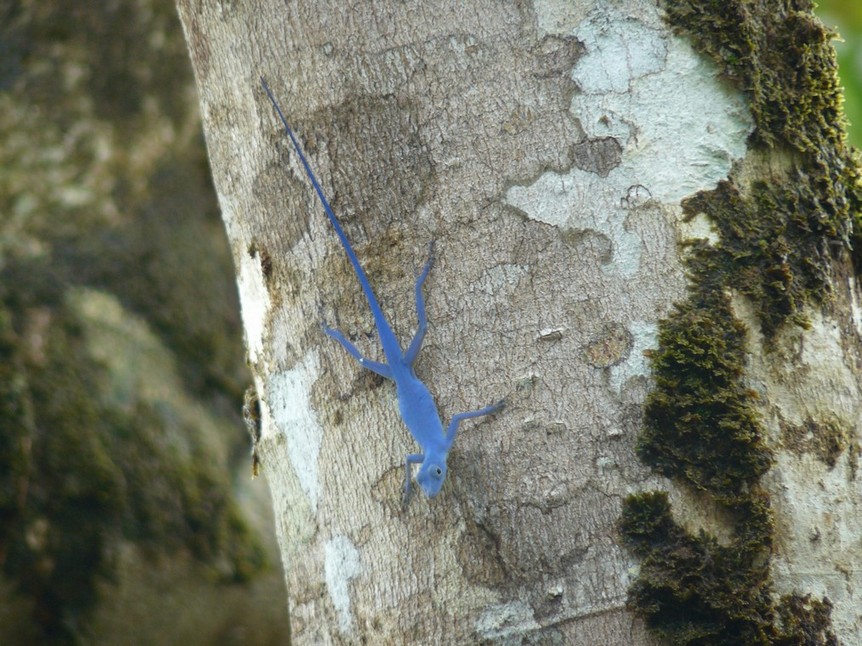 Blue AnoleAnolis gorgonae
-
 Allison's AnoleAnolis allisoni
Compare
Questions and answers
What is the scientific name of the Surprise Anole?
The scientific name of the Surprise Anole is Anolis bombiceps. Written with its author, the full name is Anolis bombiceps Cope, 1875.
Which family does the Surprise Anole belong to?
Anolis bombiceps belongs to the family Anolidae, in the order Squamata and the class Reptilia.
Where is the Surprise Anole found?
Checklists and occurrence records place Anolis bombiceps in 4 countries: Peru, Colombia, Brazil and Ecuador.
What is the conservation status of the Surprise Anole?
The IUCN Red List category recorded for Anolis bombiceps is Least Concern (LC).
What other names does the Surprise Anole have?
Anolis bombiceps is also known in English as Blue Lipped Forest Anole and Blue-lipped Forest Anole.
Sources
Data
- Catalogue of Life, 2026-10-16 XR cc by
- Global Biodiversity Information Facility CC BY 4.0
- Wikidata CC0
- English Wikipedia CC BY-SA 4.0
- GeoNames CC BY 4.0
- Within the Catalogue of Life, this name comes from The Reptile Database cc by
References
- Cope, E. D. (1875). Report on the Reptiles brought by Professor James Orton from the middle and upper Amazon and western Peru. Journal of the Academy of Natural Sciences of Philadelphia N.S. (2) 8: 159-183 [Sometimes Thought to Be Published 1876 but See Murphy et Al. 2007 for Clarification].
- Boulenger, G. A. (1885). Catalogue of the lizards in the British Museum (Natural History). Vol. 2, Second edition. London, Xiii+497 Pp.
- Peters, James A. & Donoso-Barros, Roberto. (1970). Catalogue of the Neotropical Squamata: Part II. Lizards and Amphisbaenians. Bull. US Natl. Mus. 297: 293 Pp.
- Dixon, J. R., & Soini, P. (1975). The reptiles of the upper Amazon basin, Iquitos region, Peru, Part I. Lizards and Amphisbaenians. Milwaukee Public Museum Contributions in Biology and Geology 4: 1-58 [1986?].
- Gasc, J. P. (1977). Liste commentee de lézards captures en Amazonie Colombienne. Bulletin de La Société Zoologique France. 102 (3): 267-276.
- Avila-Pires, T. C. S. (1995). Lizards of Brazilian Amazonia (Reptilia: Squamata). Zoologische Verhandelingen 299: 1-706.
- Nicholson, K. E. (2002). Phylogenetic analysis and a test of the current infrageneric classification of Norops (beta Anolis). Herpetological Monographs 16: 93-120.
- MURPHY R. W., SMITH A. and NGO A. (2007). The versions of Cope’s Batrachia and Reptilia of Costa Rica. Bibliotheca Herpetologica 7 (1):
- MENDES-PINTO, TELÊMACO JASON; Mestrando, BERNHARD, RAFAEL, VOGT, RICHARD; PEDRETT, RONNEZZA CÉLLIA LOBATO CAMPOS;GARCIA, RAUBER SANTOS. (2011). A COLLECTION OF AMPHIBIANS AND REPTILES OF THE NATIONAL INSTITUTE OF RESEARCH OF THE AMAZON. Rev. Colombiana Cienc. Anim. 3(2): 238.
- D’angiolella, Annelise B.; Tony Gamble, Teresa C. S. Avila-Pires, Guarino R. Colli, Brice P. Noonan, and Laurie J. Vitt. (2011). Anolis chrysolepis Duméril and Bibron, 1837 (Squamata: Iguanidae), Revisited: Molecular Phylogeny and Taxonomy of the Anolis chrysolepis Species Group. Bull. Mus. Comp. Zool. Harvard 160 (2): 35-63.
- NICHOLSON, KIRSTEN E.; BRIAN I. CROTHER, CRAIG GUYER & JAY M. SAVAGE. (2012). It is time for a new classification of anoles (Squamata: Dactyloidae). Zootaxa 3477: 1–108.
- Poe, S. (2013). 1986 Redux: New genera of anoles (Squamata: Dactyloidae) are unwarranted. Zootaxa 3626 (2): 295–299.
- RIBEIRO-JÚNIOR, MARCO A. (2015). Catalogue of distribution of lizards (Reptilia: Squamata) from the Brazilian Amazonia. I. Dactyloidae, Hoplocercidae, Iguanidae, Leiosauridae, Polychrotidae, Tropiduridae. Zootaxa 3983 (1): 001–110.
- Ribeiro-Júnior, Marco A. & Silvana Amaral. (2016). Diversity, distribution, and conservation of lizards (Reptilia: Squamata) in the Brazilian Amazonia. Neotropical Biodiversity, 2:1, 195-421.
- NICHOLSON, KIRSTEN E.; BRIAN I. CROTHER, CRAIG GUYER & JAY M. SAVAGE. (2018). Translating a clade based classification into one that is valid under the international code of zoological nomenclature: the case of the lizards of the family Dactyloidae (Order Squamata). Zootaxa 4461 (4): 573–586.
- Torres-Carvajal O, Pazmiño-Otamendi G, Salazar-Valenzuela D. (2019). Reptiles of Ecuador: a resource-rich portal, with a dynamic checklist and photographic guides. Amphibian & Reptile Conservation 13 (1): [General Section]: 209–229 (E178).
- Gonzalez R. C. et al. (2020). Lista dos Nomes Populares dos Répteis no Brasil – Primeira Versão. Herpetologia Brasileira 9 (2): 121 – 214.
- Metcalf, Matthew; Alexander Marsh, Emerson Torres, Devon Graham, Charles Gunnels. (2020). Herpetofauna of the Santa Cruz Forest Preserve in the Peruvian Amazon Basin. Herpetology Notes 13: 753-767.
- Metcalf, M. F., Guedouar, E., Davis, L., Rodriguez, A., Marsh, A., Pacaya, E. T., ... & Gunnels IV, C. W. (2023). Herpetofauna of Madre Selva Biological Station in Loreto, Peru. Herpetology Notes, 16, 727-740.
- Arteaga, A., Bustamante, L., & Vieira, J. (2024). Reptiles of Ecuador. Khamai Foundation & Tropical Herping, 1073 Pp.
- Rodríguez-Rodríguez, J. D., & Calderón-Espinosa, M. L. (2024). Sexual dimorphism and female ecomorphology in Anolis (Squamata: Anolidae): knowledge of female morphology increases the understanding of Anolis diversification. Biological Journal of the Linnean Society, Blae019.
- Poe, & Steven. (2025). A Guide to the Anolis Lizards (Anoles) of Mainland Central and South America. Princeton University Press, 432 Pp.
This species in other databases
Page built on 25 November 2026. See how the catalog is made and all sources and licences.
Cite this page
ScientificNames.org. (2026). Anolis bombiceps (Surprise Anole). Retrieved November 25, 2026, from https://scientificnames.org/species/anolis-bombiceps
“Anolis bombiceps (Surprise Anole).” ScientificNames.org, 2026, scientificnames.org/species/anolis-bombiceps. Accessed 25 Nov. 2026.
ScientificNames.org. “Anolis bombiceps (Surprise Anole).” Accessed November 25, 2026. https://scientificnames.org/species/anolis-bombiceps.
@misc{scientificnames_anolis_bombiceps_surprise_anole,
  author = {{ScientificNames.org}},
  title = {Anolis bombiceps (Surprise Anole)},
  year = {2026},
  url = {https://scientificnames.org/species/anolis-bombiceps},
  note = {Accessed 2026-11-25}
}