Overview
Anolis etheridgei is endemic to the Dominican Republic and occurs in the Cordillera Central. It has a small, white dewlap, a blue iris, and a tail longer than twice its snout-to-vent length.
Written 27 November 2026 from the sources listed below. Each statement was checked against the passage it cites; statements that could not be supported were removed.
Appearance
Etheridge's Anole can reach a snout-to-vent length of 4.3 cm. Its tail is longer than twice its snout-to-vent length.[1][2]
Habitat
Etheridge's Anole prefers forest as its natural habitat. It inhabits forest at elevations between 550 and 2,440 m.[5][6]
Diet
Etheridge's Anole preys on invertebrates.[7]
Reproduction and life cycle
Etheridge's Anole is oviparous.[8]
Classification of the Etheridge's Anole
| Kingdom | Animalia |
|---|---|
| Phylum | Chordata |
| Subphylum | Vertebrata |
| Infraphylum | Gnathostomata |
| Parvphylum | Osteichthyes |
| Megaclass | Tetrapoda |
| Class | Reptilia (Reptile) |
| Order | Squamata (Snakes) |
| Suborder | Iguania (Iguanas) |
| Family | Anolidae (Anoles) |
| Genus | Anolis (Anoles) |
| Species | Anolis etheridgei Williams, 1962 |
Where the Etheridge's Anole is found
Checklists and occurrence records place Anolis etheridgei in 1 country. GBIF holds 718 georeferenced records of it.
Countries
Regions and cities with the most records
- La Vega, Dominican Republic 534
- Jarabacoa, Dominican Republic 406
- Bonao, Dominican Republic 290
- Constanza, Dominican Republic 280
- Monseñor Nouel, Dominican Republic 74
- San José de Ocoa, Dominican Republic 38
- San José de Ocoa, Dominican Republic 32
- Elías Piña, Dominican Republic 19
- Santiago Province, Dominican Republic 10
- San Cristóbal, Dominican Republic 5
- San Cristóbal, Dominican Republic 5
- La Vega, Dominican Republic 3
Range as the checklists state it
Hispaniola (Dominican Republic: Cordillera Central; North slope of Loma Nalga de Maco, 4191 ft., Elias Piña Prov.)
A number beside a place is its count of GBIF occurrence records. A place without a number comes from a checklist alone. Records show where a species has been observed or collected, which can include escapes and vagrants.
Common names
English
- Etheridge's Anole
- Montane Bush Anole
Names in 2 other languages
- Russian
- Анолис Этериджа
- Spanish
- Lagarto de Arbustos Montañosos
Synonyms
3 other scientific names have been used for this species and are now treated as synonyms of Anolis etheridgei.
- Chamaelinorops darlingtoni (Williams, 1962)
- Deiroptyx etheridgei (Williams, 1962)
- Anolis darlingtoni Cochran, 1939 ambiguous synonym
Related species
-
 Green AnoleAnolis carolinensis
-
 Brown AnoleAnolis sagrei
-
 Knight AnoleAnolis equestris
-
 Common Puerto Rican AnoleAnolis cristatellus
-
 Western Bearded AnoleAnolis barbatus
-
 Water AnoleAnolis aquaticus
-
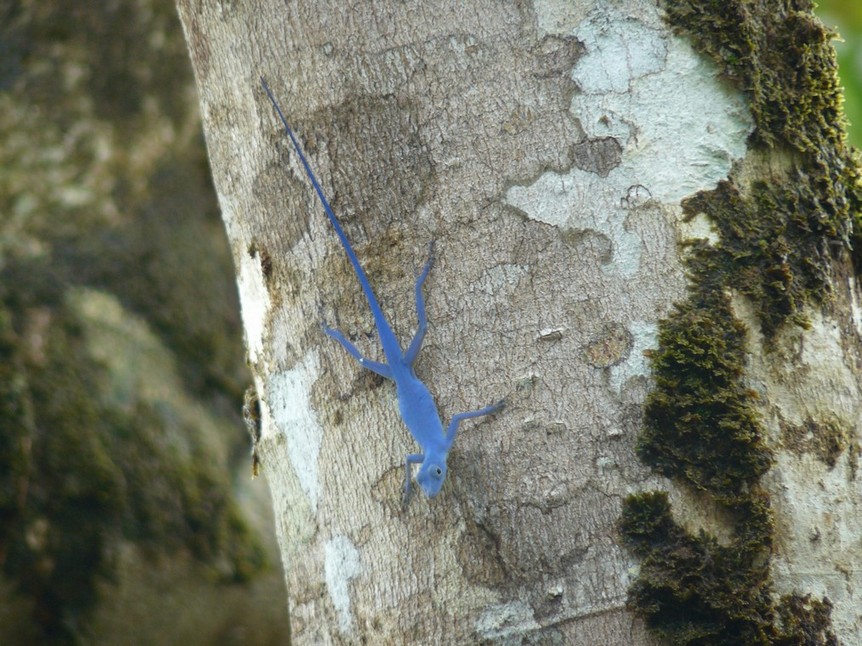 Blue AnoleAnolis gorgonae
-
 Allison's AnoleAnolis allisoni
Compare
Questions and answers
What is the scientific name of the Etheridge's Anole?
The scientific name of the Etheridge's Anole is Anolis etheridgei. Written with its author, the full name is Anolis etheridgei Williams, 1962.
Which family does the Etheridge's Anole belong to?
Anolis etheridgei belongs to the family Anolidae, in the order Squamata and the class Reptilia.
Where is the Etheridge's Anole found?
Checklists and occurrence records place Anolis etheridgei in 1 country: Dominican Republic.
What is the conservation status of the Etheridge's Anole?
The IUCN Red List category recorded for Anolis etheridgei is Vulnerable (VU).
What other names does the Etheridge's Anole have?
Anolis etheridgei is also known in English as Montane Bush Anole.
What habitat do anoles live in?
Etheridge's Anole prefers forest and inhabits forest at elevations between 550 and 2,440 m.[5][6]
What do anoles lizards eat?
Etheridge's Anole preys on invertebrates.[7]
Sources
Passages the profile rests on
- The species can reach a snout-to-vent length of 4.3 cm. Source passage: “A small anole, A. etheridgei may attain a snout-to-vent length of 4.3 cm (1.7 in).” — English Wikipedia
- The species has a tail longer than twice its snout-to-vent length. Source passage: “The tail is long, more than twice SVL.” — English Wikipedia
- The species has a small, white dewlap. Source passage: “The dewlap is small and white, and the iris of the eye is blue.” — English Wikipedia
- The species has a blue iris. Source passage: “The dewlap is small and white, and the iris of the eye is blue.” — English Wikipedia
- The species' preferred natural habitat is forest. Source passage: “The preferred natural habitat of A. etheridgei is forest, at altitudes of 550–2,440 m (1,800–8,010 ft).” — English Wikipedia
- The species inhabits forest at elevations between 550 and 2,440 m. Source passage: “The preferred natural habitat of A. etheridgei is forest, at altitudes of 550–2,440 m (1,800–8,010 ft).” — English Wikipedia
- The species preys on invertebrates. Source passage: “A. etheridgei preys upon invertebrates.” — English Wikipedia
- The species is oviparous. Source passage: “A. etheridgei is oviparous.” — English Wikipedia
Data
- Catalogue of Life, 2026-10-16 XR cc by
- Global Biodiversity Information Facility CC BY 4.0
- Wikidata CC0
- GeoNames CC BY 4.0
- Within the Catalogue of Life, this name comes from The Reptile Database cc by
References
- Williams, E. E. (1962). Notes on the herpetology of Hispaniola 7. New material of two poorly known anoles: Anolis monticola Shreve and Anolis christophei Williams. Breviora (164):1-11.
- Thomas, R. and A. Schwartz. (1967). The monticola group of the lizard genus Anolis in Hispaniola. Breviora (261):1-27.
- Williams, E. E. and T. P. Webster. (1974). Anolis rupinae new species, a syntopic sibling of A. monticola Shreve. Breviora (429): 1-22.
- Schwartz, A., & Henderson, R. W. (1991). Amphibians and Reptiles of the West Indies. University of Florida Press, Gainesville, 720 Pp.
- Poe, S. (2004). Phylogeny of anoles. Herpetological Monographs 18: 37-89.
- Nicholson, K. E., R. E. Glor, J. J. Kolbe, A. Larson, S. B. Hedges, and J. B. Losos. (2005). Mainland colonization by island lizards. Journal of Biogeography 32: 929–938.
- Vyas, & Raju. (2007). Present conservation scenario of reptile fauna in Gujarat State, India. Indian Forester, Oct 2007: 1381-1394.
- Espinoza, Robert E. and Kevin de Queiroz. (2008). Richard Emmett Etheridge. Copeia 2008, No. 3, 708–717.
- Mahler, & Luke, D. (2010). Natural history observations for two montane anole species from the Dominican Republic. Anolis Newsletter VI: 115.
- NICHOLSON, KIRSTEN E.; BRIAN I. CROTHER, CRAIG GUYER & JAY M. SAVAGE. (2012). It is time for a new classification of anoles (Squamata: Dactyloidae). Zootaxa 3477: 1–108.
- Poe, S. (2013). 1986 Redux: New genera of anoles (Squamata: Dactyloidae) are unwarranted. Zootaxa 3626 (2): 295–299.
- NICHOLSON, KIRSTEN E.; BRIAN I. CROTHER, CRAIG GUYER & JAY M. SAVAGE. (2018). Translating a clade based classification into one that is valid under the international code of zoological nomenclature: the case of the lizards of the family Dactyloidae (Order Squamata). Zootaxa 4461 (4): 573–586.
This species in other databases
Page built on 27 November 2026. See how the catalog is made and all sources and licences.
Cite this page
ScientificNames.org. (2026). Anolis etheridgei (Etheridge's Anole). Retrieved November 27, 2026, from https://scientificnames.org/species/anolis-etheridgei
“Anolis etheridgei (Etheridge's Anole).” ScientificNames.org, 2026, scientificnames.org/species/anolis-etheridgei. Accessed 27 Nov. 2026.
ScientificNames.org. “Anolis etheridgei (Etheridge's Anole).” Accessed November 27, 2026. https://scientificnames.org/species/anolis-etheridgei.
@misc{scientificnames_anolis_etheridgei_etheridges_anole,
  author = {{ScientificNames.org}},
  title = {Anolis etheridgei (Etheridge's Anole)},
  year = {2026},
  url = {https://scientificnames.org/species/anolis-etheridgei},
  note = {Accessed 2026-11-27}
}