Species · Reptiles
Barbados Anole Anolis extremus
The scientific name of the Barbados Anole is Anolis extremus. It is a species of reptile in the family Anolidae (anoles), order Squamata. The name dates from 1887.
- Scientific name
- Anolis extremus Garman, 1887
- Common name
- Barbados Anole
- Genus
- Anolis
- Family
- Anolidae (Anoles)
- Order
- Squamata
- Class
- Reptilia
- Red List category
- LC Least Concern
- Recorded in
- 4 countries
- Name status
- accepted in the Catalogue of Life

Overview
The Barbados anole (Anolis extremus) is a species of lizard belonging to the family Dactyloidae, the anoles. This species was formerly restricted to Barbados, but it has been introduced elsewhere around the Caribbean Sea.
Classification of the Barbados Anole
| Kingdom | Animalia |
|---|---|
| Phylum | Chordata |
| Subphylum | Vertebrata |
| Infraphylum | Gnathostomata |
| Parvphylum | Osteichthyes |
| Megaclass | Tetrapoda |
| Class | Reptilia (Reptile) |
| Order | Squamata (Snakes) |
| Suborder | Iguania (Iguanas) |
| Family | Anolidae (Anoles) |
| Genus | Anolis (Anoles) |
| Species | Anolis extremus Garman, 1887 |
Where the Barbados Anole is found
Checklists and occurrence records place Anolis extremus in 4 countries across North America. GBIF holds 1,039 georeferenced records of it.
Countries
Regions and cities with the most records
- Bridgetown, Barbados 625
- Christ Church, Barbados 148
- Saint Michael, Barbados 112
- Saint Joseph, Barbados 108
- Saint Peter, Barbados 67
- Saint Thomas, Barbados 64
- Saint James, Barbados 45
- Sandys, Bermuda 33
- Saint Philip, Barbados 29
- Castries, Saint Lucia 26
- Saint George, Barbados 23
- Saint John, Barbados 12
- Saint Lucy, Barbados 10
- Saint Andrew, Barbados 7
- Chaguanas, Trinidad and Tobago 4
- Port of Spain, Trinidad and Tobago 4
- Port of Spain, Trinidad and Tobago 4
1 more country has a few records outside this range
These countries hold a few records of Anolis extremus but lie outside the range the checklists give for it. Such records are often zoo or garden specimens, museum material or vagrants, so the species is not counted as occurring there.
Range as the checklists state it
Lesser Antilles: Barbados, St. Lucia, Bermuda;
A number beside a place is its count of GBIF occurrence records. A place without a number comes from a checklist alone. Records show where a species has been observed or collected, which can include escapes and vagrants.
Common names
English
- Barbados Anole
Names in 3 other languages
- French
- anolis de la Barbade
- German
- Barbados-Anolis, Blaugrüner Barbadosanolis
- Spanish
- Abaniquillo de Barbados, Lagartija de Barbados
Synonyms
One other scientific name has been used for this species and is now treated as a synonym of Anolis extremus.
- Dactyloa extremus (Garman, 1887)
Related species
-
 Green AnoleAnolis carolinensis
-
 Brown AnoleAnolis sagrei
-
 Knight AnoleAnolis equestris
-
 Crested AnoleAnolis cristatellus
-
 Western Bearded AnoleAnolis barbatus
- Water AnoleAnolis aquaticus
-
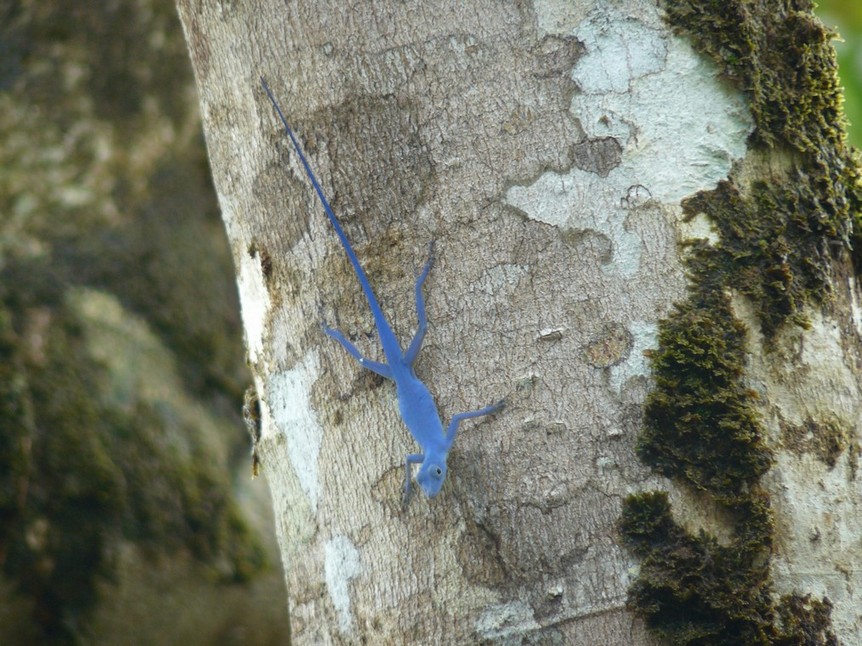 Blue AnoleAnolis gorgonae
-
 Allison's AnoleAnolis allisoni
Compare
Questions and answers
What is the scientific name of the Barbados Anole?
The scientific name of the Barbados Anole is Anolis extremus. Written with its author, the full name is Anolis extremus Garman, 1887.
Which family does the Barbados Anole belong to?
Anolis extremus belongs to the family Anolidae, in the order Squamata and the class Reptilia.
Where is the Barbados Anole found?
Checklists and occurrence records place Anolis extremus in 4 countries: Barbados, Saint Lucia, Bermuda and Trinidad and Tobago.
What is the conservation status of the Barbados Anole?
The IUCN Red List category recorded for Anolis extremus is Least Concern (LC).
Sources
Data
- Catalogue of Life, 2026-10-16 XR cc by
- Global Biodiversity Information Facility CC BY 4.0
- Wikidata CC0
- English Wikipedia CC BY-SA 4.0
- GeoNames CC BY 4.0
- Wikimedia Commons per image; credit shown with each image
- Within the Catalogue of Life, this name comes from The Reptile Database cc by
References
- Garman, S. (1887). On West Indian reptiles. Iguanidae. Bull. Essex Institute 19: 25-50.
- Grant, C. (1959). Herpetology of Barbados, B.W.I. Herpetologica 15 (2): 97-101.
- Wingate, D. B. (1965). Terrestrial herpetofauna of Bermuda. Herpetologica 21 (3): 202-218.
- Gorman, George C. & Atkins, Leonard. (1968). The relationships of the Anolis of the roquet species group (Sauria: Iguanidae). III. Comparative study of display behavior. Breviora (284): 1-31.
- Gorman, G. C. (1969). The zoogeography of Lesser Antillean Anolis lizards; an analysis based upon chromosomes and lactic dehydrogenases. Bull. Mus. Comp. Zool. Harvard 138 (3): 53-80.
- Lazell, J. D. (1972). The anoles (Sauria: Iguanidae) of the lesser Antilles. Bull. Mus. Comp. Zool. Harvard 143 (1): 1-115.
- Gorman, George C. (1976). Observations on the distribution of Anolis extremus (Sauria: Iguanidae) on St. Lucia, West Indies - A “colonizing” species. Herpetologica 32 (2): 184-188.
- Schmidt, J. (1979). Warum eigentlich immer Anolis carolinensis? Herpetofauna 1 (3): 26-29.
- Schwartz, A. and Henderson, R.W. (1985). A guide to the identification of the amphibians and reptiles of the West Indies exclusive of Hispaniola. Milwaukee Public Mus., 165 Pp.
- Schwartz, A., & Henderson, R. W. (1991). Amphibians and Reptiles of the West Indies. University of Florida Press, Gainesville, 720 Pp.
- Heselhaus, Ralf, Schmidt, & Matthias. (1995). Caribbean Anoles. TFH Publications, Neptune City, NJ, 65 Pp.
- Roughgarden, J. (1995). Anolis Lizards of the Caribbean: Ecology, Evolution, and Plate Tectonics. OXFORD UNIVERSITY PRESS, 200 Pp.
- Losos, Jonathan B. (1996). Dynamics of range expansion by three introduced species of Anolis lizards on Bermuda. Journal of Herpetology 30 (2): 204-210.
- Giannasi, N., Thorpe, R. S., & Malhotra, A. (1997). Introductions of Anolis species to the Island of St. Lucia, West Indies: testing for hybrids using multivariate morphometrics. Journal of Herpetology 31 (4): 586-589.
- Creer, Douglas A., Kevin de Queiroz, Todd R. Jackman, Jonathan B. Losos and Allan Larson. (2001). Systematics of the Anolis roquet series of the southern Lesser Antillies. Journal of Herpetology 35 (3): 428-441.
- Macedonia, J.M. & D.L. Clark. (2003). Headbob Display Structure in the Naturalized Anolis Lizards of Bermuda: Sex, Context, and Population Effects. Journal of Herpetology 37 (2): 266-276.
- Thorpe, Roger S.; Yann Surget-Groba and Helena Johansson. (2008). The relative importance of ecology and geographic isolation for speciation in anoles. Phil. Trans. R. Soc. B 363: 3071–3081.
- Thorpe, Roger S.; Yann Surget-Groba & Helena Johanss. (2010). Genetic Tests for Ecological and Allopatric Speciation in Anoles on an Island Archipelago. PLoS Genet 6 (4): E1000929. Doi:10.1371/Journal.Pgen.1000929.
- NICHOLSON, KIRSTEN E.; BRIAN I. CROTHER, CRAIG GUYER & JAY M. SAVAGE. (2012). It is time for a new classification of anoles (Squamata: Dactyloidae). Zootaxa 3477: 1–108.
- RIVAS, GILSON A.; CÉSAR R. MOLINA, GABRIEL N. UGUETO, TITO R. BARROS, CÉSAR L. BAR- RIO-AMORÓS & PHILIPPE J. R. KOK. (2012). Reptiles of Venezuela: an updated and commented checklist. Zootaxa 3211: 1–64.
- Poe, S. (2013). 1986 Redux: New genera of anoles (Squamata: Dactyloidae) are unwarranted. Zootaxa 3626 (2): 295–299.
- KÖHLER, & GUNTHER. (2014). Characters of external morphology used in Anolis taxonomy—Definition of terms, advice on usage, and illustrated examples. Zootaxa 3774 (2): 201–257.
- Helmus, Matthew R.; Jocelyn E. Behm, Wendy A.M. Jesse, Jason J. Kolbe,Jacintha Ellers, and Jonathan B. Losos. (2016). EXOTICS EXHIBIT MORE EVOLUTIONARY HISTORY THAN NATIVES: A COMPARISON OF THE ECOLOGY AND EVOLUTION OF EXOTIC AND NATIVE ANOLE LIZARDS. In: Invasion Genetics: The Baker and Stebbins Legacy, First Edition. Edited by Spencer C. H. Barrett, Robert I. Colautti, Katrina M. Dlugosch, and Loren H. Rieseberg; John Wiley & Sons, Pp. 122-138 (Publication Year given as 2017 in the Book).
- Señaris, J. Celsa; María Matilde Aristeguieta Padrón, Haidy Rojas Gil y Fernando J. M. Rojas-Runjaic. (2018). Guía ilustrada de los anfibios y reptiles del valle de Caracas, Venezuela. Ediciones IVIC, Instituto Venezolano de Investigaciones Científicas (IVIC). Caracas, Venezuela. 348 Pp.
- Thorpe, R. S., Barlow, A., Surget-Groba, Y., & Malhotra, A. (2018). Multilocus phylogeny, species age and biogeography of the Lesser Antillean anoles. Molecular Phylogenetics and Evolution.
This species in other databases
Page built on 25 November 2026. See how the catalog is made and all sources and licences.
Cite this page
ScientificNames.org. (2026). Anolis extremus (Barbados Anole). Retrieved November 25, 2026, from https://scientificnames.org/species/anolis-extremus
“Anolis extremus (Barbados Anole).” ScientificNames.org, 2026, scientificnames.org/species/anolis-extremus. Accessed 25 Nov. 2026.
ScientificNames.org. “Anolis extremus (Barbados Anole).” Accessed November 25, 2026. https://scientificnames.org/species/anolis-extremus.
@misc{scientificnames_anolis_extremus_barbados_anole,
  author = {{ScientificNames.org}},
  title = {Anolis extremus (Barbados Anole)},
  year = {2026},
  url = {https://scientificnames.org/species/anolis-extremus},
  note = {Accessed 2026-11-25}
}