Overview
The Escambray Bearded Anole is a species in the genus Anolis. The Escambray Bearded Anole is found in Cuba.
Written 27 November 2026 from the sources listed below. Each statement was checked against the passage it cites; statements that could not be supported were removed.
Classification of the Escambray Bearded Anole
| Kingdom | Animalia |
|---|---|
| Phylum | Chordata |
| Subphylum | Vertebrata |
| Infraphylum | Gnathostomata |
| Parvphylum | Osteichthyes |
| Megaclass | Tetrapoda |
| Class | Reptilia (Reptile) |
| Order | Squamata (Snakes) |
| Suborder | Iguania (Iguanas) |
| Family | Anolidae (Anoles) |
| Genus | Anolis (Anoles) |
| Species | Anolis guamuhaya (Garrido, Pérez-Beato & Moreno, 1991) |
Where the Escambray Bearded Anole is found
Checklists and occurrence records place Anolis guamuhaya in 1 country across North America. GBIF holds 9 georeferenced records of it.
Countries
Regions and cities with the most records
Range as the checklists state it
Cuba
A number beside a place is its count of GBIF occurrence records. A place without a number comes from a checklist alone. Records show where a species has been observed or collected, which can include escapes and vagrants.
Common names
English
- Escambray Bearded Anole
- Scambray Bearded Anole
Names in 2 other languages
- Japanese
- オオカメレオンモドキ
- Spanish
- Chipojo gris
Synonyms
2 other scientific names have been used for this species and are now treated as synonyms of Anolis guamuhaya.
- Chamaeleolis guamuhaya Garrido, Pérez-Beato & Moreno, 1991
- Xiphosurus guamuhaya (Garrido, Pérez-Beato & Moreno, 1991)
Related species
-
 Green AnoleAnolis carolinensis
-
 Brown AnoleAnolis sagrei
-
 Knight AnoleAnolis equestris
-
 Common Puerto Rican AnoleAnolis cristatellus
-
 Western Bearded AnoleAnolis barbatus
-
 Water AnoleAnolis aquaticus
-
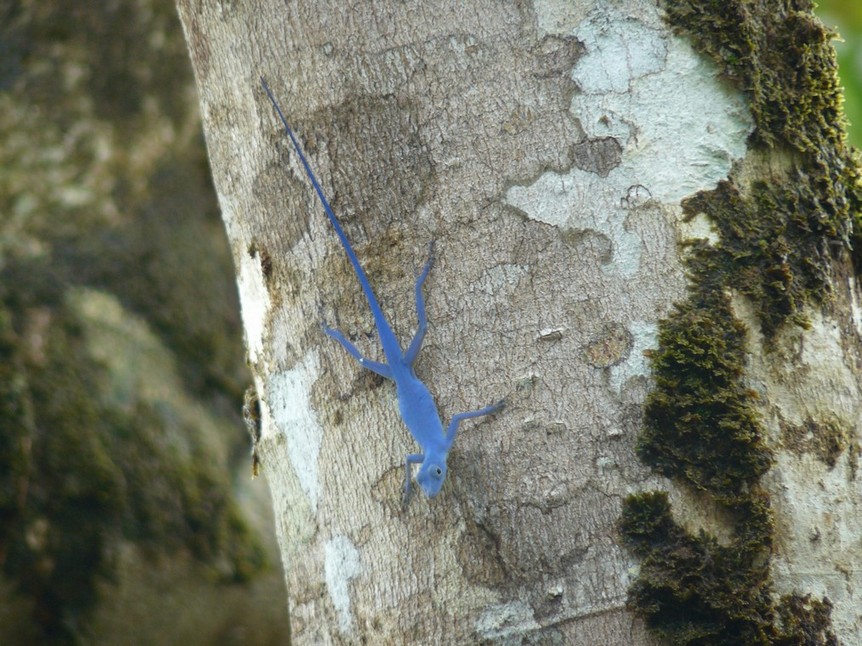 Blue AnoleAnolis gorgonae
-
 Allison's AnoleAnolis allisoni
Compare
Questions and answers
What is the scientific name of the Escambray Bearded Anole?
The scientific name of the Escambray Bearded Anole is Anolis guamuhaya. Written with its author, the full name is Anolis guamuhaya (Garrido, Pérez-Beato & Moreno, 1991).
Which family does the Escambray Bearded Anole belong to?
Anolis guamuhaya belongs to the family Anolidae, in the order Squamata and the class Reptilia.
Where is the Escambray Bearded Anole found?
Checklists and occurrence records place Anolis guamuhaya in 1 country: Cuba.
What is the conservation status of the Escambray Bearded Anole?
The IUCN Red List category recorded for Anolis guamuhaya is Endangered (EN).
What other names does the Escambray Bearded Anole have?
Anolis guamuhaya is also known in English as Scambray Bearded Anole.
Sources
Data
- Catalogue of Life, 2026-10-16 XR cc by
- Global Biodiversity Information Facility CC BY 4.0
- Wikidata CC0
- GeoNames CC BY 4.0
- Within the Catalogue of Life, this name comes from The Reptile Database cc by
References
- Garrido, O. H., O. Pérez-Beato, and L. V. Moreno. (1991). Nueva especie de Chamaeleolis (Lacertilia: Iguanidae) para Cuba. Carib. J. Sci. 27 (3-4): 162-168.
- Hass, C. A., S. B. Hedges, and L. R. Maxson. (1993). Molecular insights into the relationships and biogeography of West Indian anoline lizards. Biochem. Syst. Ecol. 21: 97-114.
- Jackman, T. et al. (1997). Phylogenetic studies of convergent adaptive radiations in Caribbean Anolis lizards. In T. J. Givnish & K.J. Sytsma (Eds.) Molecular Evolution and Adaptive Radiation, CAmbridge University Press, Pp. 535-557.
- Rodríguez Schettino, Lourdes (ed.). (1999). The iguanid lizards of Cuba. University Press of Florida, 428 Pp.
- Karch, P. (2002). Bemerkungen zur Gattung Chamaeleolis. Iguana Rundschreiben 15 (2): 11-12.
- Losos, J. B. (2009). Lizards in an Evolutionary Tree: Ecology and Adaptive Radiation of Anoles. Berkeley: University of California Press, 528 Pp.
- Holáňová, V., Rehák, I., & Frynta, D. (2012). Anolis sierramaestrae sp. nov. (Squamata: Polychrotidae) of the “chamaeleolis” species group from Eastern Cuba. Acta Societatis Zoologicae Bohemicae 76 (1–2): 45–52.
- NICHOLSON, KIRSTEN E.; BRIAN I. CROTHER, CRAIG GUYER & JAY M. SAVAGE. (2012). It is time for a new classification of anoles (Squamata: Dactyloidae). Zootaxa 3477: 1–108.
- Poe, S. (2013). 1986 Redux: New genera of anoles (Squamata: Dactyloidae) are unwarranted. Zootaxa 3626 (2): 295–299.
- Rodríguez Schettino, Lourdes, Carlos A. Mancina & Vilma Rivalta González. (2013). REPTILES OF CUBA: CHECKLIST AND GEOGRAPHIC DISTRIBUTIONS. Smithsonian Herp. Inf. Serv. (144): 1-96.
- Torres, Javier, Ruben Marrero and Tomás M. Rodríguez-Cabrera. (2015). Anolis guamuhaya (Escambray bearded anole) maximum elevation. Herpetological Review 46 (1): 86-87.
- NICHOLSON, KIRSTEN E.; BRIAN I. CROTHER, CRAIG GUYER & JAY M. SAVAGE. (2018). Translating a clade based classification into one that is valid under the international code of zoological nomenclature: the case of the lizards of the family Dactyloidae (Order Squamata). Zootaxa 4461 (4): 573–586.
- Rodríguez-Cabrera, Tomás M.; Javier Torres, Carlos A. Mancina, Ruben Marrero, Yasel U. Alfonso, Ernesto Morell Saval. (2020). New localities and distribution models inform the conservation status of the endangered lizard Anolis guamuhaya (Squamata: Dactyloidae) in central Cuba. Phyllomedusa 19 (1): 13-33.
- Patton, Austin H.; Luke J. Harmon, María del Rosario Castañeda, Hannah K. Frank, Colin M. Donihue, Anthony Herrel, and Jonathan B. Losos. (2021). When adaptive radiations collide: Different evolutionary trajectories between and within island and mainland lizard clades. Proc. Natl. Acad. Sci. U.S.A. 118 (42) E2024451118.
This species in other databases
Page built on 29 November 2026. See how the catalog is made and all sources and licences.
Cite this page
ScientificNames.org. (2026). Anolis guamuhaya (Escambray Bearded Anole). Retrieved November 29, 2026, from https://scientificnames.org/species/anolis-guamuhaya
“Anolis guamuhaya (Escambray Bearded Anole).” ScientificNames.org, 2026, scientificnames.org/species/anolis-guamuhaya. Accessed 29 Nov. 2026.
ScientificNames.org. “Anolis guamuhaya (Escambray Bearded Anole).” Accessed November 29, 2026. https://scientificnames.org/species/anolis-guamuhaya.
@misc{scientificnames_anolis_guamuhaya_escambray_bearded_anole,
  author = {{ScientificNames.org}},
  title = {Anolis guamuhaya (Escambray Bearded Anole)},
  year = {2026},
  url = {https://scientificnames.org/species/anolis-guamuhaya},
  note = {Accessed 2026-11-29}
}