Overview
Anolis mestrei is endemic to Cuba and occurs in the provinces of La Habana and Pinar del Río.
Written 27 November 2026 from the sources listed below. Each statement was checked against the passage it cites; statements that could not be supported were removed.
Similar species
The Pinardel Rio Anole belongs to the Anolis sagrei species group.[1]
Habitat
The species' preferred natural habitat is forest. It inhabits rocky environments.[2][3]
Behaviour
The Pinardel Rio Anole is terrestrial.[4]
Reproduction and life cycle
The species is oviparous.[5]
Uses
The specific name mestrei honors Aristides Mestre y Hevia, a Cuban physician and naturalist who lived from 1865 to 1952.[6]
Classification of the Pinardel Rio Anole
| Kingdom | Animalia |
|---|---|
| Phylum | Chordata |
| Subphylum | Vertebrata |
| Infraphylum | Gnathostomata |
| Parvphylum | Osteichthyes |
| Megaclass | Tetrapoda |
| Class | Reptilia (Reptile) |
| Order | Squamata (Snakes) |
| Suborder | Iguania (Iguanas) |
| Family | Anolidae (Anoles) |
| Genus | Anolis (Anoles) |
| Species | Anolis mestrei Barbour & Ramsden, 1916 |
Where the Pinardel Rio Anole is found
Checklists and occurrence records place Anolis mestrei in 1 country across North America. GBIF holds 244 georeferenced records of it.
Countries
Regions and cities with the most records
- Pinar del Río, Cuba 139
- San Cristobal, Cuba 54
- Bahía Honda, Cuba 45
- Viñales, Cuba 33
- Minas de Matahambre, Cuba 12
- Los Palacios, Cuba 9
- Pinar del Río, Cuba 7
- Bauta, Cuba 4
- Guanajay, Cuba 4
- Mariel, Cuba 4
Range as the checklists state it
Cuba (La Habana, Pinar del Rio)
A number beside a place is its count of GBIF occurrence records. A place without a number comes from a checklist alone. Records show where a species has been observed or collected, which can include escapes and vagrants.
Common names
English
- Pinardel Rio Anole
- Red-fanned Rock Anole
Names in 1 other language
- Danish
- Rødfanet Klippeanole
Synonyms
2 other scientific names have been used for this species and are now treated as synonyms of Anolis mestrei.
- Norops mestrei (Barbour & Ramsden, 1916)
- Anolis cubanus Ahl, 1925 ambiguous synonym
Related species
-
 Green AnoleAnolis carolinensis
-
 Brown AnoleAnolis sagrei
-
 Knight AnoleAnolis equestris
-
 Common Puerto Rican AnoleAnolis cristatellus
-
 Western Bearded AnoleAnolis barbatus
-
 Water AnoleAnolis aquaticus
-
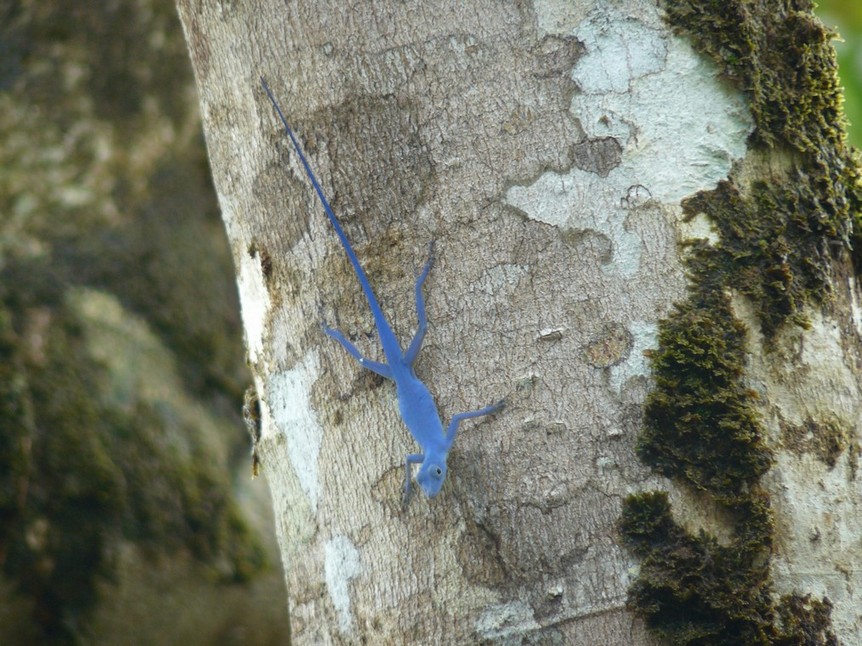 Blue AnoleAnolis gorgonae
-
 Allison's AnoleAnolis allisoni
Compare
Questions and answers
What is the scientific name of the Pinardel Rio Anole?
The scientific name of the Pinardel Rio Anole is Anolis mestrei. Written with its author, the full name is Anolis mestrei Barbour & Ramsden, 1916.
Which family does the Pinardel Rio Anole belong to?
Anolis mestrei belongs to the family Anolidae, in the order Squamata and the class Reptilia.
Where is the Pinardel Rio Anole found?
Checklists and occurrence records place Anolis mestrei in 1 country: Cuba.
What is the conservation status of the Pinardel Rio Anole?
The IUCN Red List category recorded for Anolis mestrei is Least Concern (LC).
What other names does the Pinardel Rio Anole have?
Anolis mestrei is also known in English as Red-fanned Rock Anole.
Sources
Passages the profile rests on
- The species belongs to the Anolis sagrei species group. Source passage: “Anolis mestrei belongs to the Anolis sagrei species group.” — English Wikipedia
- The species' preferred natural habitat is forest. Source passage: “The preferred natural habitat of Anolis mestrei is forest.” — English Wikipedia
- The species is saxicolous, meaning it inhabits rocky environments. Source passage: “Anolis mestrei is terrestrial and saxicolous (rock-dwelling).” — English Wikipedia
- The species is terrestrial. Source passage: “Anolis mestrei is terrestrial and saxicolous (rock-dwelling).” — English Wikipedia
- The species is oviparous. Source passage: “Anolis mestrei is oviparous.” — English Wikipedia
- The specific name mestrei honors Aristides Mestre y Hevia, a Cuban physician and naturalist who lived from 1865 to 1952. Source passage: “The specific name, mestrei, is in honor of Aristides Mestre y Hevia (1865–1952), who was a Cuban physician and naturalist.” — English Wikipedia
Data
- Catalogue of Life, 2026-10-16 XR cc by
- Global Biodiversity Information Facility CC BY 4.0
- Wikidata CC0
- GeoNames CC BY 4.0
- Within the Catalogue of Life, this name comes from The Reptile Database cc by
References
- Barbour, T. and C. T. Ramsden. (1916). A new Anolis from Cuba. Proc. Biol. Soc. Washington 29:19-20.
- Barbour, T. and C. T. Ramsden. (1919). The herpetology of Cuba. Mem. Mus. Comp. Zool., Harvard Coll. 47: 69-213.
- Ahl, E. (1925). Neue Iguaniden aus dem Zoologischen Museum Berlin. Zool. Anz. 62: 85-88.
- Barbour, T. (1937). Third list of Antillean reptiles and amphibians. Bull. Mus. Comp. Zool. Harvard 82 (2): 77-166.
- Hardy, J.D., Jr. (1958). Tail prehension and related behavior in a New World lizard. Herpetologica 14 (4): 205-6.
- Ruibal, R. (1964). An annotated checklist and key to the anoline lizards of Cuba. Bull. Mus. Comp. Zool. Harvard 130 (8): 475-520.
- Schwartz, A. (1968). The Cuban lizards of the Anolis homolechis complex. Tulane Studies in Zoology 14: 140-184.
- Schwartz, A., & Henderson, R. W. (1991). Amphibians and Reptiles of the West Indies. University of Florida Press, Gainesville, 720 Pp.
- Rodríguez Schettino, Lourdes (ed.). (1999). The iguanid lizards of Cuba. University Press of Florida, 428 Pp.
- Nicholson, K. E. (2002). Phylogenetic analysis and a test of the current infrageneric classification of Norops (beta Anolis). Herpetological Monographs 16: 93-120.
- Losos, Jonathan B., Manuel Leal, Richard E. Glor, Kevin de Queiroz, Paul E. Hertz, Lourdes Rodríguez Schettino, Ada Chamizo Lara, Todd R. Jackman & Allan Larson. (2003). Niche lability in the evolution of a Caribbean lizard community. Nature 424: 542-545.
- Poe, S. (2004). Phylogeny of anoles. Herpetological Monographs 18: 37-89.
- Losos, J. B. (2009). Lizards in an Evolutionary Tree: Ecology and Adaptive Radiation of Anoles. Berkeley: University of California Press, 528 Pp.
- Beolens, B., & Michael Watkins, a. M. G. (2011). The Eponym Dictionary of Reptiles. Johns Hopkins University Press, Baltimore, USA.
- NICHOLSON, KIRSTEN E.; BRIAN I. CROTHER, CRAIG GUYER & JAY M. SAVAGE. (2012). It is time for a new classification of anoles (Squamata: Dactyloidae). Zootaxa 3477: 1–108.
- Poe, S. (2013). 1986 Redux: New genera of anoles (Squamata: Dactyloidae) are unwarranted. Zootaxa 3626 (2): 295–299.
- Rodríguez Schettino, Lourdes, Carlos A. Mancina & Vilma Rivalta González. (2013). REPTILES OF CUBA: CHECKLIST AND GEOGRAPHIC DISTRIBUTIONS. Smithsonian Herp. Inf. Serv. (144): 1-96.
- Muñoz, Martha M.; Johanna E. Wegener and Adam C. Algar. (2014). Untangling Intra- and Interspecific Effects on Body Size Clines Reveals Divergent Processes Structuring Convergent Patterns in Anolis Lizards. The American Naturalist 184 (5), DOI: 10.1086/678084.
- Fläschendräger, & Axel. (2017). Beobachtungen an einigen Anolis-Arten im westlichen Kuba. Terraria-Elaphe 2017 (5): 52-63.
- NICHOLSON, KIRSTEN E.; BRIAN I. CROTHER, CRAIG GUYER & JAY M. SAVAGE. (2018). Translating a clade based classification into one that is valid under the international code of zoological nomenclature: the case of the lizards of the family Dactyloidae (Order Squamata). Zootaxa 4461 (4): 573–586.
- Torres, & Javier. (2019). Sterility in odd-looking Anolis mestrei (Dactyloidae) living in sympatry with trunk- ground anoles. Anolis Newsletter VII: 283.
This species in other databases
Page built on 27 November 2026. See how the catalog is made and all sources and licences.
Cite this page
ScientificNames.org. (2026). Anolis mestrei (Pinardel Rio Anole). Retrieved November 27, 2026, from https://scientificnames.org/species/anolis-mestrei
“Anolis mestrei (Pinardel Rio Anole).” ScientificNames.org, 2026, scientificnames.org/species/anolis-mestrei. Accessed 27 Nov. 2026.
ScientificNames.org. “Anolis mestrei (Pinardel Rio Anole).” Accessed November 27, 2026. https://scientificnames.org/species/anolis-mestrei.
@misc{scientificnames_anolis_mestrei_pinardel_rio_anole,
  author = {{ScientificNames.org}},
  title = {Anolis mestrei (Pinardel Rio Anole)},
  year = {2026},
  url = {https://scientificnames.org/species/anolis-mestrei},
  note = {Accessed 2026-11-27}
}