Overview
The Redonda anole (Anolis nubilis) is a species of anole lizard that is endemic to the small, uninhabited island of Redonda, part of Antigua and Barbuda in the Caribbean Lesser Antilles.
Classification of the Redonda Anole
| Kingdom | Animalia |
|---|---|
| Phylum | Chordata |
| Subphylum | Vertebrata |
| Infraphylum | Gnathostomata |
| Parvphylum | Osteichthyes |
| Megaclass | Tetrapoda |
| Class | Reptilia (Reptile) |
| Order | Squamata (Snakes) |
| Suborder | Iguania (Iguanas) |
| Family | Anolidae (Anoles) |
| Genus | Anolis (Anoles) |
| Species | Anolis nubilus Garman, 1887 |
Where the Redonda Anole is found
Checklists and occurrence records place Anolis nubilus in 1 country. GBIF holds 42 georeferenced records of it.
Countries
Regions and cities with the most records
Range as the checklists state it
Lesser Antilles: Redonda
A number beside a place is its count of GBIF occurrence records. A place without a number comes from a checklist alone. Records show where a species has been observed or collected, which can include escapes and vagrants.
Common names
English
- Redonda Anole
- Jacmel Gracile Anole
Related species
-
 Green AnoleAnolis carolinensis
-
 Brown AnoleAnolis sagrei
-
 Knight AnoleAnolis equestris
-
 Crested AnoleAnolis cristatellus
-
 Western Bearded AnoleAnolis barbatus
- Water AnoleAnolis aquaticus
-
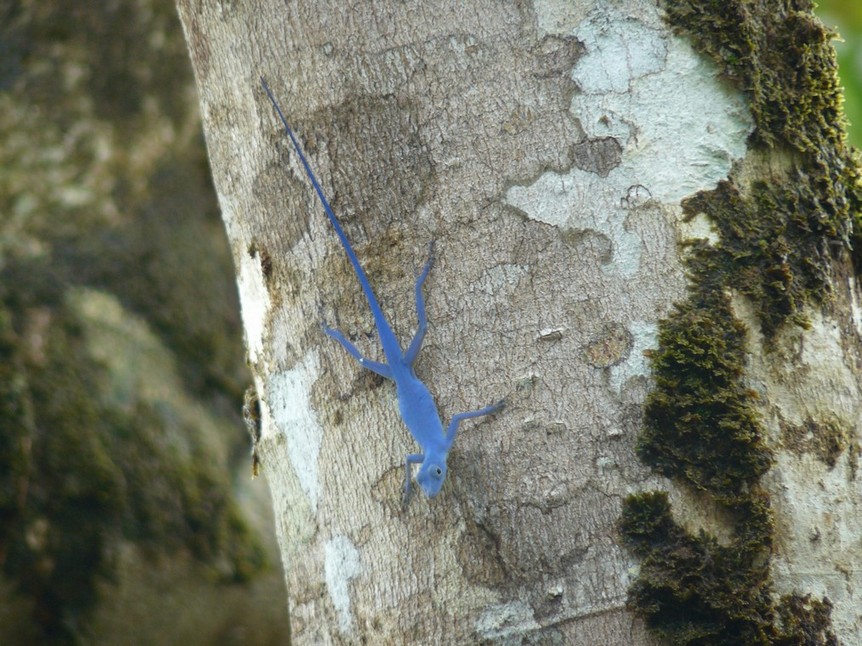 Blue AnoleAnolis gorgonae
-
 Allison's AnoleAnolis allisoni
Compare
Questions and answers
What is the scientific name of the Redonda Anole?
The scientific name of the Redonda Anole is Anolis nubilus. Written with its author, the full name is Anolis nubilus Garman, 1887.
Which family does the Redonda Anole belong to?
Anolis nubilus belongs to the family Anolidae, in the order Squamata and the class Reptilia.
Where is the Redonda Anole found?
Checklists and occurrence records place Anolis nubilus in 1 country: Antigua and Barbuda.
What is the conservation status of the Redonda Anole?
The IUCN Red List category recorded for Anolis nubilus is Critically Endangered (CR).
What other names does the Redonda Anole have?
Anolis nubilus is also known in English as Jacmel Gracile Anole.
Sources
Data
- Catalogue of Life, 2026-10-16 XR cc by
- Global Biodiversity Information Facility CC BY 4.0
- Wikidata CC0
- English Wikipedia CC BY-SA 4.0
- GeoNames CC BY 4.0
- Within the Catalogue of Life, this name comes from The Reptile Database cc by
References
- Garman, S. (1887). On West Indian reptiles. Iguanidae. Bull. Essex Institute 19: 25-50.
- Lazell, J.D., and E.E. Williams. (1962). The anoles of the Eastern Caribbean (Sauria, Iguanidae): Parts IV-VI. Bull. Mus. Comp. Zool. Harvard 127 (9): 451-478.
- Lazell, J. D. (1972). The anoles (Sauria: Iguanidae) of the lesser Antilles. Bull. Mus. Comp. Zool. Harvard 143 (1): 1-115.
- Gorman, G. C., & Stamm, B. (1975). The Anolis lizards of Mona, Redonda, and La Blanquilla: chromosomes, relationships, and natural history notes. Journal of Herpetology 9 (2): 197-205.
- Schwartz, A. and Henderson, R.W. (1985). A guide to the identification of the amphibians and reptiles of the West Indies exclusive of Hispaniola. Milwaukee Public Mus., 165 Pp.
- Schwartz, A., & Henderson, R. W. (1991). Amphibians and Reptiles of the West Indies. University of Florida Press, Gainesville, 720 Pp.
- Roughgarden, J. (1995). Anolis Lizards of the Caribbean: Ecology, Evolution, and Plate Tectonics. OXFORD UNIVERSITY PRESS, 200 Pp.
- Poe, S. (2004). Phylogeny of anoles. Herpetological Monographs 18: 37-89.
- Stenson, Andrew G.; Roger S.Thorpe and Anita Malhotra. (2004). Evolutionary differentiation of bimaculatus group anoles based on analyses of mtDNA and microsatellite data. Molecular Phylogenetics and Evolution 32: 1 –10.
- Daltry, Jennifer C. (2007). An introduction to the herpetofauna of Antigua, Barbuda and Redonda, with some conservation recommendations. Applied Herpetology 4 (2): 97-130.
- Thorpe, R. S., Jones, A. G., Malhotra, A., & Surget-Groba, Y. (2008). Adaptive radiation in Lesser Antillean lizards: molecular phylogenetics and species recognition in the Lesser Antillean dwarf gecko complex, Sphaerodactylus fantasticus. Molecular Ecology 17(6):1489-1504.
- NICHOLSON, KIRSTEN E.; BRIAN I. CROTHER, CRAIG GUYER & JAY M. SAVAGE. (2012). It is time for a new classification of anoles (Squamata: Dactyloidae). Zootaxa 3477: 1–108.
- Poe, S. (2013). 1986 Redux: New genera of anoles (Squamata: Dactyloidae) are unwarranted. Zootaxa 3626 (2): 295–299.
- Pyron, R. Alexander; Frank T. Burbrink. (2013). Early origin of viviparity and multiple reversions to oviparity in squamate reptiles. Ecology Letters 17 (1): 13–21 (Published Online 2013, in Print 2014), DOI: 10.1111/Ele.12168.
- Meiri, Shai; Aaron M. Bauer, Allen Allison, Fernando Castro-Herrera, Laurent Chirio, Guarino Colli, Indraneil Das, Tiffany M. Doan, Frank Glaw, Lee L. Grismer, Marinus Hoogmoed, Fred Kraus, Matthew LeBreton, Danny Meirte, Zoltán T. Nagy, Cristiano de C. Nogueira, Paul Oliver, Olivier S. G. Pauwels, Daniel Pincheira-Donoso, Glenn Shea, Roberto Sindaco, Oliver J. S. Tallowin, Omar Torres-Carvajal, Jean-Francois Trape, Peter Uetz, Philipp Wagner, Yuezhao Wang, Thomas Ziegler, and Uri Roll. (2017). Extinct, obscure or imaginary: the lizard species with the smallest ranges. Diversity and Distributions 24 (2): 262-273.
- NICHOLSON, KIRSTEN E.; BRIAN I. CROTHER, CRAIG GUYER & JAY M. SAVAGE. (2018). Translating a clade based classification into one that is valid under the international code of zoological nomenclature: the case of the lizards of the family Dactyloidae (Order Squamata). Zootaxa 4461 (4): 573–586.
- Thorpe, R. S. (2022). Reptiles of the Lesser Antilles. Chimaira, Frankfurt, 608 Pp.
This species in other databases
Page built on 25 November 2026. See how the catalog is made and all sources and licences.
Cite this page
ScientificNames.org. (2026). Anolis nubilus (Redonda Anole). Retrieved November 25, 2026, from https://scientificnames.org/species/anolis-nubilus
“Anolis nubilus (Redonda Anole).” ScientificNames.org, 2026, scientificnames.org/species/anolis-nubilus. Accessed 25 Nov. 2026.
ScientificNames.org. “Anolis nubilus (Redonda Anole).” Accessed November 25, 2026. https://scientificnames.org/species/anolis-nubilus.
@misc{scientificnames_anolis_nubilus_redonda_anole,
  author = {{ScientificNames.org}},
  title = {Anolis nubilus (Redonda Anole)},
  year = {2026},
  url = {https://scientificnames.org/species/anolis-nubilus},
  note = {Accessed 2026-11-25}
}