Species · Reptiles
Peters' Anole Anolis petersii
The scientific name of the Peters' Anole is Anolis petersii. It is a species of reptile in the family Anolidae (anoles), order Squamata. The name dates from 1873.
- Scientific name
- Anolis petersii Bocourt, 1873
- Common name
- Peters' Anole
- Genus
- Anolis
- Family
- Anolidae (Anoles)
- Order
- Squamata
- Class
- Reptilia
- Red List category
- NT Near Threatened
- Recorded in
- 3 countries
- Name status
- accepted in the Catalogue of Life

Overview
Anolis petersii is native to Guatemala, Honduras, and Mexico. It is terrestrial and forages on the forest floor, particularly near streams.
Written 27 November 2026 from the sources listed below. Each statement was checked against the passage it cites; statements that could not be supported were removed.
Habitat
Peters' Anole inhabits forests at elevations between 200 and 2,130 m.[1]
Behaviour
Peters' Anole is terrestrial and forages on the forest floor, particularly near streams.[2]
Reproduction and life cycle
Peters' Anole reproduces by laying eggs.[3]
Classification of the Peters' Anole
| Kingdom | Animalia |
|---|---|
| Phylum | Chordata |
| Subphylum | Vertebrata |
| Infraphylum | Gnathostomata |
| Parvphylum | Osteichthyes |
| Megaclass | Tetrapoda |
| Class | Reptilia (Reptile) |
| Order | Squamata (Snakes) |
| Suborder | Iguania (Iguanas) |
| Family | Anolidae (Anoles) |
| Genus | Anolis (Anoles) |
| Species | Anolis petersii Bocourt, 1873 |
Where the Peters' Anole is found
Checklists and occurrence records place Anolis petersii in 3 countries across North America. GBIF holds 318 georeferenced records of it.
Countries
Regions and cities with the most records
- Veracruz, Mexico 80
- Chiapas, Mexico 45
- Ixtaczoquitlán, Mexico 36
- Orizaba, Mexico 35
- Córdoba, Mexico 34
- Fortín de las Flores, Mexico 34
- Río Blanco, Mexico 33
- Nogales, Mexico 32
- Ciudad Mendoza, Mexico 31
- Oaxaca, Mexico 26
- Alta Verapaz, Guatemala 14
- Catemaco, Mexico 14
- Santa Bárbara Department, Honduras 13
- Cofradía, Honduras 12
- Quimistán, Honduras 12
- San Andrés Tuxtla, Mexico 11
- Berriozábal, Mexico 10
- Baja Verapaz, Guatemala 8
- Salamá, Guatemala 8
- Tuxtla, Mexico 8
- Cobán, Guatemala 7
- Huehuetenango, Guatemala 7
- San Pedro Carchá, Guatemala 7
- Chiapa de Corzo, Mexico 6
- Huatusco, Mexico 6
- San Cristóbal Verapaz, Guatemala 6
- Cortés Department, Honduras 5
- Coscomatepec de Bravo, Mexico 5
- Ocozocoautla de Espinosa, Mexico 5
- Santiago Tuxtla, Mexico 5
- Cacahoatán, Mexico 3
- Copán Department, Honduras 3
- Lerdo de Tejada, Mexico 3
- Puebla, Mexico 3
- Suchiapa, Mexico 3
- Hidalgo, Mexico 2
Range as the checklists state it
Mexico (Chiapas, Oaxaca, Veracruz, San Luis Potosí, Hidalgo, Puebla), Guatemala, Honduras (elevation 1340-1370 m)
A number beside a place is its count of GBIF occurrence records. A place without a number comes from a checklist alone. Records show where a species has been observed or collected, which can include escapes and vagrants.
Common names
English
- Peters' Anole
Names in 2 other languages
- Danish
- Finca Samac-anole
- Spanish
- Abaniquillo, Abaniquillo de Peters
Synonyms
2 other scientific names have been used for this species and are now treated as synonyms of Anolis petersii.
- Anolis petersii bivittata Werner, 1896
- Norops petersii (Bocourt, 1873)
Related species
-
 Green AnoleAnolis carolinensis
-
 Brown AnoleAnolis sagrei
-
 Knight AnoleAnolis equestris
-
 Common Puerto Rican AnoleAnolis cristatellus
-
 Western Bearded AnoleAnolis barbatus
-
 Water AnoleAnolis aquaticus
-
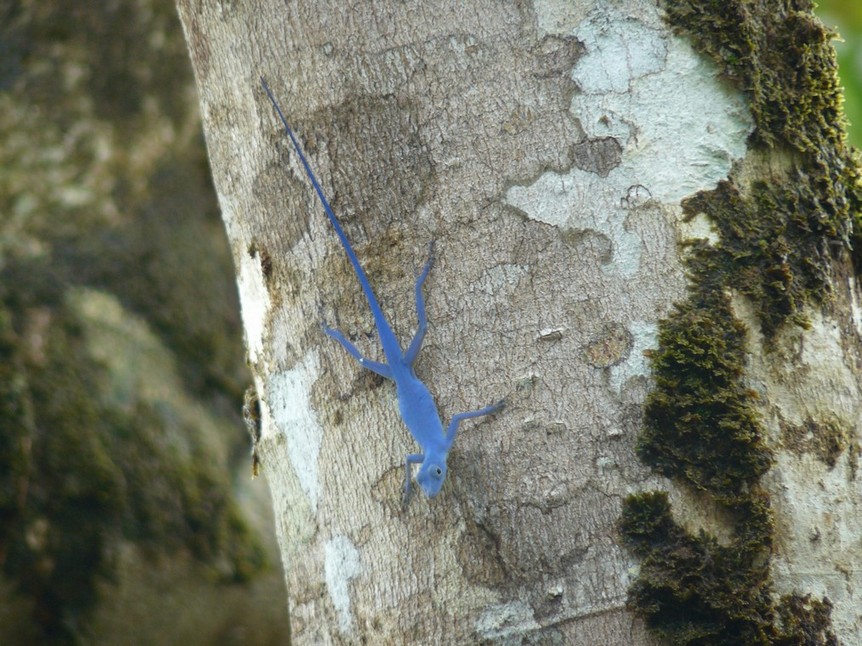 Blue AnoleAnolis gorgonae
-
 Allison's AnoleAnolis allisoni
Compare
Questions and answers
What is the scientific name of the Peters' Anole?
The scientific name of the Peters' Anole is Anolis petersii. Written with its author, the full name is Anolis petersii Bocourt, 1873.
Which family does the Peters' Anole belong to?
Anolis petersii belongs to the family Anolidae, in the order Squamata and the class Reptilia.
Where is the Peters' Anole found?
Checklists and occurrence records place Anolis petersii in 3 countries: Mexico, Guatemala and Honduras.
What is the conservation status of the Peters' Anole?
The IUCN Red List category recorded for Anolis petersii is Near Threatened (NT).
What habitat do anoles live in?
Peters' Anole inhabits forests at elevations between 200 and 2,130 m.[1]
Sources
Passages the profile rests on
- Anolis petersii inhabits forests at elevations between 200 and 2,130 m. Source passage: “The preferred natural habitat of Anolis petersii is forest, at elevations of 200–2,130 m (660–6,990 ft).” — English Wikipedia
- Anolis petersii is terrestrial and forages on the forest floor, particularly near streams. Source passage: “Anolis petersii is terrestrial, foraging on the forest floor, especially near streams.” — English Wikipedia
- Anolis petersii reproduces by laying eggs. Source passage: “Anolis petersii is oviparous.” — English Wikipedia
Data
- Catalogue of Life, 2026-10-16 XR cc by
- Global Biodiversity Information Facility CC BY 4.0
- Wikidata CC0
- GeoNames CC BY 4.0
- Wikimedia Commons per image; credit shown with each image
- Within the Catalogue of Life, this name comes from The Reptile Database cc by
References
- Bocourt, M. E. (1873). In: A. Duméril, M. F. Bocourt, and F. Mocquard, (1870-1909), Etudes sur les reptiles, p. i-xiv; In Recherches Zoologiques pour servir a l’Histoire de Ia Faune de l’Amérique Centrale et du Mexique. Mission Scientifique au Mexique et dans l’Amérique Centrale, Recherches zoologiques. Part 2, sect. 1. Imprimerie Impériale, Paris, Livr. 2-15, Pp. 33-860.
- Boulenger, G. A. (1885). Catalogue of the lizards in the British Museum (Natural History). Vol. 2, Second edition. London, Xiii+497 Pp.
- Stuart, L. C. (1948). The amphibians and reptiles of Alta Verapaz Guatamala. Miscellaneous Publications, Museum of Zoology, University of Michigan 69: 1-109.
- Taylor, E. H. (1949). A preliminary account of the herpetology of the state of San Luis Potosi, Mexico. Univ. Kansas Sci. Bull. 33 (2): 169-215.
- Shannon, Frederick A. (1951). Notes on a herpetological collection from Oaxaca and other localities in Mexico. Proc. US Natl. Mus. 101 (3284): 465-484.
- Brattstrom, B. H., & HOWELL, T. R. (1954). Notes on some collections of reptiles and amphibians from Nicaragua. Herpetologica 10: 114-123.
- Stuart, L. C. (1955). A brief review of the Guatemalan lizards of the genus Anolis. Misc. Publ. Mus. Zool., Univ. Michigan No. 91: 1-31.
- Stuart, L. C. (1963). A checklist of the herpetofauna of Guatemala. Misc. Publ. Mus. Zool., Univ. Michigan (No. 122): 1-150.
- Alvarez DEL TORO, M. (1982). Los Reptiles de Chiapas. 3rd ed. México: Tuxtla Gutiérrez, 248 Pp.
- McCRANIE, J. R., & WILSON, L. D. (1985). Plectrohyla matudai Hartweg and Noropspetersi (Bocourt): additions to the herpetofauna of Honduras. Herpetological Review 16:107-108.
- Köhler, G. (2000). Reptilien und Amphibien Mittelamerikas, Bd 1: Krokodile, Schildkröten, Echsen. Herpeton Verlag, Offenbach, 158 Pp.
- Köhler, Gunther, James R. McCranie and Larry David Wilson. (2001). A new species of anole from western Honduras (Squamata: Polychrotidae). Herpetologica 57 (3):247-255.
- Schlüter, U. (2001). Neuerungen in der Systematik der mittelamerikanischen Saumfinger der Gattung Norops seit 1996. Iguana Rundschreiben 14 (2): 19-28.
- Köhler, G., & Bauer, A. M. (2001). Case 3145: Dactyloa biporcata WIEGMANN 1834 (currently Anolis biporcatus) and Anolis petersii BOCOURT 1873 (Reptilia: Sauria): proposed conservation of the specific names and designation of a neotype for A. biporcatus. Bull. Zool. Nomenclature 58 (2): 122-125.
- Nicholson, K. E. (2002). Phylogenetic analysis and a test of the current infrageneric classification of Norops (beta Anolis). Herpetological Monographs 16: 93-120.
- Anonymous. (2002). Opinion 2015 (Case 3145) Dactyloa biporcata Wiegmann 1834 (currently Anolis biporcatus) and Anolis petersii Bocourt 1873 (Reptilia, Sauria): specific names conserved by the desdignation of a neotype for A. biporcatus. Bull. Zool. Nomenclature 59 (3): 230-231.
- Wilson, L. D., & McCranie, J. R. (2003). The herpetofauna of the cloud forests of Honduras. Amphibian & Reptile Conservation 3 (1): 34-48.
- Poe, S. (2004). Phylogeny of anoles. Herpetological Monographs 18: 37-89.
- Casas-Andreu, G., F.R. Méndez-De la Cruz and X. Aguilar-Miguel. (2004). Anfibios y Reptiles; pp. 375–390, in A.J.M. García-Mendoza, J. Ordoñez and M. Briones-Salas (ed.). Biodiversidad de Oaxaca. Instituto de Biología, UNAM-Fondo Oaxaqueño Para La Conservación de La Naturaleza-World Wildlife Fund, México, D. F.
- Köhler, G., & Acevedo, M. (2004). The anoles (genus Norops) of Guatemala. I. The species of the Pacific versant below 1500 m elevation. Salamandra 40 (2): 113-140.
- Urbina-Cardona, J. Nicolás; Mario Olivares-Pérez, Víctor Hugo Reynoso. (2006). Herpetofauna diversity and microenvironment correlates across a pasture–edge–interior ecotone in tropical rainforest fragments in the Los Tuxtlas Biosphere Reserve of Veracruz, Mexico. Biological Conservation 132: 61–75.
- Köhler, G. (2008). Reptiles of Central America. 2nd Ed. Herpeton-Verlag, 400 Pp.
- NICHOLSON, KIRSTEN E.; BRIAN I. CROTHER, CRAIG GUYER & JAY M. SAVAGE. (2012). It is time for a new classification of anoles (Squamata: Dactyloidae). Zootaxa 3477: 1–108.
- Mendoza-Hernández, A. A., J, Hernández-Ortega, E. Pérez-Ramos and U. O. García-Vázquez. (2012). Geographic distribution. Anolis petersii. Herpetological Review 43 (2): 304.
- Lemos-Espinal, Julio A. and James R. Dixon. (2013). Amphibians and Reptiles of San Luis Potosí. Eagle Mountain Publishing, Xii + 300 Pp.
This species in other databases
Page built on 28 November 2026. See how the catalog is made and all sources and licences.
Cite this page
ScientificNames.org. (2026). Anolis petersii (Peters' Anole). Retrieved November 28, 2026, from https://scientificnames.org/species/anolis-petersii
“Anolis petersii (Peters' Anole).” ScientificNames.org, 2026, scientificnames.org/species/anolis-petersii. Accessed 28 Nov. 2026.
ScientificNames.org. “Anolis petersii (Peters' Anole).” Accessed November 28, 2026. https://scientificnames.org/species/anolis-petersii.
@misc{scientificnames_anolis_petersii_peters_anole,
  author = {{ScientificNames.org}},
  title = {Anolis petersii (Peters' Anole)},
  year = {2026},
  url = {https://scientificnames.org/species/anolis-petersii},
  note = {Accessed 2026-11-28}
}