Species · Reptiles
Many-scaled Anole Anolis polylepis
The scientific name of the Many-scaled Anole is Anolis polylepis. It is a species of reptile in the family Anolidae (anoles), order Squamata. The name dates from 1874.
- Scientific name
- Anolis polylepis Peters, 1874
- Common name
- Many-scaled Anole
- Genus
- Anolis
- Family
- Anolidae (Anoles)
- Order
- Squamata
- Class
- Reptilia
- Red List category
- LC Least Concern
- Recorded in
- 2 countries
- Name status
- accepted in the Catalogue of Life

Overview
Anolis polylepis, the many-scaled anole or Golfo-Dulce anole, is a lizard endemic to the Gulf of Dulce area of Costa Rica.
Classification of the Many-scaled Anole
| Kingdom | Animalia |
|---|---|
| Phylum | Chordata |
| Subphylum | Vertebrata |
| Infraphylum | Gnathostomata |
| Parvphylum | Osteichthyes |
| Megaclass | Tetrapoda |
| Class | Reptilia (Reptile) |
| Order | Squamata (Snakes) |
| Suborder | Iguania (Iguanas) |
| Family | Anolidae (Anoles) |
| Genus | Anolis (Anoles) |
| Species | Anolis polylepis Peters, 1874 |
Where the Many-scaled Anole is found
Checklists and occurrence records place Anolis polylepis in 2 countries. GBIF holds 3,859 georeferenced records of it.
Countries
Regions and cities with the most records
- Puntarenas Province, Costa Rica 2,216
- Chiriquí Province, Panama 370
- San José, Costa Rica 192
- David, Panama 11
- Limón Province, Costa Rica 7
- Cartago Province, Costa Rica 6
Range as the checklists state it
W Panama, SW Costa Rica (exclusive of the Penisula de Osa), 0-1615 m elevation
A number beside a place is its count of GBIF occurrence records. A place without a number comes from a checklist alone. Records show where a species has been observed or collected, which can include escapes and vagrants.
Common names
English
- Many-scaled Anole
- Golfo Dulce Anole
- Pacific Lowland Anole
Names in 1 other language
- Spanish
- Gallego Brincador
Synonyms
3 other scientific names have been used for this species and are now treated as synonyms of Anolis polylepis.
- Anolis osa Köhler, Dehling & Köhler, 2010
- Anolis polylepis Poe, 2004
- Norops polylepis (Peters, 1874)
Related species
-
 Green AnoleAnolis carolinensis
-
 Brown AnoleAnolis sagrei
-
 Knight AnoleAnolis equestris
-
 Crested AnoleAnolis cristatellus
-
 Western Bearded AnoleAnolis barbatus
- Water AnoleAnolis aquaticus
-
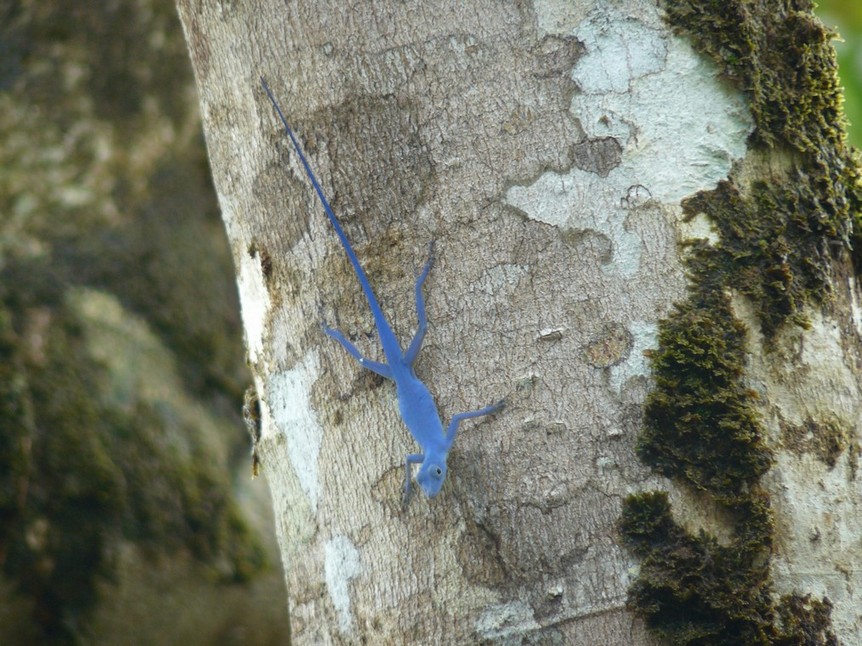 Blue AnoleAnolis gorgonae
-
 Allison's AnoleAnolis allisoni
Compare
Questions and answers
What is the scientific name of the Many-scaled Anole?
The scientific name of the Many-scaled Anole is Anolis polylepis. Written with its author, the full name is Anolis polylepis Peters, 1874.
Which family does the Many-scaled Anole belong to?
Anolis polylepis belongs to the family Anolidae, in the order Squamata and the class Reptilia.
Where is the Many-scaled Anole found?
Checklists and occurrence records place Anolis polylepis in 2 countries: Costa Rica and Panama.
What is the conservation status of the Many-scaled Anole?
The IUCN Red List category recorded for Anolis polylepis is Least Concern (LC).
What other names does the Many-scaled Anole have?
Anolis polylepis is also known in English as Golfo Dulce Anole and Pacific Lowland Anole.
Sources
Data
- Catalogue of Life, 2026-10-16 XR cc by
- Global Biodiversity Information Facility CC BY 4.0
- Wikidata CC0
- English Wikipedia CC BY-SA 4.0
- GeoNames CC BY 4.0
- Wikimedia Commons per image; credit shown with each image
- Within the Catalogue of Life, this name comes from The Reptile Database cc by
References
- Peters, & Wilhem Carl Hartwig. (1874). Über neue Saurier (Spæriodactylus, Anolis, Phrynosoma, Tropidolepisma, Lygosoma, Ophioscincus) aus Centralamerica, Mexico und Australien. Monatsber. Königl. Akad. Wiss. Berlin. 1873 (November): 738-747.
- Boulenger, G. A. (1885). Catalogue of the lizards in the British Museum (Natural History). Vol. 2, Second edition. London, Xiii+497 Pp.
- Slevin, J. R. (1942). Notes on a collection of reptiles from Boquete, Panama, with the description of a new species of Hydromorphus. Proc. Cal. Acad. Sci. 23: 463-480.
- Taylor, E. H. (1956). A review of the lizards of Costa Rica. Univ. Kansas Sci. Bull. 38 (Part 1): 3-322.
- Hertz, Paul E. (1974). Thermal Passivity of a Tropical Forest Lizard, Anolis polylepis. Journal of Herpetology 8 (4): 323-327.
- Scott, N. J. (1976). The abundance and diversity of the herpetofaunas of tropical forest litter. Biotropica 8 (1): 41-58.
- Crumly, C. (1986). Type specimens of lizards in the Museum of Comparative Zoology. part I. Amphisbaenia and Sauria (Agamidae to Iguanidae). Unpublished Manuscript, 301 Pp.
- Bauer, A.M.; Günther,R. & Klipfel,M. (1995). The herpetological contributions of Wilhelm C.H. Peters (1815-1883). SSAR Facsimile Reprints in Herpetology, 714 Pp.
- Perry, G. (1996). The evolution of sexual dimorphism in the lizard Anolis polylepis (Iguania): Evidence from intraspecific. Canadian Journal of Zoology 74: 1238-1245.
- Köhler, G. (2000). Reptilien und Amphibien Mittelamerikas, Bd 1: Krokodile, Schildkröten, Echsen. Herpeton Verlag, Offenbach, 158 Pp.
- Nicholson, K. E. (2002). Phylogenetic analysis and a test of the current infrageneric classification of Norops (beta Anolis). Herpetological Monographs 16: 93-120.
- Savage, J. M. (2002). The Amphibians and Reptiles of Costa Rica: A Herpetofauna Between Two Continents, Between Two Seas. University of Chicago Press, 934 Pp. [Review in Copeia 2003 (1): 205].
- Poe, S. (2004). Phylogeny of anoles. Herpetological Monographs 18: 37-89.
- Cooper Jr., W.E. (2005). Duration of movement as a lizard foraging movement variable. Herpetologica 61 (4): 363-372.
- Socci, A.M.; Schlaepfer, M.A. & Gavin,T.A. (2005). The importanceof soil moisture and leaf cover in a femal lizard’s (Norops polylepis) evaluation of potential oviposition sites. Herpetologica 61 (3): 233-240.
- Santos-Barrera, Georgina; Jesus Pacheco, Fernando Mendoza-Quijano, Federico Bolaños,Gerardo Cháves , Gretchen C. Daily, Paul R. Ehrlich & Gerardo Ceballos. (2008). Diversity, natural history and conservation of amphibians and reptiles from the San Vito Region, southwestern Costa Rica. Rev. Biol. Trop. 56 (2): 755-778.
- Köhler, G. (2008). Reptiles of Central America. 2nd Ed. Herpeton-Verlag, 400 Pp.
- Höbel, G. (2008). The amphibians and reptiles of the Golfo Dulce region - Los anfibios y reptiles de la región del Golfo Dulce. Stapfia 88, Neue Serie 80 (2008): 305-328.
- KÖHLER, GUNTHER; D. MATTHIAS DEHLING & JOHANNES KÖHLER. (2010). Cryptic species and hybridization in the Anolis polylepis complex, with the description of a new species from the Osa Peninsula, Costa Rica (Squamata: Polychrotidae). Zootaxa 2718: 23–38.
- Henderson, C. L. (2010). Mammals, Amphibians, and Reptiles of Costa Rica - A field guide. University of Texas Press, Austin, 198 Pp.
- KÖHLER, GUNTHER; ABEL BATISTA, MILAN VESELY, MARCOS PONCE, ARCADIO CARRIZO & SEBASTIAN LOTZKAT. (2012). Evidence for the recognition of two species of Anolis formerly referred to as A. tropidogaster (Squamata: Dactyloidae). Zootaxa 3348: 1–23.
- NICHOLSON, KIRSTEN E.; BRIAN I. CROTHER, CRAIG GUYER & JAY M. SAVAGE. (2012). It is time for a new classification of anoles (Squamata: Dactyloidae). Zootaxa 3477: 1–108.
- Köhler, J., M. Hahn & G. Köhler. (2012). Divergent evolution of hemipenial morphology in two cryptic species of mainland anoles related to Anolis polylepis. Salamandra 48 (1): 1-11.
- Suárez, Javier Ernesto Cortés and Natalia Díaz Gutiérrez. (2013). Perch use by Anolis polylepis Peters, 1874 (Polychrotidae) in a tropical humid forest at the Piro Biological Station, Costa Rica. Herpetology Notes 6: 219-222.
- Poe, S. (2013). 1986 Redux: New genera of anoles (Squamata: Dactyloidae) are unwarranted. Zootaxa 3626 (2): 295–299.
This species in other databases
Page built on 25 November 2026. See how the catalog is made and all sources and licences.
Cite this page
ScientificNames.org. (2026). Anolis polylepis (Many-scaled Anole). Retrieved November 25, 2026, from https://scientificnames.org/species/anolis-polylepis
“Anolis polylepis (Many-scaled Anole).” ScientificNames.org, 2026, scientificnames.org/species/anolis-polylepis. Accessed 25 Nov. 2026.
ScientificNames.org. “Anolis polylepis (Many-scaled Anole).” Accessed November 25, 2026. https://scientificnames.org/species/anolis-polylepis.
@misc{scientificnames_anolis_polylepis_many_scaled_anole,
  author = {{ScientificNames.org}},
  title = {Anolis polylepis (Many-scaled Anole)},
  year = {2026},
  url = {https://scientificnames.org/species/anolis-polylepis},
  note = {Accessed 2026-11-25}
}