Overview
Anolis pseudopachypus is endemic to Panama, occurring in the Ngäbe-Buglé Comarca and Chiriquí Province. It has golden-yellow sides with olive-green markings, a brick-red iris, and a maximum snout–vent length of 48 mm.
Written 27 November 2026 from the sources listed below. Each statement was checked against the passage it cites; statements that could not be supported were removed.
Appearance
The species has a brownish back and a dirty-white underside with a grayish hue. Its sides are golden-yellow with olive-green markings.[1][2]
Its limbs are green, with bunting-green coloration below and olive-green coloration above. Its iris is brick-red.[3][4]
Males have orange-yellow dewlaps with brownish gorgetal scales. The species reaches a maximum snout–vent length of 48 mm.[5][6]
Habitat
The species inhabits montane rainforests and woodland edges at elevations between 1,560 and 2,033 meters.[7][8]
Its documented distribution includes the Serranía de Tabasará mountain range and Fortuna Forest Reserve. It may occur more widely within the Serranía de Tabasará and between its documented localities.[9][10]
Behaviour
Individuals are frequently encountered sleeping on vegetation up to one meter above the ground.[11]
Conservation
The species is classified as Least Concern by the IUCN. This classification is based on its sufficiently large range and the absence of population declines.[12][13]
Although somewhat scarce, the species does not appear to be experiencing a population decline. It can adapt to disturbed habitats.[14][15]
Forest fires threaten the Serranía de Tabasará population by destroying its habitat. The population in Fortuna Forest Reserve occurs within a well-protected area that does not experience forest fires.[16][17]
Similar species
The species name refers to its resemblance and presumed taxonomic closeness to Anolis pachypus. It belongs to the Anolis auratus species group.[18][19]
The species may be classified in the genus Norops when Anolis is divided into smaller genera.[20]
Classification of the La Nevera Thick Anole
| Kingdom | Animalia |
|---|---|
| Phylum | Chordata |
| Subphylum | Vertebrata |
| Infraphylum | Gnathostomata |
| Parvphylum | Osteichthyes |
| Megaclass | Tetrapoda |
| Class | Reptilia (Reptile) |
| Order | Squamata (Snakes) |
| Suborder | Iguania (Iguanas) |
| Family | Anolidae (Anoles) |
| Genus | Anolis (Anoles) |
| Species | Anolis pseudopachypus Köhler, Ponce, Sunyer & Batista, 2007 |
Where the La Nevera Thick Anole is found
Checklists and occurrence records place Anolis pseudopachypus in 1 country. GBIF holds 8 georeferenced records of it.
Countries
Range as the checklists state it
WC Panama (Serranía de Tabasará)
A number beside a place is its count of GBIF occurrence records. A place without a number comes from a checklist alone. Records show where a species has been observed or collected, which can include escapes and vagrants.
Common names
English
- La Nevera Thick Anole
Related species
-
 Green AnoleAnolis carolinensis
-
 Brown AnoleAnolis sagrei
-
 Knight AnoleAnolis equestris
-
 Common Puerto Rican AnoleAnolis cristatellus
-
 Western Bearded AnoleAnolis barbatus
-
 Water AnoleAnolis aquaticus
-
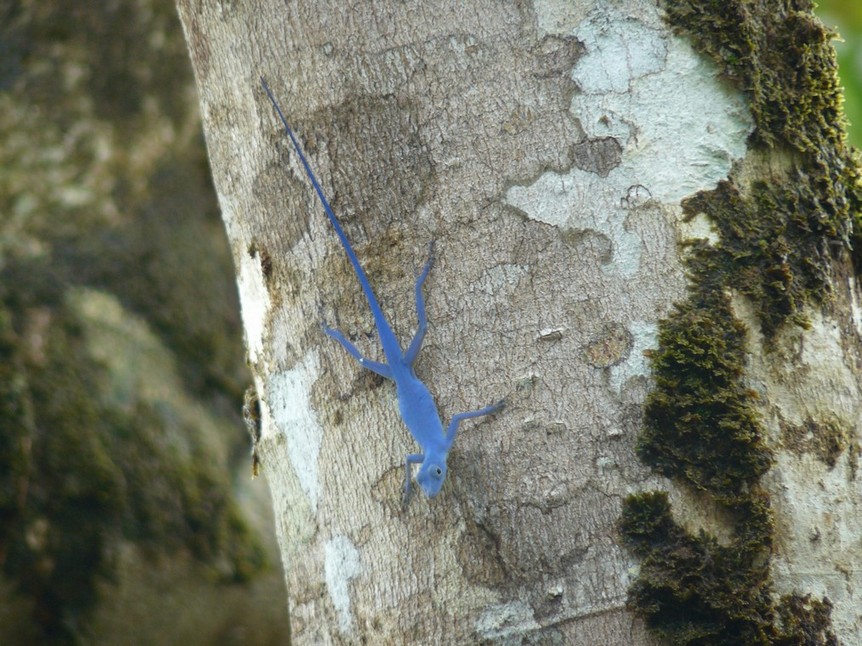 Blue AnoleAnolis gorgonae
-
 Allison's AnoleAnolis allisoni
Compare
Questions and answers
What is the scientific name of the La Nevera Thick Anole?
The scientific name of the La Nevera Thick Anole is Anolis pseudopachypus. Written with its author, the full name is Anolis pseudopachypus Köhler, Ponce, Sunyer & Batista, 2007.
Which family does the La Nevera Thick Anole belong to?
Anolis pseudopachypus belongs to the family Anolidae, in the order Squamata and the class Reptilia.
Where is the La Nevera Thick Anole found?
Checklists and occurrence records place Anolis pseudopachypus in 1 country: Panama.
What is the conservation status of the La Nevera Thick Anole?
The IUCN Red List category recorded for Anolis pseudopachypus is Least Concern (LC).
Sources
Passages the profile rests on
- The species has a brownish back and a dirty-white underside with a grayish hue. Source passage: “The back is brownish, while the underside of the body is dirty-white suffused with a grayish hue.” — English Wikipedia
- Its sides are golden-yellow with olive-green markings. Source passage: “The sides are golden-yellow with olive-green splotches.” — English Wikipedia
- Its limbs are green, with bunting-green coloration below and olive-green coloration above. Source passage: “The limbs are bunting-green below and olive-green above.” — English Wikipedia
- Its iris is brick-red. Source passage: “The iris is brick-red.” — English Wikipedia
- The species reaches a maximum snout–vent length of 48 mm. Source passage: “growing to a maximum snout–vent length of 48 mm (1.9 in).” — English Wikipedia
- Males have orange-yellow dewlaps with brownish gorgetal scales. Source passage: “Males have unicolor orange-yellow dewlaps with brownish gorgetal scales.” — English Wikipedia
- The species inhabits montane rainforests and woodland edges. Source passage: “It inhabits montane rainforests and woodland edges.” — English Wikipedia
- The species occurs at elevations between 1,560 and 2,033 meters. Source passage: “The species is found at elevations of 1,560–2,033 m (5,118–6,670 ft).” — English Wikipedia
- Its documented distribution includes the Serranía de Tabasará mountain range and Fortuna Forest Reserve. Source passage: “The anole is endemic to Panama, where it is found in two disjunct localities in the Serranía de Tabasará mountain range and Fortuna Forest Reserve.” — English Wikipedia
- The species may occur more widely within the Serranía de Tabasará and between its documented localities. Source passage: “it likely occurs more widely, both in the Serranía de Tabasará and between its known localities.” — English Wikipedia
- Individuals are frequently encountered sleeping on vegetation up to one meter above the ground. Source passage: “The species is frequently encountered sleeping on vegetation up to a meter high.” — English Wikipedia
- The species is classified as Least Concern by the IUCN. Source passage: “Anolis pseudopachypus is classified as being of least concern by the IUCN” — English Wikipedia
- Its Least Concern classification is based on its sufficiently large range and the absence of population declines. Source passage: “on the basis of its sufficiently large range and the absence of any declines in its population.” — English Wikipedia
- Although somewhat scarce, the species does not appear to be experiencing a population decline. Source passage: “Although it is a somewhat scarce anole, it does not seem to be falling in population” — English Wikipedia
- The species can adapt to disturbed habitats. Source passage: “is able to adapt to disturbed habitats.” — English Wikipedia
- Forest fires threaten the Serranía de Tabasará population by destroying its habitat. Source passage: “Its Serranía de Tabasará population is threatened by forest fires that destroy its habitat.” — English Wikipedia
- The population in Fortuna Forest Reserve occurs within a well-protected area that does not experience forest fires. Source passage: “It occurs in the Fortuna Forest Reserve, a well-protected area that does not suffer from forest fires.” — English Wikipedia
- The species name refers to its resemblance and presumed taxonomic closeness to Anolis pachypus. Source passage: “The species is named after its resemblance and presumed taxonomic closeness to Anolis pachypus.” — English Wikipedia
- The species belongs to the Anolis auratus species group. Source passage: “The anole is part of the A. auratus species group.” — English Wikipedia
- The species may be classified in the genus Norops when Anolis is divided into smaller genera. Source passage: “in which case A. pseudopachypus is placed in the genus Norops.” — English Wikipedia
Data
- Catalogue of Life, 2026-10-16 XR cc by
- Global Biodiversity Information Facility CC BY 4.0
- Wikidata CC0
- GeoNames CC BY 4.0
- Within the Catalogue of Life, this name comes from The Reptile Database cc by
References
- Four new species of anoles (genus Anolis) from the Serrania de Tabasara, west-central Panama (Squamata: Polychrotidae). (2007). Herpetologica, 63(3), 375–391. https://doi.org/10.1655/0018-0831(2007)63[375:fnsoag]2.0.co;2 Link where the name was published
- Köhler, Gunther; Marcos Ponce, Javier Sunyer, and Abel Batista. (2007). FOUR NEW SPECIES OF ANOLES (GENUS ANOLIS) FROM THE SERRANÍA DE TABASARÁ, WEST-CENTRAL PANAMA (SQUAMATA: POLYCHROTIDAE). Herpetologica 63 (3): 375-391.
- Lotzkat, S., J. Köhler, A. Hertz & G. Köhler. (2010). Morphology and colouration of male Anolis datzorum (Squamata: Polychrotidae). Salamandra 46 (1): 48-52.
- LOTZKAT, SEBASTIAN; JOE-FELIX BIENENTREU,, ANDREAS HERTZ, & GUNTHER KÖHLER. (2011). A new species of Anolis (Squamata: Iguania: Dactyloidae) formerly referred to as A. pachypus from the Cordillera de Talamanca of western Panama and adjacent Costa Rica. Zootaxa 3125: 1–21.
- NICHOLSON, KIRSTEN E.; BRIAN I. CROTHER, CRAIG GUYER & JAY M. SAVAGE. (2012). It is time for a new classification of anoles (Squamata: Dactyloidae). Zootaxa 3477: 1–108.
- Poe, S. (2013). 1986 Redux: New genera of anoles (Squamata: Dactyloidae) are unwarranted. Zootaxa 3626 (2): 295–299.
- NICHOLSON, KIRSTEN E.; BRIAN I. CROTHER, CRAIG GUYER & JAY M. SAVAGE. (2018). Translating a clade based classification into one that is valid under the international code of zoological nomenclature: the case of the lizards of the family Dactyloidae (Order Squamata). Zootaxa 4461 (4): 573–586.
- Batista, A., Hertz, A., Ponce, M. and Lotzkat, S. (2020). Notes on amphibians and reptiles from western Panama Notes on amphibians and reptiles from western Panama. Herpetology Notes 13: 219-229.
- Poe, & Steven. (2025). A Guide to the Anolis Lizards (Anoles) of Mainland Central and South America. Princeton University Press, 432 Pp.
This species in other databases
Page built on 27 November 2026. See how the catalog is made and all sources and licences.
Cite this page
ScientificNames.org. (2026). Anolis pseudopachypus (La Nevera Thick Anole). Retrieved November 27, 2026, from https://scientificnames.org/species/anolis-pseudopachypus
“Anolis pseudopachypus (La Nevera Thick Anole).” ScientificNames.org, 2026, scientificnames.org/species/anolis-pseudopachypus. Accessed 27 Nov. 2026.
ScientificNames.org. “Anolis pseudopachypus (La Nevera Thick Anole).” Accessed November 27, 2026. https://scientificnames.org/species/anolis-pseudopachypus.
@misc{scientificnames_anolis_pseudopachypus_la_nevera_thick_anole,
  author = {{ScientificNames.org}},
  title = {Anolis pseudopachypus (La Nevera Thick Anole)},
  year = {2026},
  url = {https://scientificnames.org/species/anolis-pseudopachypus},
  note = {Accessed 2026-11-27}
}