Species · Reptiles
Smallwood's Anole Anolis smallwoodi
The scientific name of the Smallwood's Anole is Anolis smallwoodi. It is a species of reptile in the family Anolidae (anoles), order Squamata. The name dates from 1964.

Overview
Anolis smallwoodi inhabits dry forests and coastal scrub in Cuba. It is a green lizard with blue spots and belongs to the trunk-crown ecomorph group of Cuban anoles.
Written 26 November 2026 from the sources listed below. Each statement was checked against the passage it cites; statements that could not be supported were removed.
Appearance
Smallwood's Anole is green with blue spots. Its typical snout-to-vent length is 3–4 inches.[1][2]
Habitat
Smallwood's Anole inhabits dry forests and coastal scrub in Cuba. It perches on tree trunks and branches.[3][4]
Diet
Smallwood's Anole hunts insects and grubs in trees. It has been reported to eat grapes in captivity.[5][6]
Behaviour
Smallwood's Anole belongs to the trunk-crown ecomorph group of Cuban anoles.[7]
Conservation
Smallwood's Anole was assessed for the IUCN Red List in 2016 and is listed as Near Threatened.[8][9]
Climate change may alter the species' range and thermal niche across Cuba.[10]
Classification of the Smallwood's Anole
| Kingdom | Animalia |
|---|---|
| Phylum | Chordata |
| Subphylum | Vertebrata |
| Infraphylum | Gnathostomata |
| Parvphylum | Osteichthyes |
| Megaclass | Tetrapoda |
| Class | Reptilia (Reptile) |
| Order | Squamata (Snakes) |
| Suborder | Iguania (Iguanas) |
| Family | Anolidae (Anoles) |
| Genus | Anolis (Anoles) |
| Species | Anolis smallwoodi Schwartz, 1964 |
Where the Smallwood's Anole is found
Checklists and occurrence records place Anolis smallwoodi in 1 country. GBIF holds 131 georeferenced records of it.
Countries
Regions and cities with the most records
- Guantánamo Province, Cuba 35
- Santiago de Cuba, Cuba 22
- Santiago de Cuba Province, Cuba 21
- Guantánamo, Cuba 8
- San Luis, Cuba 6
- Palma Soriano, Cuba 4
Range as the checklists state it
SE Cuba
A number beside a place is its count of GBIF occurrence records. A place without a number comes from a checklist alone. Records show where a species has been observed or collected, which can include escapes and vagrants.
Common names
English
- Smallwood's Anole
- Green-blotched Giant Anole
Names in 3 other languages
- Danish
- Grønplettet Kæmpeanole
- German
- Smallwoods Anolis
- Russian
- Гигантский пятнистый анолис
Synonyms
2 other scientific names have been used for this species and are now treated as synonyms of Anolis smallwoodi.
- Anolis equestris smallwoodi Schwartz, 1964
- Deiroptyx smallwoodi (Schwartz, 1964)
Subspecies and varieties
- Anolis smallwoodi palardis subspecies
- Anolis smallwoodi saxuliceps subspecies
- Anolis smallwoodi smallwoodi subspecies
Related species
-
 Green AnoleAnolis carolinensis
-
 Brown AnoleAnolis sagrei
-
 Knight AnoleAnolis equestris
-
 Common Puerto Rican AnoleAnolis cristatellus
-
 Western Bearded AnoleAnolis barbatus
-
 Water AnoleAnolis aquaticus
-
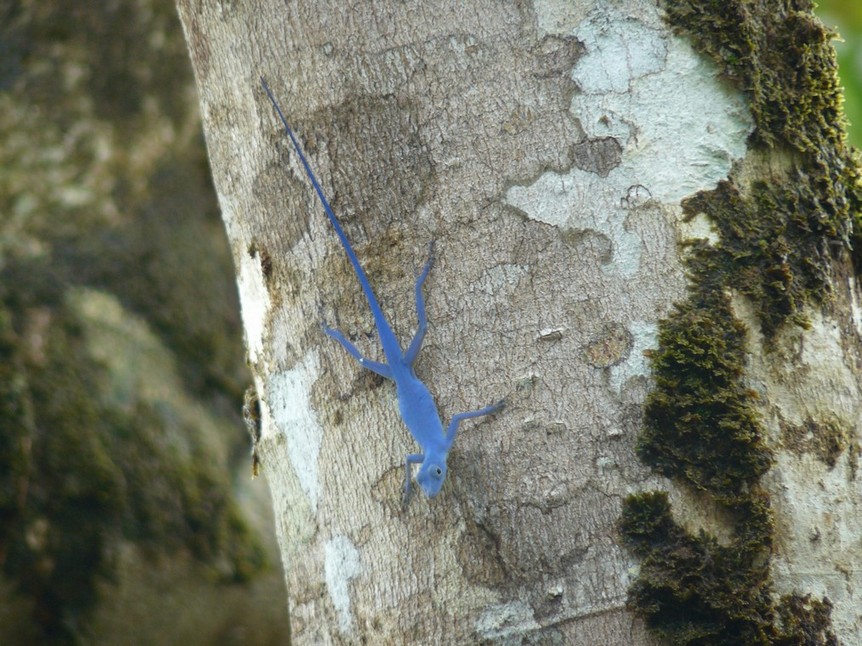 Blue AnoleAnolis gorgonae
-
 Allison's AnoleAnolis allisoni
Compare
Questions and answers
What is the scientific name of the Smallwood's Anole?
The scientific name of the Smallwood's Anole is Anolis smallwoodi. Written with its author, the full name is Anolis smallwoodi Schwartz, 1964.
Which family does the Smallwood's Anole belong to?
Anolis smallwoodi belongs to the family Anolidae, in the order Squamata and the class Reptilia.
Where is the Smallwood's Anole found?
Checklists and occurrence records place Anolis smallwoodi in 1 country: Cuba.
What is the conservation status of the Smallwood's Anole?
The IUCN Red List category recorded for Anolis smallwoodi is Near Threatened (NT).
What other names does the Smallwood's Anole have?
Anolis smallwoodi is also known in English as Green-blotched Giant Anole.
What kind of food do anoles eat?
Smallwood's Anole hunts insects and grubs in trees. It has also been reported to eat grapes in captivity.[5][6]
What habitat do anoles live in?
Smallwood's Anole inhabits dry forests and coastal scrub in Cuba. It perches on tree trunks and branches.[3][4]
Do anoles eat plants?
Smallwood's Anole has been reported to eat grapes in captivity.[5]
Sources
Passages the profile rests on
- The Smallwood's Anole is a green lizard with blue spots. Source passage: “The Smallwood's anole is a green lizard with blue spots.” — nationalzoo.si.edu
- Its typical snout-to-vent length is 3–4 inches. Source passage: “Their size snout to vent is typically 3-4 inches.” — English Wikipedia
- It inhabits dry forests and coastal scrub in Cuba. Source passage: “Anolis smallwoodi lives in dry forest and coastal scrub habitats in Cuba” — English Wikipedia
- It perches on tree trunks and branches. Source passage: “where it perches on tree trunks and branches.” — English Wikipedia
- It has been reported to eat grapes in captivity. Source passage: “has been reported to take grapes in captivity.” — English Wikipedia
- It hunts insects and grubs in trees. Source passage: “where it spends time hunting the trees for insects, grubs and” — nationalzoo.si.edu
- It belongs to the trunk-crown ecomorph group of Cuban anoles. Source passage: “It belongs to the trunk-crown ecomorph group of Cuban anoles” — English Wikipedia
- The species was assessed for the IUCN Red List in 2016. Source passage: “Smallwood's Anole Anolis smallwoodi has most recently been assessed for The IUCN Red List of Threatened Species in 2016.” — iucnredlist.org
- The species is listed as Near Threatened. Source passage: “Anolis smallwoodi is listed as Near ...” — iucnredlist.org
- Climate change may alter the species' range and thermal niche across Cuba. Source passage: “recent studies suggest that climate change may alter its range and thermal niche across the island.” — English Wikipedia
Data
- Catalogue of Life, 2026-10-16 XR cc by
- Global Biodiversity Information Facility CC BY 4.0
- Wikidata CC0
- GeoNames CC BY 4.0
- Wikimedia Commons per image; credit shown with each image
- Within the Catalogue of Life, this name comes from The Reptile Database cc by
References
- Schwartz, A. (1964). Anolis equestris in Oriente Province, Cuba. Bull. Mus. Comp. Zool. Harvard 131: 405-428.
- McCoy, Clarence J.;Richmond, Neil D. (1965). Herpetological Type-specimens in Carnegie Museum. [type catalogue]. Annals of the Carnegie Museum 38: 233-264 [1966].
- Schwartz, A. and Garrido, O.H. (1972). The lizards of the Anolis equestris complex in Cuba. Stud. Fauna Curaçao and Carib. Is. 39 (134):1-86.
- Schwartz, A., & Henderson, R. W. (1991). Amphibians and Reptiles of the West Indies. University of Florida Press, Gainesville, 720 Pp.
- Rodríguez Schettino, Lourdes (ed.). (1999). The iguanid lizards of Cuba. University Press of Florida, 428 Pp.
- Poe, S. (2004). Phylogeny of anoles. Herpetological Monographs 18: 37-89.
- Nicholson, K. E., R. E. Glor, J. J. Kolbe, A. Larson, S. B. Hedges, and J. B. Losos. (2005). Mainland colonization by island lizards. Journal of Biogeography 32: 929–938.
- Beolens, B., & Michael Watkins, a. M. G. (2011). The Eponym Dictionary of Reptiles. Johns Hopkins University Press, Baltimore, USA.
- Bona, Martin; Milan Novotný, Stanislav Danko and Adriana Burešová. (2012). Headstarting in a small population of European pond turtles (Emys orbicularis) in Central European conditions: first results. Herpetology Notes 6: 547-550.
- NICHOLSON, KIRSTEN E.; BRIAN I. CROTHER, CRAIG GUYER & JAY M. SAVAGE. (2012). It is time for a new classification of anoles (Squamata: Dactyloidae). Zootaxa 3477: 1–108.
- Poe, S. (2013). 1986 Redux: New genera of anoles (Squamata: Dactyloidae) are unwarranted. Zootaxa 3626 (2): 295–299.
- Rodríguez Schettino, Lourdes, Carlos A. Mancina & Vilma Rivalta González. (2013). REPTILES OF CUBA: CHECKLIST AND GEOGRAPHIC DISTRIBUTIONS. Smithsonian Herp. Inf. Serv. (144): 1-96.
- NICHOLSON, KIRSTEN E.; BRIAN I. CROTHER, CRAIG GUYER & JAY M. SAVAGE. (2018). Translating a clade based classification into one that is valid under the international code of zoological nomenclature: the case of the lizards of the family Dactyloidae (Order Squamata). Zootaxa 4461 (4): 573–586.
- Yuan, M. L., M. H. Wake, and I. J. Wang. (2019). Phenotypic integration between claw and toepad traits promotes microhabitat specialization in the Anolis adaptive radiation. Evolution 73: 231–244.
This species in other databases
Page built on 27 November 2026. See how the catalog is made and all sources and licences.
Cite this page
ScientificNames.org. (2026). Anolis smallwoodi (Smallwood's Anole). Retrieved November 27, 2026, from https://scientificnames.org/species/anolis-smallwoodi
“Anolis smallwoodi (Smallwood's Anole).” ScientificNames.org, 2026, scientificnames.org/species/anolis-smallwoodi. Accessed 27 Nov. 2026.
ScientificNames.org. “Anolis smallwoodi (Smallwood's Anole).” Accessed November 27, 2026. https://scientificnames.org/species/anolis-smallwoodi.
@misc{scientificnames_anolis_smallwoodi_smallwoods_anole,
  author = {{ScientificNames.org}},
  title = {Anolis smallwoodi (Smallwood's Anole)},
  year = {2026},
  url = {https://scientificnames.org/species/anolis-smallwoodi},
  note = {Accessed 2026-11-27}
}