Species · Reptiles
Moist Forest Anole Anolis unilobatus
The scientific name of the Moist Forest Anole is Anolis unilobatus. It is a species of reptile in the family Anolidae (anoles), order Squamata. The name dates from 2010.
- Scientific name
- Anolis unilobatus Köhler & Vesely, 2010
- Common name
- Moist Forest Anole
- Genus
- Anolis
- Family
- Anolidae (Anoles)
- Order
- Squamata
- Class
- Reptilia
- Red List category
- LC Least Concern
- Recorded in
- 6 countries
- Name status
- accepted in the Catalogue of Life

Overview
The Moist Forest Anole is a lizard. The Moist Forest Anole is found in Costa Rica, Nicaragua, and Honduras. The species is commonly known as the blue-spotted fan anole.
Written 27 November 2026 from the sources listed below. Each statement was checked against the passage it cites; statements that could not be supported were removed.
Appearance
The species is commonly known as the blue-spotted fan anole.[1]
Classification of the Moist Forest Anole
| Kingdom | Animalia |
|---|---|
| Phylum | Chordata |
| Subphylum | Vertebrata |
| Infraphylum | Gnathostomata |
| Parvphylum | Osteichthyes |
| Megaclass | Tetrapoda |
| Class | Reptilia (Reptile) |
| Order | Squamata (Snakes) |
| Suborder | Iguania (Iguanas) |
| Family | Anolidae (Anoles) |
| Genus | Anolis (Anoles) |
| Species | Anolis unilobatus Köhler & Vesely, 2010 |
Where the Moist Forest Anole is found
Checklists and occurrence records place Anolis unilobatus in 6 countries across North America. GBIF holds 502 georeferenced records of it.
Countries
Regions and cities with the most records
- Chiapas, Mexico 137
- Oaxaca, Mexico 55
- Cortés Department, Honduras 53
- Atlántida Department, Honduras 39
- Tela, Honduras 33
- Tuxtla, Mexico 28
- Chiapa de Corzo, Mexico 27
- Suchiapa, Mexico 27
- San Pedro Sula, Honduras 24
- Yoro Department, Honduras 24
- Olancho Department, Honduras 22
- Santa Rita, Honduras 20
- Tapachula de Córdova y Ordóñez, Mexico 20
- Arriaga, Mexico 18
- Berriozábal, Mexico 17
- Huixtla, Mexico 17
- Potrerillos, Honduras 17
- San Antonio de Cortés, Honduras 17
- Arizona, Honduras 16
- Choloma, Honduras 16
- Dulce Nombre de Culmí, Honduras 16
- Villanueva, Honduras 16
- San Francisco de Yojoa, Honduras 15
- Santa Cruz de Yojoa, Honduras 14
- La Lima, Honduras 12
- Cofradía, Honduras 11
- Choluteca Department, Honduras 10
- Santa Bárbara Department, Honduras 10
- Azacualpa, Honduras 9
- Colón Department, Honduras 9
- Guanacaste Province, Costa Rica 9
- El Crucero, Nicaragua 8
- Managua, Nicaragua 8
- Ocozocoautla de Espinosa, Mexico 8
- Omoa, Honduras 8
- Tonalá, Mexico 8
Range as the checklists state it
Costa Rica, Nicaragua, Honduras, Guatemala, Mexico (Oaxaca, Chiapas); elevation 0-1200 m
A number beside a place is its count of GBIF occurrence records. A place without a number comes from a checklist alone. Records show where a species has been observed or collected, which can include escapes and vagrants.
Common names
English
- Moist Forest Anole
- Blue-spotted Fan Anole
Names in 3 other languages
- Danish
- Awasbila-anole
- Italian
- Anolide macchia blu
- Spanish
- anole bosque húmedo
Synonyms
4 other scientific names have been used for this species and are now treated as synonyms of Anolis unilobatus.
- Anolis kidderi : Werler & Smith, 1952
- Anolis sallaei : Boulenger, 1885
- Anolis sallaei wellbornae Smith & Kerster, 1955
- Anolis sericeus Hartweg & Oliver, 1940
Related species
-
 Green AnoleAnolis carolinensis
-
 Brown AnoleAnolis sagrei
-
 Knight AnoleAnolis equestris
-
 Common Puerto Rican AnoleAnolis cristatellus
-
 Western Bearded AnoleAnolis barbatus
-
 Water AnoleAnolis aquaticus
-
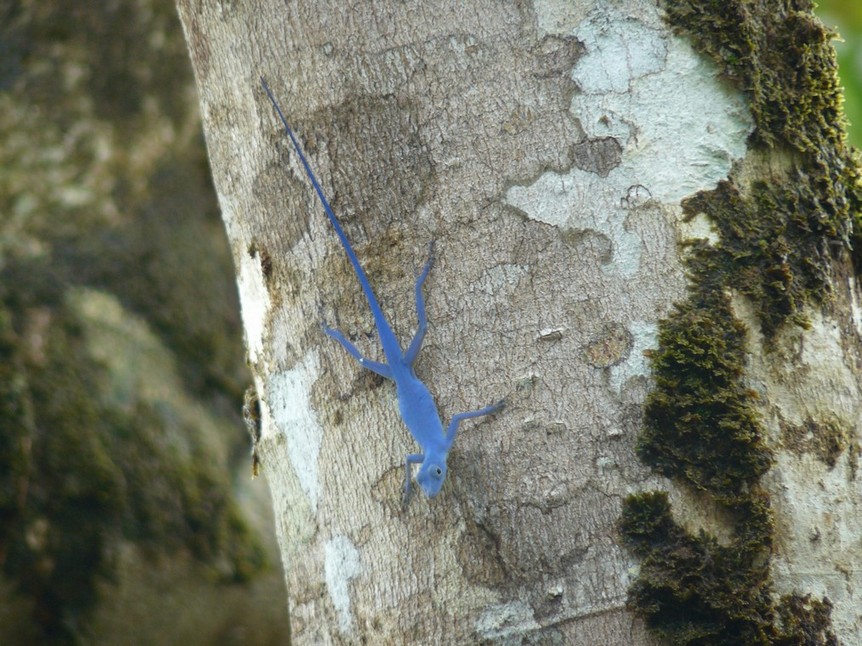 Blue AnoleAnolis gorgonae
-
 Allison's AnoleAnolis allisoni
Compare
Questions and answers
What is the scientific name of the Moist Forest Anole?
The scientific name of the Moist Forest Anole is Anolis unilobatus. Written with its author, the full name is Anolis unilobatus Köhler & Vesely, 2010.
Which family does the Moist Forest Anole belong to?
Anolis unilobatus belongs to the family Anolidae, in the order Squamata and the class Reptilia.
Where is the Moist Forest Anole found?
Checklists and occurrence records place Anolis unilobatus in 6 countries: Mexico, Honduras, Nicaragua, Costa Rica, Guatemala and El Salvador.
What is the conservation status of the Moist Forest Anole?
The IUCN Red List category recorded for Anolis unilobatus is Least Concern (LC).
What other names does the Moist Forest Anole have?
Anolis unilobatus is also known in English as Blue-spotted Fan Anole.
Sources
Passages the profile rests on
- The species is commonly known as the blue-spotted fan anole. Source passage: “Anolis unilobatus, the blue-spotted fan anole,” — inaturalist.org
Data
- Catalogue of Life, 2026-10-16 XR cc by
- Global Biodiversity Information Facility CC BY 4.0
- Wikidata CC0
- GeoNames CC BY 4.0
- Wikimedia Commons per image; credit shown with each image
- Within the Catalogue of Life, this name comes from The Reptile Database cc by
References
- A REVISION OF THE ANOLIS SERICEUS COMPLEX WITH THE RESURRECTION OF A. WELLBORNAE AND THE DESCRIPTION OF A NEW SPECIES (SQUAMATA: POLYCHROTIDAE). (2010). Herpetologica, 66(2), 207–228. https://doi.org/10.1655/07-074r1.1 Link where the name was published
- Dunn, Emmett Reid & Emlen, John T. (1932). Reptiles and amphibians from Honduras. Proceedings of the Academy of Natural Sciences of Philadelphia 84 : 21-32.
- Köhler, & Gunther and Milan Vesely. (2010). A REVISION OF THE ANOLIS SERICEUS COMPLEX WITH THE RESURRECTION OF A. WELLBORNAE AND THE DESCRIPTION OF A NEW SPECIES (SQUAMATA: POLYCHROTIDAE). Herpetologica 66 (2): 207-228.
- NICHOLSON, KIRSTEN E.; BRIAN I. CROTHER, CRAIG GUYER & JAY M. SAVAGE. (2012). It is time for a new classification of anoles (Squamata: Dactyloidae). Zootaxa 3477: 1–108.
- Sunyer, J., K.E. Nicholson, J.G. Phillips, J.A.Gubler, and L.A. Obando. (2013). Lizards (Reptilia: Squamata) of the Corn Islands, Caribbean Nicaragua. Check List 9: 1383–1390.
- Poe, S. (2013). 1986 Redux: New genera of anoles (Squamata: Dactyloidae) are unwarranted. Zootaxa 3626 (2): 295–299.
- Percino-Daniel, R., & Erika Cruz-Ocaña, W. P.-V. y. E. V.-V. (2013). Diversidad de reptiles en dos microcuencas del río Grijalva, Chiapas, México. Revista Mexicana de Biodiversidad 84: 938-948.
- KÖHLER, GUNTHER; RAÚL GÓMEZ TREJO PÉREZ, CLAUS BO P. PETERSEN & FAUSTO R. MÉNDEZ DE LA CRUZ. (2014). A revision of the Mexican Anolis (Reptilia, Squamata, Dactyloidae) from the Pacific versant west of the Isthmus de Tehuantepec in the states of Oaxaca, Guerrero, and Puebla, with the description of six new species. Zootaxa 3862 (1): 001–210.
- KÖHLER, & GUNTHER. (2014). Characters of external morphology used in Anolis taxonomy—Definition of terms, advice on usage, and illustrated examples. Zootaxa 3774 (2): 201–257.
- Sunyer, & Javier. (2014). An updated checklist of the amphibians and reptiles of Nicaragua. Mesoamerican Herpetology 1 (2): 186–202.
- Solís, J. M., L. D. Wilson, and J. H. Townsend. (2014). An updated list of the amphibians and reptiles of Honduras, with comments on their nomenclature. Mesoamerican Herpetology 1: 123–144.
- Johnson, Jerry D.; Vicente Mata-Silva, Elí García Padilla, and Larry David Wilson. (2015). The Herpetofauna of Chiapas, Mexico: composition, distribution, and conservation. Mesoamerican Herpetology 2 (3): 272–329.
- McCranie, James R. (2015). A checklist of the amphibians and reptiles of Honduras, with additions, comments on taxonomy, some recent taxonomic decisions, and areas of further studies needed. Zootaxa 3931 (3): 352–386.
- Mata-Silva, Vicente, Jerry D. Johnson, Larry David Wilson and Elí García-Padilla. (2015). The herpetofauna of Oaxaca, Mexico: composition, physiographic distribution, and conservation status. Mesoamerican Herpetology 2 (1): 6–62.
- McCranie, James R. and Gunther Köhler. (2015). The Anoles (Reptilia: Squamata: Dactyloidae: Anolis: Norops) of Honduras. Systematics, Distribution, and Conservation. Bull. Mus. Comp. Zool. Harvard (Special Publication Series, No. 1): 1-280 [Review in Q. J. Biol. 91: 227].
- Muñoz-Alonso, Luis Antonio; Jorge Nieblas-Camacho,Marina Alba Chau-Cortez, Alondra Berenice González-Navarro, Jaime López-Pérez & Juan Pérez-López. (2017). Diversidad de anfibios y reptiles en la Reservade la Biosfera Selva El Ocote: su vulnerabilidad ante la fragmentación y el cambio climático. In: Lorena Ruiz-Montoya et al. (eds), Vulnerabilidad social y biológica ante el cambio climático en la Reserva de la Biosfera Selva El Ocote. El Colegio de La Frontera Sur, Pp.395-448.
- NICHOLSON, KIRSTEN E.; BRIAN I. CROTHER, CRAIG GUYER & JAY M. SAVAGE. (2018). Translating a clade based classification into one that is valid under the international code of zoological nomenclature: the case of the lizards of the family Dactyloidae (Order Squamata). Zootaxa 4461 (4): 573–586.
- McCranie, James R. (2018). The Lizards, Crocodiles, and Turtles of Honduras. Systematics, Distribution, and Conservation. Bulletin of the Museum of Comparative Zoology, Special Publication Series (2): 1- 666.
- Hernández-Vázquez, & E, M. (2018). Anolis unilobatus Surface tension. Herpetological Review 49 (3): 535.
- Hedges SB, Powell R, Henderson RW, Hanson S, & and Murphy JC. (2019). Definition of the Caribbean Islands biogeographic region, with checklist and recommendations for standardized common names of amphibians and reptiles. Caribbean Herpetology 67: 1–53.
- Aguilar-López JL, Luría-Manzano R, Pineda E, & Canseco-Márquez L. (2021). Selva Zoque, Mexico: an important Mesoamerican tropical region for reptile species diversity and conservation. ZooKeys 1054: 127-153.
- Heimes, P. (2022). LIZARDS OF MEXICO - Part 1 Iguanian lizards. Edition Chimaira, Frankfurt Am Main, 448 Pp.
- Badillo-Saldaña, Luis M, Aaron García-Rosales, and Aurelio Ramírez-Bautista. (2022). Influence of Microhabitat Use on Morphology Traits of Three Species of the Anolis Sericeus Complex (Squamata: Dactyloidae) in Mexico. Zoology 152: 126003.
- Sunyer, Javier & José́ Gabriel Martínez-Fonseca. (2023). An updated country checklist to the amphibians and reptiles of Nicaragua. Revista Nicaragüense de Biodiversidad (100): 1-25.
- Martínez-Fonseca JG, Holmes IA, Sunyer J, Westeen EP, Grundler MR, Cerda PA, Fernández-Mena MA, Loza-Molina JC, Monagan IV Jr., Nondorf D, Pandelis GG, Rabosky ARD. (2023). A collection and analysis of amphibians and reptiles from Nicaragua with new country and departmental records. Check List 20(1): 58-125.
This species in other databases
Page built on 29 November 2026. See how the catalog is made and all sources and licences.
Cite this page
ScientificNames.org. (2026). Anolis unilobatus (Moist Forest Anole). Retrieved November 29, 2026, from https://scientificnames.org/species/anolis-unilobatus
“Anolis unilobatus (Moist Forest Anole).” ScientificNames.org, 2026, scientificnames.org/species/anolis-unilobatus. Accessed 29 Nov. 2026.
ScientificNames.org. “Anolis unilobatus (Moist Forest Anole).” Accessed November 29, 2026. https://scientificnames.org/species/anolis-unilobatus.
@misc{scientificnames_anolis_unilobatus_moist_forest_anole,
  author = {{ScientificNames.org}},
  title = {Anolis unilobatus (Moist Forest Anole)},
  year = {2026},
  url = {https://scientificnames.org/species/anolis-unilobatus},
  note = {Accessed 2026-11-29}
}