Species · Birds
Red Wattlebird Anthochaera carunculata
The scientific name of the Red Wattlebird is Anthochaera carunculata. It is a species of bird in the family Meliphagidae (honeyeater), order Passeriformes. The name dates from 1790.
- Scientific name
- Anthochaera carunculata (Shaw, 1790)
- Common name
- Red Wattlebird
- Genus
- Anthochaera
- Family
- Meliphagidae (Honeyeater)
- Order
- Passeriformes
- Class
- Aves
- Red List category
- LC Least Concern
- Recorded in
- 2 countries
- Name status
- accepted in the Catalogue of Life

Overview
The Red Wattlebird is the second-largest honeyeater native to Australia. It occurs in southeast Queensland, New South Wales, Victoria, South Australia and southwestern Western Australia.
Written 26 November 2026 from the sources listed below. Each statement was checked against the passage it cites; statements that could not be supported were removed.
Appearance
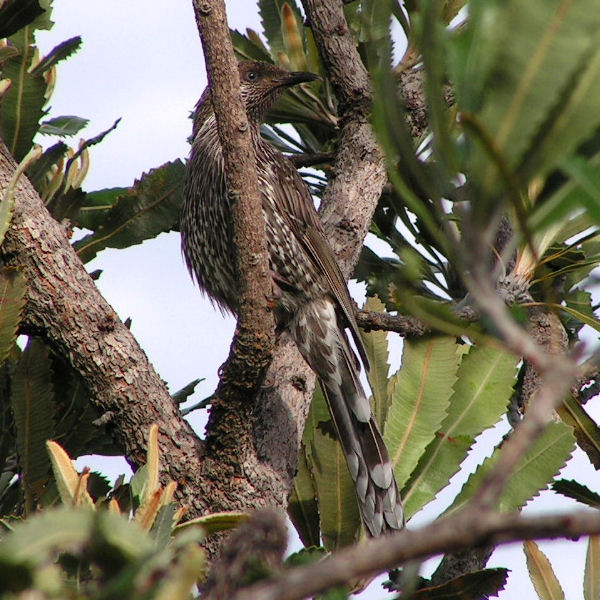
Juveniles have less prominent wattles, brown irises, a paler crown and less yellow colouring on the belly than adults. The species has a black downward-curving bill and pink or pinkish-brown legs and feet.[1][2]
Its specialized tongue has more than 100 bristles arranged in a brush-like structure for collecting nectar. Its brown streaked feathers provide camouflage among bark and branches.[3][4]
Habitat
The Red Wattlebird commonly inhabits open sclerophyll forests and woodlands dominated by eucalypts. It is more frequently found in forests with abundant shrubby or grassy understory.[5][6]
Other habitats include shrubland, heath, the margins of wet sclerophyll forests and wetlands. The species also occurs in coastal heath, suburban gardens and urban parks.[7][8]
Urban habitats include parks, reserves, gardens, golf courses, orchards and vineyards. The species has been recorded at elevations reaching 1,900 m above sea level.[9][10]
Diet
The Red Wattlebird feeds predominantly on nectar from flowering plants. Important nectar sources include eucalypts, banksias, grasstrees and emu bushes.[11][12]
It also feeds on nectar from grevilleas and bottlebrush flowers, with introduced coral trees being popular feeding plants. Its diet additionally includes insects, spiders, other small creatures and soft fruit.[13][14][15][16]
Behaviour
Red Wattlebirds are loud and conspicuous birds that generally forage in trees. They are territorial and aggressively defend food sources and nesting sites against other birds.[17][18]
During winter, Red Wattlebirds may gather in groups numbering several hundred individuals. The species commonly produces harsh coughing, squawking, rattling and chattering calls.[19][20]
Red Wattlebirds move between flowering plants while transferring pollen between them. The species is generally resident throughout much of its geographical range.[21][22]
Reproduction and life cycle
Breeding generally occurs between July and December, although nesting can occur outside these months under favourable conditions. Red Wattlebirds usually produce one or two broods annually and generally nest as solitary pairs.[23][24][25]
The nest is a cup-shaped structure made from sticks and leaves and lined with bark, grass and hair. Nests are usually positioned in forked tree branches, commonly in eucalypts, at heights of 2–16 m above the ground.[26][27]
A typical clutch contains two or three pinkish eggs marked with pale brown and lavender spots. The eggs usually hatch after an incubation period of 16–21 days.[28][29]
Nestlings generally fledge 15–20 days after hatching. Both parents generally participate in incubating eggs and feeding nestlings, and continue feeding fledglings for another two to three weeks.[30][31][32]
Young birds are fed manna and insects including beetles, bugs and flies.[33]
Conservation
The Red Wattlebird is classified as Least Concern on the IUCN Red List. Its populations have declined in some locations because of land clearing.[34][35]
The species is less common in forests affected by Phytophthora cinnamomi dieback.[36]
Uses
Red Wattlebirds contribute to pollination by transferring pollen between flowering plants. They also help control insect populations by consuming insects and spiders.[37][38]
Similar species
The Red Wattlebird may be mistaken for the spiny-cheeked honeyeater or little wattlebird in poor visibility. The yellow wattlebird is its closest relative.[39][40]
Classification of the Red Wattlebird
| Kingdom | Animalia |
|---|---|
| Phylum | Chordata |
| Subphylum | Vertebrata |
| Infraphylum | Gnathostomata |
| Parvphylum | Osteichthyes |
| Megaclass | Tetrapoda |
| Class | Aves (Bird) |
| Order | Passeriformes (Passerine) |
| Family | Meliphagidae (Honeyeater) |
| Genus | Anthochaera (Wattlebirds) |
| Species | Anthochaera carunculata (Shaw, 1790) |
Where the Red Wattlebird is found
Checklists and occurrence records place Anthochaera carunculata in 2 countries across Oceania. GBIF holds 1,452,780 georeferenced records of it.
Countries
Regions and cities with the most records
- Victoria, Australia 661,280
- New South Wales, Australia 287,916
- Australian Capital Territory, Australia 179,046
- Canberra, Australia 177,373
- Balwyn North, Australia 166,239
- Burwood, Australia 164,898
- Western Australia, Australia 164,595
- Melbourne, Australia 144,829
- Tuggeranong, Australia 137,432
- South Australia, Australia 129,809
- St Albans, Australia 80,650
- Perth, Australia 66,106
- Geelong, Australia 56,093
- Torquay, Australia 45,423
- Sydney, Australia 42,204
- Frankston East, Australia 40,900
- Parramatta, Australia 33,233
- Adelaide, Australia 28,541
- Adelaide Hills, Australia 26,546
- Hornsby, Australia 26,228
- Liverpool, Australia 24,820
- Kwinana, Australia 15,735
- Ballarat, Australia 15,550
- Mount Barker, Australia 14,601
- Bendigo, Australia 11,063
- Wollongong, Australia 9,304
- Shepparton, Australia 7,819
- Central Coast, Australia 7,425
- Bacchus Marsh, Australia 7,377
- Queensland, Australia 7,294
- Albany, Australia 6,093
- Wodonga, Australia 6,031
- Bairnsdale, Australia 5,842
- Wangaratta, Australia 5,537
- Rockingham, Australia 5,519
- Maitland, Australia 5,265
Range as the checklists state it
Australia
A number beside a place is its count of GBIF occurrence records. A place without a number comes from a checklist alone. Records show where a species has been observed or collected, which can include escapes and vagrants.
Common names
English
- Red Wattlebird
Names in 27 other languages
- Catalan
- menjamel d'arracades
- Chinese
- 紅垂蜜鳥, 红垂蜜鸟
- Croatian
- bradušasti medojed
- Czech
- laločnatka jihoaustralská
- Danish
- Rødlappet Honningæder
- Dutch
- Roodlelhoningeter
- Esperanto
- ruĝkarunkla mielmanĝulo
- Finnish
- punahelttamesikko
- French
- Méliphage barbe-rouge
- German
- Rotlappen-Honigfresser, Rotlappenhonigfresser
- Hungarian
- piroscsüngős lebenyesmadár
- Italian
- Bargigliuto rosso
- Japanese
- アカミミダレミツスイ
- Lithuanian
- raudonasis žvynuotasis medsiurbys
- Norwegian
- rødflikhonningeter
- Persian
- مرغ پوپی سرخ
- Polish
- koralicowiec czerwony
- Portuguese
- Carunculado-vermelho, papa-mel de-barbela-vermelha, papa-mel-carunculado, papa-mel-de-barbela-vermelha
- Russian
- Краснолопастный серёжкоух, Краснолопастный серёжчатый медосос
- Serbian
- Resasti medojed sa crvenim resama
- Slovak
- medárik bradavičnatý
- Spanish
- Mielero alirrufo, Mielero carunculado
- Swedish
- Röd kråsfågel, rödflikig honungsfågel
- Turkish
- Al Küpeli Balkuşu
- Ukrainian
- медолюб-сережник середній
- Welsh
- melysor tagellog coch
- kgs
- dungaarrgan
Subspecies and varieties
- Anthochaera carunculata carunculata (Eastern Red Wattlebird) subspecies
- Anthochaera carunculata clelandi (Kangaroo Island Red Wattlebird) subspecies
- Anthochaera carunculata woodwardi (Western Red Wattlebird) subspecies
Related species
-
 Regent HoneyeaterAnthochaera phrygia
-
 Yellow WattlebirdAnthochaera paradoxa
-
 Little WattlebirdAnthochaera chrysoptera
-
 Western WattlebirdAnthochaera lunulata
-
 Noisy MinerManorina melanocephala
-
 TūīProsthemadera novaeseelandiae
-
 Blue-faced HoneyeaterEntomyzon cyanotis
-
 New Holland HoneyeaterPhylidonyris novaehollandiae
Compare
Questions and answers
What is the scientific name of the Red Wattlebird?
The scientific name of the Red Wattlebird is Anthochaera carunculata. Written with its author, the full name is Anthochaera carunculata (Shaw, 1790).
Which family does the Red Wattlebird belong to?
Anthochaera carunculata belongs to the family Meliphagidae, in the order Passeriformes and the class Aves.
Where is the Red Wattlebird found?
Checklists and occurrence records place Anthochaera carunculata in 2 countries: Australia and New Zealand.
What is the conservation status of the Red Wattlebird?
The IUCN Red List category recorded for Anthochaera carunculata is Least Concern (LC).
What noise does a red wattlebird make?
The Red Wattlebird commonly produces harsh coughing, squawking, rattling and chattering calls.[20]
What do red wattlebirds eat?
Red Wattlebirds feed predominantly on nectar from flowering plants, including eucalypts, banksias, grasstrees, emu bushes, grevilleas and bottlebrush flowers. They also consume insects, spiders, other small creatures and soft fruit.[11][12][13][14][15]
Are wattle birds honey eaters?
Yes. The Red Wattlebird is a honeyeater that feeds predominantly on nectar from flowering plants.[41][11]
Where do wattle birds live?
Red Wattlebirds occur in southeast Queensland, New South Wales, Victoria, South Australia and southwestern Western Australia. They inhabit open sclerophyll forests, eucalypt woodlands, shrubland, heath, wetlands and urban gardens.[5][7][9][8][42]
What are some interesting facts about the Red Wattlebird?
The Red Wattlebird is the second-largest honeyeater native to Australia, and its specialized tongue has more than 100 bristles for collecting nectar. It contributes to pollination, helps control insect populations and can live for more than 10 years in the wild.[3][41][43][37][38]
Sources
Passages the profile rests on
- Juveniles have less prominent wattles, brown irises, a paler crown and less yellow colouring on the belly than adults. Source passage: “Juveniles have much less prominent wattles, brown irises, a pale crown, and much less yellow on the belly.” — English Wikipedia
- The species has a black downward-curving bill and pink or pinkish-brown legs and feet. Source passage: “The strong legs and feet are pink or pinkish-brown, and the downward-curving bill is black.” — English Wikipedia
- Its specialized tongue has more than 100 bristles arranged in a brush-like structure for collecting nectar. Source passage: “the end to form a brush-like structure with over a hundred bristles that soak up nectar by capillary action.” — English Wikipedia
- Its brown streaked feathers provide camouflage among bark and branches. Source passage: “Their streaky brown feathers help camouflage them among bark and branches.” — fieldofmar-e.schools.nsw.gov.au
- The species commonly inhabits open sclerophyll forests and woodlands dominated by eucalypts. Source passage: “Open sclerophyll forest and woodland, generally dominated by eucalypts, is the most common habitat of the species.” — English Wikipedia
- It is more frequently found in forests with abundant shrubby or grassy understory. Source passage: “It is more common in forests with ample shrubby or grassy understory.” — English Wikipedia
- The species also inhabits shrubland, heath and the margins of wet sclerophyll forests. Source passage: “It is less commonly encountered in shrubland, heath, or margins of wet sclerophyll forest.” — English Wikipedia
- It occurs in coastal heath, wetlands, suburban gardens and urban parks. Source passage: “These birds are often found in eucalyptus forests, heathland, wetlands, suburban gardens and urban parks.” — fieldofmar-e.schools.nsw.gov.au
- Urban habitats include parks, reserves, gardens, golf courses, orchards and vineyards. Source passage: “Within urban areas, it is abundant in parks and reserves, gardens and golf courses, as well as orchards and vineyards.” — English Wikipedia
- The species has been recorded at elevations reaching 1,900 m above sea level. Source passage: “has been found up to 1,900 m (6,000 ft) above sea level.” — English Wikipedia
- The species feeds predominantly on nectar from flowering plants. Source passage: “The red wattlebird is predominantly a nectar-feeder” — English Wikipedia
- Important nectar sources include eucalypts, banksias, grasstrees and emu bushes. Source passage: “such as those of eucalypts, banksias, grasstrees (Xanthorrhoea), and emu bushes (Eremophila).” — English Wikipedia
- The species also consumes insects and other small creatures. Source passage: “In addition to nectar, it takes insects and other small creatures” — English Wikipedia
- Its diet includes spiders and soft fruit as well as nectar and insects. Source passage: “They also eat insects, spiders and small fruits.” — fieldofmar-e.schools.nsw.gov.au
- The species particularly feeds on nectar from eucalyptus blossoms, banksias, grevilleas and bottlebrush flowers. Source passage: “They particularly feed from eucalyptus blossoms, banksias, grevilleas and bottlebrush flowers.” — fieldofmar-e.schools.nsw.gov.au
- Introduced coral trees are also popular feeding plants. Source passage: “though the introduced coral tree (Erythrina) is popular.” — English Wikipedia
- Red wattlebirds are loud and conspicuous birds that generally forage in trees. Source passage: “Loud and conspicuous, the red wattlebird is generally found in trees, where it gets most of its food” — English Wikipedia
- The species is territorial and aggressively defends food sources and nesting sites against other birds. Source passage: “Aggressive and territorial, the red wattlebird defends its nest and sources of food against other birds.” — English Wikipedia
- During winter, red wattlebirds may gather in groups numbering several hundred individuals. Source passage: “gathers in larger groups of up to several hundred birds over winter.” — English Wikipedia
- The species commonly produces harsh coughing, squawking, rattling and chattering calls. Source passage: “Red wattlebirds are loud and noisy birds with harsh coughs, squawks, rattles and chattering calls.” — fieldofmar-e.schools.nsw.gov.au
- Red wattlebirds move between flowering plants while transferring pollen between them. Source passage: “As they move between flowers feeding on nectar, they transfer pollen from one plant to another.” — fieldofmar-e.schools.nsw.gov.au
- The species is generally resident throughout much of its geographical range. Source passage: “The red wattlebird appears to be a permanent resident in much of its range” — English Wikipedia
- Breeding generally occurs between July and December, although nesting can occur outside these months under favourable conditions. Source passage: “nesting taking place between July and December, though occasionally outside these months, if conditions are favourable.” — English Wikipedia
- Red wattlebirds usually produce one or two broods annually. Source passage: “One or two broods are laid each year.” — English Wikipedia
- The species generally nests as solitary pairs. Source passage: “Red wattlebirds generally nest as solitary pairs.” — English Wikipedia
- Its nest is a cup-shaped structure made from sticks and leaves and lined with bark, grass and hair. Source passage: “The nest is a cup-shaped structure formed from sticks and leaves, lined with bark, grass, and hair” — English Wikipedia
- Nests are usually positioned in forked tree branches, commonly in eucalypts, at heights of 2–16 m above the ground. Source passage: “between 2 and 16 metres (7 and 50 ft) above ground, usually in the forked branches of a tree—generally a eucalypt.” — English Wikipedia
- A typical clutch contains two or three pinkish eggs marked with pale brown and lavender spots. Source passage: “A clutch of two or three pale brown- and lavender-spotted pinkish eggs are normally laid.” — English Wikipedia
- The eggs usually hatch after an incubation period of 16–21 days. Source passage: “They hatch after 16–21 days.” — English Wikipedia
- Nestlings generally fledge 15–20 days after hatching. Source passage: “They fledge 15–20 days after hatching” — English Wikipedia
- Both parents continue feeding fledglings for another two to three weeks. Source passage: “both parents continue to feed them for a further 2–3 weeks.” — English Wikipedia
- Both parents generally participate in incubating eggs and feeding nestlings. Source passage: “The eggs are normally incubated by both parents” — English Wikipedia
- Young birds are fed manna and insects including beetles, bugs and flies. Source passage: “Young are given manna (crystallised plant sap) and insects, such as beetles, bugs, and flies.” — English Wikipedia
- The species is classified as Least Concern on the IUCN Red List. Source passage: “it is classified as Least Concern on the IUCN Red List.” — English Wikipedia
- Red wattlebird populations have declined in some locations because of land clearing. Source passage: “Although it has declined in places from land-clearing” — English Wikipedia
- The species is less common in forests affected by Phytophthora cinnamomi dieback. Source passage: “The red wattlebird is rarer in forests that have been affected by dieback (infection by the pathogen Phytophthora cinnamomi).” — English Wikipedia
- Red wattlebirds contribute to pollination by transferring pollen between flowering plants. Source passage: “This helps native plants produce seeds and reproduce.” — fieldofmar-e.schools.nsw.gov.au
- The species helps control insect populations by consuming insects and spiders. Source passage: “They also help control insect populations by feeding on insects and spiders.” — fieldofmar-e.schools.nsw.gov.au
- The red wattlebird may be mistaken for the spiny-cheeked honeyeater or little wattlebird in poor visibility. Source passage: “though in poor visibility it might be mistaken for the spiny-cheeked honeyeater, or little or western wattlebirds.” — English Wikipedia
- The yellow wattlebird is the closest relative of the red wattlebird. Source passage: “the closest relative of the red wattlebird is the yellow wattlebird of Tasmania” — English Wikipedia
- The species is the second-largest honeyeater native to Australia. Source passage: “the second largest species of honeyeater native to Australia, eclipsed only by the yellow wattlebird.” — English Wikipedia
- The species occurs in southeast Queensland, New South Wales, Victoria, South Australia and southwestern Western Australia. Source passage: “The species is found in southeast Queensland, New South Wales, Victoria, South Australia and southwest Western Australia” — English Wikipedia
- Wild red wattlebirds can live for more than 10 years. Source passage: “Wild birds can live for more than 10 years.” — fieldofmar-e.schools.nsw.gov.au
Data
- Catalogue of Life, 2026-10-16 XR cc by
- Global Biodiversity Information Facility CC BY 4.0
- Wikidata CC0
- GeoNames CC BY 4.0
- Wikimedia Commons per image; credit shown with each image
- Within the Catalogue of Life, this name comes from The Integrated Taxonomic Information System cc0
References
- Gill, Frank, & and Minturn Wright. (2006). Birds of the World: Recommended English Names.
- Dickinson, E. C., and L. Christidis, eds. (2014). The Howard and Moore Complete Checklist of the Birds of the World, 4th Edition, Vol. 2 Passerines.
This species in other databases
Page built on 29 November 2026. See how the catalog is made and all sources and licences.
Cite this page
ScientificNames.org. (2026). Anthochaera carunculata (Red Wattlebird). Retrieved November 29, 2026, from https://scientificnames.org/species/anthochaera-carunculata
“Anthochaera carunculata (Red Wattlebird).” ScientificNames.org, 2026, scientificnames.org/species/anthochaera-carunculata. Accessed 29 Nov. 2026.
ScientificNames.org. “Anthochaera carunculata (Red Wattlebird).” Accessed November 29, 2026. https://scientificnames.org/species/anthochaera-carunculata.
@misc{scientificnames_anthochaera_carunculata_red_wattlebird,
  author = {{ScientificNames.org}},
  title = {Anthochaera carunculata (Red Wattlebird)},
  year = {2026},
  url = {https://scientificnames.org/species/anthochaera-carunculata},
  note = {Accessed 2026-11-29}
}