Species · Birds
Regent Honeyeater Anthochaera phrygia
The scientific name of the Regent Honeyeater is Anthochaera phrygia. It is a species of bird in the family Meliphagidae (honeyeater), order Passeriformes. The name dates from 1794.
- Scientific name
- Anthochaera phrygia (Shaw, 1794)
- Common name
- Regent Honeyeater
- Genus
- Anthochaera
- Family
- Meliphagidae (Honeyeater)
- Order
- Passeriformes
- Class
- Aves
- Red List category
- CR Critically Endangered
- Recorded in
- 1 country
- Name status
- accepted in the Catalogue of Life

Overview
The Regent Honeyeater is a bird in the family Meliphagidae, order Passeriformes and class Aves, first described by George Shaw in 1794. The species is endemic to southeastern Australia. It has a glossy black head and neck, pale yellow breast speckles, and black and bright yellow feathers on its wings and tail.
Written 26 November 2026 from the sources listed below. Each statement was checked against the passage it cites; statements that could not be supported were removed.
Similar species
Genetic research indicates that the Regent Honeyeater is closely related to wattlebirds. It is larger and has more extensive spangling and scalloping than other yellow-winged honeyeaters.[1][2]
Appearance
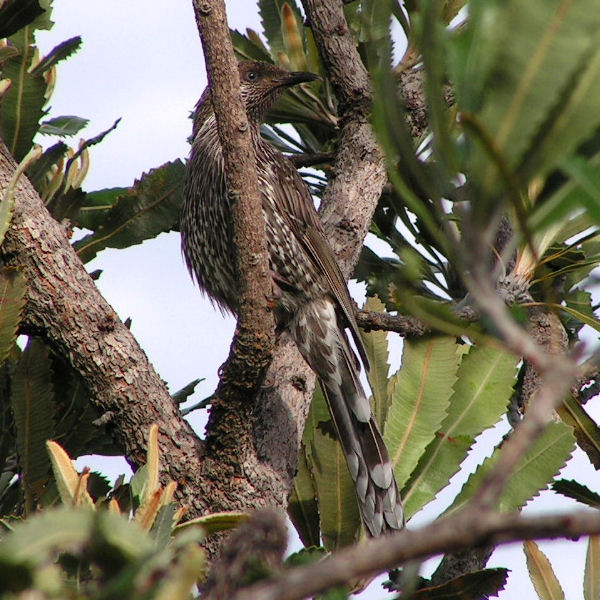
The Regent Honeyeater has a glossy black head and neck, pale yellow speckles on its breast, and black and bright yellow feathers on its wings and tail. Its foreparts are black, its underparts are mottled black and white, and its upperparts have black-and-yellow scalloping.[3][4]
The species has bare yellow to pink warty skin surrounding its eyes. Its black hood is complete, with yellow flashes on the wing tips.[5][6]
The Regent Honeyeater measures approximately 22 cm in length.[7]
Habitat
The Regent Honeyeater inhabits open eucalypt forests and woodlands, particularly box-ironbark vegetation. It also occupies coastal Spotted Gum and Swamp Mahogany forests.[8][9]
The species inhabits River She-oak gallery forests containing Needle-leaf Mistletoe.[10]
Diet
The Regent Honeyeater primarily consumes nectar from eucalyptus and mistletoe plants. It obtains nectar particularly from flowering box and ironbark eucalypts and Amyema cambagei.[11][12]
The species also consumes insects, their honeydew, and both native and cultivated fruit. Sugary insect secretions, including lerps, become an important dietary component during breeding.[13][14][15]
Behaviour
The Regent Honeyeater is nomadic.[16]
Male Regent Honeyeaters sometimes sing songs belonging to other bird species, including currawongs and eastern rosellas.[17]
Reproduction and life cycle
Breeding mostly takes place between August and January, and the breeding season appears to coincide with flowering periods of important eucalyptus and mistletoe species. Egg laying occurs from late winter to early summer, and females may make multiple breeding attempts in one season.[18][19][20]
The species constructs cup-shaped nests from fibres in forks of live eucalypt or she-oak canopies. It lays two or three eggs in each nest.[21][22]
The incubation period lasts 14 days, and the nestling period lasts 16 days. Young birds remain dependent on their parents for three to four weeks after fledging.[23][24][25]
The species experiences high breeding failure, mainly because of nest predation. Pied Currawongs are among the documented predators of Regent Honeyeater nests.[26][27]
Individuals may breed at more than one location within a year or may not breed at all at some locations in particular years.[28]
Conservation
The Regent Honeyeater is classified as critically endangered on the IUCN Red List and was listed as critically endangered under New South Wales legislation. The estimated New South Wales population may be fewer than 250 mature individuals.[29][30][31]
Approximately 75% of habitat containing the species' preferred vegetation types has been cleared. Habitat loss is identified as a major threat to the species.[32][33]
The species occurs in at least one protected area. Conservation sites have been identified throughout its range.[34][35]
Classification of the Regent Honeyeater
| Kingdom | Animalia |
|---|---|
| Phylum | Chordata |
| Subphylum | Vertebrata |
| Infraphylum | Gnathostomata |
| Parvphylum | Osteichthyes |
| Megaclass | Tetrapoda |
| Class | Aves (Bird) |
| Order | Passeriformes (Passerine) |
| Family | Meliphagidae (Honeyeater) |
| Genus | Anthochaera (Wattlebirds) |
| Species | Anthochaera phrygia (Shaw, 1794) |
Where the Regent Honeyeater is found
Checklists and occurrence records place Anthochaera phrygia in 1 country across Oceania. GBIF holds 14,098 georeferenced records of it.
Countries
Regions and cities with the most records
- New South Wales, Australia 9,455
- Victoria, Australia 3,115
- Cessnock, Australia 2,220
- Maitland, Australia 929
- Queensland, Australia 465
- Hornsby, Australia 437
- Parramatta, Australia 365
- Canberra, Australia 288
- Australian Capital Territory, Australia 250
- Sydney, Australia 246
- Burwood, Australia 236
- South Australia, Australia 226
- Balwyn North, Australia 222
- Toowoomba, Australia 207
- Adelaide, Australia 190
- Adelaide Hills, Australia 174
- Tuggeranong, Australia 160
- Melbourne, Australia 159
- Wodonga, Australia 147
- Liverpool, Australia 146
- Logan City, Australia 144
- Bendigo, Australia 143
- Central Coast, Australia 138
- Wangaratta, Australia 130
- Port Macquarie, Australia 57
- Newcastle, Australia 53
- Batemans Bay, Australia 50
- Dubbo, Australia 44
- Bathurst, Australia 25
- Mount Barker, Australia 24
- Coffs Harbour, Australia 22
- Bairnsdale, Australia 21
- Frankston East, Australia 19
- Brisbane, Australia 18
- St Albans, Australia 18
- Armidale, Australia 16
Range as the checklists state it
Australia
A number beside a place is its count of GBIF occurrence records. A place without a number comes from a checklist alone. Records show where a species has been observed or collected, which can include escapes and vagrants.
Common names
English
- Regent Honeyeater
Names in 26 other languages
- Catalan
- menjamel regent
- Chinese
- 王吸蜜鳥, 王吸蜜鸟
- Croatian
- gololici medojed
- Czech
- medosavka žlutočerná
- Danish
- Kongehonningæder
- Dutch
- Geschubde Lelhoningeter
- Esperanto
- veruka mielmanĝulo
- Finnish
- kirjomesikko
- French
- Méliphage régent
- German
- Warzenhonigfresser
- Hungarian
- kockás mézevő
- Italian
- Succiamiele del reggente
- Japanese
- キガオミツスイ
- Lithuanian
- gelsvasis žvynuotasis medsiurbys
- Norwegian
- regenthonningeter
- Polish
- koralicowiec królewski
- Portuguese
- melífago-regente, papa-mel-filigrana, papa-mel-governador
- Russian
- Бородавчатый медосос, Желтокрылый серёжкоух, Чешуйчатый медосос
- Serbian
- Kraljevski resasti medojed
- Slovak
- medárik kováčsky
- Spanish
- Mielero regente
- Swedish
- regenthonungsfågel
- Turkish
- Alaca Benekli Balkuşu
- Ukrainian
- медолюб-регент
- Welsh
- Melysor eurymylog
- nav
- Tsídii binátsįʼgoʼ hólóní diłhiłígíí
Synonyms
6 other scientific names have been used for this species and are now treated as synonyms of Anthochaera phrygia.
- Anthochaera phrygia phrygia (Shaw, 1794) Christidis & Boles, 2008
- Meliphaga phrygia tregellasi Mathews, GM, 1912
- Merops phrygius Shaw, 1794
- Xanthomyza phrygia (Shaw, 1794)
- Zanthomiza phrygia Shaw, G, 1794
- Zanthomyza phrygia Shaw, G, 1794
Related species
-
 Red WattlebirdAnthochaera carunculata
-
 Yellow WattlebirdAnthochaera paradoxa
-
 Little WattlebirdAnthochaera chrysoptera
-
 Western WattlebirdAnthochaera lunulata
-
 Noisy MinerManorina melanocephala
-
 TūīProsthemadera novaeseelandiae
-
 Blue-faced HoneyeaterEntomyzon cyanotis
-
 New Holland HoneyeaterPhylidonyris novaehollandiae
Compare
Questions and answers
What is the scientific name of the Regent Honeyeater?
The scientific name of the Regent Honeyeater is Anthochaera phrygia. Written with its author, the full name is Anthochaera phrygia (Shaw, 1794).
Which family does the Regent Honeyeater belong to?
Anthochaera phrygia belongs to the family Meliphagidae, in the order Passeriformes and the class Aves.
Where is the Regent Honeyeater found?
Checklists and occurrence records place Anthochaera phrygia in 1 country: Australia.
What is the conservation status of the Regent Honeyeater?
The IUCN Red List category recorded for Anthochaera phrygia is Critically Endangered (CR).
Where are Regent Honeyeaters found?
The Regent Honeyeater is endemic to southeastern Australia. It is no longer present in South Australia, and its distribution in Victoria has contracted to the northeastern Chiltern area. It occurs sporadically in extreme southeastern Queensland, while the principal breeding subpopulations in New South Wales occur around Capertee Valley and Bundarra-Barraba.[36][37][38][39][40]
What does a Regent Honeyeater look like?
The Regent Honeyeater has a glossy black head and neck, pale yellow breast speckles, and black and bright yellow feathers on its wings and tail. It has bare yellow to pink warty skin surrounding its eyes and a complete black hood. It measures approximately 22 cm in length.[3][5][6][7]
What is the Regent Honeyeater habitat?
The Regent Honeyeater inhabits open eucalypt forests and woodlands, particularly box-ironbark vegetation. It also occupies coastal Spotted Gum and Swamp Mahogany forests, and River She-oak gallery forests containing Needle-leaf Mistletoe.[8][9][10]
What do Regent Honeyeaters eat?
Regent Honeyeaters primarily consume nectar from eucalyptus and mistletoe plants, particularly flowering box and ironbark eucalypts and Amyema cambagei. They also eat insects, honeydew, and native and cultivated fruit. Sugary insect secretions, including lerps, become an important dietary component during breeding.[11][13][14][12][15]
Sources
Passages the profile rests on
- Genetic research indicates that the Regent Honeyeater is closely related to wattlebirds. Source passage: “Recent genetic research suggests it is closely related to the wattlebirds.” — English Wikipedia
- The Regent Honeyeater is larger and has more extensive spangling and scalloping than other yellow-winged honeyeaters. Source passage: “The species is larger and more spangled and scalloped than other yellow-winged honeyeaters” — environment.nsw.gov.au
- The bird has a glossy black head and neck, pale yellow speckles on its breast, and black and bright yellow feathers on its wings and tail. Source passage: “The neck and head are glossy black. The breast is covered with contrasting pale yellow speckles, and the feathers in the tail and wings are black and bright yellow.” — English Wikipedia
- The bird has black foreparts, mottled black-and-white underparts, scalloped black-and-yellow upperparts, and yellow-edged and tipped wings and tail. Source passage: “with black foreparts, mottled black and white underparts, and scalloped black and yellow upperparts. The wings and tail are edged and tipped yellow.” — environment.nsw.gov.au
- The bird has bare yellow to pink warty skin surrounding its eyes. Source passage: “There is a bare yellow to pink area of warty skin around the eyes.” — environment.nsw.gov.au
- The species has a complete black hood and yellow flashes on its wing tips. Source passage: “has a complete black hood and yellow flashes on the wing tips.” — environment.nsw.gov.au
- The Regent Honeyeater measures approximately 22 cm in length. Source passage: “is a medium-sized bird (22 cm in length)” — environment.nsw.gov.au
- The species inhabits open eucalypt forests and woodlands, particularly box-ironbark vegetation. Source passage: “inhabits eucalypt open forests and woodlands, predominantly box-ironbark types” — environment.nsw.gov.au
- The species also occupies coastal Spotted Gum and Swamp Mahogany forests. Source passage: “but also Spotted Gum and Swamp Mahogany on the coast.” — environment.nsw.gov.au
- The species inhabits River She-oak gallery forests containing Needle-leaf Mistletoe. Source passage: “The species also inhabits River She-oak gallery forest with Amyema cambagei (Needle-leaf Mistletoe).” — environment.nsw.gov.au
- The species primarily consumes nectar from eucalyptus and mistletoe plants. Source passage: “It feeds primarily on nectar from eucalyptus and mistletoe species” — English Wikipedia
- The species obtains nectar particularly from flowering box and ironbark eucalypts and Amyema cambagei. Source passage: “mostly feeds on nectar from flowering eucalypts, especially boxes and ironbarks, and from Amyema cambagei.” — environment.nsw.gov.au
- The species also consumes insects and their honeydew. Source passage: “and to a lesser extent on insects and their honeydew.” — English Wikipedia
- The species eats both native and cultivated fruit. Source passage: “It also feeds on both native and cultivated fruit.” — English Wikipedia
- Sugary insect secretions, including lerps, become an important dietary component during breeding. Source passage: “They also feed on the sugary exudates of insects ( e.g. lerps) which become an important part of their diet when breeding.” — environment.nsw.gov.au
- The species is nomadic. Source passage: “Extinction may occur in this nomadic species before a detectable genomic impact of small population size is realised.” — English Wikipedia
- Male Regent Honeyeaters sometimes sing songs belonging to other bird species, including currawongs and eastern rosellas. Source passage: “12 per cent of males were found to be singing other species' songs, including the currawong and eastern rosella.” — English Wikipedia
- Breeding mostly takes place between August and January. Source passage: “Breeding mostly occurs from August to January, during the southern spring and summer.” — English Wikipedia
- The breeding season appears to coincide with flowering periods of important eucalyptus and mistletoe species. Source passage: “The breeding season appears to correspond with the flowering of key eucalyptus and mistletoe species.” — English Wikipedia
- Egg laying occurs from late winter to early summer, and females may make multiple breeding attempts in one season. Source passage: “A clutch of two or three eggs is laid from late winter to early summer, with multiple attempts per season.” — environment.nsw.gov.au
- The species lays two or three eggs in a cup-shaped nest. Source passage: “Two or three eggs are laid in a cup-shaped nest.” — English Wikipedia
- The species constructs cup-shaped nests from fibres in forks of live eucalypt or she-oak canopies. Source passage: “builds a cup-shaped nest of fibres located in forks in live eucalypt (including Angophora) or she-oak canopy.” — environment.nsw.gov.au
- The incubation period lasts 14 days. Source passage: “The incubation period is 14 days” — environment.nsw.gov.au
- The nestling period lasts 16 days. Source passage: “nestling period 16 days” — environment.nsw.gov.au
- Young birds remain dependent on their parents for three to four weeks after fledging. Source passage: “post-fledging dependence period is three to four weeks.” — environment.nsw.gov.au
- The species experiences high breeding failure, mainly because of nest predation. Source passage: “The species experiences a high rate of breeding failure, which is typical of open-nesting passerines in woodland, mainly through nest predation” — environment.nsw.gov.au
- Pied Currawongs are among the documented predators of Regent Honeyeater nests. Source passage: “mainly through nest predation ( e.g. by the Pied Currawong, Strepera graculina).” — environment.nsw.gov.au
- Individuals may breed at more than one location within a year or may not breed at all at some locations in particular years. Source passage: “Individuals may breed in more than one location within a year, or the species may not breed at all in some locations in some years.” — environment.nsw.gov.au
- The Regent Honeyeater is classified as critically endangered on the IUCN Red List. Source passage: “The regent honeyeater is listed as critically endangered on the IUCN Red List” — English Wikipedia
- The species was listed as critically endangered under New South Wales legislation. Source passage: “to list the Regent Honeyeater Anthochaera phrygia (Shaw, 1794) as a CRITICALLY ENDANGERED SPECIES” — environment.nsw.gov.au
- The estimated New South Wales population may be fewer than 250 mature individuals. Source passage: “It is estimated that the NSW population of Regent Honeyeaters may now be fewer than 250 mature individuals.” — environment.nsw.gov.au
- Approximately 75% of habitat containing the species' preferred vegetation types has been cleared. Source passage: “with about 75% of habitat containing the species’ favoured vegetation types now cleared” — environment.nsw.gov.au
- Habitat loss is identified as a major threat to the species. Source passage: “giving habitat loss as the major threat.” — English Wikipedia
- The species occurs in at least one protected area. Source passage: “Occurs in at least one protected area : Yes” — iucnredlist.org
- Conservation sites have been identified throughout the species' range. Source passage: “Conservation sites identified : Yes, over entire range” — iucnredlist.org
- The Regent Honeyeater is endemic to southeastern Australia. Source passage: “a critically endangered bird endemic to southeastern Australia.” — English Wikipedia
- The species is no longer present in South Australia. Source passage: “The species is now absent from South Australia” — environment.nsw.gov.au
- In Victoria, the species' distribution has contracted to the northeastern Chiltern area. Source passage: “it’s distribution in Victoria has contracted to the north-east (Chiltern)” — environment.nsw.gov.au
- The species occurs sporadically in extreme southeastern Queensland. Source passage: “and it is now rare and sporadic in extreme south-east Queensland.” — environment.nsw.gov.au
- The principal breeding subpopulations in New South Wales occur around Capertee Valley and Bundarra-Barraba. Source passage: “Within NSW, breeding sub-populations are fragmented and now occur mainly around the Capertee Valley in central-eastern NSW and the Bundarra-Barraba region in northern inland NSW.” — environment.nsw.gov.au
Data
- Catalogue of Life, 2026-10-16 XR cc by
- Global Biodiversity Information Facility CC BY 4.0
- Wikidata CC0
- GeoNames CC BY 4.0
- Wikimedia Commons per image; credit shown with each image
- Within the Catalogue of Life, this name comes from The Integrated Taxonomic Information System cc0
References
- Dickinson, E. C., and L. Christidis, eds. (2014). The Howard and Moore Complete Checklist of the Birds of the World, 4th Edition, Vol. 2 Passerines.
This species in other databases
Page built on 26 November 2026. See how the catalog is made and all sources and licences.
Cite this page
ScientificNames.org. (2026). Anthochaera phrygia (Regent Honeyeater). Retrieved November 26, 2026, from https://scientificnames.org/species/anthochaera-phrygia
“Anthochaera phrygia (Regent Honeyeater).” ScientificNames.org, 2026, scientificnames.org/species/anthochaera-phrygia. Accessed 26 Nov. 2026.
ScientificNames.org. “Anthochaera phrygia (Regent Honeyeater).” Accessed November 26, 2026. https://scientificnames.org/species/anthochaera-phrygia.
@misc{scientificnames_anthochaera_phrygia_regent_honeyeater,
  author = {{ScientificNames.org}},
  title = {Anthochaera phrygia (Regent Honeyeater)},
  year = {2026},
  url = {https://scientificnames.org/species/anthochaera-phrygia},
  note = {Accessed 2026-11-26}
}