Species · Birds
Western Wattlebird Anthochaera lunulata
The scientific name of the Western Wattlebird is Anthochaera lunulata. It is a species of bird in the family Meliphagidae (honeyeater), order Passeriformes. The name dates from 1838.
- Scientific name
- Anthochaera lunulata Gould, 1838
- Common name
- Western Wattlebird
- Genus
- Anthochaera
- Family
- Meliphagidae (Honeyeater)
- Order
- Passeriformes
- Class
- Aves
- Red List category
- LC Least Concern
- Recorded in
- 1 country
- Name status
- accepted in the Catalogue of Life
Overview
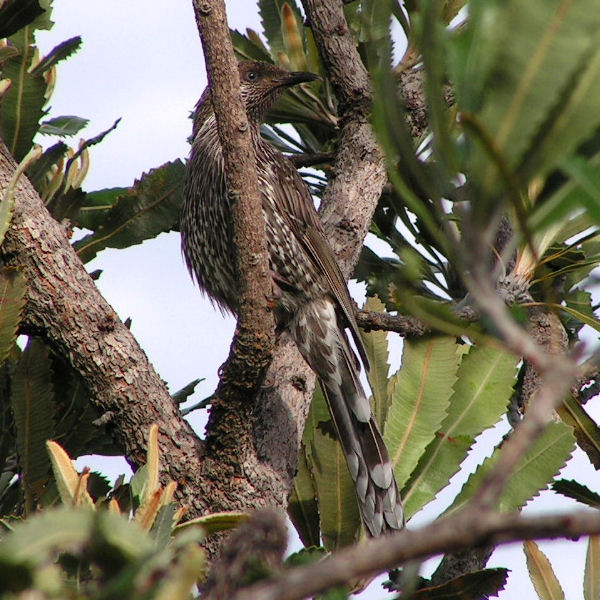
The Western Wattlebird (Anthochaera lunulata Gould, 1838) is a large honeyeater in the family Meliphagidae, order Passeriformes, class Aves. It is restricted to southwestern Australia, with a coastal distribution from Israelite Bay north to Geraldton and an inland distribution reaching the Stirling Range, Lake Grace and Northam. It has dark grey-brown upperparts with pale streaks and spots, dark grey underparts with white streaks and tips, and a red iris.
Written 26 November 2026 from the sources listed below. Each statement was checked against the passage it cites; statements that could not be supported were removed.
Appearance
The adult Western Wattlebird has dark grey-brown upperparts marked with pale streaks and spots. Its forehead, crown and nape are dark brown with fine whitish shaft streaks.[1][2]
Its dark grey underparts have white streaks and tips. A blackish-brown streak borders the eye, which has a red iris.[3][4]
The Western Wattlebird has a long, slender body and is classified as a large honeyeater.[5]
Male Western Wattlebirds measure 29–33 centimetres in length and weigh 65–78 grams. Females measure 27–30 centimetres and weigh 47–57 grams.[6][7][8][9]
The recorded weight range for birds of unrecorded sex is 45.5–83 grams.[10]
Habitat
The Western Wattlebird occurs in the high-rainfall region of southwestern Australia, where forest and woodland formerly predominated.[11]
Similar species
Anthochaera lunulata and Anthochaera chrysoptera are assigned to the subgenus Anthochaera (Anellobia). The name Anthochaera (Anellobia) derives from Jean Cabanis's generic description published in 1851.[12][13]
G. M. Mathews described a taxon named Anthochaera chrysoptera albani in 1923. Anthochaera chrysoptera albani is currently regarded as a synonym of Anthochaera lunulata.[14][15]
Classification of the Western Wattlebird
| Kingdom | Animalia |
|---|---|
| Phylum | Chordata |
| Subphylum | Vertebrata |
| Infraphylum | Gnathostomata |
| Parvphylum | Osteichthyes |
| Megaclass | Tetrapoda |
| Class | Aves (Bird) |
| Order | Passeriformes (Passerine) |
| Family | Meliphagidae (Honeyeater) |
| Genus | Anthochaera (Wattlebirds) |
| Species | Anthochaera lunulata Gould, 1838 |
Where the Western Wattlebird is found
Checklists and occurrence records place Anthochaera lunulata in 1 country across Oceania. GBIF holds 33,630 georeferenced records of it.
Countries
Regions and cities with the most records
- Western Australia, Australia 25,800
- Perth, Australia 9,035
- Kwinana, Australia 3,540
- New South Wales, Australia 1,797
- Victoria, Australia 1,695
- Rockingham, Australia 1,148
- South Australia, Australia 934
- Tasmania, Australia 623
- Queensland, Australia 545
- Albany, Australia 491
- Hornsby, Australia 490
- Sydney, Australia 386
- Parramatta, Australia 320
- Balwyn North, Australia 288
- Melbourne, Australia 286
- Mandurah, Australia 267
- Burwood, Australia 266
- Adelaide Hills, Australia 212
- Adelaide, Australia 170
- Frankston East, Australia 161
- Gold Coast, Australia 119
- Gawler, Australia 98
- Liverpool, Australia 84
- Wollongong, Australia 83
- Batemans Bay, Australia 81
- Hobart, Australia 78
- Central Coast, Australia 73
- Narangba, Australia 70
- Sunshine Coast, Australia 70
- Bairnsdale, Australia 67
- Bunbury, Australia 59
- Launceston, Australia 59
- St Albans, Australia 59
- Port Macquarie, Australia 58
- Torquay, Australia 56
- Caloundra, Australia 52
Range as the checklists state it
Australia
A number beside a place is its count of GBIF occurrence records. A place without a number comes from a checklist alone. Records show where a species has been observed or collected, which can include escapes and vagrants.
Common names
English
- Western Wattlebird
- Little Wattlebird
Names in 23 other languages
- Catalan
- menjamel de galtes blanques
- Chinese
- 小垂蜜鸟, 西方垂蜜鳥
- Croatian
- srebrnastolici medojed
- Czech
- laločnatka stříbrovousá
- Danish
- Lille Honningæder
- Dutch
- Westelijke Lelhoningeter, Westeljke Lelhoningeter
- Esperanto
- luneta mielmanĝulo
- Finnish
- lännenhelttamesikko
- French
- Méliphage mineur
- German
- Zwerghonigfresser
- Italian
- Bargigliuto minore
- Japanese
- ギンホオミツスイ, ギンホオミツスイ(銀頬蜜吸)
- Lithuanian
- vakarinis žvynuotasis medsiurbys
- Norwegian
- dryandrahonningeter
- Polish
- koralicowiec mały
- Portuguese
- papa-mel-lunulado
- Russian
- Темнозобый серёжкоух, Темнозобый серёжчатый медосос
- Serbian
- Zapadni resasti medojed
- Slovak
- medárik kočovný
- Spanish
- Mielero lunulado
- Swedish
- dryandrahonungsfågel
- Turkish
- Batılı Kızıl Kanatlı Balkuşu
- Ukrainian
- медолюб-сережник західний
Synonyms
2 other scientific names have been used for this species and are now treated as synonyms of Anthochaera lunulata.
- Anthochaera chrysoptera albani Mathews, GM, 1923
- Anthochaera chrysoptera lunulata Gould, J, 1838
Related species
-
 Red WattlebirdAnthochaera carunculata
-
 Regent HoneyeaterAnthochaera phrygia
-
 Yellow WattlebirdAnthochaera paradoxa
-
 Little WattlebirdAnthochaera chrysoptera
-
 Noisy MinerManorina melanocephala
-
 TūīProsthemadera novaeseelandiae
-
 Blue-faced HoneyeaterEntomyzon cyanotis
-
 New Holland HoneyeaterPhylidonyris novaehollandiae
Compare
Questions and answers
What is the scientific name of the Western Wattlebird?
The scientific name of the Western Wattlebird is Anthochaera lunulata. Written with its author, the full name is Anthochaera lunulata Gould, 1838.
Which family does the Western Wattlebird belong to?
Anthochaera lunulata belongs to the family Meliphagidae, in the order Passeriformes and the class Aves.
Where is the Western Wattlebird found?
Checklists and occurrence records place Anthochaera lunulata in 1 country: Australia.
What is the conservation status of the Western Wattlebird?
The IUCN Red List category recorded for Anthochaera lunulata is Least Concern (LC).
What other names does the Western Wattlebird have?
Anthochaera lunulata is also known in English as Little Wattlebird.
Are wattle birds honey eaters?
The Western Wattlebird is classified as a large honeyeater.[5]
Sources
Passages the profile rests on
- The adult Western Wattlebird has dark grey-brown upperparts marked with pale streaks and spots. Source passage: “The adult western wattlebird has dark grey-brown upper-parts with pale streaks and spots.” — English Wikipedia
- Its forehead, crown and nape are dark brown with fine whitish shaft streaks. Source passage: “It has a dark brown forehead, crown and nape, streaked with fine, whitish shafts.” — English Wikipedia
- Its dark grey underparts have white streaks and tips. Source passage: “Underparts are dark grey, streaked and tipped white.” — English Wikipedia
- It has a blackish-brown streak bordering the eye and a red iris. Source passage: “It has a blackish-brown streak bordering the eye, and has a red iris.” — English Wikipedia
- The Western Wattlebird has a long, slender body and is classified as a large honeyeater. Source passage: “A large honeyeater, it is long and slender.” — English Wikipedia
- Male Western Wattlebirds measure 29–33 centimetres in length. Source passage: “29–33 centimetres in length, 65–78 grams in weight for the males;” — English Wikipedia
- Male Western Wattlebirds weigh 65–78 grams. Source passage: “65–78 grams in weight for the males;” — English Wikipedia
- Female Western Wattlebirds measure 27–30 centimetres in length. Source passage: “and 27–30 cm and 47–57 g for the females.” — English Wikipedia
- Female Western Wattlebirds weigh 47–57 grams. Source passage: “and 27–30 cm and 47–57 g for the females.” — English Wikipedia
- The recorded weight range for birds of unrecorded sex is 45.5–83 grams. Source passage: “The weight range for unsexed birds is 45.5–83 grams.” — English Wikipedia
- The Western Wattlebird occurs in the high-rainfall region of southwestern Australia, where forest and woodland formerly predominated. Source passage: “in the high rainfall area formerly dominated by forest and woodland.” — English Wikipedia
- Anthochaera lunulata and Anthochaera chrysoptera are assigned to the subgenus Anthochaera (Anellobia). Source passage: “Both species are assigned to the subgenus Anthochaera (Anellobia),” — English Wikipedia
- The name Anthochaera (Anellobia) derives from Jean Cabanis's generic description published in 1851. Source passage: “taking its name from the generic description of Jean Cabanis (1851).” — English Wikipedia
- G. M. Mathews described a taxon named Anthochaera chrysoptera albani in 1923. Source passage: “published a description as the subspecies Anthochaera chrysoptera albani in his Austral Avian Record (1923)” — English Wikipedia
- Anthochaera chrysoptera albani is currently regarded as a synonym of Anthochaera lunulata. Source passage: “now regarded as a synonym for this species.” — English Wikipedia
Data
- Catalogue of Life, 2026-10-16 XR cc by
- Global Biodiversity Information Facility CC BY 4.0
- Wikidata CC0
- GeoNames CC BY 4.0
- Wikimedia Commons per image; credit shown with each image
- Within the Catalogue of Life, this name comes from The Integrated Taxonomic Information System cc0
References
- Gill, Frank, & and Minturn Wright. (2006). Birds of the World: Recommended English Names.
- Dickinson, E. C., and L. Christidis, eds. (2014). The Howard and Moore Complete Checklist of the Birds of the World, 4th Edition, Vol. 2 Passerines.
This species in other databases
Page built on 27 November 2026. See how the catalog is made and all sources and licences.
Cite this page
ScientificNames.org. (2026). Anthochaera lunulata (Western Wattlebird). Retrieved November 27, 2026, from https://scientificnames.org/species/anthochaera-lunulata
“Anthochaera lunulata (Western Wattlebird).” ScientificNames.org, 2026, scientificnames.org/species/anthochaera-lunulata. Accessed 27 Nov. 2026.
ScientificNames.org. “Anthochaera lunulata (Western Wattlebird).” Accessed November 27, 2026. https://scientificnames.org/species/anthochaera-lunulata.
@misc{scientificnames_anthochaera_lunulata_western_wattlebird,
  author = {{ScientificNames.org}},
  title = {Anthochaera lunulata (Western Wattlebird)},
  year = {2026},
  url = {https://scientificnames.org/species/anthochaera-lunulata},
  note = {Accessed 2026-11-27}
}