Species · Spiders and other arachnids
Sonoran Copper Head Aphonopelma mooreae
The scientific name of the Sonoran Copper Head is Aphonopelma mooreae. It is a species of arachnid in the family Theraphosidae (tarantulas), order Araneae. The name dates from 1995.
- Scientific name
- Aphonopelma mooreae Smith, 1995
- Common name
- Sonoran Copper Head
- Genus
- Aphonopelma
- Family
- Theraphosidae (Tarantulas)
- Order
- Araneae
- Class
- Arachnida
- Recorded in
- 1 country
- Name status
- accepted in the Catalogue of Life

Overview
The Mexican Jade Fuego Tarantula is an arachnid in the family Theraphosidae, order Araneae, and class Arachnida. It is reported as endemic to Yécora in the Mexican state of Sonora. It is distinguished by metallic bluish-green and blue coloration and long reddish hairs on its body and legs.
Written 26 November 2026 from the sources listed below. Each statement was checked against the passage it cites; statements that could not be supported were removed.
Appearance
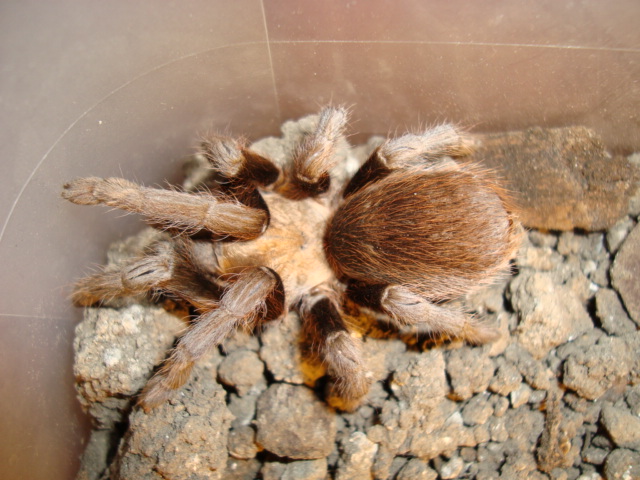
The legs have a metallic blue coloration that fades to black in some areas. They are covered in long, slender hairs ranging from fawn to red and orange.[1][2]
The carapace and chelicerae are metallic bluish-green. The opisthosoma is black and covered with long reddish hairs.[3][4]
The word fuego in the common name refers to the fiery red-orange hairs on the opisthosoma and legs. Adults measure approximately 10–13 cm (4–5 inches).[5][6]
Similar species
Chromatopelma cyaneopubescens resembles the Mexican Jade Fuego Tarantula in coloration. The Mexican Jade Fuego Tarantula has denser, more curled, and significantly longer hairs.[7][8]
Habitat
The species' reported habitat region is situated in the Sierra Madre Occidental. The Yécora region has a subtropical highland climate, an average annual temperature of 14 °C, and average annual rainfall of 1,023 mm.[9][10][11][12]
Vegetation around Yécora consists mainly of deciduous forest combined with coniferous and pine forests. Native plants include Pochote and Cyrtocarpa procera.[13][14]
The Yécora region is described as having high biodiversity. Reported predators include ocelots, lynxes, California spiny-tailed iguanas, birds, and various mammals.[15][16][17]
Behaviour
The species is terrestrial. It sometimes digs burrows ranging from simple scrape burrows to more complex tunnel-like structures.[18][19]
Classification of the Sonoran Copper Head
| Kingdom | Animalia |
|---|---|
| Phylum | Arthropoda |
| Subphylum | Chelicerata |
| Class | Arachnida (Arachnid) |
| Order | Araneae (Spider) |
| Family | Theraphosidae (Tarantulas) |
| Genus | Aphonopelma |
| Species | Aphonopelma mooreae Smith, 1995 |
Where the Sonoran Copper Head is found
Checklists and occurrence records place Aphonopelma mooreae in 1 country across North America. GBIF holds 50 georeferenced records of it.
Countries
Regions and cities with the most records
Range as the checklists state it
Mexico
A number beside a place is its count of GBIF occurrence records. A place without a number comes from a checklist alone. Records show where a species has been observed or collected, which can include escapes and vagrants.
Common names
English
- Sonoran Copper Head
- Mexican Jade Fuego Tarantula
- North American Cobalt Tarantula
Names in 2 other languages
- Czech
- sklípkan Mooreové
- Spanish
- Tarántula cobalto de la Sierra Tarahumara
Related species
-
 Texas Brown TarantulaAphonopelma hentzi
-
 Arizona Blonde TarantulaAphonopelma chalcodes
-
 Costa Rican Striped-knee TarantulaAphonopelma seemanni
-
 Desert TarantulaAphonopelma iodius
-
 California Ebony TarantulaAphonopelma eutylenum
-
 Johnny Cash TarantulaAphonopelma johnnycashi
-
 Texas Tan TarantulaAphonopelma anax
-
 Grand Canyon Black TarantulaAphonopelma marxi
Compare
Questions and answers
What is the scientific name of the Sonoran Copper Head?
The scientific name of the Sonoran Copper Head is Aphonopelma mooreae. Written with its author, the full name is Aphonopelma mooreae Smith, 1995.
Which family does the Sonoran Copper Head belong to?
Aphonopelma mooreae belongs to the family Theraphosidae, in the order Araneae and the class Arachnida.
Where is the Sonoran Copper Head found?
Checklists and occurrence records place Aphonopelma mooreae in 1 country: Mexico.
What other names does the Sonoran Copper Head have?
Aphonopelma mooreae is also known in English as Mexican Jade Fuego Tarantula and North American Cobalt Tarantula.
Sources
Passages the profile rests on
- The legs have a metallic blue coloration that fades to black in some areas. Source passage: “its legs are a gradient of metallic blue fading to black in some areas” — English Wikipedia
- The legs are covered in long, slender hairs ranging in color from fawn to red and orange. Source passage: “covered in long slender hairs which vary in color from fawn to red and orange.” — English Wikipedia
- The carapace and chelicerae are metallic bluish-green. Source passage: “The carapace and chelicerae are a metallic blueish-green color.” — English Wikipedia
- The opisthosoma is black and covered with long reddish hairs. Source passage: “The opisthosoma is black and covered with long reddish hairs.” — English Wikipedia
- The word fuego in the species' common name refers to its fiery red-orange hairs on the opisthosoma and legs. Source passage: “The Spanish word "fuego" refers to the fiery red-orange hairs on its opisthosoma and legs.” — English Wikipedia
- Adults measure approximately 10–13 cm (4–5 inches). Source passage: “Its adult size is roughly 10cm to 13cm (4 to 5 inches).” — English Wikipedia
- The species has denser, more curled, and significantly longer hairs than Chromatopelma cyaneopubescens. Source passage: “the hairs on the legs of A. mooreae are denser and curled, and overall the hairs are significantly longer.” — English Wikipedia
- Chromatopelma cyaneopubescens resembles Aphonopelma mooreae in coloration. Source passage: “It resembles the Chromatopelma cyaneopubescens in coloration” — English Wikipedia
- The species' reported habitat region is situated in the Sierra Madre Occidental. Source passage: “The region has a subtropical highland climate and is located in the Sierra Madre Occidental.” — English Wikipedia
- The Yécora region has a subtropical highland climate. Source passage: “The region has a subtropical highland climate” — English Wikipedia
- The Yécora region has an average annual temperature of 14 °C. Source passage: “Average annual temperatures are 14 °C (61 °F)” — English Wikipedia
- The Yécora region receives an average of 1,023 mm of rainfall annually. Source passage: “with an average yearly rainfall of 1023mm (40in).” — English Wikipedia
- The vegetation around Yécora consists mainly of deciduous forest combined with coniferous and pine forests. Source passage: “Yécora is mainly deciduous forest in combination with coniferous and pine forests” — English Wikipedia
- Native plants in the Yécora region include Pochote and Cyrtocarpa procera. Source passage: “with native plants such as Pochote and Cyrtocarpa procera.” — English Wikipedia
- The Yécora region is described as having high biodiversity. Source passage: “The region's biodiversity is high” — English Wikipedia
- The species' reported predators include ocelots, lynxes, and California spiny-tailed iguanas. Source passage: “Notable predators include the ocelot, lynx, and the California Spiny Tailed Iguana” — English Wikipedia
- Birds and various mammals are also reported among the species' predators. Source passage: “Other predators include birds and various mammals.” — English Wikipedia
- The species is terrestrial. Source passage: “this is a terrestrial tarantula.” — English Wikipedia
- The species sometimes digs burrows ranging from simple scrape burrows to more complex tunnel-like structures. Source passage: “A. mooreae will sometimes dig burrows ranging from simple "scrape" burrows to more intricate tunnel-like burrows.” — English Wikipedia
Data
- Catalogue of Life, 2026-10-16 XR cc by
- Global Biodiversity Information Facility CC BY 4.0
- Wikidata CC0
- GeoNames CC BY 4.0
- Wikimedia Commons per image; credit shown with each image
- Within the Catalogue of Life, this name comes from The World Spider Catalog cc by
References
- Smith, A. M. (1995). Tarantula Spiders: Tarantulas of the U.S.A. and Mexico. Fitzgerald Publishing, London, 196 pp. where the name was published
This species in other databases
Page built on 26 November 2026. See how the catalog is made and all sources and licences.
Cite this page
ScientificNames.org. (2026). Aphonopelma mooreae (Sonoran Copper Head). Retrieved November 26, 2026, from https://scientificnames.org/species/aphonopelma-mooreae
“Aphonopelma mooreae (Sonoran Copper Head).” ScientificNames.org, 2026, scientificnames.org/species/aphonopelma-mooreae. Accessed 26 Nov. 2026.
ScientificNames.org. “Aphonopelma mooreae (Sonoran Copper Head).” Accessed November 26, 2026. https://scientificnames.org/species/aphonopelma-mooreae.
@misc{scientificnames_aphonopelma_mooreae_sonoran_copper_head,
  author = {{ScientificNames.org}},
  title = {Aphonopelma mooreae (Sonoran Copper Head)},
  year = {2026},
  url = {https://scientificnames.org/species/aphonopelma-mooreae},
  note = {Accessed 2026-11-26}
}