Species · Mammals
Striped Field Mouse Apodemus agrarius
The scientific name of the Striped Field Mouse is Apodemus agrarius. It is a species of mammal in the family Muridae (mice), order Rodentia. The name dates from 1771.
- Scientific name
- Apodemus agrarius (Pallas, 1771)
- Common name
- Striped Field Mouse
- Genus
- Apodemus
- Family
- Muridae (Mice)
- Order
- Rodentia
- Class
- Mammalia
- Red List category
- LC Least Concern
- Environment
- terrestrial
- Recorded in
- 38 countries
- Name status
- accepted in the Catalogue of Life

Overview
Apodemus agrarius inhabits woodland edges, grasslands, marshes, pastures, gardens, urban areas, cultivated areas, rice paddies, woodlands and forests. It is distinguished by a prominent black stripe running along the middle of its back.
Written 26 November 2026 from the sources listed below. Each statement was checked against the passage it cites; statements that could not be supported were removed.
Appearance
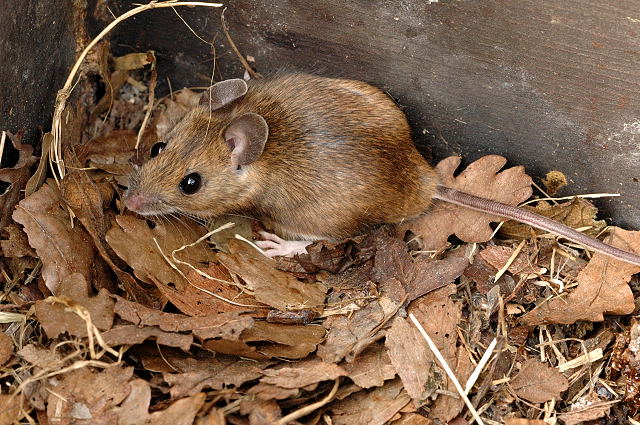
The upperparts are grayish brown with a rusty tint or yellow-brown, with a prominent black stripe running along the middle of the back. The underparts are paler and grayish compared with the upperparts.[1][2][3]
The species has relatively small ears and eyes.[4]
Habitat
The Striped Field Mouse inhabits woodland edges, grasslands, marshes, pastures, gardens and urban areas. It also occurs in grassy fields, cultivated areas, rice paddies, woodlands and forests.[5][6]
During winter, individuals may shelter in haystacks, storehouses and dwellings.[7]
Diet
The diet includes green plant parts, roots, grains, seeds, berries, nuts and insects.[8][9]
Behaviour
The species excavates short burrows containing a nesting chamber at shallow depths. Individuals inhabit burrows during nighttime hours.[10][11]
It is nocturnal during summer and mainly diurnal during winter. The species is capable of leaping and swimming.[12][13]
Most individuals spend their entire lives within 180 meters of their birthplace.[14]
Reproduction and life cycle
The species has separate male and female sexes. Females have eight nipples.[15][16]
Females can breed throughout the year. The species produces three to five broods annually, averaging six young per litter.[17][18]
Females can produce up to six litters annually, with as many as six young in each litter.[19]
Conservation
Increasing dominance was associated with changes in the ranking of native small mammal species. Its effect on community diversity and evenness changed from positive to markedly negative after its dominance exceeded 25%.[20][21]
Variation in its dominance was associated with the northward direction of its range expansion.[22]
Uses
The Striped Field Mouse is considered a common agricultural pest within its geographic range, particularly during population outbreaks. It can damage crops and raid food stores.[23][24]
Classification of the Striped Field Mouse
| Kingdom | Animalia |
|---|---|
| Phylum | Chordata |
| Subphylum | Vertebrata |
| Infraphylum | Gnathostomata |
| Parvphylum | Osteichthyes |
| Megaclass | Tetrapoda |
| Class | Mammalia (Mammal) |
| Subclass | Theria |
| Infraclass | Eutheria |
| Order | Rodentia (Rodent) |
| Suborder | Myomorpha (Mice) |
| Superfamily | Muroidea |
| Family | Muridae (Mice) |
| Subfamily | Murinae (Old World Mice) |
| Genus | Apodemus (Field Mice) |
| Species | Apodemus agrarius (Pallas, 1771) |
Where the Striped Field Mouse is found
Checklists and occurrence records place Apodemus agrarius in 38 countries across Asia. GBIF holds 32,091 georeferenced records of it.
Countries
- Austria 79
- Azerbaijan 9
- Belarus 70
- Bosnia and Herzegovina 19
- Bulgaria 103
- China 1,241
- Croatia 221
- Czechia 33
- Denmark 740
- Estonia 1,041
- Finland 189
- Georgia 28
- Germany 3,722
- Hungary 310
- Italy 18
- Japan 6
- Kazakhstan 139
- Kosovo 9
- Kyrgyzstan 28
- Latvia 28
- Lithuania 74
- Moldova 15
- Mongolia 76
- North Korea 181
- North Macedonia 13
- Poland 10,439
- Romania 584
- Russia 4,767
- Serbia 94
- Singapore 12
- Slovakia 41
- Slovenia 135
- South Korea 4,843
- Sweden 5
- Taiwan 220
- The Netherlands 8
- Turkey 29
- Ukraine 2,522
Regions and cities with the most records
- Żoliborz, Poland 2,584
- Bemowo, Poland 2,583
- Bielany, Poland 2,579
- Białołeka, Poland 2,573
- Warsaw, Poland 2,571
- Śródmieście, Poland 2,571
- Ochota, Poland 2,569
- Praga Północ, Poland 2,569
- Piastów, Poland 2,568
- Włochy, Poland 2,568
- Ursus, Poland 2,567
- Wola, Poland 2,567
- Mokotów, Poland 2,565
- Praga Południe, Poland 2,564
- Marki, Poland 2,562
- Pruszków, Poland 2,562
- Ząbki, Poland 2,562
- Targówek, Poland 2,559
- Ursynów, Poland 2,559
- Zielonka, Poland 2,558
- Rembertów, Poland 2,557
- Kobyłka, Poland 2,544
- Łomianki, Poland 2,487
- Legionowo, Poland 2,454
- Swarzędz, Poland 2,342
- Środa Wielkopolska, Poland 2,321
- Wawer, Poland 2,216
- Wesoła, Poland 2,212
- Lower Saxony, Germany 1,515
- Konstancin-Jeziorna, Poland 1,311
- Piaseczno, Poland 1,311
- Józefów, Poland 1,305
- Sulejówek, Poland 1,305
- Wołomin, Poland 1,204
- Moscow, Russia 1,148
- Vostochnoe Degunino, Russia 1,022
Range as the checklists state it
Europe & Northern Asia (excluding China)
Southern Asia
A number beside a place is its count of GBIF occurrence records. A place without a number comes from a checklist alone. Records show where a species has been observed or collected, which can include escapes and vagrants.
Common names
English
- Striped Field Mouse
Names in 30 other languages
- Belarusian
- Мыш палявая
- Bulgarian
- Полска мишка
- Chinese
- 赤背條鼠
- Croatian
- Prugasti poljski miš
- Czech
- myšice temnopásá
- Danish
- Brandmus
- Dutch
- Brandmuis
- Estonian
- juttselg-hiir
- Finnish
- peltohiiri
- French
- Mulot rayé
- German
- Brandmaus
- Greek
- Αγροπόντικας
- Hungarian
- pirókegér
- Italian
- Topo selvatico a dorso striato, Topo selvatico dorso striato
- Japanese
- セスジアカネズミ, セスジネズミ
- Kazakh
- Дала қаптеcepi
- Korean
- 등줄쥐
- Latvian
- Svītrainā klaidoņpele
- Lithuanian
- Dirvinė Pelė
- Norwegian Bokmål
- Brannmus
- Polish
- Mysz polna, Myszarka polna
- Portuguese
- Rato-do-campo-listrado
- Romanian
- Șoarece cu dungă, Șoarece dungat de câmp, Șoarece vărgat de apă, Șoarece vărgat de câmp, Șobolan de câmp
- Russian
- Полевая мышь
- Serbian
- пругасти пољски миш
- Slovak
- Ryšavka tmavopása
- Slovenian
- dimasta miš
- Spanish
- Ratón Listado
- Turkish
- Çizgili Ormanfaresi
- Ukrainian
- Миша польова
Synonyms
25 other scientific names have been used for this species and are now treated as synonyms of Apodemus agrarius.
- Apodemus agrarius caucasicus Kuznetzov, 1944
- Apodemus agrarius coreae Thomas, 1908
- Apodemus agrarius gloveri Kuroda, 1939
- Apodemus agrarius henrici Lehmann, 1970
- Apodemus agrarius insulaemus Tokuda, 1941
- Apodemus agrarius kahamanni Malec & Storch, 1962
- Apodemus agrarius karelicus Ehrström, 1914
- Apodemus agrarius mantchuricus Thomas, 1908
- Apodemus agrarius nikolskii Migouline, 1927
- Apodemus agrarius ningpoensis Corbet, 1978
- Apodemus agrarius ognevi Johansen, 1923
- Apodemus agrarius pallenscens Johnson and Jones, 1955
- Apodemus agrarius pallidior Thomas, 1908
- Apodemus agrarius septentrionalis Ognev, 1924
- Apodemus agrarius tianschanicus Ognev, 1940
- Apodemus agrarius var. insulaemus Tokuda, 1941
- Apodemus agrarius volgensis Kuznetzov, 1944
- Micromys agrarius mantchuricus : Thomas, 1906
- Mus agrarius Pallas, 1771
- Mus agrarius albostriatus Bechstein, 1801
- Mus agrarius maculatus Bechstein, 1801
- Mus agrarius mantchuricus Thomas, 1898
- Mus harti Thomas, 1898
- Mus ningpoensis Swinhoe, 1870
- Mus rubens Oken, 1816
Related species
-
 Wood MouseApodemus sylvaticus
-
 Yellow-necked MouseApodemus flavicollis
-
 Large Japanese Field MouseApodemus speciosus
-
 Ural Field MouseApodemus uralensis
-
 Small Japanese Field MouseApodemus argenteus
-
 Korean Field MouseApodemus peninsulae
- Kashmir Field MouseApodemus rusiges
-
 Alpine Field MouseApodemus alpicola
Compare
Questions and answers
What is the scientific name of the Striped Field Mouse?
The scientific name of the Striped Field Mouse is Apodemus agrarius. Written with its author, the full name is Apodemus agrarius (Pallas, 1771).
Which family does the Striped Field Mouse belong to?
Apodemus agrarius belongs to the family Muridae, in the order Rodentia and the class Mammalia.
Where is the Striped Field Mouse found?
Checklists and occurrence records place Apodemus agrarius in 38 countries, including Poland, South Korea, Russia, Germany, Ukraine and China.
What is the conservation status of the Striped Field Mouse?
The IUCN Red List category recorded for Apodemus agrarius is Least Concern (LC).
What do striped field mice eat?
Striped Field Mice eat green plant parts, roots, grains, seeds, berries, nuts and insects.[8][9]
Sources
Passages the profile rests on
- The upperparts are grayish brown with a rusty tint and a prominent black stripe running along the middle of the back. Source passage: “The upper parts of the striped field mouse are grayish brown with a rusty tint with a prominent mid-dorsal black stripe.” — English Wikipedia
- The underparts are paler and grayish compared with the upperparts. Source passage: “The under parts are paler and grayish.” — English Wikipedia
- Its dorsal coloration is yellow-brown with a prominent black stripe along the middle of the back. Source passage: “The dorsum of these mice is yellow-brown with a prominant black, mid-dorsal stripe.” — animaldiversity.org
- The species has relatively small ears and eyes. Source passage: “The ears and eyes are relatively small.” — English Wikipedia
- The species inhabits woodland edges, grasslands, marshes, pastures, gardens and urban areas. Source passage: “The striped field mouse inhabits a wide range of habitats including the edges of woodlands, grasslands and marshes, pastures and gardens, and urban areas.” — English Wikipedia
- The species occurs in grassy fields, cultivated areas, rice paddies, woodlands and forests. Source passage: “Black-striped field mice are commonly found in grassy fields, cultivated areas, rice paddies, woodlands and forests.” — animaldiversity.org
- During winter, individuals may shelter in haystacks, storehouses and dwellings. Source passage: “In the winter, it may be found in haystacks, storehouses, and dwellings.” — English Wikipedia
- Its diet includes green plant parts, roots, seeds, berries, nuts and insects. Source passage: “Its diet varies and includes green parts of plants, roots, seeds, berries, nuts, and insects.” — English Wikipedia
- The species eats roots, grains, seeds, berries, nuts and insects. Source passage: “They eat roots, grains, seeds, berries nuts and insects.” — animaldiversity.org
- The species excavates short burrows containing a nesting chamber at shallow depths. Source passage: “The striped field mouse excavates a short burrow with a nesting chamber at a shallow depth.” — English Wikipedia
- Individuals inhabit burrows during nighttime hours. Source passage: “They dig burrows that they inhabit during the nighttime hours.” — animaldiversity.org
- It is nocturnal during summer and mainly diurnal during winter. Source passage: “It is nocturnal during the summer, but mainly diurnal in the winter.” — English Wikipedia
- The species is capable of leaping and swimming. Source passage: “The black-striped field mouse is an agile leaper and swimmer.” — animaldiversity.org
- Most individuals spend their entire lives within 180 meters of their birthplace. Source passage: “Most individuals live their entire lives and die within 180 meters of their birthplace.” — animaldiversity.org
- Females have eight nipples. Source passage: “Females have eight nipples.” — animaldiversity.org
- The species has separate male and female sexes. Source passage: “gonochoric/gonochoristic/dioecious (sexes separate)” — animaldiversity.org
- The species produces three to five broods annually, averaging six young per litter. Source passage: “Three to five broods are born in a year with an average of six young per litter” — English Wikipedia
- Females can breed throughout the year. Source passage: “Mice of this species are capable of breeding throughout the year.” — animaldiversity.org
- Females can produce up to six litters annually, with as many as six young in each litter. Source passage: “Females can produce up to six litters, each of up to six young, annually.” — animaldiversity.org
- Increasing dominance of the species was associated with changes in the ranking of native small mammal species. Source passage: “we found a re-ordering of the species rank, mainly in areas with higher dominance” — pmc.ncbi.nlm.nih.gov
- Its effect on community diversity and evenness changed from positive to markedly negative after its dominance exceeded 25%. Source passage: “an initial positive impact on diversity and evenness during low dominance of the striped field mouse turned markedly negative after crossing the 25% dominance threshold.” — pmc.ncbi.nlm.nih.gov
- The northward direction of its range expansion was associated with variation in its dominance. Source passage: “Results suggested that the variation in the striped field mouse’s dominance is affected by the northern direction of its spread.” — pmc.ncbi.nlm.nih.gov
- The species is considered a common agricultural pest within its geographic range, particularly during population outbreaks. Source passage: “The striped field mouse is a common agricultural pest within its range, particularly in years of population outbreaks” — English Wikipedia
- The species can damage crops and raid food stores. Source passage: “These mice frequently cause damage to crops or raid food stores.” — animaldiversity.org
Data
- Catalogue of Life, 2026-10-16 XR cc by
- Global Biodiversity Information Facility CC BY 4.0
- Wikidata CC0
- GeoNames CC BY 4.0
- Wikimedia Commons per image; credit shown with each image
- Within the Catalogue of Life, this name comes from The Integrated Taxonomic Information System cc0
References
- Reise Prov. Russ. Reichs. vol.1 p.454 where the name was published
- Ellerman, J. R., and T. C. S. Morrison-Scott. (1966). Checklist of Palaearctic and Indian Mammals 1758 to 1946, 2nd Edition.
- Wilson, Don E., and DeeAnn M. Reeder, eds. (1993). Mammal Species of the World: A Taxonomic and Geographic Reference, 2nd Ed., 3rd Printing.
- Musser, Guy G., and Michael D. Carleton / Wilson, Don E., and DeeAnn M. Reeder, eds. (2005). Superfamily Muroidea. Mammal Species of the World: A Taxonomic and Geographic Reference, 3rd Ed., Vol. 2.
This species in other databases
- Catalogue of Life FRHR
- Wikidata Q631822
- iNaturalist 45568
- WoRMS urn:lsid:marinespecies.org:taxname:1506688
Page built on 27 November 2026. See how the catalog is made and all sources and licences.
Cite this page
ScientificNames.org. (2026). Apodemus agrarius (Striped Field Mouse). Retrieved November 27, 2026, from https://scientificnames.org/species/apodemus-agrarius
“Apodemus agrarius (Striped Field Mouse).” ScientificNames.org, 2026, scientificnames.org/species/apodemus-agrarius. Accessed 27 Nov. 2026.
ScientificNames.org. “Apodemus agrarius (Striped Field Mouse).” Accessed November 27, 2026. https://scientificnames.org/species/apodemus-agrarius.
@misc{scientificnames_apodemus_agrarius_striped_field_mouse,
  author = {{ScientificNames.org}},
  title = {Apodemus agrarius (Striped Field Mouse)},
  year = {2026},
  url = {https://scientificnames.org/species/apodemus-agrarius},
  note = {Accessed 2026-11-27}
}