Species · Flowering plants
Japanese Angelica Tree Aralia elata
The scientific name of the Japanese Angelica Tree is Aralia elata. It is a species of flowering plant in the family Araliaceae (ginseng family), order Apiales.
- Scientific name
- Aralia elata (Miq.) Seem.
- Common name
- Japanese Angelica Tree
- Genus
- Aralia
- Family
- Araliaceae (Ginseng Family)
- Order
- Apiales
- Class
- Magnoliopsida
- Red List category
- LC Least Concern
- Recorded in
- 12 countries
- Name status
- accepted in the Catalogue of Life

Overview
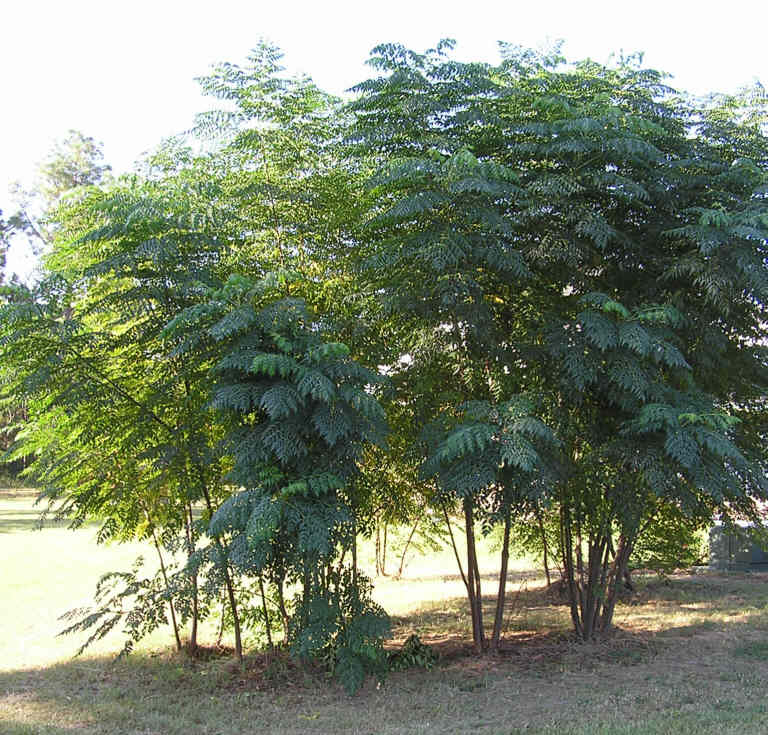
Aralia elata is native to eastern Asia, including Russia, China, Taiwan, the Korean Peninsula, and Japan. It has gray, rough, prickly bark, large double-pinnate leaves, and small white flowers arranged in large umbels.
Written 26 November 2026 from the sources listed below. Each statement was checked against the passage it cites; statements that could not be supported were removed.
Appearance
Japanese angelica tree is an upright, spiny deciduous tree or shrub that can reach 10 m in height. Its bark is gray, rough, and prickly.[1][2][3][4]
Its alternate leaves are double pinnate and measure 60–120 cm in length. It produces small white flowers arranged in large umbels in late summer, followed by small black drupes.[5][6][7][8]
Habitat
When cultivated, Japanese angelica tree prefers deep loamy soils and partial shade. It can also grow in poorer soils and full sun.[9][10]
Plants were studied in natural landscapes in Japan across gradients of light and soil nutrients.[11]
Diet
Young shoots of Japanese angelica tree are eaten in Japan during spring. In Japan, the shoots are harvested from branch ends and commonly prepared in tempura batter, although blanching and stir-frying are also used.[12][13][14]
In Korea, young shoots are harvested from early April to early May and are described as soft and fragrant. Korean preparations include blanching, pickling, pan-frying, and deep-frying.[15][16][17]
Behaviour
Absolute spine mass, spine mass fraction, total phenols, and condensed tannins increase with canopy openness. Total phenol content is negatively associated with soil nitrogen.[18][19]
Spiny-genotype individuals have lower total biomass than non-spiny-genotype individuals and are shorter under the reported glasshouse conditions. Spine development is costly to the plant.[20][21][22]
Under low-light conditions, spine mass fraction and total phenol content decrease in spiny-genotype individuals. Nutrient additions reduce spine mass fraction and total phenols without affecting absolute spine mass.[23][24]
Japanese angelica tree allocates more resources to spine development when carbohydrate supply is more plentiful. Light availability is a more important determinant of spine allocation than soil nutrients.[25][26]
The spines function as structural defences against large mammalian herbivores and can also provide structural defence against invertebrates.[27][28]
Uses
Japanese angelica tree is cultivated for its exotic appearance, sometimes in variegated forms. The cultivars Variegata and Aureovariegata have received the Royal Horticultural Society's Award of Garden Merit.[29][30]
Similar species
Japanese angelica tree is closely related to Aralia spinosa and can be confused with that species. It can be distinguished by having its inflorescence on a horizontal axis.[31][32]
Classification of the Japanese Angelica Tree
| Kingdom | Plantae |
|---|---|
| Subkingdom | Pteridobiotina |
| Phylum | Tracheophyta |
| Class | Magnoliopsida |
| Order | Apiales |
| Family | Araliaceae (Ginseng Family) |
| Subfamily | Aralioideae |
| Tribe | Aralieae |
| Genus | Aralia (Spikenard) |
| Species | Aralia elata (Miq.) Seem. |
Where the Japanese Angelica Tree is found
Checklists and occurrence records place Aralia elata in 12 countries across Asia, Europe and North America. GBIF holds 13,111 georeferenced records of it.
Countries where it is native or its origin is not stated
- Belgium 469
- China 836
- Japan 2,189
- Kazakhstan 6
- North Korea 88
- Russia 896
- South Korea 3,023
- Taiwan
- The Netherlands 734
Countries where it has been introduced
Regions and cities with the most records
- New York, United States 1,951
- New Rochelle, United States 1,111
- Mamaroneck, United States 1,107
- Pennsylvania, United States 1,081
- Harrison, United States 1,080
- The Bronx, United States 1,071
- Scarsdale, United States 1,069
- Port Washington, United States 1,038
- Mount Vernon, United States 1,024
- Yonkers, United States 1,020
- Manhattan, United States 1,006
- Greenburgh, United States 984
- Secaucus, United States 957
- Englewood, United States 956
- Dumont, United States 953
- Bergenfield, United States 952
- Cliffside Park, United States 952
- Union City, United States 950
- West New York, United States 949
- New Milford, United States 946
- Fort Lee, United States 945
- North Bergen, United States 942
- Palisades Park, United States 927
- Teaneck, United States 923
- Hackensack, United States 918
- Rye, United States 918
- Lodi, United States 890
- Paramus, United States 871
- White Plains, United States 856
- New Jersey, United States 713
- Philadelphia, United States 658
- Radnor, United States 657
- Drexel Hill, United States 653
- Havertown, United States 653
- Wayne, United States 645
- Primorye, Russia 635
18 more countries have a few records outside this range
These countries hold a few records of Aralia elata but lie outside the range the checklists give for it. Such records are often zoo or garden specimens, museum material or vagrants, so the species is not counted as occurring there.
Range as the checklists state it
Germany [I]; Russian Far East (Amur, Khabarovsk, Primorye, Sakhalin); China (Heilongjiang, Jilin, Liaoning, NE-Hebei, Shandong); North Korea; South Korea; Japan (Hokkaido, Honshu, Shikoku, Kyushu); Canada [I] (Ontario [I]); USA [I] (Connecticut [I], Illinois [I], Michigan [I], New Hampshire [I], New York [I], Ohio [I], Oregon [I], Pennsylvania [I], Washington State [I], Wisconsin [I])
A number beside a place is its count of GBIF occurrence records. A place without a number comes from a checklist alone. Records show where a species has been observed or collected, which can include escapes and vagrants.
Common names
English
- Japanese Angelica Tree
- Japanese Angelica-tree
- Japanese Aralia
Names in 9 other languages
- Chinese
- 刺龙牙, 楤木, 湖北楤木, 辽东惚木*(龙牙惚木、惚木), 辽东楤木, 龙牙楤木, 龙牙楤木叶, 龙牙楤木果
- Dutch
- Duivelswandelstok
- Finnish
- piikkiaralia
- French
- angélique du Japon, aralia élevé, aralie élevée
- German
- Hohe Aralie
- Norwegian Bokmål
- tornaralia
- Slovenian
- mandžurska aralija
- Swedish
- kinesisk parkaralia, parkaralia
- Welsh
- Aralia Japan, Araliâu Japan
Synonyms
35 other scientific names have been used for this species and are now treated as synonyms of Aralia elata.
- Aralia canescens Siebold & Zucc.
- Aralia chinensis var. albomarginata Bean
- Aralia chinensis var. aureovariegata Rehder
- Aralia chinensis var. canescens (Siebold & Zucc.) Lavallée
- Aralia chinensis var. canescens (Siebold & Zucc.) Koehne
- Aralia chinensis var. elata (Miq.) Lavallée
- Aralia chinensis var. fastigiata Skeels & Van Eselt.
- Aralia chinensis var. nuda Nakai
- Aralia chinensis var. pyramidalis Bean
- Aralia chinensis var. variegata (Anon.) Rehder
- Aralia elata (Miq.) Deeman
- Aralia elata f. aureovariegata (Rehder) Nakai
- Aralia elata f. canescens (Siebold & Zucc.) T.Yamaz.
- Aralia elata f. canescens (Siebold & Zucc.) Nakai
- Aralia elata f. fastigiata Rehder
- Aralia elata f. inermis M.Kim
- Aralia elata f. pyramidalis (Bean) Rehder
- Aralia elata f. rotundata (Nakai) W.Lee
- Aralia elata f. subinermis (Ohwi) Jôtani
- Aralia elata f. variegata (Anon.) Nakai
- Aralia elata var. canescens (Siebold & Zucc.) Nakai
- Aralia elata var. canescens (Siebold & Zucc.) Pojark.
- Aralia elata var. rotundata Nakai
- Aralia elata var. subinermis Ohwi
- Aralia emeiensis Z.Y.Zhu
- Aralia grandis Miq.
- Aralia hupehensis G.Hoo
- Aralia japonica var. variegata Anon.
- Aralia spinosa var. canescens (Siebold & Zucc.) Franch. & Sav.
- Aralia spinosa var. elata (Miq.) Sarg.
- Aralia subcapitata G.Hoo
- Dimorphanthus elatus Miq.
- Dimorphanthus mandshuricus var. argenteomarginatus Anon.
- Dimorphanthus mandshuricus var. variegatus (Anon.) Langworthy
- Aralia japonica Seem. ambiguous synonym
Subspecies and varieties
- Aralia elata var. elata (Japanese Aralia) variety
- Aralia elata var. glabrescens variety
- Aralia elata var. inermis variety
- Aralia elata var. ryukyuensis variety
Related species
-
 Devil's WalkingstickAralia spinosa
-
 Wild LicoriceAralia nudicaulis
-
 Japanese SpikenardAralia cordata
-
 American SpikenardAralia racemosa
-
 California SpikenardAralia californica
-
 Dwarf-elderAralia hispida
-
 Chinese Angelica TreeAralia chinensis
-
 Aralia rex
Compare
Questions and answers
What is the scientific name of the Japanese Angelica Tree?
The scientific name of the Japanese Angelica Tree is Aralia elata. Written with its author, the full name is Aralia elata (Miq.) Seem..
Which family does the Japanese Angelica Tree belong to?
Aralia elata belongs to the family Araliaceae, in the order Apiales and the class Magnoliopsida.
Where is the Japanese Angelica Tree found?
Checklists and occurrence records place Aralia elata in 12 countries, including South Korea, Japan, Russia, China, The Netherlands and Belgium.
What is the conservation status of the Japanese Angelica Tree?
The IUCN Red List category recorded for Aralia elata is Least Concern (LC).
What other names does the Japanese Angelica Tree have?
Aralia elata is also known in English as Japanese Angelica-tree and Japanese Aralia.
Does Japanese aralia like sun or shade?
When cultivated, Japanese angelica tree prefers partial shade, but it can also grow in full sun.[9][10]
How big does a Japanese aralia grow?
Japanese angelica tree can reach a height of 10 m. Its leaves measure 60–120 cm in length.[2][6]
Can you eat Devil's Walking Stick?
Young shoots of Japanese angelica tree are eaten in Japan during spring and are commonly prepared in tempura batter. In Korea, young shoots are also harvested and prepared by blanching, pickling, pan-frying, and deep-frying.[12][13][15][17]
Sources
Passages the profile rests on
- Aralia elata is an upright deciduous tree or shrub. Source passage: “It is an upright deciduous small tree or shrub growing up to 10 m (33 ft) in height.” — English Wikipedia
- Aralia elata can reach a height of 10 m. Source passage: “It is an upright deciduous small tree or shrub growing up to 10 m (33 ft) in height.” — English Wikipedia
- The bark of Aralia elata is gray, rough, and prickly. Source passage: “The bark is rough and gray with prickles.” — English Wikipedia
- Aralia elata is a spiny deciduous tree. Source passage: “Here, we investigated whether a spiny deciduous tree, Aralia elata (Miq.) Seem., changes its defence expression across light and nutrient gradients.” — pmc.ncbi.nlm.nih.gov
- The leaves are alternate and double pinnate. Source passage: “The leaves are alternate, large, 60–120 cm long, and double pinnate.” — English Wikipedia
- The leaves of Aralia elata measure 60–120 cm in length. Source passage: “The leaves are alternate, large, 60–120 cm long, and double pinnate.” — English Wikipedia
- Aralia elata produces small white flowers arranged in large umbels in late summer. Source passage: “The flowers are produced in large umbels in late summer, each flower small and white.” — English Wikipedia
- The fruit of Aralia elata is a small black drupe. Source passage: “The fruit is a small black drupe.” — English Wikipedia
- Aralia elata prefers deep loamy soils and partial shade when cultivated. Source passage: “It prefers deep loamy soils in partial shade” — English Wikipedia
- Aralia elata can also grow in poorer soils and full sun. Source passage: “but will grow in poorer soils and in full sun.” — English Wikipedia
- Aralia elata plants were studied in natural landscapes in Japan across gradients of light and soil nutrients. Source passage: “We measured allocation to spines and C-based secondary metabolites (condensed tannins and total phenols) on A. elata plants growing across light and nutrient gradients in situ in natural landscapes in Japan.” — pmc.ncbi.nlm.nih.gov
- The young shoots of Aralia elata are eaten in Japan during spring. Source passage: “In Japan, the shoots are eaten in the spring.” — English Wikipedia
- In Japan, the shoots are harvested from branch ends and commonly prepared in tempura batter. Source passage: “They are picked from the end of the branches and are commonly fried in a tempura batter.” — English Wikipedia
- Japanese culinary preparations of Aralia elata shoots also include blanching and stir-frying. Source passage: “They can also be blanched or stir fried, among other methods.” — English Wikipedia
- In Korea, young Aralia elata shoots are harvested from early April to early May. Source passage: “In Korea, young shoots are harvested during a month, from early April to early May, when they are soft and fragrant.” — English Wikipedia
- The young shoots harvested in Korea are described as soft and fragrant. Source passage: “when they are soft and fragrant.” — English Wikipedia
- Korean culinary preparations of Aralia elata shoots include blanching, pickling, pan-frying, and deep-frying. Source passage: “In Korean cuisine, the shoots are commonly eaten blanched, pickled, pan-fried, or deep-fried.” — English Wikipedia
- Absolute spine mass, spine mass fraction, total phenols, and condensed tannins increase with canopy openness in Aralia elata. Source passage: “In the field investigation, absolute spine mass, spine mass fraction, total phenols and condensed tannins all responded positively to canopy openness.” — pmc.ncbi.nlm.nih.gov
- Total phenol content in Aralia elata is negatively associated with soil nitrogen. Source passage: “Total phenol content was also negatively related to soil N.” — pmc.ncbi.nlm.nih.gov
- Spiny-genotype Aralia elata individuals have lower total biomass than non-spiny-genotype individuals. Source passage: “In the glasshouse, spiny genotype individuals had less total biomass, had lower stem allocation and were shorter than non-spiny genotype individuals.” — pmc.ncbi.nlm.nih.gov
- Spiny-genotype Aralia elata individuals are shorter than non-spiny-genotype individuals under the reported glasshouse conditions. Source passage: “In the glasshouse, spiny genotype individuals had less total biomass, had lower stem allocation and were shorter than non-spiny genotype individuals.” — pmc.ncbi.nlm.nih.gov
- Spine development in Aralia elata is costly to the plant. Source passage: “These results suggest that development of spines is costly for A. elata” — pmc.ncbi.nlm.nih.gov
- Spine mass fraction and total phenol content decrease under low-light conditions in spiny-genotype Aralia elata. Source passage: “In spiny genotype trees, both spine mass fraction and total phenols decreased under low light conditions.” — pmc.ncbi.nlm.nih.gov
- Nutrient additions reduce spine mass fraction and total phenols in Aralia elata without affecting absolute spine mass. Source passage: “Nutrient additions had negative effects on spine mass fraction and total phenols, but no effect on absolute spine mass.” — pmc.ncbi.nlm.nih.gov
- Aralia elata allocates more resources to spine development when carbohydrate supply is more plentiful. Source passage: “and receives greater allocation when carbohydrate supply is more plentiful.” — pmc.ncbi.nlm.nih.gov
- Light availability is a more important determinant of spine allocation in Aralia elata than soil nutrients. Source passage: “Thus, light is a more important determinant of spine allocation than soil nutrients for A. elata.” — pmc.ncbi.nlm.nih.gov
- The spines of Aralia elata function as structural defences against large mammalian herbivores. Source passage: “Plant spines are known to function as plant structural defences against large mammalian herbivores” — pmc.ncbi.nlm.nih.gov
- Aralia elata spines can also provide structural defence against invertebrates. Source passage: “and in some cases also against invertebrates” — pmc.ncbi.nlm.nih.gov
- Aralia elata is cultivated for its exotic appearance, sometimes in variegated forms. Source passage: “Aralia elata is cultivated, often in a variegated form, for its exotic appearance.” — English Wikipedia
- The cultivars Variegata and Aureovariegata have received the Royal Horticultural Society's Award of Garden Merit. Source passage: “The cultivars 'Variegata' and 'Aureovariegata' have gained the Royal Horticultural Society's Award of Garden Merit.” — English Wikipedia
- Aralia elata is closely related to Aralia spinosa and can be confused with that species. Source passage: “Aralia elata is closely related to the American species Aralia spinosa, with which it is easily confused.” — English Wikipedia
- Aralia elata can be distinguished from Aralia spinosa by having its inflorescence on a horizontal axis. Source passage: “A. elata can be differentiated by having its inflorescence on a horizontal axis.” — English Wikipedia
Data
- Catalogue of Life, 2026-10-16 XR cc by
- Global Biodiversity Information Facility CC BY 4.0
- Wikidata CC0
- GeoNames CC BY 4.0
- Wikimedia Commons per image; credit shown with each image
- Within the Catalogue of Life, this name comes from Synonymic Checklists of the Vascular Plants of the World cc by
References
- Seem. (1868). J. Bot. 6(65): 134 (1868). where the name was published
This species in other databases
Page built on 26 November 2026. See how the catalog is made and all sources and licences.
Cite this page
ScientificNames.org. (2026). Aralia elata (Japanese Angelica Tree). Retrieved November 26, 2026, from https://scientificnames.org/species/aralia-elata
“Aralia elata (Japanese Angelica Tree).” ScientificNames.org, 2026, scientificnames.org/species/aralia-elata. Accessed 26 Nov. 2026.
ScientificNames.org. “Aralia elata (Japanese Angelica Tree).” Accessed November 26, 2026. https://scientificnames.org/species/aralia-elata.
@misc{scientificnames_aralia_elata_japanese_angelica_tree,
  author = {{ScientificNames.org}},
  title = {Aralia elata (Japanese Angelica Tree)},
  year = {2026},
  url = {https://scientificnames.org/species/aralia-elata},
  note = {Accessed 2026-11-26}
}