Species · Mammals
Greater Hog Badger Arctonyx collaris
The scientific name of the Greater Hog Badger is Arctonyx collaris. It is a species of mammal in the family Mustelidae (mustelids), order Carnivora. The name dates from 1825.
- Scientific name
- Arctonyx collaris F. G. Cuvier, 1825
- Common name
- Greater Hog Badger
- Genus
- Arctonyx
- Family
- Mustelidae (Mustelids)
- Order
- Carnivora
- Class
- Mammalia
- Red List category
- VU Vulnerable
- Recorded in
- 8 countries
- Name status
- accepted in the Catalogue of Life

Overview
The Greater Hog Badger is the world's largest extant badger. It inhabits tropical evergreen forests and grasslands. It has a pig-like snout, two dark facial stripes, a white throat, and light-colored claws.
Written 26 November 2026 from the sources listed below. Each statement was checked against the passage it cites; statements that could not be supported were removed.
Appearance
The Greater Hog Badger has a stocky body and medium-length fur ranging from dark grey to brown. It has two dark facial stripes, a white throat, and a pink pig-like nose.[1][2][3]
Its tail ranges from white to light yellow and has long white hairs. Its front feet have light-colored or white claws.[4][2][5]
Its pig-like snout is adapted for feeding and detecting smells. Its teeth are modified for moving soil.[6][7]
The species measures 65–104 cm from snout to rump. Adults weigh approximately 7–14 kg, and males are larger than females.[8][9][10]
Habitat
The Greater Hog Badger inhabits grasslands, hills, mountains, tropical rainforests, tropical evergreen forests, and semi-evergreen forests.[11][12]
It occurs in the Terai region of the Indian subcontinent.[13]
Diet
The Greater Hog Badger is omnivorous. Its diet includes fruits, roots, tubers, plants, worms, small animals, and small mammals.[14][15][16]
Terrestrial earthworms appear to be its favorite food. It uses its pig-like snout to detect smells when locating food.[17][7]
Behaviour
The species digs underground to find food and create shelter. It uses its snout, incisors, and lower-jaw canine teeth to dig.[18][19]
When threatened, it can dig underground and disappear from sight. It can also produce secretions from its anal glands.[20][21]
Reproduction and life cycle
The breeding period extends from April to September. Gestation lasts between 5 and 9.5 months.[22][23]
Females give birth to litters of two to four cubs. They are the primary caregivers and nurse their young for up to four months.[24][25]
Conservation
The Greater Hog Badger is listed as Vulnerable on the IUCN Red List. Its global population is thought to be declining because of high levels of poaching.[26][27]
The species is threatened by the use of hunting dogs throughout Indochina. It has high protected status under law in Thailand and India.[28][29]
Uses
Some communities in India consume hog badger meat. Hog badgers are hunted and farmed for food in China.[30][31]
Classification of the Greater Hog Badger
| Kingdom | Animalia |
|---|---|
| Phylum | Chordata |
| Subphylum | Vertebrata |
| Infraphylum | Gnathostomata |
| Parvphylum | Osteichthyes |
| Megaclass | Tetrapoda |
| Class | Mammalia (Mammal) |
| Subclass | Theria |
| Infraclass | Eutheria |
| Order | Carnivora (Carnivores) |
| Suborder | Caniformia (Dog-like Carnivores) |
| Family | Mustelidae (Mustelids) |
| Subfamily | Melinae (Hog-badgers) |
| Genus | Arctonyx (Hog Badger) |
| Species | Arctonyx collaris F. G. Cuvier, 1825 |
Where the Greater Hog Badger is found
Checklists and occurrence records place Arctonyx collaris in 8 countries across Asia. GBIF holds 1,624 georeferenced records of it.
Countries
Regions and cities with the most records
- Zhejiang, China 1,022
- Anhui, China 377
- Biyang, China 138
- Khammouane Province, Laos 10
- Assam, India 7
- Koh Kong, Cambodia 6
- Uthai Thani, Thailand 6
- Jiangxi, China 5
- Champasak Province, Laos 4
- Fujian, China 4
- Houaphan, Laos 4
- Kamphaeng Phet, Thailand 4
- Biswanath Chariali, India 3
- Bolikhamsai, Laos 3
- Chiang Mai, Thailand 3
- Hunan, China 3
- Krabi, Thailand 3
- Krabi, Thailand 3
- Kratie, Cambodia 3
- Loei, Thailand 3
- Ninh Binh, Vietnam 3
- Phetchaburi, Thailand 3
- Satun, Thailand 3
- Vĩnh Yên, Vietnam 3
Range as the checklists state it
Southern Asia
A number beside a place is its count of GBIF occurrence records. A place without a number comes from a checklist alone. Records show where a species has been observed or collected, which can include escapes and vagrants.
Common names
English
- Greater Hog Badger
- Burmese Hog Badger
- Greater Hog-badger
- Hog Badger
- Indochinese Hog Badger
Names in 21 other languages
- Arabic
- غرير خنزيري كبير
- Bengali
- ঘরখুদিনি
- Chinese
- 豬獾, 豬獾屬
- Czech
- jezevec bělohrdlý
- Danish
- Svinegrævling
- Dutch
- Grote Varkensdas
- Finnish
- kaulusmäyrä
- French
- Grand balisaur, Grand blaireau à gorge blanche
- German
- Riesendachs, Schweinsdachs
- Hebrew
- גירית דובית
- Italian
- Tasso naso di porco
- Japanese
- ブタバナアナグマ
- Korean
- 돼지코오소리
- Norwegian Bokmål
- Indokinasvinegrevling
- Polish
- Balizaur, balizuar obrożny
- Portuguese
- Texugo-Porco
- Russian
- Свиной барсук
- Spanish
- Tejón Porcino mayor, Tejón porcino
- Swedish
- svingrävling
- Thai
- หมูหริ่ง
- Turkish
- Domuz porsuğu
Synonyms
6 other scientific names have been used for this species and are now treated as synonyms of Arctonyx collaris.
- Arctonyx annaeus Thomas, 1921
- Arctonyx collaris collaris F. G. Cuvier, 1825
- Arctonyx collaris consul Pocock, 1940
- Arctonyx collaris dictator Thomas, 1910
- Arctonyx collaris nemaeus Pocock, 1941
- Arctonyx dictator Thomas, 1910
Related species
-
 Northern Hog BadgerArctonyx albogularis
- Sumatran Hog BadgerArctonyx hoevenii
-
 WolverineGulo gulo
-
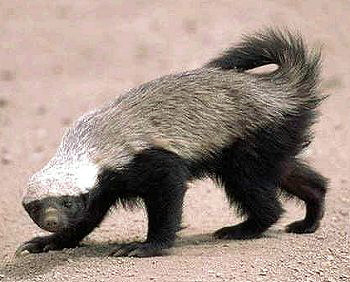 Honey BadgerMellivora capensis
-
 StoatMustela erminea
-
 Sea OtterEnhydra lutris
- SableMartes zibellina
-
 European Pine MartenMartes martes
Compare
Questions and answers
What is the scientific name of the Greater Hog Badger?
The scientific name of the Greater Hog Badger is Arctonyx collaris. Written with its author, the full name is Arctonyx collaris F. G. Cuvier, 1825.
Which family does the Greater Hog Badger belong to?
Arctonyx collaris belongs to the family Mustelidae, in the order Carnivora and the class Mammalia.
Where is the Greater Hog Badger found?
Checklists and occurrence records place Arctonyx collaris in 8 countries, including China, Thailand, Cambodia, Laos, Indonesia and India.
What is the conservation status of the Greater Hog Badger?
The IUCN Red List category recorded for Arctonyx collaris is Vulnerable (VU).
What other names does the Greater Hog Badger have?
Arctonyx collaris is also known in English as Burmese Hog Badger, Greater Hog-badger, Hog Badger and Indochinese Hog Badger.
What is the biggest badger ever?
The Greater Hog Badger is described as the world's largest extant badger.[32]
What do hog badgers eat?
Hog badgers are omnivorous. Their diet includes fruits, roots, tubers, plants, worms, small animals, and small mammals. Terrestrial earthworms appear to be their favorite food.[14][15][16][17]
Is a badger herbivore, carnivore, or omnivore?
The Greater Hog Badger is an omnivore.[14]
Sources
Passages the profile rests on
- The greater hog badger has medium-length brown hair, a stocky body, a white throat, two black facial stripes, and a pink pig-like nose. Source passage: “The greater hog badger has medium-length brown hair, a stocky body, white throat, two black stripes on an elongated white snout, with a pink, pig-like nose.” — English Wikipedia
- Its fur ranges from dark grey to brown, while its tail ranges from white to light yellow. Source passage: “Their fur color ranges from a dark grey to brown, while tail color ranges from white to a light yellow.” — animaldiversity.org
- The species has two dark facial stripes and a white throat. Source passage: “Two dark stripes are found on the face, and the throat is white in color.” — animaldiversity.org
- The species has long white hairs on its tail and white claws on its front feet. Source passage: “Its tail has long white hairs, and its front feet have white claws.” — English Wikipedia
- The species has light-colored claws, unlike the dark claws of Eurasian badgers. Source passage: “Hog badgers have light-colored claws whereas Eurasian badgers have dark claws.” — animaldiversity.org
- Its pig-like snout is adapted for feeding and is accompanied by teeth modified for moving soil. Source passage: “The most notable feature is the "pig-like snout" that is used for feeding, along with modified teeth specifically used to move soil.” — animaldiversity.org
- The species locates food using its pig-like snout to detect smells. Source passage: “It is able to find food using its adapted pig like snout to sense smells.” — animaldiversity.org
- The species measures 65–104 cm from snout to rump. Source passage: “The snout-to-rump length is 65–104 cm (26–41 in)” — English Wikipedia
- Adults weigh approximately 7–14 kg. Source passage: “the body weight is 7–14 kg (15–31 lb).” — English Wikipedia
- Males are larger than females. Source passage: “males are larger than females.” — animaldiversity.org
- The species inhabits tropical evergreen forests and grasslands. Source passage: “living in tropical evergreen forests and grasslands.” — English Wikipedia
- Its recorded habitats include grasslands, hills, mountains, tropical rainforests, tropical evergreen forests, and semi-evergreen forests. Source passage: “Hog badgers are found in grasslands, hills, mountains, tropical rainforests, tropical evergreen, and semi-evergreen forests.” — animaldiversity.org
- The species occurs in the Terai region of the Indian subcontinent. Source passage: “They are also to be found in the Terai of the Indian subcontinent” — English Wikipedia
- The species is omnivorous and eats fruits, roots, and small animals. Source passage: “The hog badger is omnivorous; its diet consists of fruits, roots and small animals.” — English Wikipedia
- Its diet includes plants, worms, and small mammals. Source passage: “Hog badgers feed on a variety of things based on what is available ranging from plants to worms to small mammals.” — animaldiversity.org
- The species eats fruit, roots, and tubers. Source passage: “They will also eat fruit, roots and tubers.” — animaldiversity.org
- Terrestrial earthworms appear to be its favorite food. Source passage: “Its favorite food appears to be terrestrial earthworms.” — animaldiversity.org
- The species digs underground to find food and create shelter. Source passage: “Hog badgers often burrows into the ground (fossorial) to find food or to create a habitat.” — animaldiversity.org
- The species uses its snout, incisors, and lower-jaw canine teeth to dig. Source passage: “They dig in the ground using their snout, incisors, and canine teeth of their lower jaws.” — animaldiversity.org
- The species can dig underground out of sight when threatened. Source passage: “Hog badgers are great diggers, and can dig out of sight if it feels threatened.” — animaldiversity.org
- The species can produce secretions from its anal glands. Source passage: “Also, they can produce secretions from their anal glands, but it is unknown whether or not that is a defense mechanism.” — animaldiversity.org
- The breeding period extends from April to September. Source passage: “The breeding period occurs from April to September” — animaldiversity.org
- Gestation lasts between 5 and 9.5 months. Source passage: “with the gestation period being 5 to 9.5 months long.” — animaldiversity.org
- Females give birth to litters of two to four cubs. Source passage: “Their litter size is 2 to 4 cubs.” — animaldiversity.org
- Females are the primary caregivers and nurse their young for up to four months. Source passage: “Females are the primary caretakers of the young, and wean them for up to 4 months.” — animaldiversity.org
- The greater hog badger is listed as Vulnerable on the IUCN Red List. Source passage: “It is listed as Vulnerable in the IUCN Red List of Threatened Species” — English Wikipedia
- Its global population is thought to be declining because of high levels of poaching. Source passage: “because the global population is thought to be declining due to high levels of poaching.” — English Wikipedia
- The species is threatened by the use of hunting dogs throughout Indochina. Source passage: “They are threatened due to the use of hunting dogs in all of Indochina.” — animaldiversity.org
- The species has high protected status under law in Thailand and India. Source passage: “In Thailand and India, they are under high protected statuses under law.” — animaldiversity.org
- Some communities in India consume hog badger meat. Source passage: “some groups in India eat hog badgers” — animaldiversity.org
- Hog badgers are hunted and farmed for food in China. Source passage: “they are hunted and farmed for food in China.” — animaldiversity.org
- The species is described as the world's largest extant badger. Source passage: “The world's largest extant badger, A. collaris co-occurs with A. albogularis in eastern India” — pmc.ncbi.nlm.nih.gov
Data
- Catalogue of Life, 2026-10-16 XR cc by
- Global Biodiversity Information Facility CC BY 4.0
- Wikidata CC0
- GeoNames CC BY 4.0
- Wikimedia Commons per image; credit shown with each image
- Within the Catalogue of Life, this name comes from The Integrated Taxonomic Information System cc0
References
- In E. Geoffroy Saint-Hilaire and F. G. Cuvier, Hist. Nat. Mammifères, pt. 3 vol.5 51 p."Bali-saur", 2 pp., 1 pl. where the name was published
- Wilson, Don E., and DeeAnn M. Reeder, eds. (1993). Mammal Species of the World: A Taxonomic and Geographic Reference, 2nd Ed., 3rd Printing.
- Wilson, Don E., and F. Russell Cole. (2000). Common Names of Mammals of the World.
- Wilson, Don E., and DeeAnn M. Reeder, eds. (2005). Mammal Species of the World: A Taxonomic and Geographic Reference, 3rd Ed., Vols. 1 & 2.
- Helgen, Kristofer M., Norman T.-L. Lim, and Lauren E. Helgen. (2008). The hog-badger is not an edentate: systematics and evolution of the genus Arctonyx (Mammalia: Mustelidae). Zoological Journal of the Linnean Society, Vol. 154, No. 2.
- Larivière, S., and A. P. Jennings / Don E. Wilson and Russell A. Mittermeier, eds. (2009). Family Mustelidae (Weasels and relatives). Handbook of the Mammals of the World. Vol. 1: Carnivores.
- Sato, Jun J. / Proulx, G., and E. Do Linh San, eds. (2016). Chapter 1: The Systematics and Taxonomy of the World’s Badger Species - A Review. Badgers: Systematics, Biology, Conservation and Research Techniques.
- Burgin, Connor J., Don E. Wilson, Russell A. Mittermeier, Anthony B. Rylands, et al. (2020). Illustrated Checklist of the Mammals of the World. Vol. 1. Monotremata to Rodentia.
This species in other databases
Page built on 27 November 2026. See how the catalog is made and all sources and licences.
Cite this page
ScientificNames.org. (2026). Arctonyx collaris (Greater Hog Badger). Retrieved November 27, 2026, from https://scientificnames.org/species/arctonyx-collaris
“Arctonyx collaris (Greater Hog Badger).” ScientificNames.org, 2026, scientificnames.org/species/arctonyx-collaris. Accessed 27 Nov. 2026.
ScientificNames.org. “Arctonyx collaris (Greater Hog Badger).” Accessed November 27, 2026. https://scientificnames.org/species/arctonyx-collaris.
@misc{scientificnames_arctonyx_collaris_greater_hog_badger,
  author = {{ScientificNames.org}},
  title = {Arctonyx collaris (Greater Hog Badger)},
  year = {2026},
  url = {https://scientificnames.org/species/arctonyx-collaris},
  note = {Accessed 2026-11-27}
}