Species · Flowering plants
Absinthe Wormwood Artemisia absinthium
The scientific name of the Absinthe Wormwood is Artemisia absinthium. It is a species of flowering plant in the family Asteraceae (composite), order Asterales.
- Scientific name
- Artemisia absinthium L.
- Common name
- Absinthe Wormwood
- Genus
- Artemisia
- Family
- Asteraceae (Composite)
- Order
- Asterales
- Class
- Magnoliopsida
- Recorded in
- 85 countries
- Name status
- accepted in the Catalogue of Life

Overview
Absinthe wormwood (Artemisia absinthium L.) is a herbaceous perennial flowering plant in the family Asteraceae, order Asterales and class Magnoliopsida. It is native to North Africa and temperate regions of Eurasia and is naturalized in Canada, the northern United States, much of the United States and the Kashmir Valley of India. It has silvery-grey, deeply divided leaves, pale yellow nodding flower heads and a strong fragrance.
Written 26 November 2026 from the sources listed below. Each statement was checked against the passage it cites; statements that could not be supported were removed.
Appearance
Absinthe wormwood is a herbaceous perennial with fibrous roots, a central taproot and long-branching lateral roots. Its stems are straight, branched, grooved and silvery-green, with a woody structure and a strong fragrance resembling garden sage.[1][2][3][4]
The stems typically grow between 0.8 and 1.2 metres tall and rarely exceed 1.5 metres. The plant commonly reaches approximately 0.9 metres in height.[5][6]
The leaves are spirally arranged, greenish-grey above and white underneath, with fine, silky silvery-white hairs and small oil-producing glands. They are deeply divided into pinnate segments with rounded lobes.[7][8][9][10]
Basal leaves can reach 250 millimetres in length, while stem leaves typically measure between 50 and 100 millimetres. Leaves are also described as approximately 5 to 13 centimetres long and divided two or three times into deeply lobed leaflets.[11][12][13]
The flowers are pale yellow, small and tubular, arranged in spherical, downward-bending flower heads. Flower stalks emerge at the upper leaf nodes and bear numerous flower heads approximately 3 millimetres in diameter.[14][15][16]
The fruit is a small achene. The seeds are light brown, broader at the base than at the tip, smooth and without hairs.[17][18][19]
Habitat
Absinthe wormwood naturally grows on uncultivated arid ground, rocky slopes and along the edges of footpaths and fields. It grows in both dry and moist soils but is generally found in dry soils.[20][21][22]
Its habitats include pastures, cropland, farmsteads, shelterbelts, roadsides, fence rows and waste areas. The species also invades coniferous and hardwood forests, prairies, meadows, grasslands, fields and disturbed areas.[23][22]
The species can be cultivated in dry soil and prefers fertile, medium-weight soil with high nitrogen content and bright exposure.[24][25]
Behaviour
Absinthe wormwood is mildly rhizomatous and produces abundant seeds. It reproduces mainly through seed production but can also spread through short roots.[26][27][28]
Growing alongside other plants tends to inhibit their growth. Chemical compounds released by the species may inhibit some neighboring plants while stimulating the growth of others.[29][30]
The species readily produces self-sown offspring.[31]
Reproduction and life cycle
Flowering occurs from early summer to early autumn, and the species is pollinated by wind. Its fruit is a small achene, and its seeds are dispersed by gravity.[32][33][17][34]
The species reproduces mainly through seeds, which can remain viable for three to four years. Seedlings can emerge from late spring through early autumn.[28][35][36]
Absinthe wormwood can be propagated using ripened cuttings taken in spring or autumn in temperate climates. It can also be propagated from seeds sown in nursery beds.[37][38]
Uses
Absinthe wormwood is cultivated as an ornamental plant. It is used as an ingredient in absinthe and other alcoholic beverages and to flavor bitters, bäsk, vermouth and pelinkovac.[39][40][41]
Wormwood has traditionally been used as a bittering ingredient in farmhouse brewing in Denmark and Estonia. Wormwood clippings and cuttings are added to chicken nesting boxes to repel lice, mites and fleas.[42][43]
The plant has traditionally been used to manage digestive complaints, including indigestion, flatulence and gastric pain. Traditional medicinal uses also include treating hepatitis, gastritis and jaundice.[44][45]
The plant has documented antioxidant, antifungal and antimicrobial activities.[46]
Diet
Consumption of absinthe wormwood by cows can alter the flavor of their milk.[47]
Similar species
Artemisia ludoviciana differs from absinthe wormwood in having lance-shaped, undivided leaves with few or no lobes. Artemisia serrata has slender, lance-shaped leaves with toothed edges.[48][49]
Artemisia dracunculus has erect flower heads rather than the nodding heads of Artemisia absinthium.[50]
Classification of the Absinthe Wormwood
| Kingdom | Plantae |
|---|---|
| Subkingdom | Pteridobiotina |
| Phylum | Tracheophyta |
| Class | Magnoliopsida |
| Order | Asterales |
| Family | Asteraceae (Composite) |
| Subfamily | Asteroideae |
| Tribe | Anthemideae |
| Subtribe | Artemisiinae |
| Genus | Artemisia (Sagewort) |
| Species | Artemisia absinthium L. |
Where the Absinthe Wormwood is found
Checklists and occurrence records place Artemisia absinthium in 85 countries across Africa, Asia, Europe, North America, Oceania and South America. GBIF holds 109,164 georeferenced records of it.
Countries where it is native or its origin is not stated
- Afghanistan 37
- Aland Islands 82
- Albania 6
- Algeria 15
- Andorra 27
- Armenia 133
- Austria 1,734
- Azerbaijan 55
- Belarus 600
- Belgium 1,016
- Bosnia and Herzegovina 33
- Brazil 370
- Bulgaria 63
- China 51
- Croatia 114
- Czechia 1,084
- Denmark 659
- Estonia 941
- Finland 1,704
- France 14,164
- Georgia 50
- Greece 44
- Guernsey 4
- Hungary 216
- India 74
- Iran 25
- Ireland 13
- Isle of Man 88
- Italy 1,789
- Japan 17
- Jersey 1
- Kazakhstan 366
- Kosovo
- Kyrgyzstan 37
- Latvia 70
- Liechtenstein 1
- Lithuania 136
- Luxembourg 67
- Moldova 27
- Mongolia 5
- Montenegro 10
- Morocco 6
- North Macedonia
- Norway 1,123
- Pakistan 51
- Poland 2,685
- Romania 126
- Russia 18,939
- San Marino 1
- Serbia 19
- Slovakia 681
- Slovenia 60
- South Africa 10
- Spain 3,178
- Sweden 9,789
- Switzerland 5,356
- Syria 3
- Tajikistan 3
- The Netherlands 2,165
- Turkey 101
- Turkmenistan 3
- Ukraine 4,125
- United Kingdom 17,508
- Uzbekistan 32
Countries where it has been introduced
- Argentina 123
- Australia 56
- Bolivia 14
- Canada 5,790
- Chile 33
- Colombia 60
- Cuba 4
- Dominican Republic 1
- Ecuador 14
- Eritrea
- Ethiopia 11
- Germany 7,848
- Haiti 5
- Honduras
- Mexico 159
- New Zealand 35
- Paraguay 3
- Peru 20
- Portugal 63
- Puerto Rico
- United States 3,033
Regions and cities with the most records
- England, United Kingdom 15,128
- Auvergne-Rhône-Alpes, France 5,371
- Provence-Alpes-Côte d'Azur, France 5,000
- Valais, Switzerland 3,542
- Alberta, Canada 2,810
- Kalmar, Sweden 2,145
- Hucknall, United Kingdom 2,083
- Eastwood, United Kingdom 2,079
- Halesowen, United Kingdom 2,043
- Dudley, United Kingdom 2,039
- Heanor, United Kingdom 2,037
- Brierley Hill, United Kingdom 2,024
- Tipton, United Kingdom 2,009
- Ilkeston, United Kingdom 1,998
- West Bromwich, United Kingdom 1,958
- Stourbridge, United Kingdom 1,944
- Smethwick, United Kingdom 1,934
- Basford, United Kingdom 1,931
- Wednesbury, United Kingdom 1,927
- Arnold, United Kingdom 1,923
- Bartley Green, United Kingdom 1,890
- Ripley, United Kingdom 1,882
- Kingswinford, United Kingdom 1,876
- Stapleford, United Kingdom 1,861
- Walsall, United Kingdom 1,858
- Kirkby in Ashfield, United Kingdom 1,854
- Bavaria, Germany 1,817
- Nottingham, United Kingdom 1,798
- Birmingham, United Kingdom 1,779
- Long Eaton, United Kingdom 1,758
- Willenhall, United Kingdom 1,756
- Moscow Oblast, Russia 1,750
- Aldridge, United Kingdom 1,693
- Sutton in Ashfield, United Kingdom 1,689
- Bloxwich, United Kingdom 1,668
- Wednesfield, United Kingdom 1,664
4 more countries have a few records outside this range
These countries hold a few records of Artemisia absinthium but lie outside the range the checklists give for it. Such records are often zoo or garden specimens, museum material or vagrants, so the species is not counted as occurring there.
Range as the checklists state it
England (England, Wales, Isle of Man, Scotland, Isles of Scilly); Ireland (S-Ireland); Denmark; Norway; Sweden; Finland; Netherlands; Belgium; Luxembourg; Germany (Brandenburg, Berlin, Baden-Württemberg, Bayern, Hessen, Hamburg, Mecklenburg-Vorpommern, Niedersachsen, Nordrhein-Westfalen, Rheinland-Pfalz, Schleswig-Holstein, Saarland [I], Sachsen, Sachsen-Anhalt, Thüringen); Switzerland; Liechtenstein; Austria; Poland; Czech Republic; Slovakia; Hungary; Portugal; Spain; Andorra; France; Channel Isl. (Alderney, Guernsey, Jersey, Sark); Corsica; Sardinia; Italy; San Marino; Slovenia; Croatia; Bosnia & Hercegovina; Montenegro; Serbia; Kosovo; North Macedonia; Albania; Romania; Bulgaria; European Turkey; Greece (NW- & N-Greece); S-European Russia; Estonia; Latvia; Lithuania; Belarus; C-European Russia; E-European Russia; N-European Russia; NW-European Russia (incl. Kaliningrad region); Moldova; Ukraine; Crimea; Morocco; Algeria; Azores [I] (Sao Miguel Isl. [I]); Ethiopia [I]; Eritrea [I]; Siberia (Altay, Buryatia, Irkutsk, Krasnoyarsk, W-Siberia); Kazakhstan; Turkmenistan; Uzbekistan; Kyrgyzstan; Tajikistan; Northern Caucasus; Georgia [Caucasus]; Armenia; Azerbaijan (incl. Nachichevan); Turkey (E-Anatolia, Inner Anatolia, N-Anatolia, NE-Anatolia, NW-Anatolia: Bithynia, S-Anatolia, SE-Anatolia, SSW-Anatolia, SW-Anatolia); Iran (EC-Iran, NE-Iran: Mts., N-Iran, Iranian Aserbaijan, W-Iran); Afghanistan (Badakshan, Bamyan, Ghorat, Kabul, Wardak, Orozgan / Daykundi, Paktia / Khost, Parwan, Takhar); China (Jiangsu, Xinjiang); Pakistan (Kurram, Chitral); NW-India (Poonch, Jammu & Kashmir): Sulawesi [I]; Lesser Sunda Isl. [I]; Australia [I] (Western Australia [I], Queensland [I]); New Zealand [I]; Chatham Isl. [I]; Canada [I] (Alberta [I], British Columbia [I], Manitoba [I], New Brunswick [I], Newfoundland [I], Nova Scotia [I], Ontario [I], Prince Edward Isl. [I], Québec [I], Saskatchewan [I]); USA [I] (California [I], Colorado [I], Connecticut [I], Idaho [I], Illinois [I], Indiana [I], Iowa [I], Kansas [I], Maine [I], Maryland [I], Massachusetts [I], Michigan [I], Minnesota [I], Missouri [I], Montana [I], Nebraska [I], New Hampshire [I], New Jersey [I], New York [I], North Carolina [I], North Dakota [I], Ohio [I], Oregon [I], Pennsylvania [I], Rhode Island [I], South Carolina [I], South Dakota [I], Tennessee [I], Utah [I], Vermont [I], Washington [I], Wisconsin [I], Wyoming [I]); Mexico [I]; Honduras [I]; Cuba [I]; Dominican Republic [I]; Haiti [I]; Puerto Rico [I]; Virgin Isl. [I]; Colombia [I]; Ecuador [I]; Peru [I]; Bolivia [I]; Paraguay [I]; Argentina [I]; Chile [I] (Valparaíso [I], Maule [I], Ñuble [I], Biobío [I], Araucanía [I], Los Rios [I], Los Lagos [I], Magallanes [I]); Juan Fdz. Isl. [I]
A number beside a place is its count of GBIF occurrence records. A place without a number comes from a checklist alone. Records show where a species has been observed or collected, which can include escapes and vagrants.
Common names
English
- Absinthe Wormwood
- Wormwood
- Absinthe Sagewort
- Absinthium
Names in 34 other languages
- Arabic
- شيح ابن سينا
- Armenian
- Ափսինթ, Դառը օշինդր
- Basque
- Asentsio
- Belarusian
- Палын горкі
- Catalan
- Donzell
- Chinese
- ou zhou ai, zhong ya ku hao, 苦艾
- Croatian
- Pravi pelin
- Czech
- pelyněk pravý
- Danish
- Have-malurt, Havemalurt
- Dutch
- Absintalsem
- Estonian
- koirohi
- Finnish
- Koiruoho, mali
- French
- Grande absinthe, Herbe aux vers, absinthe, absinthe commune, armoise absinthe, armoise amère
- Galician
- Asente
- German
- Absinth, Wermut, Wermutkraut, echter Wermut
- Hungarian
- fehér üröm
- Italian
- Assenzio, Assenzio maggiore
- Japanese
- nigayomogi, アブサン, ニガヨモギ, 苦蓬
- Lithuanian
- Kartusis kietis, Pelynas
- Macedonian
- Пелин
- Northern Sami
- málurttas
- Norwegian Bokmål
- ekte malurt, malurt
- Polish
- Bylica piołun
- Portuguese
- absinto, losna
- Russian
- polyn gor'kaja, Полынь горькая
- Serbian
- Бели пелен
- Slovak
- palina pravá
- Spanish
- Ajenjo euroasiático, absintio, ajenjo
- Swedish
- malört, äkta malört
- Turkish
- Acı Pelin, Pelin otu
- Ukrainian
- Полин гіркий
- Welsh
- Canwraidd Lwyd, Chwermwd, Chwerwddwr, Chwerwlys, Chwerwlys Cyffredin, Chwerwyn, Chwerwyn Llwyd, Gannwreid
- arg
- Ixenzo
- frr
- Weremk
Synonyms
21 other scientific names have been used for this species and are now treated as synonyms of Artemisia absinthium.
- Absinthium bipedale Gilib.
- Absinthium majus Garsault
- Absinthium officinale Brot.
- Artemisia absinthia St.-Lag.
- Artemisia absinthium f. argentea (Aspegren ex Svanlund) Neuman
- Artemisia absinthium f. contracta Werner Christ.
- Artemisia absinthium var. absinthium
- Artemisia absinthium var. argentea Aspegren ex Svanlund
- Artemisia absinthium var. insipida Stechm.
- Artemisia arborescens f. rehan (Chiov.) Chiov.
- Artemisia arborescens var. cupaniana Chiov.
- Artemisia baldaccii Degen
- Artemisia doonense Royle
- Artemisia kulbadica Boiss. & Buhse
- Artemisia rehan Chiov.
- Artemisia rhaetica Brügger
- Tanacetum absinthium L.
- Tanacetum kulbadica Boiss. & Buhse
- Absinthium vulgare Lam. ambiguous synonym
- Artemisia inodora Mill. ambiguous synonym
- Artemisia pendula Salisb. ambiguous synonym
Related species
-
 TarragonArtemisia dracunculus
-
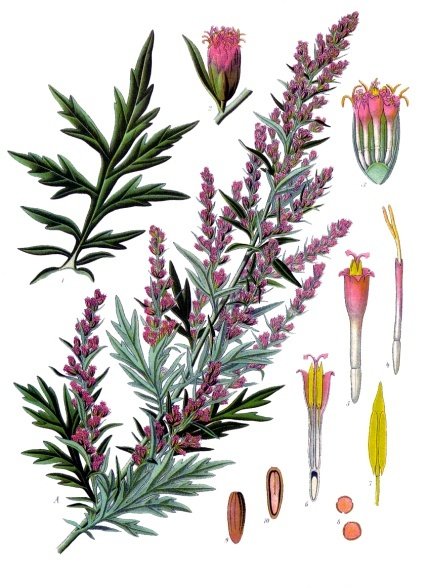 MugwortArtemisia vulgaris
-
 Annual WormwoodArtemisia annua
-
 Big SagebrushArtemisia tridentata
-
 Chinese MugwortArtemisia argyi
-
 Japanese MugwortArtemisia princeps
-
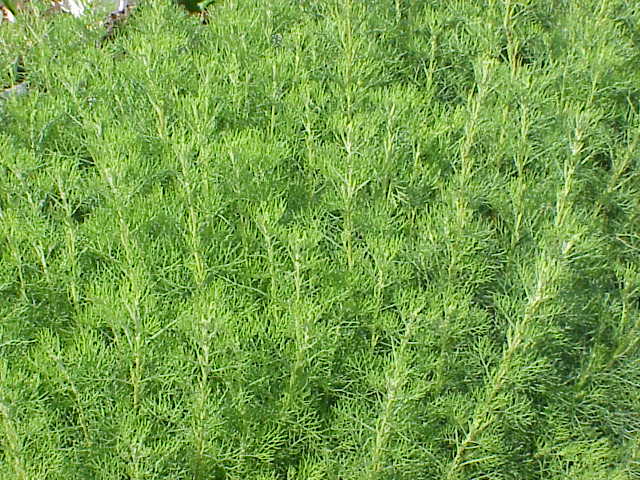 Lad's-loveArtemisia abrotanum
-
 White SageArtemisia ludoviciana
Compare
Questions and answers
What is the scientific name of the Absinthe Wormwood?
The scientific name of the Absinthe Wormwood is Artemisia absinthium. Written with its author, the full name is Artemisia absinthium L..
Which family does the Absinthe Wormwood belong to?
Artemisia absinthium belongs to the family Asteraceae, in the order Asterales and the class Magnoliopsida.
Where is the Absinthe Wormwood found?
Checklists and occurrence records place Artemisia absinthium in 85 countries, including Russia, United Kingdom, France, Sweden, Switzerland and Ukraine.
What other names does the Absinthe Wormwood have?
Artemisia absinthium is also known in English as Wormwood, Absinthe Sagewort and Absinthium.
What does wormwood do to the human body?
Absinthe wormwood has traditionally been used to manage digestive complaints, including indigestion, flatulence and gastric pain. Traditional medicinal uses also include treating hepatitis, gastritis and jaundice. The plant has documented antioxidant, antifungal and antimicrobial activities.[44][45][46]
Is wormwood toxic to humans?
Long-term use of absinthe wormwood essential oil may cause toxic and mental disorders in humans.[51]
Where is wormwood naturally found?
Absinthe wormwood is native to North Africa and temperate regions of Eurasia. It is naturally found on uncultivated arid ground, rocky slopes and along the edges of footpaths and fields.[20][52]
Can people eat wormwood?
Absinthe wormwood is used as an ingredient in absinthe and other alcoholic beverages and to flavor bitters, bäsk, vermouth and pelinkovac. Long-term use of its essential oil may cause toxic and mental disorders in humans.[40][41][51]
Is Artemisia poisonous to humans?
Long-term use of the essential oil of Artemisia absinthium may cause toxic and mental disorders in humans.[51]
Sources
Passages the profile rests on
- Artemisia absinthium is a herbaceous perennial with fibrous roots and straight, branched stems. Source passage: “A. absinthium is a herbaceous perennial plant with fibrous roots. The stems are straight, growing to 0.8–1.2 m” — English Wikipedia
- The stems are grooved, branched and silvery-green, with a strong odor. Source passage: “grooved, branched, and silvery-green with a strong odor.” — English Wikipedia
- The plant has a woody stem and a fragrance resembling garden sage. Source passage: “A fragrant perennial herbaceous plant with a woody stem. The fragrance resembles that of garden sage.” — dnr.wisconsin.gov
- The root system includes a central taproot and long-branching lateral roots. Source passage: “Plants have central taproots as well as long-branching lateral roots.” — dnr.wisconsin.gov
- The stems typically grow to between 0.8 and 1.2 metres tall and rarely exceed 1.5 metres. Source passage: “growing to 0.8–1.2 m (2 ft 7 in – 3 ft 11 in) (and rarely over 1.5 metres (4 ft 11 in)) tall” — English Wikipedia
- The plant commonly reaches approximately 0.9 metres in height and can sometimes grow to approximately 1.5 metres. Source passage: “It commonly grows to 3 feet tall (sometimes to 5 feet tall).” — nwcb.wa.gov
- The leaves are spirally arranged, greenish-grey above and white underneath, with silky silvery-white hairs and small oil-producing glands. Source passage: “Leaves are spirally arranged, greenish-grey colored above, white below, covered with silky silvery-white trichomes, and bearing minute oil-producing glands.” — English Wikipedia
- Its leaves are light green-grey and covered with fine, silky white hairs. Source passage: “Leaves are light green-greyish and covered in fine, silky white hairs.” — dnr.wisconsin.gov
- Its leaves are deeply divided into pinnate segments with rounded lobes. Source passage: “Deeply pinnately divided with round lobes/edges.” — dnr.wisconsin.gov
- The plant has a gray-green appearance because it is covered with fine, silky hairs. Source passage: “Plant is covered with fine, silky hairs and has a gray-green appearance.” — nwcb.wa.gov
- The basal leaves can reach 250 millimetres in length. Source passage: “The basal leaves are up to 250 mm (10 in) long” — English Wikipedia
- The stem leaves typically measure between 50 and 100 millimetres long. Source passage: “with the cauline leaves (those on the stem) smaller, 50–100 mm (2–4 in) long” — English Wikipedia
- Its leaves are approximately 5 to 13 centimetres long and divided two or three times into deeply lobed leaflets. Source passage: “Leaves are 2 to 5 inches long, divided two or three times into deeply lobed leaflets.” — nwcb.wa.gov
- The flowers are pale yellow, tubular and arranged in spherical, downward-bending flower heads. Source passage: “Flowers are pale yellow, tubular, and clustered in spherical bent-down heads (capitula)” — English Wikipedia
- Its flowers are small and tubular, forming yellow clusters on drooping stalks. Source passage: “Small tubular flowers borne on dangling and dropping stalks form yellow clusters.” — dnr.wisconsin.gov
- Its flower stalks emerge at the upper leaf nodes and bear numerous yellow flower heads approximately 3 millimetres in diameter. Source passage: “Flower stalks appear at each upper leaf node and produce numerous yellow flower heads that are 1/8 inch in diameter.” — nwcb.wa.gov
- Its fruit is a small achene. Source passage: “The fruit is a small achene.” — English Wikipedia
- Its seeds are light brown and broader at the base than at the tip. Source passage: “Light brown seeds are shaped like sunflowers seeds, broader at the base and more narrow at the tip.” — dnr.wisconsin.gov
- The seeds are smooth and lack hairs. Source passage: “Seeds (achenes) are smooth and hairless.” — nwcb.wa.gov
- The species naturally grows on uncultivated arid ground, rocky slopes and along the edges of footpaths and fields. Source passage: “A. absinthium grows naturally on uncultivated arid ground, on rocky slopes, and at the edge of footpaths and fields.” — English Wikipedia
- The species grows in both dry and moist soils. Source passage: “The plant grows in both dry and moist soils.” — nwcb.wa.gov
- It is generally found in dry soils in pastures, cropland, farmsteads, shelterbelts, roadsides, fence rows and waste areas. Source passage: “Absinth wormwood is generally found on dry soils in pastures, cropland, farmsteads, shelterbelts, roadsides, fence rows and waste areas.” — nwcb.wa.gov
- The species invades coniferous and hardwood forests, prairies, meadows, grasslands, fields and disturbed areas. Source passage: “Invades coniferous and hardwood forests, prairies, meadows, grasslands, fields, and disturbed areas.” — dnr.wisconsin.gov
- The species can be cultivated in dry soil. Source passage: “The plant can easily be cultivated in dry soil.” — English Wikipedia
- The species prefers fertile, medium-weight soil with high nitrogen content and bright exposure. Source passage: “It should be planted under bright exposure in fertile, midweight soil. It prefers soil rich in nitrogen” — English Wikipedia
- The species is mildly rhizomatous. Source passage: “Plants are mildly rhizomatous.” — dnr.wisconsin.gov
- The species produces abundant seeds. Source passage: “Plants are prolific seed producers.” — dnr.wisconsin.gov
- The species reproduces mainly through seed production but can also spread through short roots. Source passage: “Reproduces primarily through seed production, but can also spread by short roots.” — nwcb.wa.gov
- Growing alongside other plants tends to inhibit their growth. Source passage: “Growing the plant with others tends to stunt their growth” — English Wikipedia
- Chemical compounds released by the species may inhibit some neighboring plants while stimulating the growth of others. Source passage: “Chemical compounds may inhibit the growth of some surrounding plant species while stimulating the growth of others.” — dnr.wisconsin.gov
- The species readily produces self-sown offspring. Source passage: “A. absinthium also self-seeds generously.” — English Wikipedia
- Flowering occurs from early summer to early autumn. Source passage: “Flowering occurs from early summer to early autumn” — English Wikipedia
- The species is pollinated by wind. Source passage: “pollination is anemophilous.” — English Wikipedia
- Its seeds are dispersed by gravity. Source passage: “Seed dispersal occurs by gravity.” — English Wikipedia
- Seedlings can emerge from late spring through early autumn. Source passage: “seedlings emerging anytime from late spring to early fall.” — nwcb.wa.gov
- Its seeds can remain viable for three to four years. Source passage: “Seeds may remain viable for 3 to 4 years.” — nwcb.wa.gov
- The species can be propagated using ripened cuttings taken in spring or autumn in temperate climates. Source passage: “can be propagated by ripened cuttings taken in spring or autumn in temperate climates” — English Wikipedia
- The species can also be propagated from seeds sown in nursery beds. Source passage: “or by seeds in nursery beds.” — English Wikipedia
- The species is cultivated as an ornamental plant. Source passage: “It is grown as an ornamental plant” — English Wikipedia
- The species is used as an ingredient in absinthe and other alcoholic beverages. Source passage: “is used as an ingredient in the spirit absinthe and some other alcoholic beverages.” — English Wikipedia
- The plant is used to flavor bitters, bäsk, vermouth and pelinkovac. Source passage: “including bitters, bäsk, vermouth, and pelinkovac.” — English Wikipedia
- Wormwood has traditionally been used as a bittering ingredient in farmhouse brewing in Denmark and Estonia. Source passage: “Wormwood was traditionally relatively common as a bittering spice in farmhouse brewing in Denmark, and to some extent Estonia.” — English Wikipedia
- Wormwood clippings and cuttings are added to chicken nesting boxes to repel lice, mites and fleas. Source passage: “Wormwood clippings and cuttings are added to chicken nesting boxes to repel lice, mites, and fleas.” — English Wikipedia
- The plant has traditionally been used to manage digestive complaints including indigestion, flatulence and gastric pain. Source passage: “dyspepsia, indigestion, flatulence, gastric pain” — pmc.ncbi.nlm.nih.gov
- Traditional medicinal uses include treating hepatitis, gastritis and jaundice. Source passage: “hepatocyte enlargement, hepatitis, gastritis, jaundice” — pmc.ncbi.nlm.nih.gov
- The plant has documented antioxidant, antifungal and antimicrobial activities. Source passage: “It has also been documented to possess antioxidant, antifungal, antimicrobial” — pmc.ncbi.nlm.nih.gov
- Consumption of the plant by cows can alter the flavor of their milk. Source passage: “It alters the flavor of milk when cows consume the plant.” — dnr.wisconsin.gov
- Artemisia ludoviciana differs from wormwood in having lance-shaped, undivided leaves with few or no lobes. Source passage: “Artemisia ludoviciana [native] – Leaves are lance-shaped and undivided (with few to no lobes).” — dnr.wisconsin.gov
- Artemisia serrata has slender, lance-shaped leaves with toothed edges. Source passage: “Artemisia serrata [native] – Lance-shaped slender leaves have toothed edges.” — dnr.wisconsin.gov
- Artemisia dracunculus has erect flower heads rather than the nodding heads of Artemisia absinthium. Source passage: “Artemisia dracunculus [native, particular concern] – Flower heads are erect, not nodding like the invasive A. absinthium.” — dnr.wisconsin.gov
- Long-term use of the essential oil may cause toxic and mental disorders in humans. Source passage: “Long-term use of A. absinthium essential oil may cause toxic and mental disorders in humans” — pmc.ncbi.nlm.nih.gov
- The species is native to North Africa and temperate regions of Eurasia. Source passage: “native to North Africa and temperate regions of Eurasia” — English Wikipedia
Data
- Catalogue of Life, 2026-10-16 XR cc by
- Global Biodiversity Information Facility CC BY 4.0
- Wikidata CC0
- GeoNames CC BY 4.0
- Wikimedia Commons per image; credit shown with each image
- Within the Catalogue of Life, this name comes from Synonymic Checklists of the Vascular Plants of the World cc by
References
- L. (1753). Sp. Pl. [Linnaeus] 2: 848 (1753). where the name was published
This species in other databases
Page built on 27 November 2026. See how the catalog is made and all sources and licences.
Cite this page
ScientificNames.org. (2026). Artemisia absinthium (Absinthe Wormwood). Retrieved November 27, 2026, from https://scientificnames.org/species/artemisia-absinthium
“Artemisia absinthium (Absinthe Wormwood).” ScientificNames.org, 2026, scientificnames.org/species/artemisia-absinthium. Accessed 27 Nov. 2026.
ScientificNames.org. “Artemisia absinthium (Absinthe Wormwood).” Accessed November 27, 2026. https://scientificnames.org/species/artemisia-absinthium.
@misc{scientificnames_artemisia_absinthium_absinthe_wormwood,
  author = {{ScientificNames.org}},
  title = {Artemisia absinthium (Absinthe Wormwood)},
  year = {2026},
  url = {https://scientificnames.org/species/artemisia-absinthium},
  note = {Accessed 2026-11-27}
}