Species · Flowering plants
Japanese Mugwort Artemisia princeps
The scientific name of the Japanese Mugwort is Artemisia princeps. It is a species of flowering plant in the family Asteraceae (composite), order Asterales.
- Scientific name
- Artemisia princeps Pamp.
- Common name
- Japanese Mugwort
- Genus
- Artemisia
- Family
- Asteraceae (Composite)
- Order
- Asterales
- Class
- Magnoliopsida
- Recorded in
- 6 countries
- Name status
- accepted in the Catalogue of Life

Overview
The species is native to China, Japan, and Korea. It has feather-shaped, scalloped, light green leaves with dense white fuzz underneath and produces small, buff-coloured flowers.
Written 26 November 2026 from the sources listed below. Each statement was checked against the passage it cites; statements that could not be supported were removed.
Appearance
The leaves are feather-shaped, scalloped, and light green, with dense white fuzz on their undersides. The plant produces small, buff-coloured flowers.[1][2]
Japanese mugwort can grow to a height of 1.2 metres.[3]
Habitat
The species grows along roadsides, on slopes, in valleys, and beside riverbanks. It is native to China, Japan, and Korea.[4][5]
The species has been introduced into Belgium and the Netherlands. It is actively cultivated in Hawaii.[6][7]
Behaviour
Japanese mugwort spreads rapidly through underground stolons. Its underground stolons enable rapid spread.[8]
Reproduction and life cycle
The species produces hermaphroditic flowers, which are pollinated by wind. Flowering occurs from July through November.[9][10][11]
Uses
The leaves and young seedlings are consumed either raw or cooked. They can be added to salads and soups after their bitterness is removed.[12][13]
In Japan, the herb is used to flavour glutinous rice dumplings called kusa mochi or yomogi mochi. It is also used to flavour rice flour dumplings called kusa dango.[14][15]
Young leaves can be lightly boiled, pounded, and added to foods to provide colour, aroma, and flavour. In Japanese cuisine, the leaves are sometimes blanched and added to soups or rice.[16][17]
In Korea, the species is used in traditional cuisine and traditional medicine. Korean springtime dishes made with its young leaves include jeon, ssuk kimchi, and ssukguk.[18][19]
Fresh leaves and dried ground leaves are used as ingredients in Korean rice cakes. The species is also used to flavour and colour ice cream, breads, cakes, tea, and lattes in Korea.[20][21]
The species is used in moxibustion, a traditional medical practice. This practice is used in China, Korea, Mongolia, Tibet, Nepal, and Vietnam.[22][23]
Classification of the Japanese Mugwort
| Kingdom | Plantae |
|---|---|
| Subkingdom | Pteridobiotina |
| Phylum | Tracheophyta |
| Class | Magnoliopsida |
| Order | Asterales |
| Family | Asteraceae (Composite) |
| Subfamily | Asteroideae |
| Tribe | Anthemideae |
| Subtribe | Artemisiinae |
| Genus | Artemisia (Sagewort) |
| Species | Artemisia princeps Pamp. |
Where the Japanese Mugwort is found
Checklists and occurrence records place Artemisia princeps in 6 countries across Asia and Europe. GBIF holds 7,321 georeferenced records of it.
Countries where it is native or its origin is not stated
Countries where it has been introduced
Regions and cities with the most records
- Azamino, Japan 426
- Inagi, Japan 405
- Noborito, Japan 391
- Kanagawa, Japan 383
- Komae, Japan 380
- Chōfu, Japan 369
- Fuchū, Japan 364
- Tokyo, Japan 346
- Koganei, Japan 342
- Kokubunji, Japan 338
- Musashino, Japan 337
- Sekimachi-minami, Japan 332
- Nishi-Tokyo-shi, Japan 328
- Kamiigusa, Japan 324
- Machida, Japan 322
- Shimoigusa, Japan 312
- Asagaya-minami, Japan 311
- Minamirinkan, Japan 310
- Nagano, Japan 310
- Den’enchōfu, Japan 303
- Kodaira, Japan 302
- Zama, Japan 291
- Higashikurume, Japan 290
- Yamato, Japan 283
- Minawa, Japan 281
- Ōizumi-gakuenchō, Japan 278
- Ebara, Japan 277
- Ōta, Japan 275
- Jeollanam-do, South Korea 273
- Tama, Japan 272
- Ōizumimachi, Japan 267
- Kawasaki, Japan 265
- Aihara, Japan 255
- Minato City, Japan 252
- Nakano, Japan 251
- Tokyo, Japan 248
5 more countries have a few records outside this range
These countries hold a few records of Artemisia princeps but lie outside the range the checklists give for it. Such records are often zoo or garden specimens, museum material or vagrants, so the species is not counted as occurring there.
Range as the checklists state it
Netherlands [I]; Belgium [I]; China (Anhui, S-Gansu, Guangdong, Guangxi, Guizhou, S-Hebei, Henan, Hubei, Hunan, Jiangsu, Jiangxi, S-Liaoning, SE-Nei Mongol, S-Shaanxi, Shandong, S-Shanxi, Sichuan, Yunnan); Japan (Honshu, Shikoku, Kyushu); Ogasawara Isl. (Chichijima, Otohtojima, Hahajima); Taiwan; India [c]
A number beside a place is its count of GBIF occurrence records. A place without a number comes from a checklist alone. Records show where a species has been observed or collected, which can include escapes and vagrants.
Common names
English
- Japanese Mugwort
- Korean Mugwort
- Korean Wormwood
- Yomogi
Names in 7 other languages
- Chinese
- 魁蒿
- Dutch
- Wijde alsem
- Estonian
- jaapani puju
- French
- armoise yomogi
- Japanese
- ヨモギ
- Korean
- 쑥
- Slovak
- palina vznešená
Synonyms
13 other scientific names have been used for this species and are now treated as synonyms of Artemisia princeps.
- Artemisia indica var. maximowiczii (Nakai) H.Hara
- Artemisia macrantha var. occidentalis Pamp.
- Artemisia montana f. occidentalis Pamp.
- Artemisia montana var. nipponica (Nakai) Pamp.
- Artemisia parvula Pamp.
- Artemisia princeps f. dentata Pamp.
- Artemisia princeps f. princeps
- Artemisia princeps var. princeps
- Artemisia vulgaris f. nipponica Nakai
- Artemisia vulgaris var. latiloba Nakai
- Artemisia vulgaris var. maximoviczii Nakai
- Artemisia vulgaris var. maximowiczii Nakai
- Artemisia vulgaris var. indica Hayata ambiguous synonym
Related species
-
 Absinthe WormwoodArtemisia absinthium
-
 TarragonArtemisia dracunculus
-
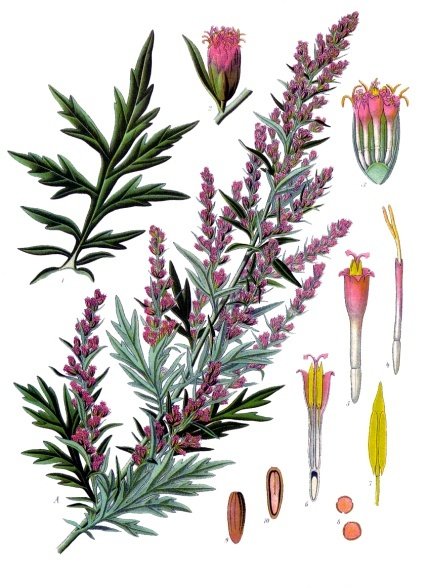 MugwortArtemisia vulgaris
-
 Annual WormwoodArtemisia annua
-
 Big SagebrushArtemisia tridentata
-
 Chinese MugwortArtemisia argyi
-
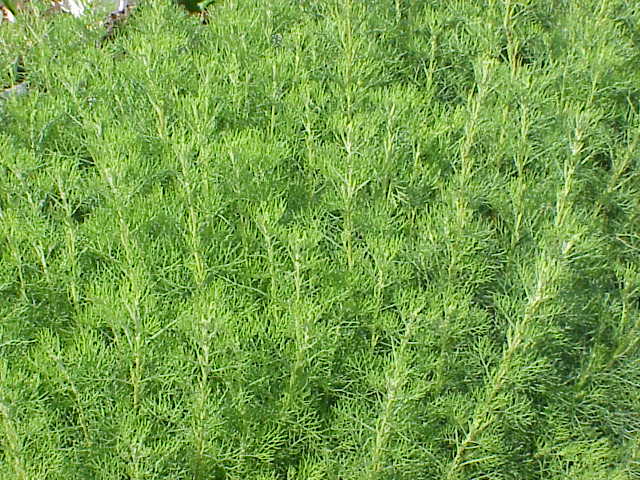 Lad's-loveArtemisia abrotanum
-
 White SageArtemisia ludoviciana
Compare
Questions and answers
What is the scientific name of the Japanese Mugwort?
The scientific name of the Japanese Mugwort is Artemisia princeps. Written with its author, the full name is Artemisia princeps Pamp..
Which family does the Japanese Mugwort belong to?
Artemisia princeps belongs to the family Asteraceae, in the order Asterales and the class Magnoliopsida.
Where is the Japanese Mugwort found?
Checklists and occurrence records place Artemisia princeps in 6 countries, including Japan, South Korea, China, Taiwan and India.
What other names does the Japanese Mugwort have?
Artemisia princeps is also known in English as Korean Mugwort, Korean Wormwood and Yomogi.
What is yomogi used for?
Yomogi is used in Japanese cuisine to flavour glutinous rice dumplings called kusa mochi or yomogi mochi and rice flour dumplings called kusa dango. Its leaves and young seedlings are also consumed raw or cooked, and the species is used in moxibustion.[12][14][15][22]
Sources
Passages the profile rests on
- The leaves are feather-shaped, scalloped, and light green, with dense white fuzz on their undersides. Source passage: “The leaves are feather shaped, scalloped and light green, with white dense fuzz on the underside.” — English Wikipedia
- The plant produces small, buff-coloured flowers. Source passage: “It bears small, buff-coloured flowers from July to November” — English Wikipedia
- The plant can grow to a height of 1.2 metres. Source passage: “grows to 1.2 meters (3 ft 11 in).” — English Wikipedia
- The species grows along roadsides, on slopes, in valleys, and beside riverbanks. Source passage: “It grows in a variety of habitats including roadsides, slopes, valleys and riverbanks.” — English Wikipedia
- The species is native to China, Japan, and Korea. Source passage: “Artemisia princeps is native to China, Japan and Korea.” — English Wikipedia
- The species has been introduced into Belgium and the Netherlands. Source passage: “It has been introduced into Belgium and the Netherlands.” — English Wikipedia
- The species is actively cultivated in Hawaii. Source passage: “The plant is also actively grown in the state of Hawaii” — English Wikipedia
- The species spreads rapidly through underground stolons. Source passage: “This species spreads rapidly by means of underground stolons” — English Wikipedia
- The species produces hermaphroditic flowers. Source passage: “which are hermaphroditic” — English Wikipedia
- The flowers are pollinated by wind. Source passage: “and pollinated by wind.” — English Wikipedia
- Flowering occurs from July through November. Source passage: “It bears small, buff-coloured flowers from July to November” — English Wikipedia
- The leaves and young seedlings are consumed either raw or cooked. Source passage: “Leaves and young seedlings can be eaten raw or cooked.” — English Wikipedia
- The leaves and young seedlings can be added to salads and soups after their bitterness is removed. Source passage: “They can also be used in salads and soups after removal of the bitterness.” — English Wikipedia
- In Japan, the herb is used to flavour glutinous rice dumplings called kusa mochi or yomogi mochi. Source passage: “In Japan the herb is used to flavour glutinous rice dumplings called kusa mochi (草餅) or yomogi mochi (蓬餅)” — English Wikipedia
- In Japan, the herb is also used to flavour rice flour dumplings called kusa dango. Source passage: “or rice flour dumplings called kusa dango (草団子).” — English Wikipedia
- Young leaves can be lightly boiled, pounded, and added to foods to provide colour, aroma, and flavour. Source passage: “The young leaves can be lightly boiled before being pounded and added to impart a pleasant colour, aroma and flavour.” — English Wikipedia
- In Japanese cuisine, the leaves are sometimes blanched and added to soups or rice. Source passage: “The leaves are occasionally blanched and added to soups or rice in Japanese cuisine.” — English Wikipedia
- In Korea, the species is used in traditional cuisine and traditional medicine. Source passage: “Mugwort, referred to as ssuk (쑥) in Korean, is widely used in Korean cuisine as well as in traditional medicine (hanyak).” — English Wikipedia
- Korean springtime dishes made with its young leaves include jeon, ssuk kimchi, and ssukguk. Source passage: “the young leaves of mugwort are used to prepare savory dishes such as jeon (Korean-style pancakes), ssuk kimchi, (쑥김치), ssukguk (쑥국, soup made with ssuk).” — English Wikipedia
- Fresh leaves and dried ground leaves are used as ingredients in Korean rice cakes. Source passage: “fresh mugwort as well as dried leaves ground into powder are a characteristic ingredient in various types of tteok (rice cakes).” — English Wikipedia
- In Korea, the species is used to flavour and colour ice cream, breads, cakes, tea, and lattes. Source passage: “Today, ssuk also adds flavor and color to more contemporary desserts and beverages, e.g. ice cream, breads, cakes, mugwort tea (ssukcha 쑥차) and ssuk latte (쑥라떼).” — English Wikipedia
- The species is used in moxibustion, a traditional medical practice. Source passage: “Artemisia princeps is one of the species of mugwort used in moxibustion” — English Wikipedia
- The species is used in moxibustion in China, Korea, Mongolia, Tibet, Nepal, and Vietnam. Source passage: “a traditional medical practice of China, Korea, Mongolia, Tibet, Nepal and Vietnam.” — English Wikipedia
Data
- Catalogue of Life, 2026-10-16 XR cc by
- Global Biodiversity Information Facility CC BY 4.0
- Wikidata CC0
- GeoNames CC BY 4.0
- Wikimedia Commons per image; credit shown with each image
- Within the Catalogue of Life, this name comes from Synonymic Checklists of the Vascular Plants of the World cc by
References
- Pamp. (1930). Nuovo Giorn. Bot. Ital., n. s. 36(4): 444-446 (1930). where the name was published
This species in other databases
- Catalogue of Life GWSX
- Wikidata Q1076280
- iNaturalist 452353
- World Flora Online wfo-0000005942
- GRIN 414749
Page built on 27 November 2026. See how the catalog is made and all sources and licences.
Cite this page
ScientificNames.org. (2026). Artemisia princeps (Japanese Mugwort). Retrieved November 27, 2026, from https://scientificnames.org/species/artemisia-princeps
“Artemisia princeps (Japanese Mugwort).” ScientificNames.org, 2026, scientificnames.org/species/artemisia-princeps. Accessed 27 Nov. 2026.
ScientificNames.org. “Artemisia princeps (Japanese Mugwort).” Accessed November 27, 2026. https://scientificnames.org/species/artemisia-princeps.
@misc{scientificnames_artemisia_princeps_japanese_mugwort,
  author = {{ScientificNames.org}},
  title = {Artemisia princeps (Japanese Mugwort)},
  year = {2026},
  url = {https://scientificnames.org/species/artemisia-princeps},
  note = {Accessed 2026-11-27}
}