Species · Crustaceans
Arubolana imula
Arubolana imula has no English name on record in the checklists used here. It is a species of crustacean in the family Cirolanidae, order Isopoda. The name dates from 1979.
- Scientific name
- Arubolana imula Botosaneanu & Stock, 1979
- Genus
- Arubolana
- Family
- Cirolanidae
- Order
- Isopoda
- Class
- Malacostraca
- Red List category
- VU Vulnerable
- Environment
- marine
- Recorded in
- 1 country
- Name status
- accepted in the Catalogue of Life
Overview
Arubolana imula is completely blind and measures 6.25 mm in length.
Written 27 November 2026 from the sources listed below. Each statement was checked against the passage it cites; statements that could not be supported were removed.
Appearance
Arubolana imula is completely blind and lacks eyes. It measures 6.25 mm in length.[1][2]
Habitat
Arubolana imula inhabits the fine silt layer at the bottom of the Mangel Cora Tunnel, an almost completely dark tunnel. It lives in brackish water with variable salinity ranging from 13.4‰ to 37.8‰.[3][4][5][6]
Diet
Arubolana imula scavenges and feeds on organic matter. It is most abundant in areas near rotting wood.[7][8]
Behaviour
Arubolana imula tolerates a wide range of salinity and is considered euryhaline.[9]
Similar species
Arubolana imula is the largest species in its genus.[10]
Conservation
Arubolana imula was classified as vulnerable in a 1996 IUCN conservation assessment.[11]
Classification of Arubolana imula
| Kingdom | Animalia |
|---|---|
| Phylum | Arthropoda |
| Subphylum | Crustacea |
| Class | Malacostraca |
| Order | Isopoda |
| Suborder | Cymothoida |
| Superfamily | Cymothooidea |
| Family | Cirolanidae |
| Genus | Arubolana |
| Species | Arubolana imula Botosaneanu & Stock, 1979 |
Where Arubolana imula is found
Checklists and occurrence records place Arubolana imula in 1 country. GBIF holds 5 georeferenced records of it.
Countries
A number beside a place is its count of GBIF occurrence records. A place without a number comes from a checklist alone. Records show where a species has been observed or collected, which can include escapes and vagrants.
Related species
- Arubolana parvioculata
- Arubolana rotunditelson
- Cirolanid IsopodArubolana aruboides
-
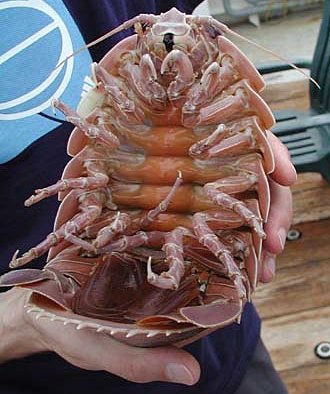 Giant IsopodBathynomus giganteus
-
 Darth Vader Supergiant IsopodBathynomus vaderi
-
 Sand PiranhaExcirolana chiltoni
-
 Speckled Sea LouseEurydice pulchra
- Bathynomus jamesi
Compare
Questions and answers
Where is Arubolana imula found?
It is endemic to the Dutch island of Aruba in the Lesser Antilles of the Caribbean. It has only been recorded from the Mangel Cora Tunnel in the Lago Colony on Aruba.[12][13]
What does Arubolana imula eat?
It scavenges and feeds on organic matter and is most abundant near rotting wood.[7][8]
What is the conservation status of Arubolana imula?
It was classified as vulnerable in a 1996 IUCN conservation assessment.[11]
What does the name imula mean?
The specific epithet imula derives from a Latin word meaning 'the very deepest'.[14]
When was Arubolana imula described?
It was formally described in 1979 by Lazare Botosaneanu and Jan Hendrik Stock.[15]
Sources
Passages the profile rests on
- Arubolana imula measures 6.25 mm in length. Source passage: “measuring 6.25 mm (0.25 in) long.” — English Wikipedia
- Arubolana imula is completely blind and lacks eyes. Source passage: “They are completely blind and have no eyes.” — English Wikipedia
- Arubolana imula inhabits the fine silt layer at the bottom of the Mangel Cora Tunnel. Source passage: “A. imula lives in this layer, where it scavenges and feeds on organic matter.” — English Wikipedia
- Arubolana imula inhabits an almost completely dark tunnel. Source passage: “The tunnel is almost entirely without light and has a bottom layer of fine silt.” — English Wikipedia
- Arubolana imula lives in brackish water with variable salinity. Source passage: “The water is brackish with highly variable salinity due to its proximity to both the ocean and fresh groundwater” — English Wikipedia
- The water inhabited by Arubolana imula has a salinity ranging from 13.4‰ to 37.8‰. Source passage: “changing from 13.4‰ to 37.8‰” — English Wikipedia
- Arubolana imula scavenges and feeds on organic matter. Source passage: “where it scavenges and feeds on organic matter.” — English Wikipedia
- Arubolana imula is most abundant in areas near rotting wood. Source passage: “It is most abundant near rotting wood.” — English Wikipedia
- Arubolana imula tolerates a wide range of salinity and is therefore considered euryhaline. Source passage: “The isopod is considered to be euryhaline as it tolerates this wide range of salinity.” — English Wikipedia
- Arubolana imula is the largest species in its genus. Source passage: “It is the largest species in its genus” — English Wikipedia
- Arubolana imula was classified as vulnerable in a 1996 IUCN conservation assessment. Source passage: “A 1996 assessment of the crustacean's conservation status by the IUCN classified it as being vulnerable.” — English Wikipedia
- Arubolana imula is endemic to the Dutch island of Aruba in the Lesser Antilles of the Caribbean. Source passage: “Arubolana imula is endemic to the Dutch island of Aruba in the Lesser Antilles of the Caribbean.” — English Wikipedia
- Arubolana imula has only been recorded from the Mangel Cora Tunnel in the Lago Colony on Aruba. Source passage: “The species has only ever been recorded from its type locality, the Mangel Cora Tunnel in the Lago Colony.” — English Wikipedia
- The specific epithet imula derives from a Latin word meaning 'the very deepest'. Source passage: “The specific epithet is derived from the Latin word meaning "the very deepest"” — English Wikipedia
- Arubolana imula was formally described in 1979 by Lazare Botosaneanu and Jan Hendrik Stock. Source passage: “Arubolana imula was formally described in 1979 by Lazare Botosaneanu and Jan Hendrik Stock” — English Wikipedia
Data
- Catalogue of Life, 2026-10-16 XR cc by
- Global Biodiversity Information Facility CC BY 4.0
- Wikidata CC0
- GeoNames CC BY 4.0
- Within the Catalogue of Life, this name comes from World Marine, Freshwater and Terrestrial Isopod Crustaceans database cc by
References
- Botosaneanu, L., & Stock, J. H. (1979). Arubolana imula n. gen. n. sp., the first hypogean cirolanid isopod crustacean found in the Lesser Antilles. Bijdragen Tot de Dierkunde, 49: 227–233. https://doi.org/10.1163/26660644-04902004 Link where the name was published
This species in other databases
- Catalogue of Life H2K6
- Wikidata Q308340
- iNaturalist 94662
- WoRMS urn:lsid:marinespecies.org:taxname:259119
- ITIS 543219
Page built on 28 November 2026. See how the catalog is made and all sources and licences.
Cite this page
ScientificNames.org. (2026). Arubolana imula. Retrieved November 28, 2026, from https://scientificnames.org/species/arubolana-imula
“Arubolana imula.” ScientificNames.org, 2026, scientificnames.org/species/arubolana-imula. Accessed 28 Nov. 2026.
ScientificNames.org. “Arubolana imula.” Accessed November 28, 2026. https://scientificnames.org/species/arubolana-imula.
@misc{scientificnames_arubolana_imula,
  author = {{ScientificNames.org}},
  title = {Arubolana imula},
  year = {2026},
  url = {https://scientificnames.org/species/arubolana-imula},
  note = {Accessed 2026-11-28}
}