Species · Birds
Dark-winged Canastero Asthenes arequipae
The scientific name of the Dark-winged Canastero is Asthenes arequipae. It is a species of bird in the family Furnariidae (ovenbird), order Passeriformes. The name dates from 1869.
- Scientific name
- Asthenes arequipae (P. L. Sclater & Salvin, 1869)
- Common name
- Dark-winged Canastero
- Genus
- Asthenes
- Family
- Furnariidae (Ovenbird)
- Order
- Passeriformes
- Class
- Aves
- Red List category
- LC Least Concern
- Recorded in
- 3 countries
- Name status
- accepted in the Catalogue of Life

Overview
Asthenes arequipae occurs from the Department of Arequipa in southwestern Peru south to the Tarapacá Region of northern Chile and east to the La Paz and Oruro departments of western Bolivia. It is identifiable by its pale plain breast, rufous flanks, dark wings and tail, and brown back.
Written 27 November 2026 from the sources listed below. Each statement was checked against the passage it cites; statements that could not be supported were removed.
Appearance
Adult Dark-winged Canasteros have a light gray supercilium and a dull buff face with an indistinct brownish line behind the eye. The crown, nape, and back are medium to dark brown, while the rump and uppertail coverts are rufous brown.[1][2]
The wing coverts are blackish with narrow rufous edges, and the flight feathers are blackish. The outermost tail feathers are rufous, while the remaining tail feathers are blackish.[3][4]
The center of the throat is orange rufous, contrasting with the creamy-white sides of the throat, breast, and belly. The flanks and undertail coverts are rufous, with the flanks described as tawny rufous.[5][6]
The iris ranges from dark brown to light gray. The maxilla is black or dark gray, and the mandible is blackish, often with a pinkish base. The legs and feet range in color from blue-gray to black.[7][8][9]
Juveniles have an entirely white throat and faint dusky bars or mottling on the breast and belly. Males and females have the same plumage.[10][11]
The Dark-winged Canastero measures 14.5–16.5 cm in length and weighs 17.5–24 g.[12][13]
Habitat
The Dark-winged Canastero inhabits arid landscapes, particularly scrublands and nearby woodlands.[14]
Diet
The diet consists mostly of arthropods and also includes seeds.[15]
Behaviour
The Dark-winged Canastero forages on the ground and in low woody vegetation, usually alone or in pairs, by gleaning prey. It is a year-round resident throughout its geographic range.[16][17]
The species usually sings from the top of a bush or small tree. Small family groups roost in nests throughout the year.[18][19]
Reproduction and life cycle
The nest is a globular structure made of sticks, some of which are thorny. Its entrance is near the top or on the side and leads through a tunnel to the nest chamber. The nest can reach 75 cm in length.[20][21][22]
The nest chamber is lined with wool, feathers, and soft plant material. The species often builds its nest in a Polylepis tree, and less frequently in a shrub or on a columnar cactus.[23][24]
Both sexes participate in nest construction. The species is thought to be monogamous.[25][26]
Conservation
The IUCN classifies the Dark-winged Canastero as Least Concern. The species has a large geographic range, but its population size is unknown and believed to be decreasing.[27][28]
No immediate threats to the species have been identified. It is considered fairly common to common across most of its range.[29][30]
Similar species
Some taxonomic authorities classify the Dark-winged Canastero as a subspecies of the Rusty-vented Canastero (Asthenes dorbignyi).[31]
The taxon's plumage, morphology, vocalizations, behavior, and nest structure have been suggested as potentially supporting placement in the genus Phacellodomus rather than Asthenes.[32]
Classification of the Dark-winged Canastero
| Kingdom | Animalia |
|---|---|
| Phylum | Chordata |
| Subphylum | Vertebrata |
| Infraphylum | Gnathostomata |
| Parvphylum | Osteichthyes |
| Megaclass | Tetrapoda |
| Class | Aves (Bird) |
| Order | Passeriformes (Passerine) |
| Family | Furnariidae (Ovenbird) |
| Genus | Asthenes (Canastero) |
| Species | Asthenes arequipae (P. L. Sclater & Salvin, 1869) |
Where the Dark-winged Canastero is found
Checklists and occurrence records place Asthenes arequipae in 3 countries across South America. GBIF holds 3,659 georeferenced records of it.
Countries
Regions and cities with the most records
- Arica y Parinacota Region, Chile 1,674
- Arequipa, Peru 1,527
- Ciudad Satelite, Peru 760
- Selva Alegre, Peru 752
- Arequipa, Peru 711
- Jacobo Hunter, Peru 631
- Cono Norte, Peru 411
- Tarapacá, Chile 73
- Ayacucho, Peru 65
- Puno, Peru 62
- Potosí Department, Bolivia 57
- Tacna, Peru 55
- Moquegua Department, Peru 53
- Oruro, Bolivia 26
- Huancavelica, Peru 13
- Lima region, Peru 10
- Moquegua, Peru 6
- San Antonio, Peru 6
- Ica, Peru 3
- La Paz Department, Bolivia 3
- Nazca, Peru 3
Range as the checklists state it
South America
A number beside a place is its count of GBIF occurrence records. A place without a number comes from a checklist alone. Records show where a species has been observed or collected, which can include escapes and vagrants.
Common names
English
- Dark-winged Canastero
- Arequipa Canastero
Names in 19 other languages
- Chinese
- 暗翅卡纳灶鸟, 黑翅卡納雀
- Croatian
- sivolici kanastero
- Czech
- hrnčiřík tmavokřídlý
- Danish
- Mørkvinget Kurvebygger
- Dutch
- Zwartvleugelcanastero
- Esperanto
- malhelflugila sinalakso
- Finnish
- Tummasiipikanastero
- French
- Synallaxe d'Arequipa, Synallaxe à ailes sombres
- German
- Dunkelflügelcanastero
- Italian
- Canestraio aliscure
- Japanese
- チャバネカマドドリ
- Norwegian
- svartvingekurvfugl
- Polish
- koszykarz ciemnoskrzydły
- Portuguese
- cesteiro-de-arequipa, lenheiro-de-asa-escura
- Russian
- Темнокрылый канастеро
- Slovak
- košikárik tmavokrídly
- Spanish
- Canastero de Alas Oscuras, Canastero de Arequipa, Canastero del norte
- Swedish
- mörkvingad kanastero
- Ukrainian
- канастеро темнокрилий
Synonyms
3 other scientific names have been used for this species and are now treated as synonyms of Asthenes arequipae.
- Asthenes dorbignyi arequipae (P. L. Sclater & Salvin, 1869)
- Synallaxis arequipae P. L. Sclater & Salvin, 1869
- Thripophaga dorbignyi arequipae Salvin, O; Sclater, PL, 1869
Related species
-
 Hudson's CanasteroAsthenes hudsoni
-
 Berlepsch's CanasteroAsthenes berlepschi
-
 White-chinned ThistletailAsthenes fuliginosa
-
 Line-fronted CanasteroAsthenes urubambensis
-
 Sharp-billed CanasteroAsthenes pyrrholeuca
-
 Cordilleran CanasteroAsthenes modesta
-
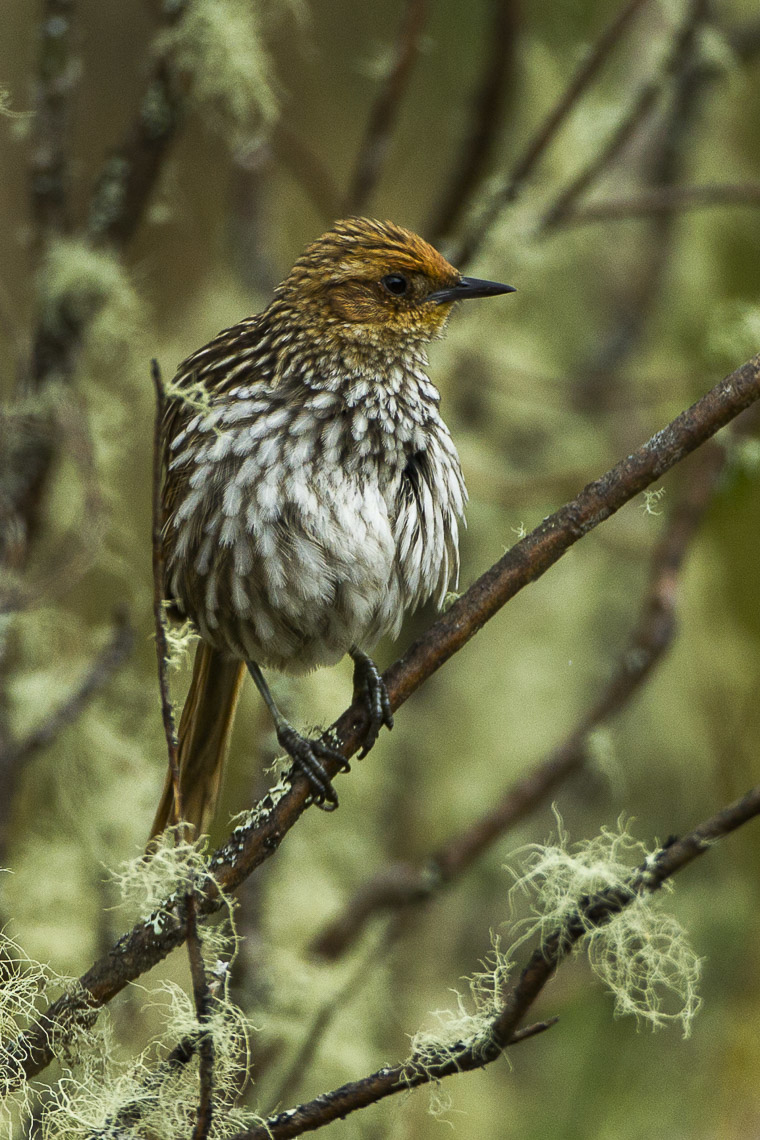 Many-striped CanasteroAsthenes flammulata
-
 Austral CanasteroAsthenes anthoides
Compare
Questions and answers
What is the scientific name of the Dark-winged Canastero?
The scientific name of the Dark-winged Canastero is Asthenes arequipae. Written with its author, the full name is Asthenes arequipae (P. L. Sclater & Salvin, 1869).
Which family does the Dark-winged Canastero belong to?
Asthenes arequipae belongs to the family Furnariidae, in the order Passeriformes and the class Aves.
Where is the Dark-winged Canastero found?
Checklists and occurrence records place Asthenes arequipae in 3 countries: Peru, Chile and Bolivia.
What is the conservation status of the Dark-winged Canastero?
The IUCN Red List category recorded for Asthenes arequipae is Least Concern (LC).
What other names does the Dark-winged Canastero have?
Asthenes arequipae is also known in English as Arequipa Canastero.
Sources
Passages the profile rests on
- Adult Dark-winged Canasteros have a light gray supercilium and a dull buff face with an indistinct brownish line behind the eye. Source passage: “Adults have a light gray supercilium and an indistinct brownish line behind the eye in an otherwise dull buff face.” — English Wikipedia
- The crown, nape, and back are medium to dark brown, while the rump and uppertail coverts are rufous brown. Source passage: “Their crown, nape, and back are medium to dark brown and their rump and uppertail coverts rufous brown.” — English Wikipedia
- The wing coverts are blackish with narrow rufous edges, and the flight feathers are blackish. Source passage: “Their wing coverts are blackish with narrow rufous edges and their flight feathers blackish.” — English Wikipedia
- The outermost tail feathers are rufous, while the remaining tail feathers are blackish. Source passage: “Their tail's outermost pair of feathers are rufous and the rest blackish.” — English Wikipedia
- The center of the throat is orange rufous, contrasting with the creamy-white sides of the throat, breast, and belly. Source passage: “The center of their throat is orange rufous. The sides of their throat, breast, and belly are creamy white” — English Wikipedia
- The flanks and undertail coverts are rufous, with the flanks described as tawny rufous. Source passage: “their flanks tawny rufous, and their undertail coverts rufous.” — English Wikipedia
- The iris ranges from dark brown to light gray. Source passage: “Their iris is dark brown to light gray” — English Wikipedia
- The maxilla is black or dark gray, and the mandible is blackish, often with a pinkish base. Source passage: “their maxilla black or dark gray, their mandible blackish (often with a pinkish base)” — English Wikipedia
- The legs and feet range in color from blue-gray to black. Source passage: “their legs and feet blue-gray to black.” — English Wikipedia
- Juveniles have an entirely white throat and faint dusky bars or mottling on the breast and belly. Source passage: “Juveniles have an entirely white throat and faint dusky bars or mottling on the breast and belly.” — English Wikipedia
- Males and females have the same plumage. Source passage: “The sexes have the same plumage.” — English Wikipedia
- The Dark-winged Canastero measures 14.5–16.5 cm in length. Source passage: “The dark-winged canastero is 14.5 to 16.5 cm (5.7 to 6.5 in) long” — English Wikipedia
- The species weighs 17.5–24 g. Source passage: “weighs 17.5 to 24 g (0.62 to 0.85 oz).” — English Wikipedia
- The species inhabits arid landscapes, particularly scrublands and nearby woodlands. Source passage: “It inhabits arid landscapes, especially scrublands and nearby woodlands.” — English Wikipedia
- The diet consists mostly of arthropods and also includes seeds. Source passage: “is known to be mostly arthropods and include seeds.” — English Wikipedia
- The species forages on the ground and in low woody vegetation, usually alone or in pairs, by gleaning prey. Source passage: “It forages on the ground and in low woody vegetation, usually singly or in pairs, and gleaning for its prey.” — English Wikipedia
- The Dark-winged Canastero is a year-round resident throughout its geographic range. Source passage: “The dark-winged canastero is a year-round resident throughout its range.” — English Wikipedia
- The species usually sings from the top of a bush or small tree. Source passage: “It usually sings from atop a bush or small tree.” — English Wikipedia
- Small family groups roost in nests throughout the year. Source passage: “Small family groups roost in nests year-round.” — English Wikipedia
- The nest is a globular structure made of sticks, some of which are thorny. Source passage: “The dark-winged canastero's nest is a globular mass of sticks, some of which are thorny” — English Wikipedia
- The nest entrance is near the top or on the side and leads through a tunnel to the nest chamber. Source passage: “with an entrance near the top or on the side and a tunnel to the nest chamber.” — English Wikipedia
- The nest can reach 75 cm in length. Source passage: “The nest may be up to 75 cm (30 in) long.” — English Wikipedia
- The nest chamber is lined with wool, feathers, and soft plant material. Source passage: “The chamber is lined with wool, feathers, and soft plant material.” — English Wikipedia
- The species often builds its nest in a Polylepis tree, and less frequently in a shrub or on a columnar cactus. Source passage: “The nest is often built in a Polylepis tree and less commonly in a shrub or on a columnar cactus.” — English Wikipedia
- Both sexes participate in nest construction. Source passage: “Both sexes build the nest.” — English Wikipedia
- The species is thought to be monogamous. Source passage: “The species is thought to be monogamous.” — English Wikipedia
- The IUCN classifies the Dark-winged Canastero as Least Concern. Source passage: “The IUCN has assessed the dark-winged canastero as being of Least Concern.” — English Wikipedia
- The species has a large geographic range, but its population size is unknown and believed to be decreasing. Source passage: “It has a large range but an unknown population size that is believed to be decreasing.” — English Wikipedia
- No immediate threats to the species have been identified. Source passage: “No immediate threats have been identified.” — English Wikipedia
- The species is considered fairly common to common across most of its range. Source passage: “It is considered fairly common to common over most of its range.” — English Wikipedia
- Some taxonomic authorities classify the taxon as a subspecies of the Rusty-vented Canastero (Asthenes dorbignyi). Source passage: “The South American Classification Committee of the American Ornithological Society and the Clements taxonomy treat it as a subspecies of the rusty-vented canastero (A. dorbignyi)” — English Wikipedia
- The taxon's plumage, morphology, vocalizations, behavior, and nest structure have been suggested as potentially supporting placement in the genus Phacellodomus rather than Asthenes. Source passage: “these taxa have plumage, morphological, vocal, behavioral, and nest structure characteristics that may better place them in the thornbird genus Phacellodomus rather than Asthenes.” — English Wikipedia
Data
- Catalogue of Life, 2026-10-16 XR cc by
- Global Biodiversity Information Facility CC BY 4.0
- Wikidata CC0
- GeoNames CC BY 4.0
- Wikimedia Commons per image; credit shown with each image
- Within the Catalogue of Life, this name comes from The Integrated Taxonomic Information System cc0
This species in other databases
Page built on 29 November 2026. See how the catalog is made and all sources and licences.
Cite this page
ScientificNames.org. (2026). Asthenes arequipae (Dark-winged Canastero). Retrieved November 29, 2026, from https://scientificnames.org/species/asthenes-arequipae
“Asthenes arequipae (Dark-winged Canastero).” ScientificNames.org, 2026, scientificnames.org/species/asthenes-arequipae. Accessed 29 Nov. 2026.
ScientificNames.org. “Asthenes arequipae (Dark-winged Canastero).” Accessed November 29, 2026. https://scientificnames.org/species/asthenes-arequipae.
@misc{scientificnames_asthenes_arequipae_dark_winged_canastero,
  author = {{ScientificNames.org}},
  title = {Asthenes arequipae (Dark-winged Canastero)},
  year = {2026},
  url = {https://scientificnames.org/species/asthenes-arequipae},
  note = {Accessed 2026-11-29}
}