Species · Birds
Cipo Canastero Asthenes luizae
The scientific name of the Cipo Canastero is Asthenes luizae. It is a species of bird in the family Furnariidae (ovenbird), order Passeriformes. The name dates from 1990.
- Scientific name
- Asthenes luizae Vielliard, 1990
- Common name
- Cipo Canastero
- Genus
- Asthenes
- Family
- Furnariidae (Ovenbird)
- Order
- Passeriformes
- Class
- Aves
- Red List category
- NT Near Threatened
- Recorded in
- 1 country
- Name status
- accepted in the Catalogue of Life

Overview
The Cipo Canastero (Asthenes luizae Vielliard, 1990) is a bird in the family Furnariidae, order Passeriformes, and class Aves. It inhabits rocky, grassy areas with bushy vegetation in campos rupestres grasslands at elevations between 900 and 1,500 meters. It is predominantly gray, with a rufous-chestnut tail that it often holds cocked.
Written 27 November 2026 from the sources listed below. Each statement was checked against the passage it cites; statements that could not be supported were removed.
Appearance
The Cipo Canastero has a relatively short bill and a medium-length tail. Its predominantly gray plumage contrasts with its rufous-chestnut tail.[1][2]
Adults have a gray-brown face with fine blackish streaks, a narrow whitish supercilium, and a dark line through the eye. The crown is warm brown, while the back and rump are grayish brown.[3][4]
The wings are predominantly dull dark brown, with whitish-brown edges on some flight feathers. The innermost tail feathers are dark brown, while the remaining feathers are chestnut-rufous.[5][6]
The chin and central upper throat are white with thin black streaks. The underparts are gray, with a dusky olive wash on the belly center and a chestnut wash on the undertail coverts.[7][8]
The iris ranges from blackish to brown, and the legs and feet are dull pinkish to gray. The tail is long and graduated and is often held cocked.[9][10][11]
The species measures approximately 17 cm in length and weighs between 25.5 and 30.5 grams.[12][13]
Habitat
The Cipo Canastero inhabits rocky outcrops surrounded by bushy vegetation in campos rupestres grasslands. It also occurs in grassy areas containing rocks.[14][15]
It occurs at elevations between 900 and 1,500 meters.[16]
Diet
The Cipo Canastero feeds on arthropods.[17]
Behaviour
The Cipo Canastero forages alone or in pairs, gleaning prey from rocks and the ground. It remains in its range throughout the year.[18][19][20]
Its song descends and consists of approximately 12 notes. Its call is high-pitched.[21][22]
Reproduction and life cycle
The Cipo Canastero constructs a spherical or cylindrical nest from sticks. The nest is placed in a bush near the ground.[23][24]
Conservation
The Cipo Canastero is endemic to Brazil and occurs at a few locations in the Espinhaço Mountains of north-central and east-central Minas Gerais, southeastern Brazil.[25][26]
The species was assessed as Near Threatened in the IUCN assessment history reported by the document. Its most recent IUCN Red List assessment was in 2020.[27][28]
The estimated population consists of 10,600 mature individuals and is believed to be decreasing. The species is fairly common in some localities and occurs in at least two national parks.[29][30][31][32]
Brood parasitism by the introduced Shiny Cowbird is considered the most serious current threat and the main cause of the ongoing decline. Frequent dry-season fires are considered a potentially serious threat.[33][34]
Classification of the Cipo Canastero
| Kingdom | Animalia |
|---|---|
| Phylum | Chordata |
| Subphylum | Vertebrata |
| Infraphylum | Gnathostomata |
| Parvphylum | Osteichthyes |
| Megaclass | Tetrapoda |
| Class | Aves (Bird) |
| Order | Passeriformes (Passerine) |
| Family | Furnariidae (Ovenbird) |
| Genus | Asthenes (Canastero) |
| Species | Asthenes luizae Vielliard, 1990 |
Where the Cipo Canastero is found
Checklists and occurrence records place Asthenes luizae in 1 country across South America. GBIF holds 509 georeferenced records of it.
Countries
Regions and cities with the most records
Range as the checklists state it
South America
A number beside a place is its count of GBIF occurrence records. A place without a number comes from a checklist alone. Records show where a species has been observed or collected, which can include escapes and vagrants.
Common names
English
- Cipo Canastero
Names in 23 other languages
- Catalan
- cisteller fosc
- Chinese
- 石紋卡納雀, 西波卡纳灶鸟
- Croatian
- sivotrbi kanastero
- Czech
- hrnčiřík ciposký
- Danish
- Cipókurvebygger
- Dutch
- Cipócanastero
- Esperanto
- cipoa sinalakso
- Finnish
- ciponkanastero
- French
- Synallaxe du Cipo
- German
- Cipo-Schlüpfer, Minas Gerais-Canastero, Minas Geraiscanastero, Minas-Gerais-Canastero
- Italian
- Canestraio di Cipò
- Japanese
- ブラジルミヤマカマドドリ
- Lithuanian
- brazilinė kanastera
- Norwegian
- cipokurvfugl
- Polish
- koszykarz szarobrzuchy
- Portuguese
- cesteiro-do-cipó, lenheiro-da-serra-do-cipó
- Russian
- Сипоанский канастеро
- Slovak
- košikárik skalný
- Spanish
- Canastero de Cipó
- Swedish
- cipókanastero
- Turkish
- Sipo Sepetöreni
- Ukrainian
- канастеро сірочеревий
- Welsh
- plethwr Cipo
Synonyms
One other scientific name has been used for this species and is now treated as a synonym of Asthenes luizae.
- Thripophaga luizae Vielliard, JME, 1990
Related species
-
 Hudson's CanasteroAsthenes hudsoni
-
 Berlepsch's CanasteroAsthenes berlepschi
-
 White-chinned ThistletailAsthenes fuliginosa
-
 Line-fronted CanasteroAsthenes urubambensis
-
 Sharp-billed CanasteroAsthenes pyrrholeuca
-
 Cordilleran CanasteroAsthenes modesta
-
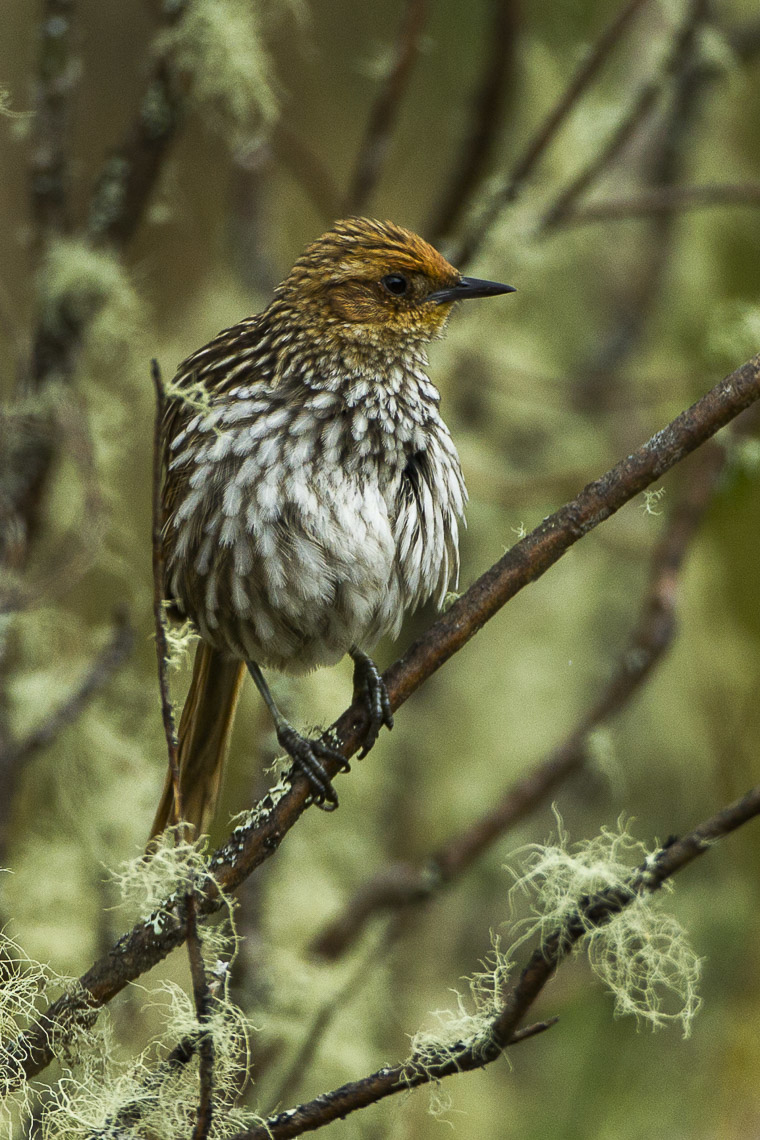 Many-striped CanasteroAsthenes flammulata
-
 Austral CanasteroAsthenes anthoides
Compare
Questions and answers
What is the scientific name of the Cipo Canastero?
The scientific name of the Cipo Canastero is Asthenes luizae. Written with its author, the full name is Asthenes luizae Vielliard, 1990.
Which family does the Cipo Canastero belong to?
Asthenes luizae belongs to the family Furnariidae, in the order Passeriformes and the class Aves.
Where is the Cipo Canastero found?
Checklists and occurrence records place Asthenes luizae in 1 country: Brazil.
What is the conservation status of the Cipo Canastero?
The IUCN Red List category recorded for Asthenes luizae is Near Threatened (NT).
Where is the Cipo Canastero found?
It is endemic to Brazil and occurs at a few locations in the Espinhaço Mountains of north-central and east-central Minas Gerais, southeastern Brazil.[25][26]
What does the Cipo Canastero eat?
It feeds on arthropods.[17]
How does the Cipo Canastero forage?
It forages alone or in pairs, gleaning prey from rocks and the ground.[18][19]
What are the Cipo Canastero's calls like?
It produces a descending song consisting of approximately 12 notes and has a high-pitched call.[21][22]
How does the Cipo Canastero build its nest?
It constructs a spherical or cylindrical nest from sticks and places it in a bush near the ground.[23][24]
What is the conservation status of the Cipo Canastero?
It was assessed as Near Threatened in the IUCN assessment history reported by the document. Its estimated population is 10,600 mature individuals and is believed to be decreasing.[27][29][30]
What are the main threats to the Cipo Canastero?
Brood parasitism by the introduced Shiny Cowbird is considered the most serious current threat and the main cause of the ongoing decline. Frequent dry-season fires are considered a potentially serious threat.[33][34]
When was the Cipo Canastero described?
It was described in 1990 from a specimen collected in December 1985 in the Serra do Cipo.[35]
Is the Cipo Canastero monotypic?
Yes, the species is monotypic.[36]
Sources
Passages the profile rests on
- The species has a relatively short bill and a medium-length tail. Source passage: “It has a rather short bill and a medium-length tail.” — English Wikipedia
- The species is predominantly gray with a rufous-chestnut tail. Source passage: “Mostly gray with a rufous-chestnut tail.” — ebird.org
- Adults have a gray-brown face with fine blackish streaks, a narrow whitish supercilium, and a dark line through the eye. Source passage: “Adults have narrow whitish supercilium and a dark brown or blackish brown line through the eye on an otherwise gray-brown face with fine blackish streaks.” — English Wikipedia
- The crown is warm brown, while the back and rump are grayish brown. Source passage: “Their crown is warm brown and their back and rump grayish brown.” — English Wikipedia
- The wings are predominantly dull dark brown, with whitish-brown edges on some flight feathers. Source passage: “Their wings are mostly dull dark brown with whitish brown edges on some flight feathers.” — English Wikipedia
- The tail has dark brown innermost feathers and chestnut-rufous remaining feathers. Source passage: “Their tail's innermost pair of feathers are dark brown and the rest chestnut-rufous.” — English Wikipedia
- The chin and central upper throat are white with thin black streaks. Source passage: “Their chin and the center of their upper throat are white with thin black streaks.” — English Wikipedia
- The underparts are gray, with a dusky olive wash on the belly center and a chestnut wash on the undertail coverts. Source passage: “The sides of their throat and their underparts are gray with a dusky olive wash on the center of the belly and a chestnut wash on their undertail coverts.” — English Wikipedia
- The iris ranges from blackish to brown. Source passage: “Their iris is blackish to brown” — English Wikipedia
- The legs and feet are dull pinkish to gray. Source passage: “their legs and feet dull pinkish to gray.” — English Wikipedia
- The species has a long, graduated tail that it often holds cocked. Source passage: “Distinctive ovenbird with a long, graduated tail that is often held cocked.” — ebird.org
- The species measures approximately 17 cm in length. Source passage: “The Cipo canastero is about 17 cm (6.7 in) long” — English Wikipedia
- The species weighs between 25.5 and 30.5 grams. Source passage: “weighs 25.5 to 30.5 g (0.90 to 1.1 oz).” — English Wikipedia
- The species inhabits rocky outcrops surrounded by bushy vegetation in campos rupestres grasslands. Source passage: “It inhabits areas of rocky outcrops and bushy vegetation in the grasslands of the campos rupestres.” — English Wikipedia
- The species is found in grassy areas containing rocks. Source passage: “Found in grassy areas with rocks,” — ebird.org
- The species occurs at elevations between 900 and 1,500 meters. Source passage: “In elevation it ranges from 900 to 1,500 m (3,000 to 4,900 ft).” — English Wikipedia
- The species feeds on arthropods. Source passage: “The Cipo canastero feeds on arthropods.” — English Wikipedia
- The species forages alone or in pairs. Source passage: “It forages singly or in pairs” — English Wikipedia
- The species obtains prey by gleaning it from rocks and the ground. Source passage: “gleaning its prey from rocks and the ground.” — English Wikipedia
- The species remains in its range throughout the year. Source passage: “The Cipo canastero is a year-round resident throughout its range.” — English Wikipedia
- The species produces a descending song consisting of approximately 12 notes. Source passage: “The Cipo canastero's song is a "descending series of about 12 notes 'tseeptseep---' ".” — English Wikipedia
- The species has a high-pitched call. Source passage: “Its call is a "high 'tjip' ".” — English Wikipedia
- The species constructs a spherical or cylindrical nest from sticks. Source passage: “The Cipo canastero builds a spherical or cylindrical nest of sticks” — English Wikipedia
- The nest is placed in a bush near the ground. Source passage: “near the ground in a bush.” — English Wikipedia
- The species is endemic to Brazil. Source passage: “It is endemic to Brazil.” — English Wikipedia
- The species occurs at a few locations in the Espinhaço Mountains of north-central and east-central Minas Gerais, southeastern Brazil. Source passage: “The Cipo canastero is found in a few locations in the Espinhaço Mountains of north-central and east-central Minas Gerais, a state in southeastern Brazil.” — English Wikipedia
- The species was assessed as Near Threatened in the IUCN assessment history reported by the document. Source passage: “The IUCN originally in 1994 assessed the Cipo canastero as Endangered, then in 2004 as Vulnerable, and since 2011 as Near Threatened.” — English Wikipedia
- The species was most recently assessed for the IUCN Red List in 2020. Source passage: “Cipo Canastero Asthenes luizae has most recently been assessed for The IUCN Red List of Threatened Species in 2020.” — iucnredlist.org
- The estimated population consists of 10,600 mature individuals. Source passage: “an estimated population of 10,600 mature individuals” — English Wikipedia
- The population is believed to be decreasing. Source passage: “that is believed to be decreasing.” — English Wikipedia
- The species occurs in at least two national parks. Source passage: “occurs in at least two national parks.” — English Wikipedia
- The species is fairly common in some localities. Source passage: “It is fairly common in some locales” — English Wikipedia
- Brood parasitism by the introduced Shiny Cowbird is considered the most serious current threat and the main cause of the ongoing decline. Source passage: “Brood parasitism by the recently introduced Shiny Cowbird (Molothrus bonariensis) is thought to be the most serious current threat and the main cause of the species's ongoing decline.” — English Wikipedia
- Frequent dry-season fires are considered a potentially serious threat to the species. Source passage: “Frequent fires in the dry season are also a potentially serious threat” — English Wikipedia
- The species was described in 1990 from a specimen collected in December 1985 in the Serra do Cipo. Source passage: “The Cipo canastero was described in 1990 from a specimen collected in December 1985 in the Serra do Cipo.” — English Wikipedia
- The species is monotypic. Source passage: “The Cipo canastero is monotypic.” — English Wikipedia
Data
- Catalogue of Life, 2026-10-16 XR cc by
- Global Biodiversity Information Facility CC BY 4.0
- Wikidata CC0
- GeoNames CC BY 4.0
- Wikimedia Commons per image; credit shown with each image
- Within the Catalogue of Life, this name comes from The Integrated Taxonomic Information System cc0
References
- Vielliard, & Jacques Marie Edme. (1990). Uma Nova Espécie de Asthenes da serra do Cipó, Minas Gerais, Brasil. Ararajuba, Vol. 1, No. 1. where the name was published
- Gill, Frank, & and Minturn Wright. (2006). Birds of the World: Recommended English Names.
This species in other databases
Page built on 27 November 2026. See how the catalog is made and all sources and licences.
Cite this page
ScientificNames.org. (2026). Asthenes luizae (Cipo Canastero). Retrieved November 27, 2026, from https://scientificnames.org/species/asthenes-luizae
“Asthenes luizae (Cipo Canastero).” ScientificNames.org, 2026, scientificnames.org/species/asthenes-luizae. Accessed 27 Nov. 2026.
ScientificNames.org. “Asthenes luizae (Cipo Canastero).” Accessed November 27, 2026. https://scientificnames.org/species/asthenes-luizae.
@misc{scientificnames_asthenes_luizae_cipo_canastero,
  author = {{ScientificNames.org}},
  title = {Asthenes luizae (Cipo Canastero)},
  year = {2026},
  url = {https://scientificnames.org/species/asthenes-luizae},
  note = {Accessed 2026-11-27}
}