Species · Birds
Itatiaia Spinetail Asthenes moreirae
The scientific name of the Itatiaia Spinetail is Asthenes moreirae. It is a species of bird in the family Furnariidae (ovenbird), order Passeriformes. The name dates from 1906.
- Scientific name
- Asthenes moreirae (Miranda-Ribeiro, 1906)
- Common name
- Itatiaia Spinetail
- Genus
- Asthenes
- Family
- Furnariidae (Ovenbird)
- Order
- Passeriformes
- Class
- Aves
- Red List category
- LC Least Concern
- Recorded in
- 1 country
- Name status
- accepted in the Catalogue of Life

Overview
The species is endemic to southeastern Brazil, where it occurs in Minas Gerais, São Paulo, Rio de Janeiro, and Espírito Santo. It is distinguished by its uniformly dark brown upperparts and tail feathers with few remaining barbs at their tips, producing a spiny appearance.
Written 27 November 2026 from the sources listed below. Each statement was checked against the passage it cites; statements that could not be supported were removed.
Appearance
The Itatiaia Spinetail measures 18–19 cm in length and weighs 10–11 g. Males and females have the same plumage.[1][2][3]
The crown, upperparts, wings, and tail are uniformly dark brown. The tail feathers have few remaining barbs at their tips, producing a spiny appearance.[4][5]
Adults have a mostly dull brown face that may show a faint, paler eyering. The chin and throat are pale dingy buff, with a tawny ochraceous central throat patch.[6][7]
The underparts are pale buffy brown, with the palest coloration in the belly center and browner coloration on the flanks. The iris is brown, the maxilla blackish, the mandible brownish horn, and the legs and feet dark grayish.[8][9]
Juveniles have a smaller throat patch and some brown barring on the breast compared with adults.[10]
Habitat
The Itatiaia Spinetail inhabits semi-humid to humid montane scrublands and Chusquea bamboo thickets. It also occurs in areas of tall grass near scrub.[11][12][13]
The species usually occurs above the tree line at elevations of 1,850–2,800 m. It is also found in bamboo thickets and clearings in montane forests containing grass and shrubs.[14][15]
The species occurs in Serra do Itatiaia, Serra do Caraça, and Serra dos Órgãos.[16]
Diet
Arthropods constitute most of the Itatiaia Spinetail's diet. Small fruits are also included.[17][18]
Behaviour
The Itatiaia Spinetail usually forages in pairs and occasionally in groups of three. It generally forages close to the ground, obtaining prey by gleaning it from foliage and branches.[19][20][21]
The species sometimes performs notably acrobatic movements while foraging. It remains resident throughout its range year-round.[22][23]
The song consists of accelerating, extremely high-pitched, slightly rising notes. The call is a low-pitched 'piuw' sound.[24][25]
Reproduction and life cycle
The species constructs an oval nest made of moss, with some twigs arranged around its exterior. The nest entrance is positioned near the top.[26][27][28]
Conservation
The species is considered uncommon to locally fairly common and occurs in two national parks. Climate change-related habitat stresses are expected to adversely affect it.[29][30][31]
Burning of vegetation in the tree-line ecotone is identified as a major threat to the species.[32]
Similar species
The Itatiaia Spinetail was formerly classified in the genus Oreophylax and was also placed in Schizoeaca by some authors. Genetic research published in 2011 placed the species and all other members of Schizoeaca in Asthenes.[33][34]
The Itatiaia Spinetail has no recognized subspecies.[35]
Classification of the Itatiaia Spinetail
| Kingdom | Animalia |
|---|---|
| Phylum | Chordata |
| Subphylum | Vertebrata |
| Infraphylum | Gnathostomata |
| Parvphylum | Osteichthyes |
| Megaclass | Tetrapoda |
| Class | Aves (Bird) |
| Order | Passeriformes (Passerine) |
| Family | Furnariidae (Ovenbird) |
| Genus | Asthenes (Canastero) |
| Species | Asthenes moreirae (Miranda-Ribeiro, 1906) |
Where the Itatiaia Spinetail is found
Checklists and occurrence records place Asthenes moreirae in 1 country across South America. GBIF holds 1,619 georeferenced records of it.
Countries
Regions and cities with the most records
- Rio de Janeiro, Brazil 925
- Minas Gerais, Brazil 578
- Itatiaia, Brazil 376
- Nova Friburgo, Brazil 290
- Cachoeiras de Macacu, Brazil 258
- Resende, Brazil 160
- Manhumirim, Brazil 61
- Espírito Santo, Brazil 56
- Bom Jardim, Brazil 35
- Itanhandu, Brazil 28
- Guapimirim, Brazil 26
- São Pedro, Brazil 26
- Teresópolis, Brazil 26
- Petrópolis, Brazil 25
- Espera Feliz, Brazil 24
- Passa Quatro, Brazil 18
- Cruzeiro, Brazil 13
- São Paulo, Brazil 11
- Santa Bárbara, Brazil 3
Range as the checklists state it
South America
A number beside a place is its count of GBIF occurrence records. A place without a number comes from a checklist alone. Records show where a species has been observed or collected, which can include escapes and vagrants.
Common names
English
- Itatiaia Spinetail
- Itatiaia Thistletail
Names in 22 other languages
- Catalan
- cuaespinós d'Itatiaia
- Chinese
- 巴西棘尾雀, 巴西針尾雀
- Croatian
- južnobrazilska trnorepa
- Czech
- ostrochvostka riodejaneirská
- Danish
- Brasiliansk Børstehale
- Dutch
- Itatiaiastekelstaart
- Esperanto
- itatiaja sinalakso
- Finnish
- riodejaneironpiikkipyrstö, rionpiikkipyrstö
- French
- Synallaxe d'Itatiaia, Synallaxe d’Itatiaia
- German
- Blasscanastero, Blasser Distelschwanz
- Italian
- Codaspino di Itatiaia
- Japanese
- ヤマトゲオカマドドリ
- Lithuanian
- brazilinis dygliauodegis
- Norwegian
- itatiaiatistelstjert
- Polish
- koszykarz płowy
- Portuguese
- garrincha-chorona, rabo-espinhoso-de-itatiaia
- Russian
- Желтохвостая корпуана, Тусклый чертополошник
- Slovak
- košikárik dlhochvostý
- Spanish
- Piscuiz de Itatiaia, Pizcuiz de Itatiaia
- Swedish
- itatiaiaborststjärt
- Turkish
- İtatiaia Sepetöreni
- Ukrainian
- корпуана чагарникова
Synonyms
5 other scientific names have been used for this species and are now treated as synonyms of Asthenes moreirae.
- Oreophylax moreirae (Miranda-Ribeiro, 1906)
- Oreophylax moreirae BirdLife International (2004, 2008)
- Schizoeaca moreirae (Miranda-Ribeiro, 1906)
- Schizoeaca moreirae moreirae Sibley & Monroe (1990, 1993)
- Synallaxis moreirae Miranda-Ribeiro, 1906
Related species
-
 Hudson's CanasteroAsthenes hudsoni
-
 Berlepsch's CanasteroAsthenes berlepschi
-
 White-chinned ThistletailAsthenes fuliginosa
-
 Line-fronted CanasteroAsthenes urubambensis
-
 Sharp-billed CanasteroAsthenes pyrrholeuca
-
 Cordilleran CanasteroAsthenes modesta
-
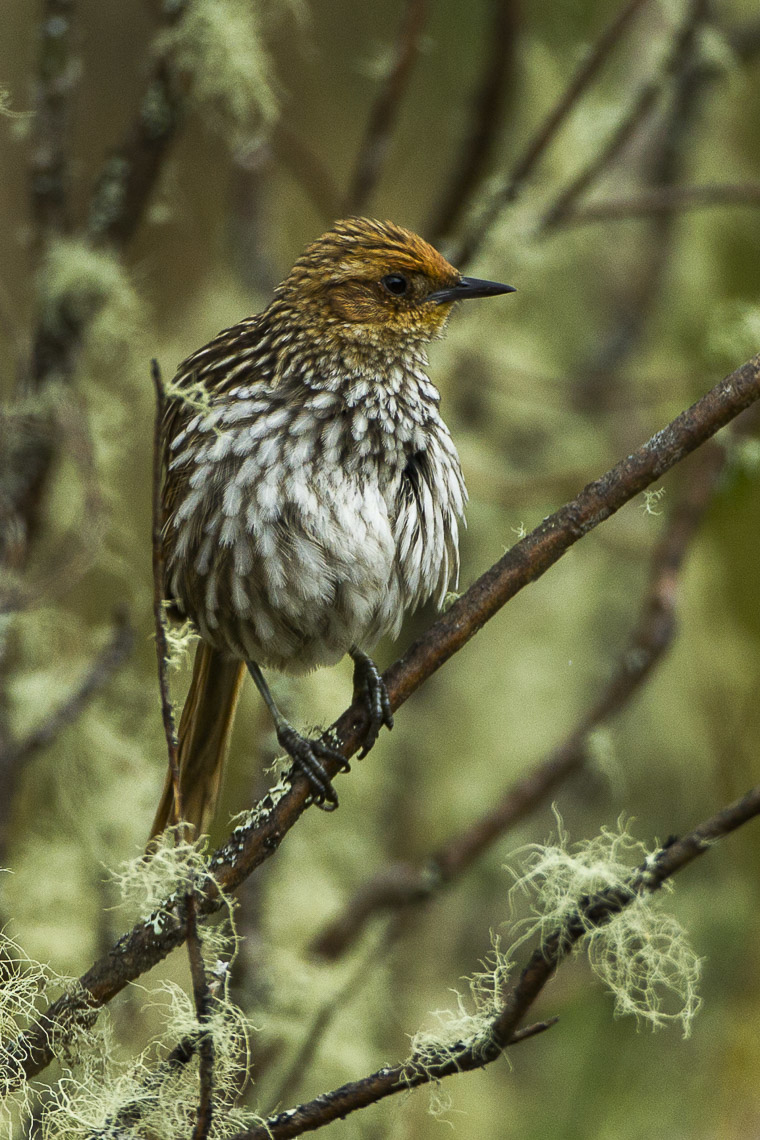 Many-striped CanasteroAsthenes flammulata
-
 Austral CanasteroAsthenes anthoides
Compare
Questions and answers
What is the scientific name of the Itatiaia Spinetail?
The scientific name of the Itatiaia Spinetail is Asthenes moreirae. Written with its author, the full name is Asthenes moreirae (Miranda-Ribeiro, 1906).
Which family does the Itatiaia Spinetail belong to?
Asthenes moreirae belongs to the family Furnariidae, in the order Passeriformes and the class Aves.
Where is the Itatiaia Spinetail found?
Checklists and occurrence records place Asthenes moreirae in 1 country: Brazil.
What is the conservation status of the Itatiaia Spinetail?
The IUCN Red List category recorded for Asthenes moreirae is Least Concern (LC).
What other names does the Itatiaia Spinetail have?
Asthenes moreirae is also known in English as Itatiaia Thistletail.
Where does the Itatiaia Spinetail occur?
It is endemic to southeastern Brazil and occurs in Minas Gerais, São Paulo, Rio de Janeiro, and Espírito Santo. Its recorded localities include Serra do Itatiaia, Serra do Caraça, and Serra dos Órgãos.[36][37][16]
At what elevation does the Itatiaia Spinetail occur?
It usually occurs above the tree line at elevations of 1,850–2,800 m.[14]
What does the Itatiaia Spinetail eat?
Its diet consists mostly of arthropods and also includes small fruits.[17][18]
What are the major threats to the Itatiaia Spinetail?
Burning of vegetation in the tree-line ecotone is identified as a major threat. Climate change-related habitat stresses are also expected to adversely affect the species.[29][32]
Does the Itatiaia Spinetail migrate?
The species remains resident throughout its range year-round.[23]
How does the Itatiaia Spinetail build its nest?
It constructs an oval nest made of moss, with some twigs arranged around the exterior and an entrance near the top.[26][27][28]
Are there recognized subspecies of the Itatiaia Spinetail?
The Itatiaia Spinetail has no recognized subspecies.[35]
Sources
Passages the profile rests on
- The Itatiaia Spinetail measures 18–19 cm in length. Source passage: “The Itatiaia spinetail is 18 to 19 cm (7.1 to 7.5 in) long” — English Wikipedia
- The Itatiaia Spinetail weighs 10–11 g. Source passage: “weighs 10 to 11 g (0.35 to 0.39 oz).” — English Wikipedia
- Males and females have the same plumage. Source passage: “The sexes have the same plumage.” — English Wikipedia
- The species has uniformly dark brown crown, upperparts, wings, and tail. Source passage: “Their crown, upperparts, wings, and tail are uniformly dark brown.” — English Wikipedia
- The tail feathers have few remaining barbs at their tips, producing a spiny appearance. Source passage: “Their tail feathers lack most barbs at the end, giving them a spiny appearance.” — English Wikipedia
- Adults have a mostly dull brown face that may show a faint, paler eyering. Source passage: “Adults have a mostly dull brown face, sometimes with a faint paler eyering.” — English Wikipedia
- The chin and throat are pale dingy buff, with a tawny ochraceous central throat patch. Source passage: “Their chin and throat are pale dingy buff with a tawny ochraceous patch in the center of the latter.” — English Wikipedia
- The underparts are pale buffy brown, with the palest coloration in the belly center and browner coloration on the flanks. Source passage: “Their underparts are pale buffy brown that is palest in the center of the belly and browner on the flanks.” — English Wikipedia
- The species has a brown iris, blackish maxilla, brownish horn mandible, and dark grayish legs and feet. Source passage: “Their iris is brown, their maxilla blackish, their mandible brownish horn, and their legs and feet dark grayish.” — English Wikipedia
- Juveniles have a smaller throat patch and some brown barring on the breast compared with adults. Source passage: “Juveniles have a smaller throat patch than adults and their breast has some brown barring.” — English Wikipedia
- The species inhabits semi-humid to humid montane scrublands. Source passage: “It inhabits semi-humid to humid montane scrublands,” — English Wikipedia
- The species occurs in Chusquea bamboo thickets. Source passage: “Chusquea bamboo thickets,” — English Wikipedia
- The species also inhabits areas of tall grass near scrub. Source passage: “and areas of tall grass near scrub.” — English Wikipedia
- The Itatiaia Spinetail usually occurs above the tree line at elevations of 1,850–2,800 m. Source passage: “It usually occurs above tree line, from 1,850 to 2,800 m (6,100 to 9,200 ft).” — English Wikipedia
- The species is found in bamboo thickets and clearings in montane forests containing grass and shrubs. Source passage: “Found in bamboo thickets and clearings in montane forests with grass and shrubs” — ebird.org
- The species occurs in Serra do Itatiaia, Serra do Caraça, and Serra dos Órgãos. Source passage: “It is named for Serra do Itatiaia and also occurs in Serra do Caraça and Serra dos Órgãos.” — English Wikipedia
- Arthropods constitute most of the Itatiaia Spinetail's diet. Source passage: “The Itatiaia spinetail feeds mostly on arthropods” — English Wikipedia
- Small fruits are also included in the species' diet. Source passage: “but also includes small fruits in its diet.” — English Wikipedia
- The species usually forages in pairs and occasionally in groups of three. Source passage: “It usually forages in pairs, sometimes in groups of three,” — English Wikipedia
- The Itatiaia Spinetail generally forages close to the ground. Source passage: “staying near the ground.” — English Wikipedia
- The species obtains prey by gleaning it from foliage and branches. Source passage: “It gleans prey from foliage and branches” — English Wikipedia
- The species sometimes performs notably acrobatic movements while foraging. Source passage: “and sometimes is quite acrobatic when foraging.” — English Wikipedia
- The Itatiaia Spinetail remains resident throughout its range year-round. Source passage: “The Itatiaia spinetail is a year-round resident throughout its range.” — English Wikipedia
- The species' song consists of accelerating, extremely high-pitched, slightly rising notes. Source passage: “accelerating series of extr. high, slightly rising notes” — English Wikipedia
- The species' call is a low-pitched 'piuw' sound. Source passage: “Its call is a "low 'piuw' ".” — English Wikipedia
- The species constructs an oval nest made of moss. Source passage: “The Itatiaia spinetail makes an oval nest of moss” — English Wikipedia
- The nest has some twigs arranged around its exterior. Source passage: “with some twigs around the outside” — English Wikipedia
- The nest entrance is positioned near the top. Source passage: “and an entrance near the top.” — English Wikipedia
- Climate change-related habitat stresses are expected to adversely affect the species. Source passage: “Stresses to its habitat due to climate change are expected to adversely affect the species.” — English Wikipedia
- The species is considered uncommon to locally fairly common. Source passage: “It is considered uncommon to locally fairly common” — English Wikipedia
- The species occurs in two national parks. Source passage: “and occurs in two national parks.” — English Wikipedia
- Burning of vegetation in the tree-line ecotone is identified as a major threat to the species. Source passage: “Burning of timber-line ecotone vegetation a major threat” — English Wikipedia
- The Itatiaia Spinetail was formerly classified in the genus Oreophylax and was also placed in Schizoeaca by some authors. Source passage: “The Itatiaia spinetail was long placed in the monotypic genus Oreophylax and by some authors in Schizoeaca,” — English Wikipedia
- Genetic research published in 2011 placed the species and all other members of Schizoeaca in Asthenes. Source passage: “but genetic data published in 2011 places it and all other members of Schizoeaca firmly in Asthenes.” — English Wikipedia
- The Itatiaia Spinetail has no recognized subspecies. Source passage: “It has no subspecies.” — English Wikipedia
- The Itatiaia Spinetail is endemic to southeastern Brazil. Source passage: “It is endemic to southeastern Brazil.” — English Wikipedia
- The species occurs in the Brazilian states of Minas Gerais, São Paulo, Rio de Janeiro, and Espírito Santo. Source passage: “The Itatiaia spinetail is found in the mountains of southeastern Brazil's Minas Gerais, São Paulo, Rio de Janeiro, and Espírito Santo states.” — English Wikipedia
Data
- Catalogue of Life, 2026-10-16 XR cc by
- Global Biodiversity Information Facility CC BY 4.0
- Wikidata CC0
- GeoNames CC BY 4.0
- Wikimedia Commons per image; credit shown with each image
- Within the Catalogue of Life, this name comes from The Integrated Taxonomic Information System cc0
This species in other databases
Page built on 27 November 2026. See how the catalog is made and all sources and licences.
Cite this page
ScientificNames.org. (2026). Asthenes moreirae (Itatiaia Spinetail). Retrieved November 27, 2026, from https://scientificnames.org/species/asthenes-moreirae
“Asthenes moreirae (Itatiaia Spinetail).” ScientificNames.org, 2026, scientificnames.org/species/asthenes-moreirae. Accessed 27 Nov. 2026.
ScientificNames.org. “Asthenes moreirae (Itatiaia Spinetail).” Accessed November 27, 2026. https://scientificnames.org/species/asthenes-moreirae.
@misc{scientificnames_asthenes_moreirae_itatiaia_spinetail,
  author = {{ScientificNames.org}},
  title = {Asthenes moreirae (Itatiaia Spinetail)},
  year = {2026},
  url = {https://scientificnames.org/species/asthenes-moreirae},
  note = {Accessed 2026-11-27}
}