Species · Birds
Rusty-fronted Canastero Asthenes ottonis
The scientific name of the Rusty-fronted Canastero is Asthenes ottonis. It is a species of bird in the family Furnariidae (ovenbird), order Passeriformes. The name dates from 1901.
- Scientific name
- Asthenes ottonis (Berlepsch, 1901)
- Common name
- Rusty-fronted Canastero
- Genus
- Asthenes
- Family
- Furnariidae (Ovenbird)
- Order
- Passeriformes
- Class
- Aves
- Red List category
- LC Least Concern
- Recorded in
- 1 country
- Name status
- accepted in the Catalogue of Life

Overview
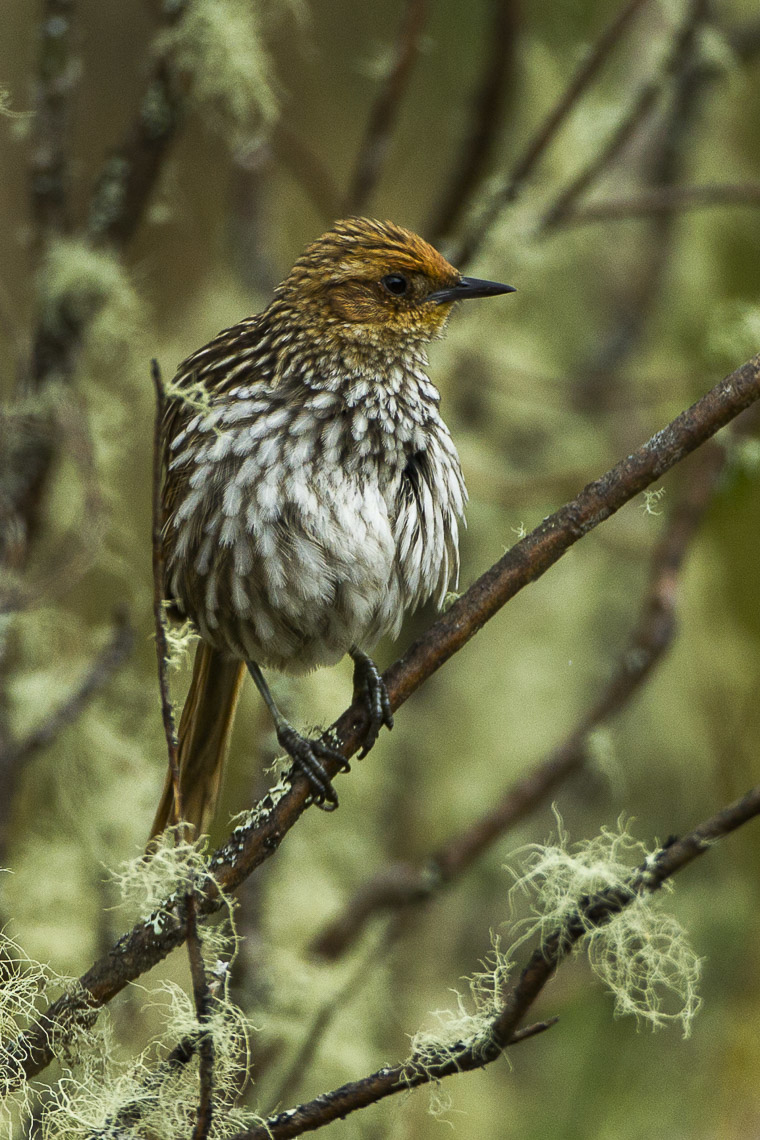
Asthenes ottonis is endemic to Peru, occurring in the Andes of south-central Peru in the departments of Huancavelica, Ayacucho, Apurímac, and Cuzco. Adults have a rufous forehead with faint pale streaks, rich brown upperparts, and predominantly rufous-chestnut wings and tail.
Written 27 November 2026 from the sources listed below. Each statement was checked against the passage it cites; statements that could not be supported were removed.
Habitat
The Rusty-fronted Canastero inhabits semi-humid to arid montane scrublands and the edges of Polylepis woodlands. It occurs at elevations between 2,750 and 4,000 metres.[1][2]
Appearance
The Rusty-fronted Canastero measures 18–19 cm in length and weighs approximately 13 grams. Male and female birds have the same plumage.[3][4][5]
Adults have a rufous forehead with faint pale streaks. The crown, back, and rump are rich brown, while the uppertail coverts are chestnut-rufous.[6][7]
The wings are predominantly rufous-chestnut, with dark fuscous tips on the flight feathers. The rufous-chestnut tail has inner three feather pairs longer than the remaining feathers.[8][9]
The chin and upper throat range from light orange-rufous to chestnut-rufous. The lower throat is pale grayish buff with brownish-gray streaks, and the breast is slightly darker with pale buff streaking.[10][11][12]
The belly is buff-whitish, while the flanks and undertail coverts are rufescent brown. The iris is dark brown to brown, and the legs and feet range from olive-gray to dark gray.[13][14][15]
Behaviour
The Rusty-fronted Canastero is a year-round resident throughout its range. It is usually observed alone or in pairs.[16][17]
Its song consists of three high-pitched ascending notes followed by a rapidly descending series. Its calls are high-pitched and nasal vocalizations.[18][19]
Diet
The Rusty-fronted Canastero is thought to feed on arthropods collected from low vegetation and the ground. Its diet and foraging behaviour are not well known.[20][21]
Reproduction and life cycle
The breeding biology of the Rusty-fronted Canastero is undocumented.[22]
Conservation
The Rusty-fronted Canastero was assessed as Least Concern by the IUCN. It has a somewhat limited geographical range and is considered fairly common despite being poorly known.[23][24][25]
The population size is unknown and is believed to be stable. BirdLife DataZone reports that the number of mature individuals is unknown and the population trend is stable.[26][27][28]
No immediate threats to the species have been identified. It occurs in at least one protected area.[29][30]
The 2024 IUCN assessment lists the Rusty-fronted Canastero for evaluation on the IUCN Red List.[31]
Similar species
Genetic data indicate that the Rusty-fronted Canastero is most closely related to the eye-ringed thistletail.[32]
Classification of the Rusty-fronted Canastero
| Kingdom | Animalia |
|---|---|
| Phylum | Chordata |
| Subphylum | Vertebrata |
| Infraphylum | Gnathostomata |
| Parvphylum | Osteichthyes |
| Megaclass | Tetrapoda |
| Class | Aves (Bird) |
| Order | Passeriformes (Passerine) |
| Family | Furnariidae (Ovenbird) |
| Genus | Asthenes (Canastero) |
| Species | Asthenes ottonis (Berlepsch, 1901) |
Where the Rusty-fronted Canastero is found
Checklists and occurrence records place Asthenes ottonis in 1 country across South America. GBIF holds 6,013 georeferenced records of it.
Countries
Regions and cities with the most records
- Cuzco Department, Peru 5,557
- Wanchaq, Peru 1,820
- Cusco, Peru 1,809
- Santiago, Peru 1,664
- Apurímac Department, Peru 277
- Abancay, Peru 223
- Ayacucho, Peru 113
- Ayacucho, Peru 31
- Junin, Peru 29
- Huanta, Peru 17
- Chilca, Peru 16
- Huancavelica, Peru 15
- Huancayo, Peru 14
- Quillabamba, Peru 5
- Santa Ana, Peru 5
Range as the checklists state it
South America
A number beside a place is its count of GBIF occurrence records. A place without a number comes from a checklist alone. Records show where a species has been observed or collected, which can include escapes and vagrants.
Common names
English
- Rusty-fronted Canastero
Names in 22 other languages
- Catalan
- Cisteller frontvermell, cisteller de front vermell
- Chinese
- 鏽額卡納雀, 锈额卡纳灶鸟
- Croatian
- riđočeli kanastero
- Czech
- hrnčiřík rezavočelý
- Danish
- Rustpandet Kurvebygger
- Dutch
- Garlepps Canastero, Gartepps Canastero
- Esperanto
- rustofrunta sinalakso
- Finnish
- ruosteotsakanastero
- French
- Synallaxe à front rouille
- German
- Garlepp-Schlüpfer, Rostgesichtcanastero
- Italian
- Canestraio fronteruggine
- Japanese
- アカビタイカマドドリ
- Lithuanian
- rudakaktė kanastera
- Norwegian
- rustpannekurvfugl
- Polish
- koszykarz rdzawoczelny
- Portuguese
- cesteiro-de-testa-ruiva, lenheiro-de-fronte-ruiva
- Russian
- Рыжелобый канастеро
- Slovak
- košikárik hrdzavočelý
- Spanish
- Canastero frentirrufo, Piscuiz frentirrufo
- Swedish
- rostpannad kanastero
- Turkish
- Kızıl Alınlı Sepetören
- Ukrainian
- канастеро рудолобий
Synonyms
2 other scientific names have been used for this species and are now treated as synonyms of Asthenes ottonis.
- Siptornis ottonis Berlepsch, 1901
- Thripophaga ottonis Berlepsch, HHCL, 1901
Related species
-
 Hudson's CanasteroAsthenes hudsoni
-
 Berlepsch's CanasteroAsthenes berlepschi
-
 White-chinned ThistletailAsthenes fuliginosa
-
 Line-fronted CanasteroAsthenes urubambensis
-
 Sharp-billed CanasteroAsthenes pyrrholeuca
-
 Cordilleran CanasteroAsthenes modesta
-
 Many-striped CanasteroAsthenes flammulata
-
 Austral CanasteroAsthenes anthoides
Compare
Questions and answers
What is the scientific name of the Rusty-fronted Canastero?
The scientific name of the Rusty-fronted Canastero is Asthenes ottonis. Written with its author, the full name is Asthenes ottonis (Berlepsch, 1901).
Which family does the Rusty-fronted Canastero belong to?
Asthenes ottonis belongs to the family Furnariidae, in the order Passeriformes and the class Aves.
Where is the Rusty-fronted Canastero found?
Checklists and occurrence records place Asthenes ottonis in 1 country: Peru.
What is the conservation status of the Rusty-fronted Canastero?
The IUCN Red List category recorded for Asthenes ottonis is Least Concern (LC).
Where is the Rusty-fronted Canastero found?
It is endemic to Peru and occurs in the Andes of south-central Peru, specifically in Huancavelica, Ayacucho, Apurímac, and Cuzco.[33][34]
At what elevation does the Rusty-fronted Canastero occur?
It occurs at elevations between 2,750 and 4,000 metres.[2]
What does the Rusty-fronted Canastero eat?
It is thought to feed on arthropods collected from low vegetation and the ground.[20]
What is the conservation status of the Rusty-fronted Canastero?
It was assessed as Least Concern by the IUCN.[23]
What species is most closely related to the Rusty-fronted Canastero?
Genetic data indicate that its closest relative is the eye-ringed thistletail.[32]
Where has the Rusty-fronted Canastero been recorded in Cuzco?
It has been recorded at Humedal Lucre-Huacarpay in Cuzco, Peru.[35]
Sources
Passages the profile rests on
- The species inhabits semi-humid to arid montane scrublands and the edges of Polylepis woodlands. Source passage: “It inhabits semi-humid to arid montane scrublands and the edge of Polylepis woodlands.” — English Wikipedia
- The species occurs at elevations between 2,750 and 4,000 metres. Source passage: “In elevation it ranges between 2,750 and 4,000 m (9,000 and 13,100 ft).” — English Wikipedia
- The Rusty-fronted Canastero measures 18–19 cm in length. Source passage: “The rusty-fronted canastero is 18 to 19 cm (7.1 to 7.5 in) long and weighs about 13 g (0.46 oz).” — English Wikipedia
- The species weighs approximately 13 grams. Source passage: “weighs about 13 g (0.46 oz).” — English Wikipedia
- Male and female Rusty-fronted Canasteros have the same plumage. Source passage: “The sexes have the same plumage.” — English Wikipedia
- Adults have a rufous forehead with faint pale streaks. Source passage: “Their forehead ("front") is rufous with faint pale streaks.” — English Wikipedia
- The crown, back, and rump are rich brown, while the uppertail coverts are chestnut-rufous. Source passage: “Their crown, back, and rump are rich brown and their uppertail coverts chestnut-rufous.” — English Wikipedia
- The wings are predominantly rufous-chestnut with dark fuscous tips on the flight feathers. Source passage: “Their wings are mostly rufous-chestnut with dark fuscous tips on the flight feathers.” — English Wikipedia
- The tail is rufous-chestnut, with the inner three feather pairs longer than the remaining feathers. Source passage: “Their tail is rufous-chestnut; the inner three pairs of feathers are longer than the others and have dark fuscous shafts.” — English Wikipedia
- The chin and upper throat range from light orange-rufous to chestnut-rufous. Source passage: “Their chin and upper throat are light orange-rufous to chestnut-rufous” — English Wikipedia
- The lower throat is pale grayish buff with brownish-gray streaks. Source passage: “their lower throat pale grayish buff streaked with brownish gray” — English Wikipedia
- The breast is slightly darker than the lower throat and has pale buff streaking. Source passage: “their breast slightly darker and streaked with pale buff” — English Wikipedia
- The belly is buff-whitish, while the flanks and undertail coverts are rufescent brown. Source passage: “their belly buff-whitish, and their flanks and undertail coverts rufescent brown.” — English Wikipedia
- The iris is dark brown to brown. Source passage: “Their iris is dark brown to brown” — English Wikipedia
- The legs and feet range in colour from olive-gray to dark gray. Source passage: “their legs and feet olive-gray to dark gray.” — English Wikipedia
- The Rusty-fronted Canastero is a year-round resident throughout its range. Source passage: “The rusty-fronted canastero is a year-round resident throughout its range.” — English Wikipedia
- The species is usually observed alone or in pairs. Source passage: “It is usually seen singly or in pairs.” — English Wikipedia
- The species' song consists of three high-pitched ascending notes followed by a rapidly descending series. Source passage: “3 high-pitched ascending notes followed by a rapidly descending series” — English Wikipedia
- The species' calls have been described as high-pitched and nasal vocalizations. Source passage: “high-pitched 'veer' and nasal 'djeeh'” — English Wikipedia
- The species is thought to feed on arthropods collected from low vegetation and the ground. Source passage: “It is thought to feed on arthropods gleaned from low vegetation and the ground.” — English Wikipedia
- The diet and foraging behaviour of the Rusty-fronted Canastero are not well known. Source passage: “The rusty-fronted canastero's diet and foraging behavior are not well known.” — English Wikipedia
- The breeding biology of the Rusty-fronted Canastero is undocumented. Source passage: “Nothing is known about the rusty-fronted canastero's breeding biology.” — English Wikipedia
- The Rusty-fronted Canastero was assessed as Least Concern by the IUCN. Source passage: “The IUCN has assessed the rusty-fronted canastero as being of Least Concern.” — English Wikipedia
- The species has a somewhat limited geographical range. Source passage: “It has a somewhat limited range” — English Wikipedia
- The Rusty-fronted Canastero is considered fairly common despite being poorly known. Source passage: “It is poorly known but thought to be fairly common.” — English Wikipedia
- The population size of the species is unknown and is believed to be stable. Source passage: “an unknown population size that is believed to be stable.” — English Wikipedia
- BirdLife DataZone reports that the number of mature individuals is unknown. Source passage: “Number of mature individuals Unknown” — datazone.birdlife.org
- BirdLife DataZone reports a stable population trend for the species. Source passage: “Population trend Stable” — datazone.birdlife.org
- No immediate threats to the species have been identified. Source passage: “No immediate threats have been identified.” — English Wikipedia
- The species occurs in at least one protected area. Source passage: “It occurs in at least one protected area.” — English Wikipedia
- The 2024 IUCN assessment lists the Rusty-fronted Canastero for evaluation on the IUCN Red List. Source passage: “Rusty-fronted Canastero Asthenes ottonis has most recently been assessed for The IUCN Red List of Threatened Species in 2024.” — iucnredlist.org
- Genetic data indicate that the Rusty-fronted Canastero is most closely related to the eye-ringed thistletail. Source passage: “genetic data show it to be most closely related to the eye-ringed thistletail (A. palpebralis).” — English Wikipedia
- The Rusty-fronted Canastero occurs in the Andes of south-central Peru, specifically in the departments of Huancavelica, Ayacucho, Apurímac, and Cuzco. Source passage: “The rusty-fronted canastero is found in the Andes of south-central Peru's Huancavelica, Ayacucho, Apurímac, and Cuzco departments.” — English Wikipedia
- The Rusty-fronted Canastero is endemic to Peru. Source passage: “It is endemic to Peru.” — English Wikipedia
- The species has been recorded at Humedal Lucre-Huacarpay in Cuzco, Peru. Source passage: “Humedal Lucre-Huacarpay, Cuzco [Cusco], Peru” — ebird.org
Data
- Catalogue of Life, 2026-10-16 XR cc by
- Global Biodiversity Information Facility CC BY 4.0
- Wikidata CC0
- GeoNames CC BY 4.0
- Wikimedia Commons per image; credit shown with each image
- Within the Catalogue of Life, this name comes from The Integrated Taxonomic Information System cc0
References
- Gill, Frank, & and Minturn Wright. (2006). Birds of the World: Recommended English Names.
This species in other databases
Page built on 29 November 2026. See how the catalog is made and all sources and licences.
Cite this page
ScientificNames.org. (2026). Asthenes ottonis (Rusty-fronted Canastero). Retrieved November 29, 2026, from https://scientificnames.org/species/asthenes-ottonis
“Asthenes ottonis (Rusty-fronted Canastero).” ScientificNames.org, 2026, scientificnames.org/species/asthenes-ottonis. Accessed 29 Nov. 2026.
ScientificNames.org. “Asthenes ottonis (Rusty-fronted Canastero).” Accessed November 29, 2026. https://scientificnames.org/species/asthenes-ottonis.
@misc{scientificnames_asthenes_ottonis_rusty_fronted_canastero,
  author = {{ScientificNames.org}},
  title = {Asthenes ottonis (Rusty-fronted Canastero)},
  year = {2026},
  url = {https://scientificnames.org/species/asthenes-ottonis},
  note = {Accessed 2026-11-29}
}