Species · Birds
Vilcabamba Thistletail Asthenes vilcabambae
The scientific name of the Vilcabamba Thistletail is Asthenes vilcabambae. It is a species of bird in the family Furnariidae (ovenbird), order Passeriformes. The name dates from 1972.
- Scientific name
- Asthenes vilcabambae (Vaurie, Weske & Terborgh, 1972)
- Common name
- Vilcabamba Thistletail
- Genus
- Asthenes
- Family
- Furnariidae (Ovenbird)
- Order
- Passeriformes
- Class
- Aves
- Red List category
- LC Least Concern
- Recorded in
- 1 country
- Name status
- accepted in the Catalogue of Life
Overview
Asthenes vilcabambae is endemic to the Vilcabamba Mountains of Peru, where it inhabits the northern and central Cordillera Vilcabamba. It is distinguished by its long, deeply forked tail with sparse feather-end barbs that give it a ragged appearance.
Written 27 November 2026 from the sources listed below. Each statement was checked against the passage it cites; statements that could not be supported were removed.
Appearance
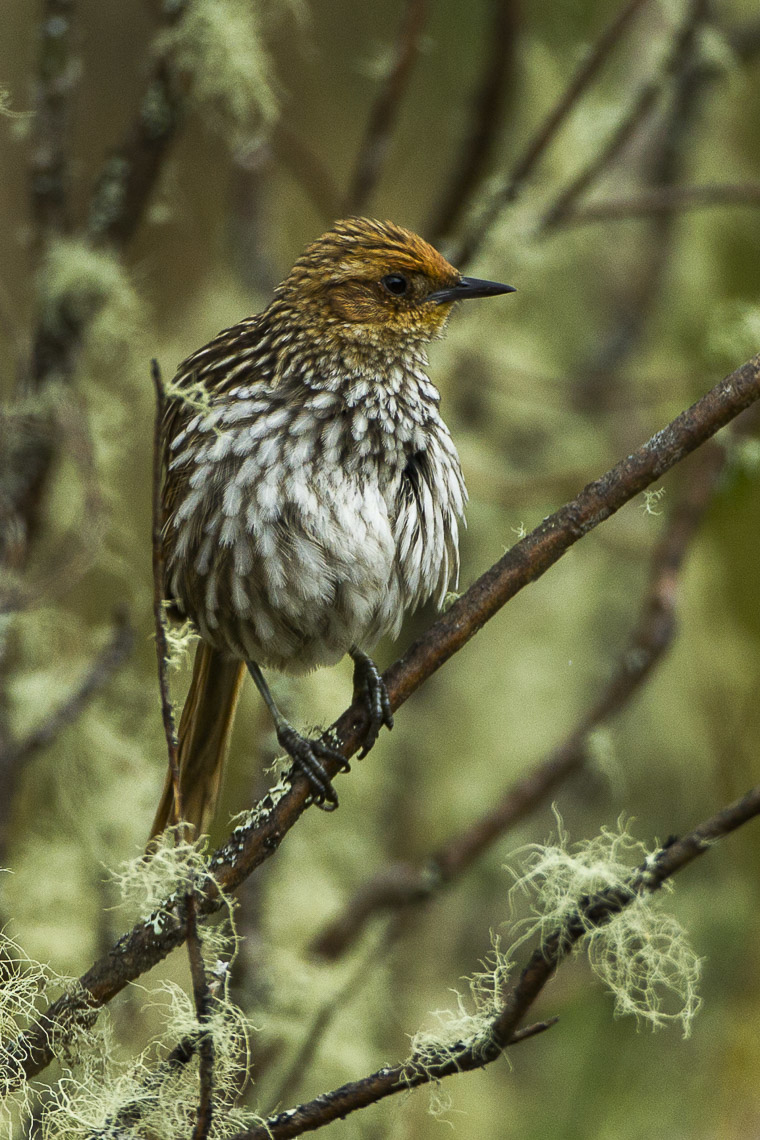
Adult Vilcabamba Thistletails have a brownish face, a paler brown forehead, and a broad supercilium. The brownish crown has faint black spotting.[1][2]
The back and rump are brownish, while the dark brown wings have rufous feather edges. The long, deeply forked tail is paler and more rufescent brown than the back, with sparse feather-end barbs producing a ragged appearance.[3][4]
The chin is light ochraceous to tawny, the throat is pale grayish brown, and the darker grayish underparts have faint scaling and brownish flanks.[5]
The iris is dark brown, the bill is blackish to dark gray and sometimes has a pale mandibular base, and the legs and feet are dark bluish gray. Male and female Vilcabamba Thistletails have the same plumage.[6][7]
The Vilcabamba Thistletail measures 18–20 cm in length and weighs between 18.5 and 22 g.[8][9]
Habitat
The Vilcabamba Thistletail primarily inhabits elfin forest and Polylepis woodlands in the tree-line ecotone. It favors habitats containing dense stands of Chusquea bamboo.[10][11]
It also occurs in smaller numbers in higher-elevation páramo grassland and lower cloudforest. Its usual elevational range is approximately 2,800–3,600 m, and it is rarely recorded at elevations as low as 2,500 m.[12][13][14]
The species is endemic to the Vilcabamba Mountains of Peru, with a distribution restricted to the northern and central Cordillera Vilcabamba. Within Peru, it occurs east of the Apurímac River in the departments of Junín and Cuzco.[15][16][17]
Diet
The species is assumed to feed mainly on arthropods collected from foliage.[18]
Behaviour
Vilcabamba Thistletails are usually observed individually or in pairs. The species is believed to remain in its geographic range throughout the year.[19][20]
The main song consists of several clear, slightly rising notes that accelerate into a fast trill and finish with a slightly lower-pitched note. An alternative song consists of short bursts containing three or four strongly overslurred notes.[21][22]
The species has a short call described as 'pyeek'.[23]
Conservation
The Vilcabamba Thistletail is classified as Least Concern by the IUCN and was most recently assessed for the IUCN Red List in 2024. It is also classified as Least Concern in the eBird species listing.[24][25][26]
The population size is unknown, although it is believed to be stable. No immediate threats to the species have been identified.[27][28]
The species is considered quite common in suitable habitat. Large portions of its range are currently inaccessible to human disturbance, and much of its geographic range falls within Otishi National Park.[29][30][31]
BirdLife International's factsheet associates the species with the Cordillera Vilcabamba - Avireri - VRAEM Key Biodiversity Area in Peru.[32]
Classification of the Vilcabamba Thistletail
| Kingdom | Animalia |
|---|---|
| Phylum | Chordata |
| Subphylum | Vertebrata |
| Infraphylum | Gnathostomata |
| Parvphylum | Osteichthyes |
| Megaclass | Tetrapoda |
| Class | Aves (Bird) |
| Order | Passeriformes (Passerine) |
| Family | Furnariidae (Ovenbird) |
| Genus | Asthenes (Canastero) |
| Species | Asthenes vilcabambae (Vaurie, Weske & Terborgh, 1972) |
Where the Vilcabamba Thistletail is found
Checklists and occurrence records place Asthenes vilcabambae in 1 country across South America. GBIF holds 184 georeferenced records of it.
Countries
Regions and cities with the most records
Range as the checklists state it
South America
A number beside a place is its count of GBIF occurrence records. A place without a number comes from a checklist alone. Records show where a species has been observed or collected, which can include escapes and vagrants.
Common names
English
- Vilcabamba Thistletail
Names in 22 other languages
- Catalan
- cuaespinós de Vilcabamba
- Chinese
- 維卡班巴薊尾雀, 维山棘尾雀
- Croatian
- ljuskastotrba trnorepa
- Czech
- ostrochvostka vilcabambská
- Danish
- Vilcabambabørstehale
- Dutch
- Vilcabambadistelstaart
- Esperanto
- vilkabamba sinalakso
- Finnish
- vilcabambanpiikkipyrstö
- French
- Synallaxe de Vilcabamba
- German
- Rostkehl-Distelschwanz, Rostkehlcanastero
- Italian
- Codaspino di Vilcabamba
- Japanese
- ビルカバンバトゲオカマドドリ
- Lithuanian
- kuskinis dygliauodegis
- Norwegian
- vilcabambatistelstjert
- Polish
- koszykarz brodaty
- Portuguese
- lenheiro-de-vilcabamba, rabo-espinhoso-de-vilcabamba
- Russian
- Чешуебрюхий канастеро, Чешуебрюхий чертополошник
- Slovak
- košikárik vilcabambský
- Spanish
- Piscuiz de Vilcabamba
- Swedish
- vilcabambaborststjärt
- Turkish
- Vilkabamba Sepetöreni
- Ukrainian
- корпуана рудогорла
Synonyms
4 other scientific names have been used for this species and are now treated as synonyms of Asthenes vilcabambae.
- Asthenes vilcabambae vilcabambae (Vaurie, Weske & Terborgh, 1972)
- Schizoeaca fuliginosa vilcabambae Vaurie, Weske & Terborgh, 1972
- Schizoeaca vilcabambae Vaurie, Weske & Terborgh, 1972
- Schizoeaca vilcabambae vilcabambae Vaurie, Weske & Terborgh, 1972
Related species
-
 Hudson's CanasteroAsthenes hudsoni
-
 Berlepsch's CanasteroAsthenes berlepschi
-
 White-chinned ThistletailAsthenes fuliginosa
-
 Line-fronted CanasteroAsthenes urubambensis
-
 Sharp-billed CanasteroAsthenes pyrrholeuca
-
 Cordilleran CanasteroAsthenes modesta
-
 Many-striped CanasteroAsthenes flammulata
-
 Austral CanasteroAsthenes anthoides
Compare
Questions and answers
What is the scientific name of the Vilcabamba Thistletail?
The scientific name of the Vilcabamba Thistletail is Asthenes vilcabambae. Written with its author, the full name is Asthenes vilcabambae (Vaurie, Weske & Terborgh, 1972).
Which family does the Vilcabamba Thistletail belong to?
Asthenes vilcabambae belongs to the family Furnariidae, in the order Passeriformes and the class Aves.
Where is the Vilcabamba Thistletail found?
Checklists and occurrence records place Asthenes vilcabambae in 1 country: Peru.
What is the conservation status of the Vilcabamba Thistletail?
The IUCN Red List category recorded for Asthenes vilcabambae is Least Concern (LC).
Where is the Vilcabamba Thistletail found?
It is endemic to the Vilcabamba Mountains of Peru and is restricted to the northern and central Cordillera Vilcabamba. It occurs east of the Apurímac River in the departments of Junín and Cuzco.[15][16][17]
What habitats does the Vilcabamba Thistletail occupy?
It primarily inhabits elfin forest and Polylepis woodlands in the tree-line ecotone, favoring dense stands of Chusquea bamboo. It also occurs in smaller numbers in higher-elevation páramo grassland and lower cloudforest.[10][12][11]
What is the elevational range of the Vilcabamba Thistletail?
Its usual elevational range is approximately 2,800–3,600 m. It is rarely recorded as low as 2,500 m.[13][14]
What does the Vilcabamba Thistletail eat?
It is assumed to feed mainly on arthropods collected from foliage.[18]
How large is the Vilcabamba Thistletail?
It measures 18–20 cm in length and weighs between 18.5 and 22 g.[8][9]
What is the conservation status of the Vilcabamba Thistletail?
It is classified as Least Concern by the IUCN and in the eBird species listing. Its population size is unknown but believed to be stable.[24][27][26]
What sounds does the Vilcabamba Thistletail make?
Its main song consists of clear, slightly rising notes that accelerate into a fast trill and end with a slightly lower-pitched note. An alternative song consists of short bursts of three or four strongly overslurred notes, and its short call is described as 'pyeek'.[21][22][23]
Sources
Passages the profile rests on
- Adult Vilcabamba thistletails have a brownish face, a paler brown forehead, and a broad supercilium. Source passage: “Adults have a brownish face with a paler brown forehead and wide supercilium.” — English Wikipedia
- The crown is brownish with faint black spotting. Source passage: “Their crown is brownish faintly spotted with black.” — English Wikipedia
- The back and rump are brownish, while the dark brown wings have rufous feather edges. Source passage: “Their back and rump are brownish and their wings dark brown with rufous edges to the feathers.” — English Wikipedia
- The tail is long, deeply forked, and paler and more rufescent brown than the back, with sparse feather-end barbs producing a ragged appearance. Source passage: “Their tail is a paler but more rufescent brown than the back; it is long and deeply forked with few barbs at the feather ends that give a ragged appearance.” — English Wikipedia
- The chin is light ochraceous to tawny, the throat is pale grayish brown, and the darker grayish underparts have faint scaling and brownish flanks. Source passage: “Their chin is light ochraceous to tawny, their throat pale grayish brown, and their underparts a darker grayish with a faint scaled appearance and brownish flanks.” — English Wikipedia
- The iris is dark brown, the bill is blackish to dark gray and sometimes has a pale mandibular base, and the legs and feet are dark bluish gray. Source passage: “Their iris is dark brown, their bill blackish to dark gray with sometimes a pale base to the mandible, and their legs and feet dark bluish gray.” — English Wikipedia
- Male and female Vilcabamba thistletails have the same plumage. Source passage: “The sexes have the same plumage.” — English Wikipedia
- The Vilcabamba thistletail measures 18–20 cm in length. Source passage: “The Vilcabamba thistletail is 18 to 20 cm (7.1 to 7.9 in) long” — English Wikipedia
- The species weighs between 18.5 and 22 g. Source passage: “weighs 18.5 to 22 g (0.65 to 0.78 oz).” — birdnet.cornell.edu
- The species primarily inhabits elfin forest and Polylepis woodlands in the tree-line ecotone. Source passage: “It primarily inhabits elfin forest and Polylepis woodlands in the tree line ecotone.” — English Wikipedia
- The species favors habitats containing dense stands of Chusquea bamboo. Source passage: “It favors areas with dense stands of Chusquea bamboo.” — English Wikipedia
- The Vilcabamba thistletail also occurs in smaller numbers in higher-elevation páramo grassland and lower cloudforest. Source passage: “It is found in lesser numbers in the higher páramo grassland and lower cloudforest.” — English Wikipedia
- Its usual elevational range is approximately 2,800–3,600 m. Source passage: “In elevation it ranges mostly between 2,800 and 3,600 m (9,200 and 11,800 ft)” — English Wikipedia
- The species is rarely recorded at elevations as low as 2,500 m. Source passage: “and is rarely found as low as 2,500 m (8,200 ft).” — English Wikipedia
- The Vilcabamba thistletail is endemic to the Vilcabamba Mountains of Peru. Source passage: “It is endemic to the Vilcabamba Mountains of Peru.” — English Wikipedia
- Its distribution is restricted to the northern and central Cordillera Vilcabamba. Source passage: “The Vilcabamba thistletail is found only in the northern and central Cordillera Vilcabamba of Peru.” — English Wikipedia
- Within Peru, the species occurs east of the Apurímac River in the departments of Junín and Cuzco. Source passage: “There it occurs east of the Apurímac River in the departments of Junín and Cuzco.” — English Wikipedia
- The species is assumed to feed mainly on arthropods collected from foliage. Source passage: “It is assumed to feed mostly on arthropods that it gleans from foliage.” — English Wikipedia
- Vilcabamba thistletails are usually observed individually or in pairs. Source passage: “It is usually seen singly or in pairs.” — English Wikipedia
- The species is believed to remain in its geographic range throughout the year. Source passage: “The Vilcabamba thistletail is believed to be a year-round resident throughout its range.” — English Wikipedia
- Its main song consists of several clear, slightly rising notes that accelerate into a fast trill and finish with a slightly lower-pitched note. Source passage: “several clear, slightly rising notes that progressively increase in speed...into a fast trill...and then ends on a single slightly lower-pitched note.” — English Wikipedia
- An alternative song consists of short bursts containing three or four strongly overslurred notes. Source passage: “short, fast bursts of 3-4 strongly overslurred notes” — English Wikipedia
- The species has a short call described as 'pyeek'. Source passage: “Its main call is a short "pyeek".” — English Wikipedia
- The Vilcabamba thistletail is classified as Least Concern by the IUCN. Source passage: “The IUCN has assessed the Vilcabamba thistletail as being of Least Concern.” — English Wikipedia
- The species was most recently assessed for the IUCN Red List in 2024. Source passage: “Vilcabamba Thistletail Asthenes vilcabambae has most recently been assessed for The IUCN Red List of Threatened Species in 2024.” — iucnredlist.org
- The species is classified as Least Concern in the eBird species listing. Source passage: “Vilcabamba Thistletail Asthenes vilcabambae. LC Least Concern” — ebird.org
- The population size of the Vilcabamba thistletail is unknown, although it is believed to be stable. Source passage: “a very restricted range and an unknown population size, though the latter is believed to be stable.” — English Wikipedia
- No immediate threats to the Vilcabamba thistletail have been identified. Source passage: “No immediate threats have been identified.” — English Wikipedia
- The species is considered quite common in suitable habitat. Source passage: “It is apparently "quite common in appropriate habitat"” — English Wikipedia
- Large portions of the species' range are currently inaccessible to human disturbance. Source passage: “[l]arge portions of [its] range are in areas currently inaccessible to human disturbance.” — English Wikipedia
- Much of the Vilcabamba thistletail's geographic range falls within Otishi National Park. Source passage: “Much of the range is within Otishi National Park.” — English Wikipedia
- BirdLife International's factsheet associates the species with the Cordillera Vilcabamba - Avireri - VRAEM Key Biodiversity Area in Peru. Source passage: “Peru Cordillera Vilcabamba - Avireri - VRAEM 30.63% 2023 B2 (KBA)” — datazone.birdlife.org
Data
- Catalogue of Life, 2026-10-16 XR cc by
- Global Biodiversity Information Facility CC BY 4.0
- Wikidata CC0
- GeoNames CC BY 4.0
- Within the Catalogue of Life, this name comes from The Integrated Taxonomic Information System cc0
This species in other databases
Page built on 28 November 2026. See how the catalog is made and all sources and licences.
Cite this page
ScientificNames.org. (2026). Asthenes vilcabambae (Vilcabamba Thistletail). Retrieved November 28, 2026, from https://scientificnames.org/species/asthenes-vilcabambae
“Asthenes vilcabambae (Vilcabamba Thistletail).” ScientificNames.org, 2026, scientificnames.org/species/asthenes-vilcabambae. Accessed 28 Nov. 2026.
ScientificNames.org. “Asthenes vilcabambae (Vilcabamba Thistletail).” Accessed November 28, 2026. https://scientificnames.org/species/asthenes-vilcabambae.
@misc{scientificnames_asthenes_vilcabambae_vilcabamba_thistletail,
  author = {{ScientificNames.org}},
  title = {Asthenes vilcabambae (Vilcabamba Thistletail)},
  year = {2026},
  url = {https://scientificnames.org/species/asthenes-vilcabambae},
  note = {Accessed 2026-11-28}
}