Species · Insects
Asthenopholis minor
Asthenopholis minor has no English name on record in the checklists used here. It is a species of insect in the family Scarabaeidae (dung beetles), order Coleoptera. The name dates from 1898.
- Scientific name
- Asthenopholis minor Brenske, 1898
- Genus
- Asthenopholis
- Family
- Scarabaeidae (Dung Beetles)
- Order
- Coleoptera
- Class
- Insecta
- Recorded in
- 2 countries
- Name status
- accepted in the Catalogue of Life
Overview
Asthenopholis minor Brenske, 1898 is a beetle belonging to the family Scarabaeidae. The species occurs in South Africa, including KwaZulu-Natal, Mpumalanga, Limpopo and Eastern Cape, as well as Lesotho and Eswatini. It has a black head, thorax and scutellum, reddish brown elytra, and fine white scales on the thorax, scutellum and elytra.
Written 28 November 2026 from the sources listed below. Each statement was checked against the passage it cites; statements that could not be supported were removed.
Appearance
The head, thorax and scutellum are black. The elytra are reddish brown, and fine white scales occur on the thorax, scutellum and elytra.[1][2][3]
Habitat
The species occurs in South Africa, including KwaZulu-Natal, Mpumalanga, Limpopo and Eastern Cape, as well as Lesotho and Eswatini.[4]
Classification of Asthenopholis minor
| Kingdom | Animalia |
|---|---|
| Phylum | Arthropoda |
| Subphylum | Hexapoda |
| Class | Insecta (Insect) |
| Order | Coleoptera (Beetle) |
| Suborder | Polyphaga |
| Series | Staphyliniformia |
| Superfamily | Scarabaeoidea |
| Family | Scarabaeidae (Dung Beetles) |
| Subfamily | Melolonthinae |
| Tribe | Leucopholini |
| Genus | Asthenopholis |
| Species | Asthenopholis minor Brenske, 1898 |
Where Asthenopholis minor is found
Checklists and occurrence records place Asthenopholis minor in 2 countries across Africa.
Countries
Range as the checklists state it
Afrotropical(Republic South Africa:KwaZulu-Natal, Mpumalanga, Limpopo, Eastern Cape, Lesotho, Eswatini)
A number beside a place is its count of GBIF occurrence records. A place without a number comes from a checklist alone. Records show where a species has been observed or collected, which can include escapes and vagrants.
Related species
- Asthenopholis adspersa
- Asthenopholis subfasciata
- Asthenopholis crypsis
- Asthenopholis ugandensis
- Asthenopholis rex
- Asthenopholis crassa
-
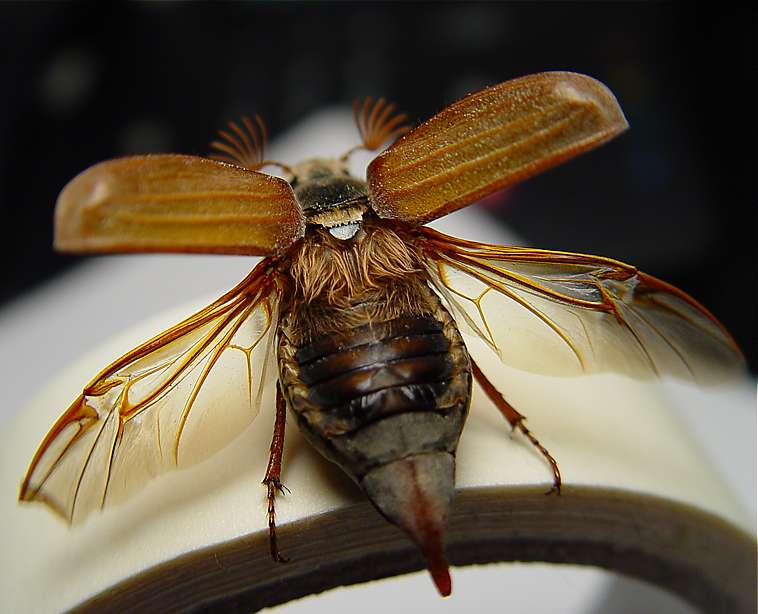 CockchaferMelolontha melolontha
-
 Hercules BeetleDynastes (Dynastes) hercules
Compare
Questions and answers
How large are adult males?
Adult males measure approximately 14.5–18 mm in length.[5]
How large are adult females?
Adult females measure approximately 14–19 mm in length.[6]
What colour are the elytra?
The elytra are reddish brown.[2]
Sources
Passages the profile rests on
- The head, thorax and scutellum of this species are black. Source passage: “The head, thorax and scutellum are black” — English Wikipedia
- The elytra of this species are reddish brown. Source passage: “the elytra are reddish brown.” — English Wikipedia
- Fine white scales occur on the thorax, scutellum and elytra. Source passage: “There are fine, white scales on the thorax, scutellum and elytra.” — English Wikipedia
- The species occurs in South Africa, including KwaZulu-Natal, Mpumalanga, Limpopo and Eastern Cape, as well as Lesotho and Eswatini. Source passage: “It is found in South Africa (KwaZulu-Natal, Mpumalanga, Limpopo, Eastern Cape), Lesotho and Eswatini.” — English Wikipedia
- Adult males measure approximately 14.5–18 mm in length. Source passage: “Adults reach a length of about 14.5–18 mm (0.57–0.71 in) for males” — English Wikipedia
- Adult females measure approximately 14–19 mm in length. Source passage: “14–19 mm (0.55–0.75 in) for females.” — English Wikipedia
Data
- Catalogue of Life, 2026-10-16 XR cc by
- Wikidata CC0
- GeoNames CC BY 4.0
- Within the Catalogue of Life, this name comes from World Scarabaeidae Database cc by
References
- Brenske, E. (1898). Melolonthiden aus Afrika. Stettiner Entomologische Zeitung, Stettin 59(4):333-394. https://www.zobodat.at/pdf/Entomologische-Zeitung-Stettin_59_0333-0394.pdf Link where the name was published
This species in other databases
Page built on 28 November 2026. See how the catalog is made and all sources and licences.
Cite this page
ScientificNames.org. (2026). Asthenopholis minor. Retrieved November 28, 2026, from https://scientificnames.org/species/asthenopholis-minor
“Asthenopholis minor.” ScientificNames.org, 2026, scientificnames.org/species/asthenopholis-minor. Accessed 28 Nov. 2026.
ScientificNames.org. “Asthenopholis minor.” Accessed November 28, 2026. https://scientificnames.org/species/asthenopholis-minor.
@misc{scientificnames_asthenopholis_minor,
  author = {{ScientificNames.org}},
  title = {Asthenopholis minor},
  year = {2026},
  url = {https://scientificnames.org/species/asthenopholis-minor},
  note = {Accessed 2026-11-28}
}