Species · Birds
American Goshawk Astur atricapillus
The scientific name of the American Goshawk is Astur atricapillus. It is a species of bird in the family Accipitridae (hawks), order Accipitriformes. The name dates from 1812.
- Scientific name
- Astur atricapillus (A. Wilson, 1812)
- Common name
- American Goshawk
- Genus
- Astur
- Family
- Accipitridae (Hawks)
- Order
- Accipitriformes
- Class
- Aves
- Recorded in
- 5 countries
- Name status
- accepted in the Catalogue of Life
Overview
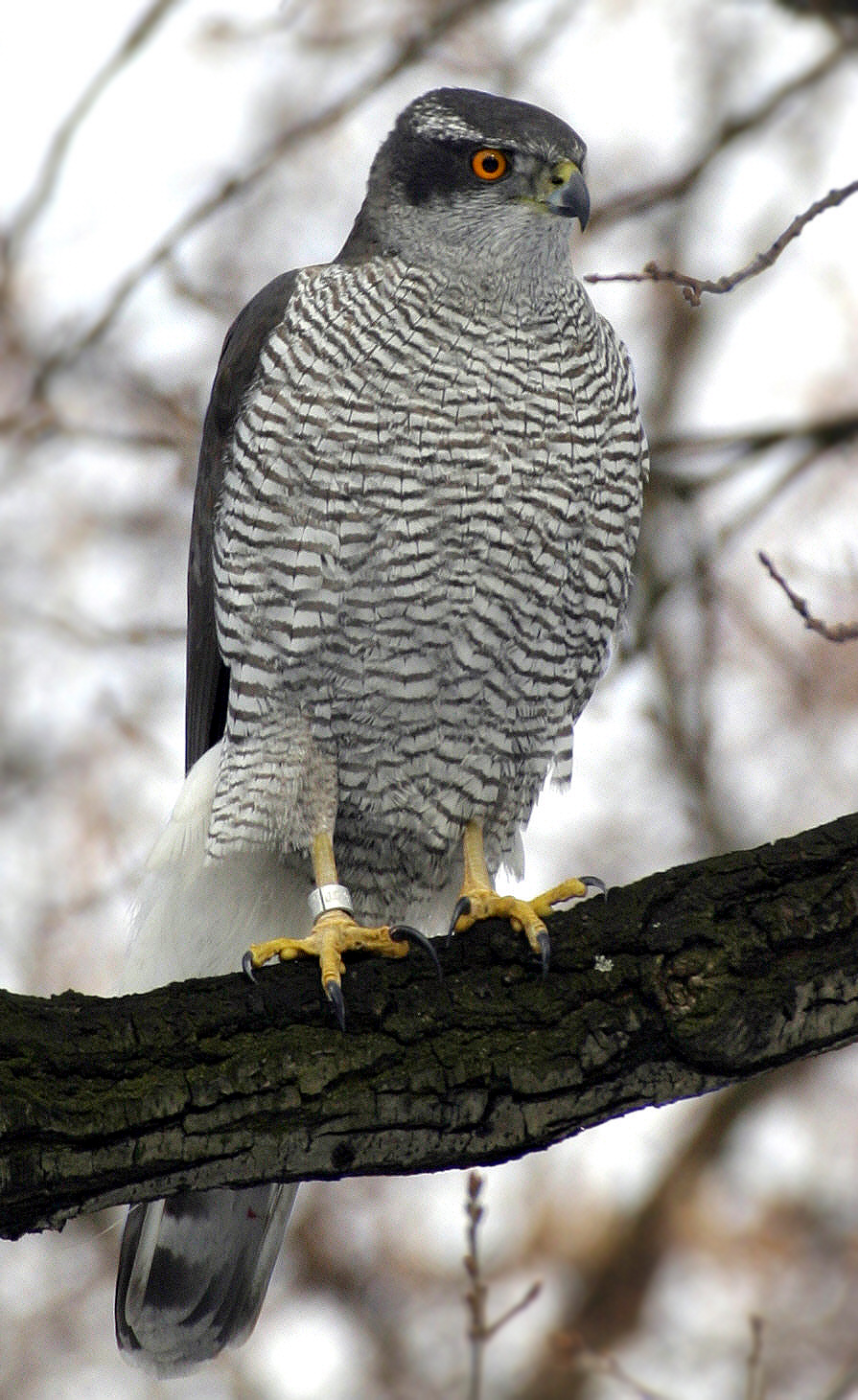
Adults are generally blue-gray above, with a contrasting black head, broad white supercilia, and grayish underparts with fine wavy barring and black shaft streaks.
Written 27 November 2026 from the sources listed below. Each statement was checked against the passage it cites; statements that could not be supported were removed.
Appearance
Adult American Goshawks are generally blue-gray above, with a contrasting black head and broad white supercilia. Their grayish underparts commonly have fine gray wavy barring and conspicuous black shaft streaks.[1][2]
Adults from mainland Alaska tend to have paler plumage and more pale flecking than other American Goshawks.[3]
Habitat
American Goshawks inhabit both deciduous and coniferous forests. They favor tall, old-growth forest stands with intermediate to heavy canopy coverage and sparse understory vegetation, typically with forest openings nearby for additional hunting opportunities.[4][5][6]
American Goshawks can occupy elevations up to the tree line, which is usually no higher than 3,000 m. Narrow, tree-lined riparian zones can provide suitable winter habitat when extensive woodlands are absent.[7][8]
American Goshawks occur broadly across the western United States, including Alaska, and western Canada. Their western breeding range extends from Washington to southern California and eastward to central Colorado and westernmost Texas, with discontinuous breeding populations in southeastern Arizona and southwestern New Mexico.[9][10][11]
In Mexico, the breeding distribution extends through Sonora and Chihuahua along the Sierra Madre Occidental to Jalisco and Guerrero. American Goshawks also breed in the Great Lakes region, including northern Minnesota, Illinois, Michigan, and parts of Ohio, and in mountainous areas of New England, New York, central Pennsylvania, and northwestern New Jersey.[12][13][14]
The laingi subspecies occurs on Haida Gwaii and Vancouver Island. The apache subspecies ranges from southern Arizona and New Mexico throughout the species' Mexican range.[15][16]
Behaviour
American Goshawks are mainly resident, although populations from colder regions migrate south during winter. Migrating individuals are frequently observed flying south along mountain ridges during autumn.[17][18]
American Goshawks from northernmost or high-mountain populations move to warmer, lower-elevation forests during winter. Prey availability is considered the primary factor influencing migration and wintering-area selection.[19][20]
Male juvenile American Goshawks tend to disperse farther than female juveniles.[21]
Conservation
The Montana Field Guide identifies timber harvesting and fire as threats to the American Goshawk.[22]
Similar species
Juvenile American Goshawks can be confused with juvenile Cooper's Hawks. Juvenile American Goshawks have heavier, more vertically oriented chest and abdominal streaking than juvenile Cooper's Hawks.[23][24]
Juvenile American Goshawks can also be mistaken for juvenile gray hawks in the southwestern United States and Mexico.[25]
Classification of the American Goshawk
| Kingdom | Animalia |
|---|---|
| Phylum | Chordata |
| Subphylum | Vertebrata |
| Infraphylum | Gnathostomata |
| Parvphylum | Osteichthyes |
| Megaclass | Tetrapoda |
| Class | Aves (Bird) |
| Order | Accipitriformes (Hawks) |
| Family | Accipitridae (Hawks) |
| Genus | Astur (True Goshawks and Allies) |
| Species | Astur atricapillus (A. Wilson, 1812) |
Where the American Goshawk is found
Checklists and occurrence records place Astur atricapillus in 5 countries across North America. GBIF holds 116,969 georeferenced records of it.
Countries
Regions and cities with the most records
- Quebec, Canada 18,117
- Alberta, Canada 7,258
- Alaska, United States 6,939
- British Columbia, Canada 6,390
- Ontario, Canada 6,051
- Minnesota, United States 5,698
- Michigan, United States 5,192
- Colorado, United States 4,542
- Montana, United States 3,852
- Oregon, United States 3,774
- California, United States 3,656
- Idaho, United States 3,246
- Arizona, United States 3,231
- Duluth, United States 3,142
- Superior, United States 3,111
- Washington, United States 2,759
- New Hampshire, United States 2,717
- Maine, United States 2,694
- Utah, United States 2,121
- Newfoundland and Labrador, Canada 1,959
- Yukon, Canada 1,904
- Massachusetts, United States 1,835
- Manitoba, Canada 1,790
- Nova Scotia, Canada 1,785
- Pennsylvania, United States 1,747
- Wyoming, United States 1,665
- New York, United States 1,618
- Calgary, Canada 1,449
- New Mexico, United States 1,400
- Vermont, United States 1,365
- New Jersey, United States 1,214
- Anchorage, United States 1,177
- L'Ancienne-Lorette, Canada 1,055
- Neufchâtel-Est–Lebourgneuf, Canada 1,009
- Victoria-Fraserview, Canada 1,004
- Richmond, Canada 1,003
1 more country has a few records outside this range
These countries hold a few records of Astur atricapillus but lie outside the range the checklists give for it. Such records are often zoo or garden specimens, museum material or vagrants, so the species is not counted as occurring there.
Range as the checklists state it
Middle America
North America
A number beside a place is its count of GBIF occurrence records. A place without a number comes from a checklist alone. Records show where a species has been observed or collected, which can include escapes and vagrants.
Common names
English
- American Goshawk
- AMGO
Names in 21 other languages
- Chinese
- 美洲苍鹰
- Croatian
- američki jastreb
- Czech
- jestřáb nearktický
- Danish
- Amerikansk Duehøg
- Dutch
- Amerikaanse Havik
- Esperanto
- nordamerika akcipitro
- Estonian
- ameerika kanakull
- Finnish
- Amerikankanahaukka
- French
- Autour d'Amérique, Autour d’Amérique, Autour à tête noire
- German
- Amerikanischer Habicht
- Italian
- Astore americano
- Japanese
- アメリカオオタカ
- Norwegian
- kråkehauk
- Polish
- jastrząb czerwonooki
- Portuguese
- açor-americano
- Russian
- Американский тетеревятник
- Slovak
- jastrab indiánsky
- Spanish
- Azor norteamericano, Gavilán Azor Americano
- Swedish
- amerikansk duvhök
- Welsh
- Gwyddwalch America
- nav
- Giníłbáhí
Synonyms
3 other scientific names have been used for this species and are now treated as synonyms of Astur atricapillus.
- Accipiter atricapillus Wilson, A, 1812
- Astur americanus Daudin, FM, 1800
- Falco atricapillus A. Wilson, 1812
Subspecies and varieties
- Astur atricapillus apache subspecies
- Astur atricapillus atricapillus (Eastern Goshawk) subspecies
- Astur atricapillus laingi (Haida Gwaii Goshawk) subspecies
Related species
-
 Eurasian GoshawkAstur gentilis
- Cooper's HawkAstur cooperii
- Black SparrowhawkAstur melanoleucus
- Bicolored HawkAstur bicolor
- Chilean HawkAstur chilensis
- Gundlach's HawkAstur gundlachi
- Henst's GoshawkAstur henstii
- Meyer's GoshawkAstur meyerianus
Compare
Questions and answers
What is the scientific name of the American Goshawk?
The scientific name of the American Goshawk is Astur atricapillus. Written with its author, the full name is Astur atricapillus (A. Wilson, 1812).
Which family does the American Goshawk belong to?
Astur atricapillus belongs to the family Accipitridae, in the order Accipitriformes and the class Aves.
Where is the American Goshawk found?
Checklists and occurrence records place Astur atricapillus in 5 countries: United States, Canada, Mexico, Saint Pierre and Miquelon and Bermuda.
What other names does the American Goshawk have?
Astur atricapillus is also known in English as AMGO.
Sources
Passages the profile rests on
- Adult American Goshawks are generally blue-gray above, with a contrasting black head and broad white supercilia. Source passage: “This race is typically a blue-gray color above with a boldly contrasting black head and broad white supercilia.” — English Wikipedia
- Adult American Goshawks commonly have grayish underparts with fine gray wavy barring and conspicuous black shaft streaks. Source passage: “American goshawks are often grayish below with fine gray waving barring and, compared to most Eurasian goshawks, rather apparent black shaft streaks” — English Wikipedia
- Adult American Goshawks from mainland Alaska tend to have paler plumage and more pale flecking than other American Goshawks. Source passage: “Birds from mainland Alaska tend to be paler overall with more pale flecking than other American goshawks.” — English Wikipedia
- American Goshawks inhabit both deciduous and coniferous forests. Source passage: “American and Eurasian goshawks can be found in both deciduous and coniferous forests.” — English Wikipedia
- American Goshawks favor tall, old-growth forest stands with intermediate to heavy canopy coverage and sparse understory vegetation. Source passage: “which should be tall, old-growth with intermediate to heavy canopy coverage (often more than 40%) and minimal density undergrowth” — English Wikipedia
- American Goshawks typically require forest openings nearby for additional hunting opportunities. Source passage: “Also, goshawks typically require proximity to openings in which to execute additional hunting.” — English Wikipedia
- American Goshawks can occupy elevations up to the tree line, which is usually no higher than 3,000 m. Source passage: “Altitudinally, goshawks may live anywhere up to a given mountain range's tree line, which is usually 3,000 m (9,800 ft) in elevation or less.” — English Wikipedia
- Narrow, tree-lined riparian zones can provide suitable winter habitat when extensive woodlands are absent. Source passage: “Narrow tree-lined riparian zones in otherwise relatively open habitats can provide suitable wintering habitat in the absence of more extensive woodlands.” — English Wikipedia
- American Goshawks occur broadly across the western United States, including Alaska, and western Canada. Source passage: “In North America, they are most broadly found in the Western United States, including Alaska, and western Canada.” — English Wikipedia
- The western breeding range extends from Washington to southern California and eastward to central Colorado and westernmost Texas. Source passage: “from Washington to southern California extending east to central Colorado and westernmost Texas.” — English Wikipedia
- Discontinuous breeding populations occur in southeastern Arizona and southwestern New Mexico. Source passage: “Somewhat discontinuous breeding populations are found in southeastern Arizona and southwestern New Mexico” — English Wikipedia
- The species' breeding distribution in Mexico extends through Sonora and Chihuahua along the Sierra Madre Occidental to Jalisco and Guerrero. Source passage: “into western Mexico down through Sonora and Chihuahua along the Sierra Madre Occidental as far as Jalisco and Guerrero” — English Wikipedia
- American Goshawks breed in the Great Lakes region, including northern Minnesota, Illinois, Michigan, and parts of Ohio. Source passage: “where a good-sized breeding population occurs in the northern parts of Minnesota, Illinois, Michigan, and somewhat into Ohio” — English Wikipedia
- American Goshawks also breed in mountainous areas of New England, New York, central Pennsylvania, and northwestern New Jersey. Source passage: “They breed also in mountainous areas of New England, New York, central Pennsylvania, and northwestern New Jersey” — English Wikipedia
- The laingi subspecies occurs on Haida Gwaii and Vancouver Island. Source passage: “A. a. laingi Tavernier, 1940 – This insular race is found on Haida Gwaii and Vancouver Island.” — English Wikipedia
- The apache subspecies ranges from southern Arizona and New Mexico throughout the species' Mexican range. Source passage: “The range of this subspecies extends from southern Arizona and New Mexico down throughout the species' range in Mexico.” — English Wikipedia
- American Goshawks are mainly resident, although populations from colder regions migrate south during winter. Source passage: “It is mainly resident, but birds from colder regions migrate south for the winter.” — English Wikipedia
- Migrating American Goshawks are frequently observed flying south along mountain ridges during autumn. Source passage: “migratory goshawks are often seen migrating south along mountain ridge tops at nearly any time of the fall depending on latitude.” — English Wikipedia
- American Goshawks from northernmost or high-mountain populations move to warmer, lower-elevation forests during winter. Source passage: “In winter months, the northernmost or high mountain populations move down to warmer forests with lower elevations” — English Wikipedia
- Prey availability is considered the primary factor influencing migration and wintering-area selection. Source passage: “Prey availability may primarily dictate the proportion of goshawk populations that migrate and the selection of wintering areas” — English Wikipedia
- Male juvenile American Goshawks tend to disperse farther than female juveniles. Source passage: “Male young goshawks tend to disperse farther than females” — English Wikipedia
- The Montana Field Guide identifies timber harvesting and fire as threats to the American Goshawk. Source passage: “It faces threats from timber harvest and fire.” — fieldguide.mt.gov
- Juvenile American Goshawks can be confused with juvenile Cooper's Hawks. Source passage: “Juveniles are sometimes confused with the smaller Cooper's hawk (Astur cooperii)” — English Wikipedia
- Juvenile American Goshawks have heavier, more vertically oriented chest and abdominal streaking than juvenile Cooper's Hawks. Source passage: “the juvenile goshawk displays a heavier, vertical streaking pattern on chest and abdomen” — English Wikipedia
- Juvenile American Goshawks can be mistaken for juvenile gray hawks in the southwestern United States and Mexico. Source passage: “gray hawk (Buteo plagiatus) juveniles (overlapping with true goshawks in the southwest United States into Mexico) have contrasting face pattern” — English Wikipedia
- Male American Goshawks of the atricapillus subspecies weigh between 655 and 1,200 g. Source passage: “Male atricapillus goshawk have been found to weigh from 655 to 1,200 g (1.444 to 2.646 lb)” — English Wikipedia
- Female American Goshawks of the atricapillus subspecies weigh between 758 and 1,562 g. Source passage: “females from 758 to 1,562 g (1.671 to 3.444 lb).” — English Wikipedia
Data
- Catalogue of Life, 2026-10-16 XR cc by
- Global Biodiversity Information Facility CC BY 4.0
- GeoNames CC BY 4.0
- Within the Catalogue of Life, this name comes from The Integrated Taxonomic Information System cc0
This species in other databases
Page built on 27 November 2026. See how the catalog is made and all sources and licences.
Cite this page
ScientificNames.org. (2026). Astur atricapillus (American Goshawk). Retrieved November 27, 2026, from https://scientificnames.org/species/astur-atricapillus
“Astur atricapillus (American Goshawk).” ScientificNames.org, 2026, scientificnames.org/species/astur-atricapillus. Accessed 27 Nov. 2026.
ScientificNames.org. “Astur atricapillus (American Goshawk).” Accessed November 27, 2026. https://scientificnames.org/species/astur-atricapillus.
@misc{scientificnames_astur_atricapillus_american_goshawk,
  author = {{ScientificNames.org}},
  title = {Astur atricapillus (American Goshawk)},
  year = {2026},
  url = {https://scientificnames.org/species/astur-atricapillus},
  note = {Accessed 2026-11-27}
}