Species · Birds
Black Sparrowhawk Astur melanoleucus
The scientific name of the Black Sparrowhawk is Astur melanoleucus. It is a species of bird in the family Accipitridae (hawks), order Accipitriformes. The name dates from 1830.
- Scientific name
- Astur melanoleucus (A. Smith, 1830)
- Common name
- Black Sparrowhawk
- Genus
- Astur
- Family
- Accipitridae (Hawks)
- Order
- Accipitriformes
- Class
- Aves
- Recorded in
- 31 countries
- Name status
- accepted in the Catalogue of Life
Overview
Astur melanoleucus occurs widely across sub-Saharan Africa and inhabits forests, woodlands, savanna, plantations and suburban landscapes. Adults typically have predominantly black plumage with a white throat, breast and belly, while the species has both light and dark colour morphs.
Written 27 November 2026 from the sources listed below. Each statement was checked against the passage it cites; statements that could not be supported were removed.
Conservation
The Black Sparrowhawk is listed as not globally threatened by CITES.[1]
Appearance
Adult Black Sparrowhawks typically have predominantly black plumage with a white throat, breast and belly. The species has both light and dark colour morphs.[2][3]
Juveniles have brown and russet plumage with dark streaks on the head and chest. Their eye colour changes from mid-grey through light brown to dark red as they mature.[4][5]
Adult birds have yellow legs and large feet and talons. Their tails have approximately three or four pale crossbars.[6][7]
Adult males typically weigh between 450 and 650 grams, while adult females typically weigh between 750 and 1,020 grams.[8][9]
The species has a typical total body length of approximately 50 centimetres and a wingspan of approximately one metre. Its tail is approximately 25 centimetres long, and its tarsi measure approximately eight centimetres.[10][11][12][13]
Habitat
The Black Sparrowhawk inhabits forest, woodland, thick savanna and plantations. Its natural habitats include forest patches, rich woodlands and riverine strips extending into dry bush areas.[14][15]
The species occurs in mangrove forests in coastal Kenya. It occupies elevations ranging from sea level to approximately 3,700 metres.[16][17]
In southern Africa, the species uses commercially cultivated eucalyptus, poplar and pine stands. It also inhabits suburban and human-altered landscapes.[18][19]
Diet
Black Sparrowhawks primarily prey on medium-sized birds, particularly pigeons and doves. Most birds taken weigh between 80 and 300 grams.[20][21][22]
Male Black Sparrowhawks primarily hunt doves, whereas females take more large prey such as pigeons and francolins.[23]
The species sometimes preys on poultry in rural villages. It regularly takes other raptors, including shikras, Ovambo sparrowhawks, African goshawks and wood owls.[24][25]
Small mammals such as bats, rodents and juvenile mongooses occasionally supplement its diet.[26]
Behaviour
Black Sparrowhawks usually locate prey from a perch concealed by foliage. They commonly kill prey during a short flying dash.[27][28]
Black Sparrowhawks are mostly silent outside the breeding season. They can carry plucked and decapitated prey for distances of up to 12 kilometres.[29][30]
Reproduction and life cycle
Black Sparrowhawks form monogamous pairs. The subspecies A. m. melanoleucus generally breeds between May and October, while in Zambia the species breeds between July and February.[31][32][33]
Females typically lay between two and four eggs per clutch. The eggs are incubated for approximately 34 to 38 days.[34][35]
Nest sites are generally located between seven and 36 metres above the ground. Nests measure approximately 50 to 70 centimetres in width and 30 to 75 centimetres in depth.[36][37]
Young birds typically fledge between 37 and 50 days after hatching. Parents continue caring for fledged juveniles for another 37 to 47 days.[38][39]
Some Black Sparrowhawk nests have been reused continuously for decades, with one documented nest used for 32 years.[40]
Classification of the Black Sparrowhawk
| Kingdom | Animalia |
|---|---|
| Phylum | Chordata |
| Subphylum | Vertebrata |
| Infraphylum | Gnathostomata |
| Parvphylum | Osteichthyes |
| Megaclass | Tetrapoda |
| Class | Aves (Bird) |
| Order | Accipitriformes (Hawks) |
| Family | Accipitridae (Hawks) |
| Genus | Astur (True Goshawks and Allies) |
| Species | Astur melanoleucus (A. Smith, 1830) |
Where the Black Sparrowhawk is found
Checklists and occurrence records place Astur melanoleucus in 31 countries across Africa. GBIF holds 49,874 georeferenced records of it.
Countries
- Angola 33
- Benin 51
- Botswana 63
- Burundi 8
- Cameroon 200
- Central African Republic 13
- Democratic Republic of the Congo 123
- Equatorial Guinea 16
- Eswatini 190
- Ethiopia 558
- Gabon 56
- Ghana 422
- Guinea 13
- Guinea-Bissau 22
- Ivory Coast 38
- Kenya 5,353
- Lesotho 23
- Liberia 53
- Malawi 189
- Mozambique 103
- Namibia 111
- Nigeria 238
- Republic of the Congo 26
- Rwanda 228
- Sierra Leone 39
- South Africa 38,531
- Tanzania 781
- Togo 8
- Uganda 1,316
- Zambia 268
- Zimbabwe 801
Regions and cities with the most records
- KwaZulu-Natal, South Africa 9,537
- Western Cape, South Africa 9,393
- Gauteng, South Africa 8,575
- Rondebosch, South Africa 4,739
- Randburg, South Africa 4,587
- Cape Town, South Africa 4,569
- Retreat, South Africa 4,398
- Muizenberg, South Africa 4,312
- Johannesburg, South Africa 4,215
- Roodepoort, South Africa 3,998
- Edenvale, South Africa 3,172
- Midrand, South Africa 2,998
- Eastern Cape, South Africa 2,906
- Mpumalanga, South Africa 2,550
- Krugersdorp, South Africa 2,434
- Pinetown, South Africa 2,372
- Ntuzuma, South Africa 2,305
- Centurion, South Africa 2,198
- Pretoria, South Africa 2,056
- Free State, South Africa 1,991
- Germiston, South Africa 1,975
- Alberton, South Africa 1,892
- Durban, South Africa 1,873
- Kuils River, South Africa 1,840
- Midstream, South Africa 1,788
- Soweto, South Africa 1,775
- Mpophomeni, South Africa 1,520
- Nairobi, Kenya 1,431
- Imara Daima Estate, Kenya 1,423
- Howick, South Africa 1,362
- Pietermaritzburg, South Africa 1,344
- Nairobi County, Kenya 1,323
- Gqeberha, South Africa 1,306
- Thembisa, South Africa 1,263
- Durbanville, South Africa 1,257
- Karuri, Kenya 1,241
Range as the checklists state it
Africa
A number beside a place is its count of GBIF occurrence records. A place without a number comes from a checklist alone. Records show where a species has been observed or collected, which can include escapes and vagrants.
Common names
English
- Black Sparrowhawk
- Black Goshawk
- Great Sparrowhawk
Names in 29 other languages
- Afrikaans
- Swartsperwer
- Arabic
- الباشق الأسود, باشق أسود
- Catalan
- astor blanc i negre
- Chinese
- 黑白雀鷹, 黑鹰
- Croatian
- crno-bijeli jastreb
- Czech
- jestřáb černohřbetý
- Danish
- Afrikansk Skovhøg
- Dutch
- Zwarte Havik
- Esperanto
- nigra akcipitro
- Estonian
- pugal-kanakull
- Finnish
- mustakanahaukka
- French
- Autour noir
- German
- Dominohabicht, Mohrenhabicht
- Hungarian
- szerecsenhéja
- Italian
- Astore nero
- Japanese
- オオハイタカ
- Lithuanian
- keršasis paukštvanagis
- Norwegian
- nonnehauk
- Polish
- jastrząb czarno-biały
- Portuguese
- açor-preto
- Russian
- Чёрно-белый ястреб
- Serbian
- Crni jastreb
- Slovak
- jastrab čierno-biely
- Spanish
- Azor blanco y negro, Azor blanquinegro, Gavilán Negro
- Swahili
- Kipanga Mweusi
- Swedish
- svart duvhök
- Turkish
- Kara Atmaca
- Ukrainian
- яструб чорний
- Zulu
- uheshanomnyama
Synonyms
4 other scientific names have been used for this species and are now treated as synonyms of Astur melanoleucus.
- Accipiter melanoleucus A. Smith, 1830
- Accipiter melanoleueus Smith, A, 1830
- Neonisus melanoleucus
- Nisus verreauxii Schlegel, H, 1862
Subspecies and varieties
- Astur melanoleucus melanoleucus (Southern Black Goshawk) subspecies
- Astur melanoleucus temminckii subspecies
Related species
-
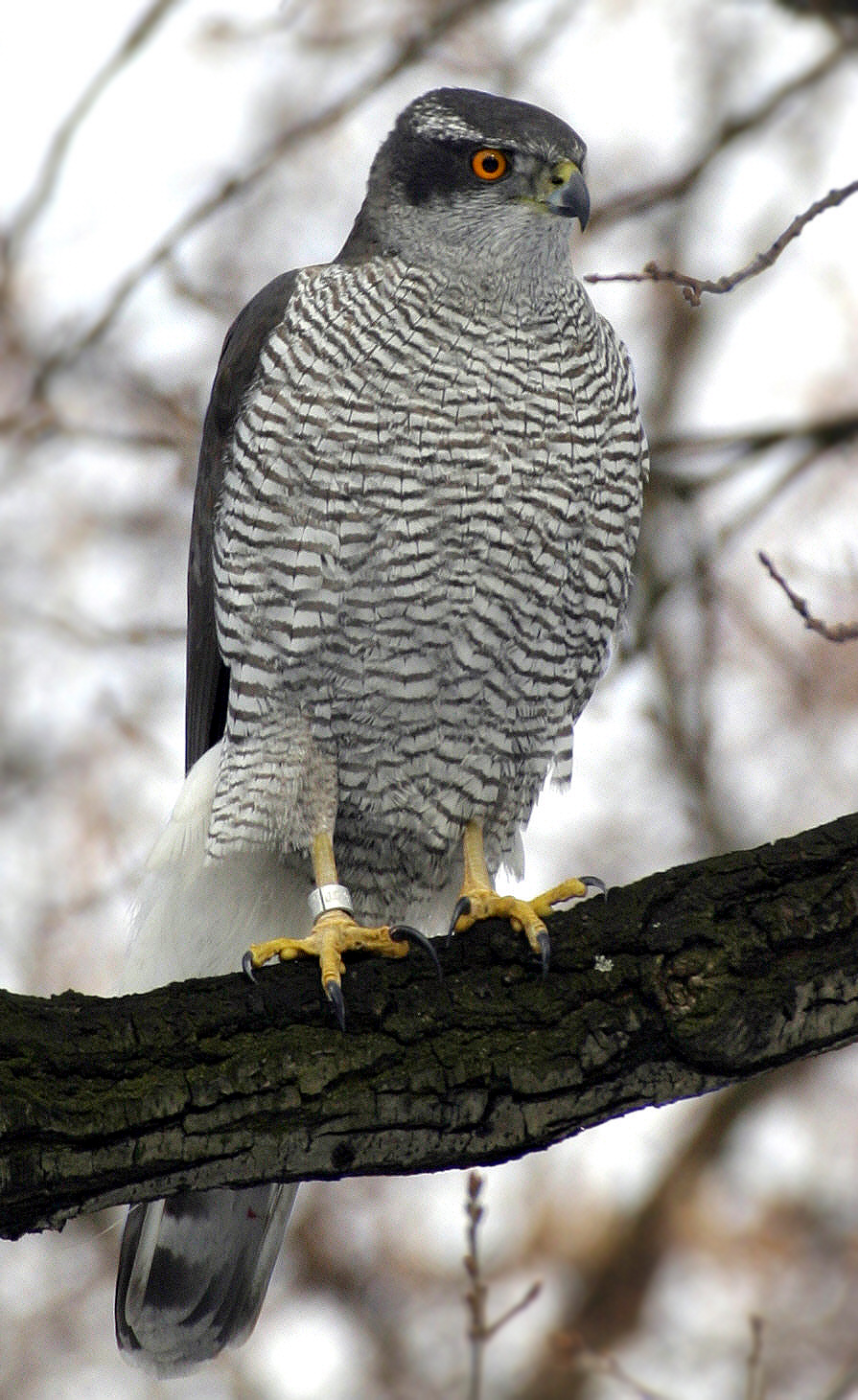 Eurasian GoshawkAstur gentilis
- American GoshawkAstur atricapillus
- Cooper's HawkAstur cooperii
- Bicolored HawkAstur bicolor
- Chilean HawkAstur chilensis
- Gundlach's HawkAstur gundlachi
- Henst's GoshawkAstur henstii
- Meyer's GoshawkAstur meyerianus
Compare
Questions and answers
What is the scientific name of the Black Sparrowhawk?
The scientific name of the Black Sparrowhawk is Astur melanoleucus. Written with its author, the full name is Astur melanoleucus (A. Smith, 1830).
Which family does the Black Sparrowhawk belong to?
Astur melanoleucus belongs to the family Accipitridae, in the order Accipitriformes and the class Aves.
Where is the Black Sparrowhawk found?
Checklists and occurrence records place Astur melanoleucus in 31 countries, including South Africa, Kenya, Uganda, Zimbabwe, Tanzania and Ethiopia.
What other names does the Black Sparrowhawk have?
Astur melanoleucus is also known in English as Black Goshawk and Great Sparrowhawk.
What is a black sparrowhawk?
The Black Sparrowhawk (Astur melanoleucus) is a bird in the family Accipitridae, order Accipitriformes and class Aves. Adults typically have predominantly black plumage with a white throat, breast and belly.[2]
What does a sparrowhawk eat?
The Black Sparrowhawk primarily eats medium-sized birds, particularly pigeons and doves. It also preys on other raptors and sometimes poultry, while bats, rodents and juvenile mongooses occasionally supplement its diet.[20][21][24][25][26]
How big is a black sparrowhawk?
The Black Sparrowhawk has a typical total body length of approximately 50 centimetres and a wingspan of approximately one metre. Adult males typically weigh between 450 and 650 grams, while females typically weigh between 750 and 1,020 grams.[8][9][10][11]
Will a sparrow hawk take a chicken?
The Black Sparrowhawk sometimes preys on poultry in rural villages.[24]
Sources
Passages the profile rests on
- The black sparrowhawk is listed as not globally threatened by CITES. Source passage: “listed as not globally threatened by CITES.” — English Wikipedia
- Adult black sparrowhawks typically have predominantly black plumage with a white throat, breast and belly. Source passage: “both sexes of the black sparrowhawk have a predominantly black plumage with a white throat, breast and belly.” — English Wikipedia
- The species has both light and dark colour morphs. Source passage: “The two different colour morphs (light and dark) exhibited by black sparrowhawks” — English Wikipedia
- Juveniles have brown and russet plumage with dark streaks on the head and chest. Source passage: “The full plumage of juveniles is a range of browns and russets with dark streaks along the head and, more conspicuously, down the chest.” — English Wikipedia
- Juvenile eye colour changes from mid-grey through light brown to dark red as the birds mature. Source passage: “their eyes change in color from mid-grey, through light brown, to dark red.” — English Wikipedia
- The legs of adult black sparrowhawks are yellow and their feet and talons are large. Source passage: “The legs are yellow, with large feet and talons.” — English Wikipedia
- The tails have approximately three or four pale crossbars. Source passage: “The tails are cross-barred with about three or four paler stripes” — English Wikipedia
- Adult males typically weigh between 450 and 650 grams. Source passage: “Typically the weights of males lie between 450 and 650 g” — English Wikipedia
- Adult females typically weigh between 750 and 1,020 grams. Source passage: “that of females lies in the 750 to 1,020 g (1.65 to 2.25 lb) range.” — English Wikipedia
- The species has a typical total body length of approximately 50 centimetres. Source passage: “The typical total length is about 50 cm (20 in)” — English Wikipedia
- The wingspan is approximately one metre. Source passage: “and wingspan about 1 m (39 in).” — English Wikipedia
- The tail is approximately 25 centimetres long. Source passage: “the tails are long (about 25 cm (9.8 in))” — English Wikipedia
- The tarsi measure approximately eight centimetres. Source passage: “as are the tarsi (about 8 cm (3.1 in).” — English Wikipedia
- The species inhabits forest, woodland, thick savanna and plantations. Source passage: “Found in forest, woodland, thick savanna, and plantations.” — ebird.org
- The species naturally inhabits forest patches, rich woodlands and riverine strips extending into dry bush areas. Source passage: “They naturally inhabit patches of forest, rich woodlands and riverine strips extending into dry bush areas.” — English Wikipedia
- The species occurs in mangrove forests in coastal Kenya. Source passage: “including mangrove forest in coastal Kenya.” — English Wikipedia
- Black sparrowhawks occupy elevations ranging from sea level to approximately 3,700 metres. Source passage: “They are found in elevations from sea-level to 3,700 m (12,100 ft).” — English Wikipedia
- In southern Africa, the species uses commercially cultivated eucalyptus, poplar and pine stands. Source passage: “black sparrowhawks have adapted to stands of the non-indigenous eucalyptus, poplar, and pine” — English Wikipedia
- The species also inhabits suburban and human-altered landscapes. Source passage: “favored habitat includes suburban and human-altered landscapes.” — English Wikipedia
- Black sparrowhawks primarily prey on medium-sized birds. Source passage: “Black sparrowhawks prey primarily on mid-sized birds.” — English Wikipedia
- Their common prey includes pigeons and doves. Source passage: “It preys predominantly on birds of moderate size, such as pigeons and doves, in suburban areas.” — English Wikipedia
- Most birds taken by black sparrowhawks weigh between 80 and 300 grams. Source passage: “Most birds preyed on by this species are in the size range of 80–300 g (2.8–10.6 oz).” — English Wikipedia
- Male black sparrowhawks primarily hunt doves, whereas females take more large prey such as pigeons and francolins. Source passage: “Doves are the primary prey of males, whereas females take a greater quantity of larger prey such as pigeons and francolins.” — English Wikipedia
- The species sometimes preys on poultry in rural villages. Source passage: “They also feed on poultry found in rural villages” — English Wikipedia
- Black sparrowhawks regularly prey on other raptors, including shikras, Ovambo sparrowhawks, African goshawks and wood owls. Source passage: “With some regularity, they prey on other raptor species, including shikra, Ovambo sparrowhawk, African goshawk and wood owl.” — English Wikipedia
- Small mammals such as bats, rodents and juvenile mongooses occasionally supplement their diet. Source passage: “Very occasionally, they may supplement their diet with small mammals, such as bats, rodents and juvenile mongooses.” — English Wikipedia
- Black sparrowhawks usually locate prey from a perch concealed by foliage. Source passage: “Most prey is spotted from a foliage-concealed perch” — English Wikipedia
- They commonly kill prey during a short flying dash. Source passage: “which is then killed in flight during a short flying dash.” — English Wikipedia
- Black sparrowhawks are mostly silent outside the breeding season. Source passage: “They are mostly silent except during the breeding season.” — English Wikipedia
- Black sparrowhawks can carry plucked and decapitated prey for distances of up to 12 kilometres. Source passage: “Black sparrowhawks can carry their plucked and decapitated prey over a distance of up to 12 km (7.5 mi)” — English Wikipedia
- The subspecies A. m. melanoleucus generally breeds between May and October. Source passage: “A. m. melanoleucus breed between May and October.” — English Wikipedia
- In Zambia, black sparrowhawks breed between July and February. Source passage: “In Zambia, they breed at an intermediate time, between July and February.” — English Wikipedia
- Black sparrowhawks form monogamous pairs. Source passage: “Black sparrowhawks form monogamous pairs” — English Wikipedia
- Females typically lay between two and four eggs per clutch. Source passage: “Typically, the female will lay 2-4 eggs” — English Wikipedia
- The eggs are incubated for approximately 34 to 38 days. Source passage: “the pair will incubate them for about 34–38 days until they hatch.” — English Wikipedia
- Nest sites are generally located between seven and 36 metres above the ground. Source passage: “Nests have been found from 7 to 36 m (23 to 118 ft) high in trees” — English Wikipedia
- Nests measure approximately 50 to 70 centimetres in width and 30 to 75 centimetres in depth. Source passage: “The nests can measure from 50 to 70 cm (20 to 28 in) in width and 30–75 cm (12–30 in) deep.” — English Wikipedia
- Young birds typically fledge between 37 and 50 days after hatching. Source passage: “After 37 to 50 days, the juveniles are fledged” — English Wikipedia
- Parents continue caring for fledged juveniles for another 37 to 47 days. Source passage: “the parents will continue to care for them for the next 37 to 47 days.” — English Wikipedia
- Some black sparrowhawk nests have been reused continuously for decades, with one documented nest used for 32 years. Source passage: “One nest is, in fact, known to have been used continuously for 32 years by a succession of pairs.” — English Wikipedia
Data
- Catalogue of Life, 2026-10-16 XR cc by
- Global Biodiversity Information Facility CC BY 4.0
- Wikidata CC0
- GeoNames CC BY 4.0
- Within the Catalogue of Life, this name comes from The Integrated Taxonomic Information System cc0
This species in other databases
Page built on 29 November 2026. See how the catalog is made and all sources and licences.
Cite this page
ScientificNames.org. (2026). Astur melanoleucus (Black Sparrowhawk). Retrieved November 29, 2026, from https://scientificnames.org/species/astur-melanoleucus
“Astur melanoleucus (Black Sparrowhawk).” ScientificNames.org, 2026, scientificnames.org/species/astur-melanoleucus. Accessed 29 Nov. 2026.
ScientificNames.org. “Astur melanoleucus (Black Sparrowhawk).” Accessed November 29, 2026. https://scientificnames.org/species/astur-melanoleucus.
@misc{scientificnames_astur_melanoleucus_black_sparrowhawk,
  author = {{ScientificNames.org}},
  title = {Astur melanoleucus (Black Sparrowhawk)},
  year = {2026},
  url = {https://scientificnames.org/species/astur-melanoleucus},
  note = {Accessed 2026-11-29}
}