Species · Birds
Eurasian Goshawk Astur gentilis
The scientific name of the Eurasian Goshawk is Astur gentilis. It is a species of bird in the family Accipitridae (hawks), order Accipitriformes. The name dates from 1758.
- Scientific name
- Astur gentilis (Linnaeus, 1758)
- Common name
- Eurasian Goshawk
- Genus
- Astur
- Family
- Accipitridae (Hawks)
- Order
- Accipitriformes
- Class
- Aves
- Recorded in
- 79 countries
- Name status
- accepted in the Catalogue of Life
Overview
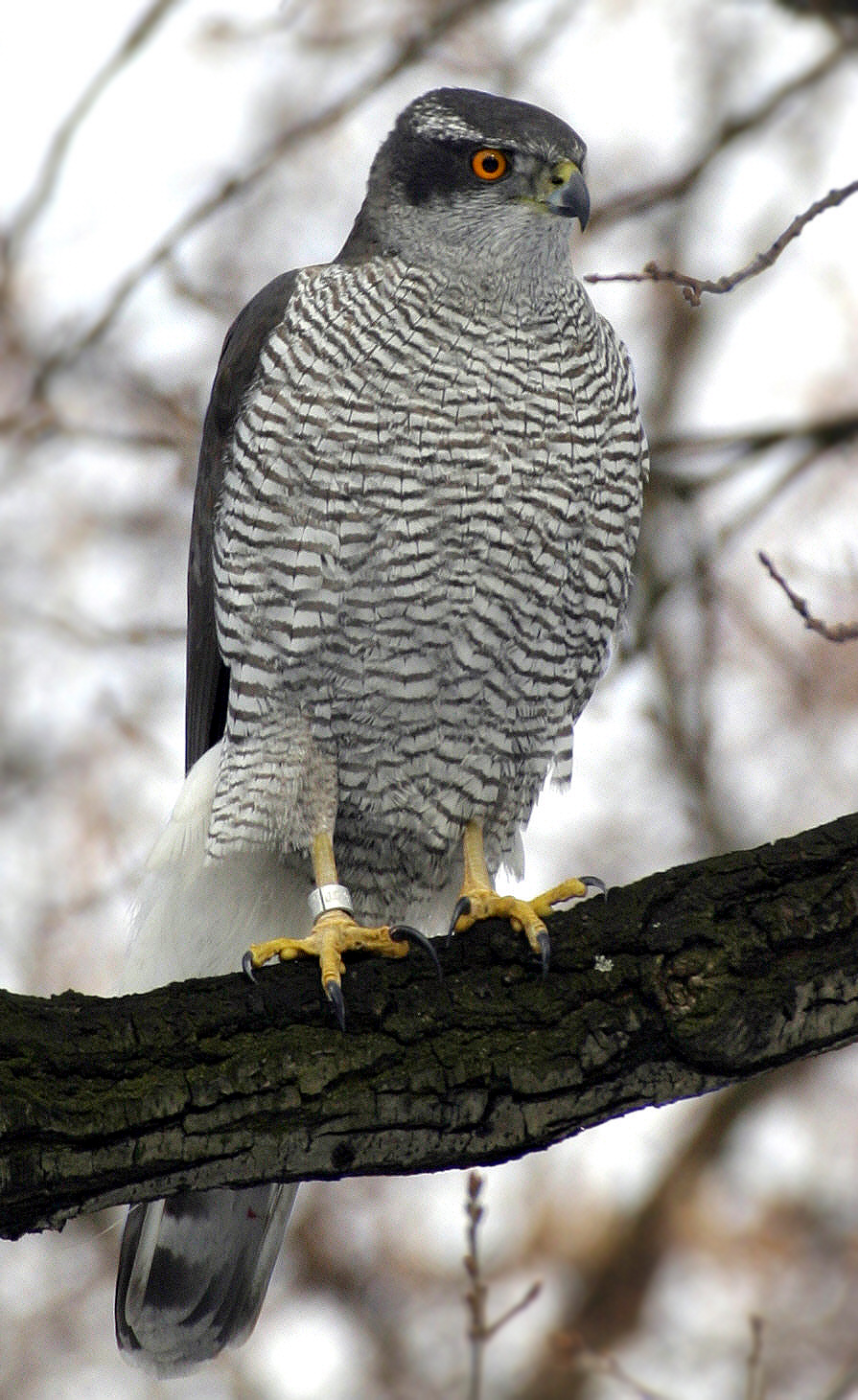
Astur gentilis inhabits deciduous and coniferous forests, urban environments containing small woods, shelter-belts, and copses, and other habitats up to approximately 3,000 metres. It has relatively short, broad wings, a long tail, a sizeable bill, robust short legs, and particularly thick toes.
Written 26 November 2026 from the sources listed below. Each statement was checked against the passage it cites; statements that could not be supported were removed.
Appearance
Across most of its range, the Eurasian Goshawk is blue-grey or brownish-grey above, with dark markings and a grey or white underside.[1]
Habitat
The Eurasian Goshawk inhabits both deciduous and coniferous forests. It can also occupy urban environments containing small woods, shelter-belts, and copses.[2][3]
The species can occur at elevations up to approximately 3,000 metres. It can also inhabit dwarf tree communities along drainage areas of the lower tundra.[4][5]
Behaviour
Most Eurasian Goshawks remain in the same general area throughout the year. Individuals from colder regions migrate south during winter, while northernmost and high-mountain populations move to warmer forests at lower elevations.[6][7][8]
Reproduction and life cycle
A breeding population of Eurasian Goshawks inhabits the Imperial Palace gardens in Tokyo. The species has bred there since at least 2001, when a nest was discovered in an evergreen oak tree.[9][10][11]
Classification of the Eurasian Goshawk
| Kingdom | Animalia |
|---|---|
| Phylum | Chordata |
| Subphylum | Vertebrata |
| Infraphylum | Gnathostomata |
| Parvphylum | Osteichthyes |
| Megaclass | Tetrapoda |
| Class | Aves (Bird) |
| Order | Accipitriformes (Hawks) |
| Family | Accipitridae (Hawks) |
| Genus | Astur (True Goshawks and Allies) |
| Species | Astur gentilis (Linnaeus, 1758) |
Where the Eurasian Goshawk is found
Checklists and occurrence records place Astur gentilis in 79 countries across Asia and Europe. GBIF holds 956,251 georeferenced records of it.
Countries
- Aland Islands 1,674
- Albania 42
- Andorra 115
- Armenia 209
- Austria 2,892
- Azerbaijan 115
- Bangladesh 4
- Belarus 1,188
- Belgium 31,962
- Bhutan 198
- Bosnia and Herzegovina 83
- Bulgaria 2,535
- Canada 2,316
- China 3,974
- Croatia 799
- Cyprus 210
- Czechia 3,482
- Denmark 66,455
- Estonia 10,143
- Finland 131,978
- France 39,723
- Georgia 586
- Germany 38,778
- Gibraltar 6
- Greece 953
- Hong Kong 64
- Hungary 998
- India 259
- Iran 137
- Ireland 31
- Isle of Man 11
- Israel 236
- Italy 5,905
- Japan 1,072
- Jordan 3
- Kazakhstan 190
- Kosovo 17
- Kuwait 21
- Kyrgyzstan 51
- Latvia 949
- Lebanon 23
- Liechtenstein 16
- Lithuania 905
- Luxembourg 379
- Macao 3
- Moldova 229
- Mongolia 301
- Montenegro 71
- Myanmar 17
- Nepal 403
- North Korea 14
- North Macedonia 39
- Norway 84,388
- Pakistan 4
- Palestinian Territory 26
- Poland 8,885
- Portugal 10,456
- Romania 751
- Russia 14,048
- San Marino 7
- Saudi Arabia 21
- Serbia 656
- Slovakia 886
- Slovenia 463
- South Korea 2,965
- Spain 38,438
- Sweden 318,293
- Switzerland 11,890
- Syria 5
- Taiwan 1,045
- Thailand 9
- The Netherlands 57,757
- Turkey 1,988
- Ukraine 3,828
- United Arab Emirates 11
- United Kingdom 6,602
- United States 40,030
- Uzbekistan 29
- Vietnam 6
Regions and cities with the most records
- Stockholm, Sweden 59,435
- Västra Götaland, Sweden 41,513
- Sollentuna, Sweden 36,754
- Danderyd, Sweden 36,313
- Solna, Sweden 36,184
- Sundbyberg, Sweden 36,097
- Stockholm, Sweden 36,022
- Täby, Sweden 34,527
- Rinkeby, Sweden 34,141
- Lidingö, Sweden 33,873
- Jakobsberg, Sweden 31,456
- Capital Region, Denmark 28,654
- Huddinge, Sweden 27,214
- Kalmar, Sweden 26,988
- Nacka, Sweden 26,858
- Trångsund, Sweden 26,660
- Upplands Väsby, Sweden 24,335
- Tullinge, Sweden 22,343
- Skåne, Sweden 22,014
- Uppsala, Sweden 21,151
- Vallentuna, Sweden 20,275
- Tumba, Sweden 18,965
- Haninge, Sweden 18,726
- Allerød, Denmark 18,041
- Birkerød, Denmark 17,818
- Karlebo, Denmark 17,788
- Hørsholm, Denmark 17,742
- Lillerød, Denmark 17,601
- Farum, Denmark 15,841
- Hillerød, Denmark 14,987
- Virum, Denmark 14,901
- Jönköping, Sweden 14,195
- Södermanland, Sweden 12,846
- Charlottenlund, Denmark 12,822
- Ballerup, Denmark 12,619
- Hellerup, Denmark 12,553
5 more countries have a few records outside this range
These countries hold a few records of Astur gentilis but lie outside the range the checklists give for it. Such records are often zoo or garden specimens, museum material or vagrants, so the species is not counted as occurring there.
Range as the checklists state it
Europe & Northern Asia (excluding China)
Southern Asia
A number beside a place is its count of GBIF occurrence records. A place without a number comes from a checklist alone. Records show where a species has been observed or collected, which can include escapes and vagrants.
Common names
English
- Eurasian Goshawk
- Goose Hawk
- Gos
- Goshawk
- Grouse Hawk
- Northern Goshawk
Names in 98 other languages
- Albanian
- Gjeraqina
- Arabic
- باز, باز شمالي
- Armenian
- Ցախաքլորաորս
- Asturian
- Ferriascu, azor
- Azerbaijani
- Tetraçalan
- Basque
- Aztore
- Belarusian
- Шуляк-галубятнiк, Ястраб вялікі, Ястраб-цецяроўнік
- Breton
- Gwazsparfell, Sparfell voan
- Bulgarian
- Голям ястреб
- Catalan
- Astor, astor comú
- Chinese
- 苍鹰, 蒼鷹
- Croatian
- Jastreb kokošar
- Czech
- jestřáb lesní
- Danish
- Duehøg
- Dutch
- Havik
- Esperanto
- Norda akcipitro, ordinara akcipitro
- Estonian
- Harilik kanakull, kanakull
- Faroese
- Høsnaheykur
- Finnish
- kanahaukka
- French
- Autour des palombes, Autour des ramiers
- Georgian
- ქორი
- German
- Habicht, Hühnerhabicht
- Greek
- Διπλοσάινο, Διπλοσάϊνο
- Hebrew
- נץ גדול
- Hindi
- उत्तरी बाज
- Hungarian
- héja
- Icelandic
- Gáshaukur
- Irish
- Seabach, Spioróg mhór
- Italian
- Astore
- Japanese
- オオタカ
- Kazakh
- Қаршыға
- Korean
- 참매
- Latvian
- vistu vanags
- Lithuanian
- Vištvanagis, paprastasis vištvanagis
- Luxembourgish
- Huer, Héngerdéif
- Macedonian
- јастреб кокошкар
- Maltese
- Sparvier tal-îamiem
- Mongolian
- Үлэг харцага
- Northern Sami
- Vuoncáfálli, goahppilfálli, vuopmerievssatfálli
- Norwegian
- hønsehauk
- Persian
- باز (پرنده), طرلان
- Polish
- Jastrząb, jastrząb (zwyczajny)
- Portuguese
- Açor, açor-comum, açor-eurasiático, açor-euroasiático, açor-nortenho
- Punjabi
- ਬਾਜ਼
- Romanian
- Uliu porumbar
- Russian
- Тетеревятник, Ястреб-тетеревятник, большой ястреб, ястреб-голубятник, ястреб-курятник, ястреб-утятник
- Scottish Gaelic
- Gos-sheabhag
- Serbian
- Jastreb, Јастреб, Јастреб кокошар - Jastreb kokošar
- Slovak
- jastrab veľký
- Slovenian
- kragulj
- Spanish
- Azor común, Azor euroasiático, Gavilán azor
- Swahili
- Kipanga Mkubwa
- Swedish
- duvhök
- Thai
- เหยี่ยวนกเขาท้องขาว
- Turkish
- Bayağı çakır kuşu, Çakır
- Ukrainian
- Яструб-тетерев'ятник, яструб великий
- Vietnamese
- Ó ngỗng
- Welsh
- Gwalch marth
- als
- Happech
- ang
- Hafoc
- ava
- Хъарчигъа
- bak
- Ҡор ҡарсығаһы
- che
- Kúyra, Куьйра
- chm
- Алавӓрӓш, Цӹвӹвӓрӓш
- chv
- Пысӑк хурчка, Хурчка
- cjs
- Қартыға
- cor
- Goedh-hok, Goth-hok
- cos
- Altore
- csb
- Kùrzélc
- dsb
- Jastśeb
- frr
- Hanjüger
- fry
- Hauk
- fur
- Cagnŕs
- glv
- Shawk vooar ny sperriu
- hsb
- Jatřob
- ido
- Acipitro
- kbd
- Къашыргъэшхуэ
- kjn
- Хартыға
- kom
- Дозмӧр варыш
- kur
- Baz
- lbe
- Къарчигъай
- lld
- Sparvel gran
- mhr
- кугывараш, чывывараш
- nds
- Haavk
- oji
- Gibonasii
- pnb
- اتلا گوسہاک
- roh
- Sprer
- rom
- Hulyaika
- rue
- Ястряб голубятник
- sah
- Улар кыырда
- scn
- Farcuni ri voscu
- srd
- Istore lepperajolu, Stori columbinu
- tat
- Тавык карчыгасы
- tuk
- Çakırkuşu
- tyv
- Хартыга
- vls
- Oavik
- wln
- Wôteu ås colons mansåds
- yid
- הינער־יאַסטער
Synonyms
7 other scientific names have been used for this species and are now treated as synonyms of Astur gentilis.
- Accipiter gentilis (Linnaeus, 1758)
- Asterias palumbarius Morris, FO, 1837
- Astur gentilis fujiyamae Swann & Hartert.1823
- Astur palumbarius (Linnaeus)
- Astur palumbarius khamensis Bianchi.1901
- Falco gentilis Linnaeus, 1758
- Falco palumbarius Linnaeus, C, 1758
Subspecies and varieties
- Astur gentilis albidus (Kamchatka Goshawk) subspecies
- Astur gentilis arrigonii subspecies
- Astur gentilis buteoides subspecies
- Astur gentilis fujiyamae subspecies
- Astur gentilis gentilis (European Goshawk) subspecies
- Astur gentilis marginatus subspecies
- Astur gentilis schvedowi subspecies
- Astur gentilis subps subspecies
Questions and answers
What is the scientific name of the Eurasian Goshawk?
The scientific name of the Eurasian Goshawk is Astur gentilis. Written with its author, the full name is Astur gentilis (Linnaeus, 1758).
Which family does the Eurasian Goshawk belong to?
Astur gentilis belongs to the family Accipitridae, in the order Accipitriformes and the class Aves.
Where is the Eurasian Goshawk found?
Checklists and occurrence records place Astur gentilis in 79 countries, including Sweden, Finland, Norway, Denmark, The Netherlands and United States.
What other names does the Eurasian Goshawk have?
Astur gentilis is also known in English as Goose Hawk, Gos, Goshawk, Grouse Hawk and Northern Goshawk.
Why is it called goshawk?
The English name goshawk derives from the Old English word gōsheafoc, meaning goose-hawk.[12]
Where does a goshawk live?
The Eurasian Goshawk occurs across most of Europe, excluding Ireland and Iceland, and across much of Russia to Anadyr and Kamchatka. It also occurs in northwestern Morocco, Corsica, Sardinia, southern Greece, Turkey, the Caucasus, parts of the Himalayas including India and Nepal, western China, and Japan.[13][14][15][16][17]
Sources
Passages the profile rests on
- Across most of its range, the Eurasian goshawk is blue-grey or brownish-grey above, with dark markings and a grey or white underside. Source passage: “Across most of the species' range, it is blue-grey above or brownish-grey with dark barring or streaking over a grey or white base colour below” — English Wikipedia
- The Eurasian goshawk inhabits both deciduous and coniferous forests. Source passage: “Eurasian goshawks can be found in both deciduous and coniferous forests.” — English Wikipedia
- The species can occupy urban environments containing small woods, shelter-belts, and copses. Source passage: “the Eurasian goshawk may live in fairly urbanised patchworks of small woods, shelter-belts and copses” — English Wikipedia
- Eurasian goshawks can occur at elevations up to approximately 3,000 metres. Source passage: “Altitudinally, goshawks may live anywhere up to a given mountain range's tree line, which is usually 3,000 m (9,800 ft) in elevation or less.” — English Wikipedia
- The species can inhabit dwarf tree communities along drainage areas of the lower tundra. Source passage: “here may adapt to dwarf tree communities, often along drainages of the lower tundra.” — English Wikipedia
- Most Eurasian goshawks remain in the same general area throughout the year. Source passage: “A majority of goshawks remain sedentary throughout the year.” — English Wikipedia
- Individuals from colder regions migrate south during winter. Source passage: “birds from colder regions migrate south for the winter.” — English Wikipedia
- Northernmost and high-mountain populations move to warmer forests at lower elevations during winter. Source passage: “the northernmost or high mountain populations move down to warmer forests with lower elevations” — English Wikipedia
- A breeding population inhabits the Imperial Palace gardens in Tokyo. Source passage: “a population of the species lives and breeds in the Imperial Palace gardens in Tokyo” — English Wikipedia
- Eurasian goshawks have bred in the Imperial Palace gardens in Tokyo since at least 2001. Source passage: “Goshawks were first recorded breeding in this location in 2001” — English Wikipedia
- A nest was discovered in an evergreen oak tree at the Tokyo breeding location in 2001. Source passage: “when a nest was found in an evergreen oak (Quercus acuta) tree.” — English Wikipedia
- The English name goshawk derives from the Old English word gōsheafoc, meaning goose-hawk. Source passage: “The term goshawk comes from the Old English gōsheafoc, "goose-hawk".” — English Wikipedia
- The Eurasian goshawk occurs across most of Europe, excluding Ireland and Iceland. Source passage: “It is found in most areas of Europe excluding Ireland and Iceland.” — English Wikipedia
- Its Eurasian range extends across much of Russia to Anadyr and Kamchatka. Source passage: “Their Eurasian distribution sweeps continuously across most of Russia, excluding the fully treeless tundra in the northern stretches, to the western limits of Siberia as far as Anadyr and Kamchatka.” — English Wikipedia
- The species occurs in northwestern Morocco, Corsica, Sardinia, southern Greece, Turkey, and the Caucasus. Source passage: “in their southern limits in extreme northwestern Morocco, Corsica and Sardinia, the "toe" of Italy, southern Greece, Turkey, the Caucasus” — English Wikipedia
- The species occurs in parts of the Himalayas, including India and Nepal. Source passage: “in some parts of Tibet and the Himalayas (India and Nepal)” — English Wikipedia
- The Eurasian goshawk occurs in western China and Japan. Source passage: “western China and Japan.” — English Wikipedia
Data
- Catalogue of Life, 2026-10-16 XR cc by
- Global Biodiversity Information Facility CC BY 4.0
- Wikidata CC0
- GeoNames CC BY 4.0
- Wikimedia Commons per image; credit shown with each image
- Within the Catalogue of Life, this name comes from The Integrated Taxonomic Information System cc0
This species in other databases
Page built on 27 November 2026. See how the catalog is made and all sources and licences.
Cite this page
ScientificNames.org. (2026). Astur gentilis (Eurasian Goshawk). Retrieved November 27, 2026, from https://scientificnames.org/species/astur-gentilis
“Astur gentilis (Eurasian Goshawk).” ScientificNames.org, 2026, scientificnames.org/species/astur-gentilis. Accessed 27 Nov. 2026.
ScientificNames.org. “Astur gentilis (Eurasian Goshawk).” Accessed November 27, 2026. https://scientificnames.org/species/astur-gentilis.
@misc{scientificnames_astur_gentilis_eurasian_goshawk,
  author = {{ScientificNames.org}},
  title = {Astur gentilis (Eurasian Goshawk)},
  year = {2026},
  url = {https://scientificnames.org/species/astur-gentilis},
  note = {Accessed 2026-11-27}
}