Species · Fishes
Teraglin Atractoscion atelodus
The scientific name of the Teraglin is Atractoscion atelodus. It is a species of fish in the family Sciaenidae (drums), order Perciformes. The name dates from 1867.
- Scientific name
- Atractoscion atelodus (Günther, 1867)
- Common name
- Teraglin
- Genus
- Atractoscion
- Family
- Sciaenidae (Drums)
- Order
- Perciformes
- Class
- Teleostei
- Red List category
- DD Data Deficient
- Environment
- marine
- Recorded in
- 1 country
- Name status
- accepted in the Catalogue of Life
Overview
The species is endemic to eastern Australia, occurring from southern Queensland to Montague Island in New South Wales. It has an iridescent blue and purple body, often with diagonal black markings along the flanks.
Written 27 November 2026 from the sources listed below. Each statement was checked against the passage it cites; statements that could not be supported were removed.
Appearance
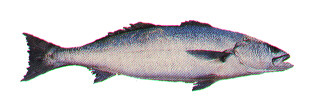
Teraglin has a slender, elongated body and a pointed snout. Its mouth is large and oblique, with a slightly protruding lower jaw.[1][2]
The dorsal fin has 11 spines and 31–34 soft rays, while the anal fin has two spines and nine soft rays. The caudal fin is emarginate.[3][4][5]
Adult individuals lack canine-like teeth. The specific name atelodus means 'imperfect teeth' and refers to this absence.[6][7]
The body is iridescent blue and purple, often with diagonal black markings along the flanks. Yellow coloration occurs along the jaw edges and inside the operculum, and a blotch is present on the pectoral-fin axil.[8][9][10]
The maximum published total length is 51.5 cm.[11]
Habitat
Adult individuals inhabit offshore waters, while juveniles inhabit inshore waters, including deeper estuaries. The species occurs at depths reaching 200 m.[12][13][14]
Behaviour
Adult individuals form schools in offshore waters.[15]
Reproduction and life cycle
Teraglin matures at a relatively small body size and young age. The prevailing southerly-flowing Eastern Australian Current influences the distribution of its larvae across its range.[16][17]
Conservation
Estimated biomass in 2021–22 was 0.32 of the unfished biomass level, with a 95% confidence interval of 0.20–0.46. Stock biomass declined steadily from the 1970s until the early 2000s and subsequently increased slightly.[18][19]
The estimated maximum sustainable yield was 154 tonnes, with a 95% confidence interval of 124–205 tonnes. Estimated fishing mortality in 2021–22 was approximately 0.25 of the fishing mortality associated with maximum sustainable yield.[20][21]
Recent harvest levels have been historically low, alongside low fishing effort.[22]
Uses
The species is caught in significant quantities by recreational anglers. Its flesh is regarded as highly palatable.[23][24]
New South Wales has introduced bag and minimum size limits for the species.[25]
Classification of the Teraglin
| Kingdom | Animalia |
|---|---|
| Phylum | Chordata |
| Subphylum | Vertebrata |
| Infraphylum | Gnathostomata |
| Parvphylum | Osteichthyes |
| Gigaclass | Actinopterygii |
| Superclass | Actinopteri |
| Class | Teleostei (Teleost) |
| Order | Perciformes |
| Suborder | Percoidei |
| Family | Sciaenidae (Drums) |
| Genus | Atractoscion |
| Species | Atractoscion atelodus (Günther, 1867) |
Where the Teraglin is found
Checklists and occurrence records place Atractoscion atelodus in 1 country. GBIF holds 51 georeferenced records of it.
Countries
A number beside a place is its count of GBIF occurrence records. A place without a number comes from a checklist alone. Records show where a species has been observed or collected, which can include escapes and vagrants.
Common names
English
- Teraglin
Names in 1 other language
- Portuguese
- Corvina-cauda-de-lua
Synonyms
5 other scientific names have been used for this species and are now treated as synonyms of Atractoscion atelodus.
- Atractoscion aequidens (Sasaki, 1989)
- Atractoscion stelodus (Günther, 1867)
- Otolithus atelodus Günther, 1867
- Otolithus teraglin MacLeay, 1880
- Zeluco atelodus Whitley, 1931
Related species
-
 White SeabassAtractoscion nobilis
-
 Geelbeck CroakerAtractoscion aequidens
-
 Small Scale Lunate Caudal Fin CroakerAtractoscion microlepis
- Atractoscion macrolepis
-
 Red DrumSciaenops ocellatus
-
 TotoabaTotoaba macdonaldi
-
 Freshwater DrumAplodinotus grunniens
-
 Atlantic CroakerMicropogonias undulatus
Compare
Questions and answers
What is the scientific name of the Teraglin?
The scientific name of the Teraglin is Atractoscion atelodus. Written with its author, the full name is Atractoscion atelodus (Günther, 1867).
Which family does the Teraglin belong to?
Atractoscion atelodus belongs to the family Sciaenidae, in the order Perciformes and the class Teleostei.
Where is the Teraglin found?
Checklists and occurrence records place Atractoscion atelodus in 1 country: Australia.
What is the conservation status of the Teraglin?
The IUCN Red List category recorded for Atractoscion atelodus is Data Deficient (DD).
Sources
Passages the profile rests on
- The species has a slender, elongated body and a pointed snout. Source passage: “a large species with a slender, elongate body and a pointed snout” — English Wikipedia
- The species has a large oblique mouth and a slightly protruding lower jaw. Source passage: “large oblique mouth with a slightly protruding lower jaw.” — English Wikipedia
- The dorsal fin has 11 spines and 31–34 soft rays. Source passage: “The dorsal fin is supported by 11 spines and 31 to 34 soft rays” — English Wikipedia
- The anal fin has two spines and nine soft rays. Source passage: “the anal fin has 2 spines and 9 soft rays.” — English Wikipedia
- The caudal fin is emarginate. Source passage: “the caudal fin is emarginate.” — English Wikipedia
- Adult individuals lack canine-like teeth. Source passage: “The adults have no canine-like teeth” — English Wikipedia
- The specific name atelodus means 'imperfect teeth' and refers to the absence of canine teeth. Source passage: “The specific name atelodus means "imperfect teeth", an allusion to the lack of canines.” — English Wikipedia
- The body is iridescent blue and purple, often with diagonal black markings along the flanks. Source passage: “The colour of the body is iridescent blue and purple, frequently with diagonal black lines on the flanks.” — English Wikipedia
- Yellow coloration occurs along the jaw edges and inside the operculum. Source passage: “There is bright yellow on the edges of jaws and the inside of the operculum.” — English Wikipedia
- The species has a blotch on the pectoral-fin axil. Source passage: “There is a blotch on the axil of the pectoral-fin.” — English Wikipedia
- The maximum published total length is 51.5 cm. Source passage: “This species reaches a maximum published total length of 51.5 cm (20.3 in).” — English Wikipedia
- Adult individuals inhabit offshore waters. Source passage: “The adults are schooling fishes on offshore waters” — English Wikipedia
- Juveniles inhabit inshore waters, including deeper estuaries. Source passage: “the juvebiles live in inshore waters, including deeper estuaries.” — English Wikipedia
- The species occurs at depths reaching 200 m. Source passage: “These fishes are found down to depths of 200 m (660 ft).” — English Wikipedia
- Adult individuals form schools in offshore waters. Source passage: “The adults are schooling fishes on offshore waters” — English Wikipedia
- The species matures at a relatively small body size and young age. Source passage: “Teraglin grow reasonably quickly and mature at a relatively small size and young age” — fish.gov.au
- The prevailing southerly-flowing Eastern Australian Current influences the distribution of the species' larvae across its range. Source passage: “influence of the prevailing southerly flowing Eastern Australian Current in distributing larvae across this area” — fish.gov.au
- The estimated biomass in 2021–22 was 0.32 of the unfished biomass level, with a 95% confidence interval of 0.20–0.46. Source passage: “the biomass of Teraglin was at 0.32 (95% CI 0.20–0.46) of unfished levels” — fish.gov.au
- The stock biomass declined steadily from the 1970s until the early 2000s and subsequently increased slightly. Source passage: “The biomass depleted steadily from the 1970s to the early 2000s and has increased slightly since that time.” — fish.gov.au
- The estimated maximum sustainable yield was 154 tonnes, with a 95% confidence interval of 124–205 tonnes. Source passage: “Maximum Sustainable Yield (MSY) was estimated to be 154 t (95% CI 124–205 t).” — fish.gov.au
- Estimated fishing mortality in 2021–22 was approximately 0.25 of the fishing mortality associated with maximum sustainable yield. Source passage: “in 2021–22 was estimated to be approximately 0.25 of FMSY” — fish.gov.au
- Recent harvest levels have been historically low, alongside low fishing effort. Source passage: “Recent harvests of Teraglin have been at historically low levels, with corresponding low levels of fishing effort” — fish.gov.au
- The species is also caught in significant quantities by recreational anglers. Source passage: “with a significant amount caught by recreational anglers.” — English Wikipedia
- The flesh of the species is regarded as highly palatable. Source passage: “The flesh is regarded as highly palatable.” — English Wikipedia
- New South Wales has introduced bag and minimum size limits for the species. Source passage: “New South Wales has introduced bag and minimum size limits.” — English Wikipedia
Data
- Catalogue of Life, 2026-10-16 XR cc by
- Global Biodiversity Information Facility CC BY 4.0
- Wikidata CC0
- GeoNames CC BY 4.0
- Within the Catalogue of Life, this name comes from World Register of Marine Species cc by
This species in other databases
- Catalogue of Life JJR3
- Wikidata Q47140764
- iNaturalist 786403
- WoRMS urn:lsid:marinespecies.org:taxname:1461251
Page built on 29 November 2026. See how the catalog is made and all sources and licences.
Cite this page
ScientificNames.org. (2026). Atractoscion atelodus (Teraglin). Retrieved November 29, 2026, from https://scientificnames.org/species/atractoscion-atelodus
“Atractoscion atelodus (Teraglin).” ScientificNames.org, 2026, scientificnames.org/species/atractoscion-atelodus. Accessed 29 Nov. 2026.
ScientificNames.org. “Atractoscion atelodus (Teraglin).” Accessed November 29, 2026. https://scientificnames.org/species/atractoscion-atelodus.
@misc{scientificnames_atractoscion_atelodus_teraglin,
  author = {{ScientificNames.org}},
  title = {Atractoscion atelodus (Teraglin)},
  year = {2026},
  url = {https://scientificnames.org/species/atractoscion-atelodus},
  note = {Accessed 2026-11-29}
}