Species · Fishes
Small Scale Lunate Caudal Fin Croaker Atractoscion microlepis
The scientific name of the Small Scale Lunate Caudal Fin Croaker is Atractoscion microlepis. It is a species of fish in the family Sciaenidae (drums), order Perciformes. The name dates from 2017.
- Scientific name
- Atractoscion microlepis Song, Kim & Kang, 2017
- Common name
- Small Scale Lunate Caudal Fin Croaker
- Genus
- Atractoscion
- Family
- Sciaenidae (Drums)
- Order
- Perciformes
- Class
- Teleostei
- Red List category
- DD Data Deficient
- Environment
- marine
- Recorded in
- 1 country
- Name status
- accepted in the Catalogue of Life

Overview
Wikidata describes Atractoscion microlepis as “species of fish”.
Classification of the Small Scale Lunate Caudal Fin Croaker
| Kingdom | Animalia |
|---|---|
| Phylum | Chordata |
| Subphylum | Vertebrata |
| Infraphylum | Gnathostomata |
| Parvphylum | Osteichthyes |
| Gigaclass | Actinopterygii |
| Superclass | Actinopteri |
| Class | Teleostei (Teleost) |
| Order | Perciformes |
| Suborder | Percoidei |
| Family | Sciaenidae (Drums) |
| Genus | Atractoscion |
| Species | Atractoscion microlepis Song, Kim & Kang, 2017 |
Origin of the name. Etymology. The specific name, microlepis, refers to the small scales. FIGURE 3. NJ-tree showing relationships among Atractoscion species including Atractoscion microlepis sp. nov. and Atractoscion macrolepis sp. nov. Numbers at branches indicate bootstrap probabilities in 5000 bootstrap replications. Bar indicates genetic distance of 0.02. * Atractosion atelodus was resurrected from synonym of A. aequidens. FIGURE 4. Photographs of the comparative materials. (A) Syntype of Otolithus aequidens, MNHN A - 5586, 835.0 mm SL from South Africa; (B) Holotype of Otolithus atelodus, BMNH 1886.6.19.9, 263.0 mm SL from Australia; (C) Holotype of Otolithus teraglin, AMS I. 9773, 515.0 mm SL from Australia; (D) Syntype of Otolithus californiensis, NMW _ 31129, 273.3 mm SL from California; (E) Syntype of Otolithus californiensis, MCZ 10898, 309.0 mm SL from California. Comparisons. The 15 specimens were very similar to two congeneric species, but in some characteristics were clearly differentiated. Morphologically, A. microlepis sp. nov. is clearly distinguished from A. aequidens by the mode number of lateral line pored scales (78 for A. microlepis sp. nov., 76 for A. aequidens) and from A. nobilis by the number of dorsal-fin soft rays (25 - 26 for A. microlepis sp. nov., 20 - 23 for A. nobilis) (Figs 1 - 2, Table 3). A. microlepis sp. nov. differs from A. aequidens and A. nobilis in the body depth as a percentage of the SL (20.0 - 27.3 % for A. microlepis sp. nov., 19.4 - 22.4 % for A. aequidens, 23.8 - 26.1 % for A. nobilis), the head depth as a percentage of the SL (17.7 - 20.1 %, 15.7 - 17.5 % and 18.6 - 18.9 %, respectively), the pectoral-fin length as a percentage of the SL (14.9 - 17.4 %, 12.4 - 15.5 % and 19.9 - 21.5 %, respectively), and the snout length as a percentage of the head length (23.9 - 28.7 %, 25.1 - 30.1 % and 18.1 - 22.5 %, respectively) (Table 2). The original description of A. aequidens gave no description of the lateral line pored scales (Cuvier 1830). Sasaki (1996) provided a simple record of A. aequidens from the Gulf of Aden. According to Jawad et al. (2012), the first record of A. aequidens from Oman was based on a single specimen. Reference to the study of Jawad et al. (2012) shows that there are no meristic or quantitative morphological differences between A. microlepis sp. nov. and A. aequidens, and in the present study they are considered to be the same species. To clarify the taxonomic status of A. microlepis sp. nov. we compared 506 bp sequences of mtDNA COI from A. microlepis sp. nov. with those of other Atractoscion species. The neighbour joining tree showed that, based on K 2 P distances, the specimens of A. microlepis sp. nov. differed from A. aequidens by 4.8 - 5.0 %, and from A. nobilis by 8.6 - 11.2 % (Fig. 3, Table 4). TABLE 4. Genetic distances among five Atractoscion species and outgroups. (1) (2) (3) (4) (5) (6) Atractoscion aequidens (1) South Africa
Where the Small Scale Lunate Caudal Fin Croaker is found
Checklists and occurrence records place Atractoscion microlepis in 1 country. GBIF holds 4 georeferenced records of it.
Countries
A number beside a place is its count of GBIF occurrence records. A place without a number comes from a checklist alone. Records show where a species has been observed or collected, which can include escapes and vagrants.
Common names
English
- Small Scale Lunate Caudal Fin Croaker
Names in 2 other languages
- Korean
- Jan-bi-neul-cho-seung-kko-ri-min-eo
- Portuguese
- Corvina-de-escamas-pequenas
Related species
-
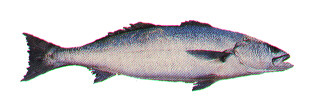 White SeabassAtractoscion nobilis
-
 Geelbeck CroakerAtractoscion aequidens
- TeraglinAtractoscion atelodus
- Atractoscion macrolepis
-
 Red DrumSciaenops ocellatus
-
 TotoabaTotoaba macdonaldi
-
 Freshwater DrumAplodinotus grunniens
-
 Atlantic CroakerMicropogonias undulatus
Compare
Questions and answers
What is the scientific name of the Small Scale Lunate Caudal Fin Croaker?
The scientific name of the Small Scale Lunate Caudal Fin Croaker is Atractoscion microlepis. Written with its author, the full name is Atractoscion microlepis Song, Kim & Kang, 2017.
Which family does the Small Scale Lunate Caudal Fin Croaker belong to?
Atractoscion microlepis belongs to the family Sciaenidae, in the order Perciformes and the class Teleostei.
Where is the Small Scale Lunate Caudal Fin Croaker found?
Checklists and occurrence records place Atractoscion microlepis in 1 country: Oman.
What is the conservation status of the Small Scale Lunate Caudal Fin Croaker?
The IUCN Red List category recorded for Atractoscion microlepis is Data Deficient (DD).
Sources
Data
- Catalogue of Life, 2026-10-16 XR cc by
- Global Biodiversity Information Facility CC BY 4.0
- Wikidata CC0
- GeoNames CC BY 4.0
- Wikimedia Commons per image; credit shown with each image
- Within the Catalogue of Life, this name comes from World Register of Marine Species cc by
References
- Song, Y. S.; Kim, J.-K.; Kang, J.-H.; Kim, S. Y. (2017). Two new species of the genus Atractoscion, and resurrection of the species Atractoscion atelodus (Günther 1867) (Perciformes: Sciaenidae). Zootaxa, 4306. https://doi.org/10.11646/zootaxa.4306.2.3 Link where the name was published
This species in other databases
- Catalogue of Life JJR5
- Wikidata Q47140766
- iNaturalist 786405
- WoRMS urn:lsid:marinespecies.org:taxname:1385241
Page built on 27 November 2026. See how the catalog is made and all sources and licences.
Cite this page
ScientificNames.org. (2026). Atractoscion microlepis (Small Scale Lunate Caudal Fin Croaker). Retrieved November 27, 2026, from https://scientificnames.org/species/atractoscion-microlepis
“Atractoscion microlepis (Small Scale Lunate Caudal Fin Croaker).” ScientificNames.org, 2026, scientificnames.org/species/atractoscion-microlepis. Accessed 27 Nov. 2026.
ScientificNames.org. “Atractoscion microlepis (Small Scale Lunate Caudal Fin Croaker).” Accessed November 27, 2026. https://scientificnames.org/species/atractoscion-microlepis.
@misc{scientificnames_atractoscion_microlepis_small_scale_lunate_caudal_fin_croaker,
  author = {{ScientificNames.org}},
  title = {Atractoscion microlepis (Small Scale Lunate Caudal Fin Croaker)},
  year = {2026},
  url = {https://scientificnames.org/species/atractoscion-microlepis},
  note = {Accessed 2026-11-27}
}