Species · Flowering plants
Bactris mexicana
Bactris mexicana has no English name on record in the checklists used here. It is a species of flowering plant in the family Arecaceae (palm), order Arecales.
- Scientific name
- Bactris mexicana Mart.
- Genus
- Bactris
- Family
- Arecaceae (Palm)
- Order
- Arecales
- Class
- Liliopsida
- Red List category
- LC Least Concern
- Recorded in
- 7 countries
- Name status
- accepted in the Catalogue of Life

Overview
Bactris mexicana Mart. is a flowering palm tree in the family Arecaceae, order Arecales, and class Liliopsida. It grows in wet tropical biomes on moist and rocky soils in Belize, Guatemala, Honduras, Mexico, and Nicaragua. It has spiny stems, compound leaves with irregularly clustered pinnae, and orange, egg-shaped fruits.
Written 27 November 2026 from the sources listed below. Each statement was checked against the passage it cites; statements that could not be supported were removed.
Appearance
Bactris mexicana is a palm tree with spiny stems and compound leaves. It can reach 3 metres in height, and its stems measure 2–3.5 centimetres wide.[1][2][3]
The leaf stems measure 35–100 centimetres in length. Each compound leaf contains eight to twenty-nine pinnae arranged in irregular clusters.[4][5][6]
The male flowers measure 2–4.5 millimetres in length and contain six stamens. The female flowers measure 3–5 millimetres in length.[7][8]
The female flowers have a cup-shaped calyx measuring up to 1 millimetre in length and a tube-shaped corolla measuring 3–4 millimetres in length.[9][10]
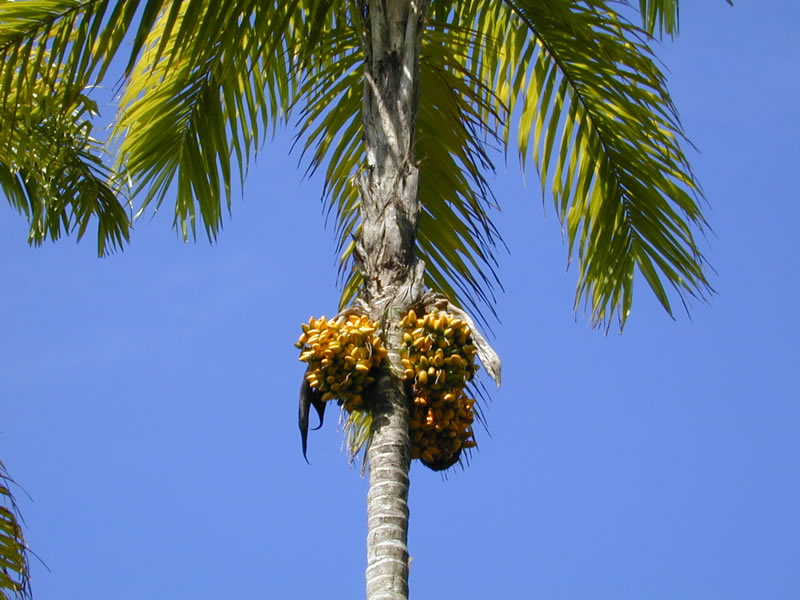
The fruits are orange and egg-shaped, measuring 0.8–1.2 centimetres long and 0.9–1.2 centimetres wide. Their mesocarp has a powdery texture, and the endocarp resembles a spinning top or beetroot, with a pitted upper surface.[11][12][13][14]
Habitat
Bactris mexicana grows in wet tropical biomes on moist and rocky soils. Its recorded habitats include wet forests, sub-evergreen high forests, and montane rainforests.[15][16][17][18][19]
The species occurs at elevations of up to 500 metres.[20]
Diet
Desmarest's spiny pocket mouse eats this plant.[21]
Conservation
The IUCN classified Bactris mexicana as Least Concern in 2021. The species has a large and stable population.[22][23]
Deforestation affects the species in some parts of its geographical range. It tolerates environmental disturbance.[24][25]
The species occurs in the Rio Bravo Conservation and Management Area, the Mountain Pine Ridge Forest Reserve, and the Maya Biosphere Reserve.[26][27][28]
It also occurs in Pico Bonito National Park, the Los Tuxtlas Biosphere Reserve, the Montes Azules Biosphere Reserve, and the Laguna de Términos flora and fauna protection area.[29][30][31][32]
Uses
Local people use Bactris mexicana to manufacture baskets and furniture.[33][34]
Classification of Bactris mexicana
| Kingdom | Plantae |
|---|---|
| Subkingdom | Pteridobiotina |
| Phylum | Tracheophyta |
| Class | Liliopsida |
| Order | Arecales |
| Family | Arecaceae (Palm) |
| Genus | Bactris (Bactris Palm) |
| Species | Bactris mexicana Mart. |
Where Bactris mexicana is found
Checklists and occurrence records place Bactris mexicana in 7 countries across North America. GBIF holds 522 georeferenced records of it.
Countries
Regions and cities with the most records
- Veracruz, Mexico 94
- Chiapas, Mexico 88
- Catemaco, Mexico 40
- Oaxaca, Mexico 27
- Toledo District, Belize 27
- Tabasco, Mexico 21
- Puebla, Mexico 16
- Cayo District, Belize 14
- Campeche, Mexico 10
- Palenque, Mexico 10
- Izabal Department, Guatemala 9
- Macuspana, Mexico 9
- San Andrés Tuxtla, Mexico 9
- Alta Verapaz, Guatemala 8
- Atlántida Department, Honduras 7
- Belmopan, Belize 6
- Stann Creek, Belize 6
- Arizona, Honduras 5
- Petén, Guatemala 5
- Tela, Honduras 5
- Yajalón, Mexico 5
- El Estor, Guatemala 4
- Río de Teapa, Mexico 4
- Tlapacoyan, Mexico 4
- Belize District, Belize 3
- Jinotega Department, Nicaragua 3
- Nanchital de Lázaro Cárdenas del Río, Mexico 3
- Orange Walk District, Belize 3
- Playas del Rosario, Mexico 3
- Quintana Roo, Mexico 3
- Villahermosa, Mexico 3
- Guatemala, Guatemala
A number beside a place is its count of GBIF occurrence records. A place without a number comes from a checklist alone. Records show where a species has been observed or collected, which can include escapes and vagrants.
Common names
Names in 4 other languages
- Chinese
- 墨西哥桃果椰子
- Spanish
- chiquiyul
- hus
- cóyol
- tzh
- chapay
Subspecies and varieties
- Bactris mexicana var. mexicana variety
- Bactris mexicana var. trichophylla variety
Related species
-
 Peach PalmBactris gasipaes
-
 Lata PalmBactris major
-
 Bactris maraja
-
 Tobago CaneBactris guineensis
-
 Bactris setosa
- Prickly PalmBactris plumeriana
- Prickly PoleBactris jamaicana
- Bactris cubensis
Compare
Questions and answers
What are some native plants to Mexico?
Bactris mexicana is a palm species native to Mexico, as well as Belize, Guatemala, Honduras, and Nicaragua.[35]
Sources
Passages the profile rests on
- Bactris mexicana is a palm tree with spiny stems, compound leaves, and orange, egg-shaped fruits. Source passage: “Bactris mexicana is a palm tree with spiny stems, compound leaves, and orange, egg-shaped fruits.” — English Wikipedia
- The palm can reach a height of 3 metres. Source passage: “Bactris mexicana is a palm tree that can grow up to 3 metres (9.8 ft) high.” — English Wikipedia
- Its stems are 2–3.5 centimetres wide. Source passage: “The stems are 2–3.5 centimetres (0.79–1.38 in) wide, and are usually spiny.” — English Wikipedia
- The leaf stems measure 35–100 centimetres in length. Source passage: “The leaf stems are 35–100 centimetres (1.15–3.28 ft) long.” — English Wikipedia
- Its compound leaves contain eight to twenty-nine pinnae. Source passage: “The leaves are compound, and have eight to twenty-nine pinnae.” — English Wikipedia
- The leaf pinnae are arranged in irregular clusters. Source passage: “The pinnae are arranged into irregular clusters.” — English Wikipedia
- The male flowers measure 2–4.5 millimetres in length and contain six stamens. Source passage: “The male flowers are 2–4.5 millimetres (0.079–0.177 in) long, and have six stamens.” — English Wikipedia
- The female flowers measure 3–5 millimetres in length. Source passage: “The female flowers are 3–5 millimetres (0.12–0.20 in) long.” — English Wikipedia
- The female flowers have a cup-shaped calyx measuring up to 1 millimetre in length. Source passage: “The calyx is cup shaped, and up to 1 millimetre (0.039 in) long.” — English Wikipedia
- The female flowers have a tube-shaped corolla measuring 3–4 millimetres in length. Source passage: “The corolla is tube-shaped, and 3–4 millimetres (0.12–0.16 in) long.” — English Wikipedia
- Its fruits are orange and egg-shaped. Source passage: “The fruits are orange, egg-shaped, 0.8–1.2 centimetres (0.31–0.47 in) long, and 0.9–1.2 centimetres (0.35–0.47 in) wide.” — English Wikipedia
- Its fruits measure 0.8–1.2 centimetres long and 0.9–1.2 centimetres wide. Source passage: “The fruits are orange, egg-shaped, 0.8–1.2 centimetres (0.31–0.47 in) long, and 0.9–1.2 centimetres (0.35–0.47 in) wide.” — English Wikipedia
- The fruit mesocarp has a powdery texture. Source passage: “The mesocarp is powdery.” — English Wikipedia
- The fruit endocarp resembles a spinning top or beetroot and has a pitted upper surface. Source passage: “The endocarp is shaped like a spinning top or beetroot, and is pitted on top.” — English Wikipedia
- The species grows in wet tropical biomes. Source passage: “Bactris mexicana is native to the wet tropical biome of Belize, Guatemala, Honduras, Mexico, and Nicaragua.” — English Wikipedia
- The species grows on moist and rocky soils. Source passage: “Bactris mexicana grows on moist and rocky soils, in wet forests, sub-evergreen high forests, and montane rainforests.” — English Wikipedia
- Its recorded habitats include wet forests. Source passage: “Bactris mexicana grows on moist and rocky soils, in wet forests, sub-evergreen high forests, and montane rainforests.” — English Wikipedia
- Its recorded habitats include sub-evergreen high forests. Source passage: “Bactris mexicana grows on moist and rocky soils, in wet forests, sub-evergreen high forests, and montane rainforests.” — English Wikipedia
- Its recorded habitats include montane rainforests. Source passage: “Bactris mexicana grows on moist and rocky soils, in wet forests, sub-evergreen high forests, and montane rainforests.” — English Wikipedia
- The species occurs at elevations of up to 500 metres. Source passage: “It grows at elevations of up to 500 metres (1,600 ft).” — English Wikipedia
- Desmarest's spiny pocket mouse eats this plant. Source passage: “The plant is eaten by Desmarest's spiny pocket mouse.” — English Wikipedia
- The IUCN classified the species as Least Concern in 2021. Source passage: “In 2021, the IUCN assessed Bactris mexicana as of Least Concern.” — English Wikipedia
- The species has a large and stable population. Source passage: “The population is large and stable.” — English Wikipedia
- Deforestation affects the species in some parts of its geographical range. Source passage: “In some parts of its range, the species is affected by deforestation.” — English Wikipedia
- The species tolerates environmental disturbance. Source passage: “However, it is tolerant to disturbance.” — English Wikipedia
- The species occurs in the Rio Bravo Conservation and Management Area. Source passage: “The species is present in protected areas, including the Rio Bravo Conservation and Management Area” — English Wikipedia
- The species occurs in the Mountain Pine Ridge Forest Reserve. Source passage: “the Mountain Pine Ridge Forest Reserve” — English Wikipedia
- The species occurs in the Maya Biosphere Reserve. Source passage: “the Maya Biosphere Reserve” — English Wikipedia
- The species occurs in Pico Bonito National Park. Source passage: “Pico Bonito National Park” — English Wikipedia
- The species occurs in the Los Tuxtlas Biosphere Reserve. Source passage: “the Los Tuxtlas Biosphere Reserve” — English Wikipedia
- The species occurs in the Montes Azules Biosphere Reserve. Source passage: “the Montes Azules Biosphere Reserve” — English Wikipedia
- The species occurs in the Laguna de Términos flora and fauna protection area. Source passage: “the Laguna de Términos flora and fauna protection area.” — English Wikipedia
- Local people use the species to manufacture baskets. Source passage: “Local people use Bactris mexicana to make baskets and furniture.” — English Wikipedia
- Local people use the species to manufacture furniture. Source passage: “Local people use Bactris mexicana to make baskets and furniture.” — English Wikipedia
- The species is native to Belize, Guatemala, Honduras, Mexico, and Nicaragua. Source passage: “Bactris mexicana is native to the wet tropical biome of Belize, Guatemala, Honduras, Mexico, and Nicaragua.” — English Wikipedia
Data
- Catalogue of Life, 2026-10-16 XR cc by
- Global Biodiversity Information Facility CC BY 4.0
- Wikidata CC0
- GeoNames CC BY 4.0
- Wikimedia Commons per image; credit shown with each image
- Within the Catalogue of Life, this name comes from The World Checklist of Vascular Plants (WCVP) cc by
References
- A.D.d'Orbigny, Voy. Amér. Mér. 7(3): 65 (1844) where the name was published
This species in other databases
Page built on 27 November 2026. See how the catalog is made and all sources and licences.
Cite this page
ScientificNames.org. (2026). Bactris mexicana. Retrieved November 27, 2026, from https://scientificnames.org/species/bactris-mexicana
“Bactris mexicana.” ScientificNames.org, 2026, scientificnames.org/species/bactris-mexicana. Accessed 27 Nov. 2026.
ScientificNames.org. “Bactris mexicana.” Accessed November 27, 2026. https://scientificnames.org/species/bactris-mexicana.
@misc{scientificnames_bactris_mexicana,
  author = {{ScientificNames.org}},
  title = {Bactris mexicana},
  year = {2026},
  url = {https://scientificnames.org/species/bactris-mexicana},
  note = {Accessed 2026-11-27}
}