Species · Flowering plants
Tobago Cane Bactris guineensis
The scientific name of the Tobago Cane is Bactris guineensis. It is a species of flowering plant in the family Arecaceae (palm), order Arecales.
- Scientific name
- Bactris guineensis (L.) H.E.Moore
- Common name
- Tobago Cane
- Genus
- Bactris
- Family
- Arecaceae (Palm)
- Order
- Arecales
- Class
- Liliopsida
- Recorded in
- 5 countries
- Name status
- accepted in the Catalogue of Life

Overview
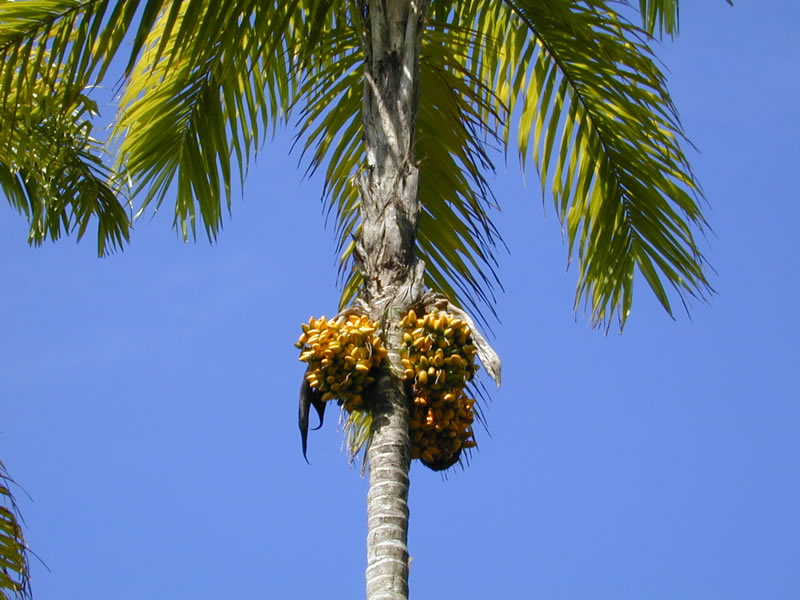
Tobago cane is an evergreen, clustering flowering plant in the family Arecaceae, order Arecales and class Liliopsida. It is native to Central America and Venezuela and occurs in seasonally dry areas, rainforests and deciduous forests. It produces clusters of spherical, dark purple ripe fruit approximately 2 cm in diameter.
Written 27 November 2026 from the sources listed below. Each statement was checked against the passage it cites; statements that could not be supported were removed.
Appearance
Tobago cane has stems and side leaves covered with thin yellow spines. It reaches approximately 2.5–3 m in height.[1][2]
Its flowers are white or cream-colored. Its spherical fruit is dark purple when ripe and grows in clusters, with a diameter of approximately 2 cm.[3][4][5]
Habitat
Tobago cane occurs in seasonally dry areas, including deciduous forests, and in rainforests. It occurs in deciduous forests at elevations up to approximately 850 m above sea level.[6][7][8]
The species requires well-drained, moist soil and some protection from direct sunlight.[9][10]
Diet
The fruit is edible and has a mildly acidic flavor.[11]
Uses
The stems were historically used to manufacture canes. The fruit can be processed into juice and other beverages, as well as candied fruit and jams.[12][13][14]
The fruit is reported to have medicinal uses as an anthelmintic or laxative and for treating snakebites.[15][16]
Classification of the Tobago Cane
| Kingdom | Plantae |
|---|---|
| Subkingdom | Pteridobiotina |
| Phylum | Tracheophyta |
| Class | Liliopsida |
| Order | Arecales |
| Family | Arecaceae (Palm) |
| Genus | Bactris (Bactris Palm) |
| Species | Bactris guineensis (L.) H.E.Moore |
Where the Tobago Cane is found
Checklists and occurrence records place Bactris guineensis in 5 countries across North America and South America. GBIF holds 2,286 georeferenced records of it.
Countries
Regions and cities with the most records
- Cesar Department, Colombia 985
- Córdoba, Colombia 707
- Curumaní, Colombia 348
- Chimichagua, Colombia 322
- Planeta Rica, Colombia 223
- Becerril, Colombia 203
- Chiriguaná, Colombia 203
- La Jagua de Ibirico, Colombia 203
- Sahagún, Colombia 186
- Ciénaga de Oro, Colombia 156
- Santander Department, Colombia 147
- Montelíbano, Colombia 132
- Puerto Wilches, Colombia 75
- Antioquia, Colombia 51
- Sucre Department, Colombia 51
- Magdalena Department, Colombia 48
- Bolívar, Colombia 45
- San Carlos, Colombia 45
- El Copey, Colombia 40
- Chinú, Colombia 39
- Ariguaní, Colombia 36
- Guanacaste Province, Costa Rica 30
- Barrancabermeja, Colombia 29
- Cartagena, Colombia 26
- San Onofre, Colombia 23
- Turbaco, Colombia 23
- Yondó, Colombia 21
- Santa Rosa, Colombia 19
- Tolú Viejo, Colombia 19
- Atlántico, Colombia 17
- Granada Department, Nicaragua 16
- Arjona, Colombia 15
- Galapa, Colombia 14
- Barranquilla, Colombia 12
- Malambo, Colombia 12
- Mompós, Colombia 12
A number beside a place is its count of GBIF occurrence records. A place without a number comes from a checklist alone. Records show where a species has been observed or collected, which can include escapes and vagrants.
Common names
English
- Tobago Cane
- Guinea Bactris
- Prickly-pole
Names in 2 other languages
- Chinese
- 几内亚桃果椰, 圭英利美人棕, 美洲桃果椰子
- Spanish
- Castilla, Cañabrava, Corocito, Corozo, Corozo de lata, Gallinaza, Guevotigre, Lata
Synonyms
8 other scientific names have been used for this species and are now treated as synonyms of Bactris guineensis.
- Bactris horrida Oerst.
- Bactris oraria L.H.Bailey
- Bactris piritu (H.Karst.) H.Wendl.
- Bactris rotunda Stokes
- Cocos acicularis Sw.
- Cocos guineensis L.
- Guilielma piritu H.Karst.
- Bactris minor Jacq. ambiguous synonym
Related species
-
 Peach PalmBactris gasipaes
-
 Lata PalmBactris major
-
 Bactris maraja
-
 Bactris setosa
-
 Bactris mexicana
- Prickly PalmBactris plumeriana
- Prickly PoleBactris jamaicana
- Bactris cubensis
Compare
Questions and answers
What is the scientific name of the Tobago Cane?
The scientific name of the Tobago Cane is Bactris guineensis. Written with its author, the full name is Bactris guineensis (L.) H.E.Moore.
Which family does the Tobago Cane belong to?
Bactris guineensis belongs to the family Arecaceae, in the order Arecales and the class Liliopsida.
Where is the Tobago Cane found?
Checklists and occurrence records place Bactris guineensis in 5 countries: Colombia, Costa Rica, Panama, Nicaragua and Venezuela.
What other names does the Tobago Cane have?
Bactris guineensis is also known in English as Guinea Bactris and Prickly-pole.
Sources
Passages the profile rests on
- The plant has stems and side leaves covered with thin yellow spines. Source passage: “Its stems and side leaves are covered in thin yellow spines.” — English Wikipedia
- The plant reaches approximately 2.5–3 m in height. Source passage: “Bactris guineensis grows to around 2.5 m (8 ft) to 3 m (10 ft) in height.” — English Wikipedia
- Its flowers are white or cream-colored. Source passage: “Flowers are white or cream in color.” — English Wikipedia
- Its fruit is spherical and dark purple when ripe. Source passage: “When ripe, the fruit is dark purple.” — English Wikipedia
- The fruit grows in clusters and has a diameter of approximately 2 cm. Source passage: “It is spherical with a diameter of about 2 cm and grows in clusters.” — English Wikipedia
- The species occurs in seasonally dry areas, including deciduous forests. Source passage: “Bactris guineensis is found in seasonally dry areas including deciduous forests” — English Wikipedia
- The species occurs in rainforests. Source passage: “They are also found in rainforests.” — English Wikipedia
- The species occurs in deciduous forests at elevations up to approximately 850 m above sea level. Source passage: “deciduous forests up to 850 m (2,800 ft) above sea level.” — English Wikipedia
- The species requires well-drained, moist soil. Source passage: “They require well-drained moist soil” — English Wikipedia
- The species requires some protection from direct sunlight. Source passage: “and some amount of protection from the sun.” — English Wikipedia
- The fruit is edible and has a mildly acidic flavor. Source passage: “The fruit is edible and has a mildly acidic flavor.” — English Wikipedia
- The stems were historically used to manufacture canes. Source passage: “The stems of B. guineensis was historically used to make canes.” — English Wikipedia
- The fruit can be processed into juice and other beverages. Source passage: “The fruit may be used to make juice or other beverages” — English Wikipedia
- The fruit can be used to produce candied fruit and jams. Source passage: “candied fruit, and jams.” — English Wikipedia
- The fruit is reported to have medicinal uses as an anthelmintic or laxative. Source passage: “Medicinally, it can be used as an anthelmintic or laxative” — English Wikipedia
- The fruit is reported to be used medicinally for treating snakebites. Source passage: “or to treat snakebites.” — English Wikipedia
Data
- Catalogue of Life, 2026-10-16 XR cc by
- Global Biodiversity Information Facility CC BY 4.0
- Wikidata CC0
- GeoNames CC BY 4.0
- Wikimedia Commons per image; credit shown with each image
- Within the Catalogue of Life, this name comes from The World Checklist of Vascular Plants (WCVP) cc by
References
- Gentes Herbarum 9: 251 (1963) where the name was published
This species in other databases
- Catalogue of Life 67ZXH
- Wikidata Q5692006
- iNaturalist 364396
- World Flora Online wfo-0000307467
- GRIN 102806
Page built on 28 November 2026. See how the catalog is made and all sources and licences.
Cite this page
ScientificNames.org. (2026). Bactris guineensis (Tobago Cane). Retrieved November 28, 2026, from https://scientificnames.org/species/bactris-guineensis
“Bactris guineensis (Tobago Cane).” ScientificNames.org, 2026, scientificnames.org/species/bactris-guineensis. Accessed 28 Nov. 2026.
ScientificNames.org. “Bactris guineensis (Tobago Cane).” Accessed November 28, 2026. https://scientificnames.org/species/bactris-guineensis.
@misc{scientificnames_bactris_guineensis_tobago_cane,
  author = {{ScientificNames.org}},
  title = {Bactris guineensis (Tobago Cane)},
  year = {2026},
  url = {https://scientificnames.org/species/bactris-guineensis},
  note = {Accessed 2026-11-28}
}