Species · Flowering plants
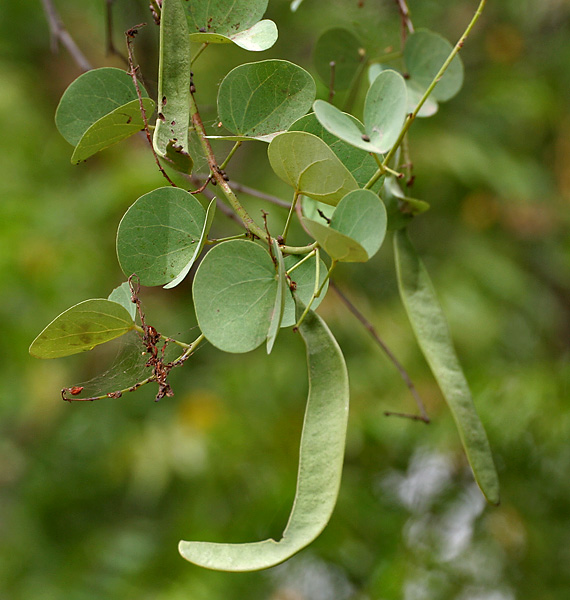
Brazilian Orchid Tree Bauhinia forficata
The scientific name of the Brazilian Orchid Tree is Bauhinia forficata. It is a species of flowering plant in the family Fabaceae (bean), order Fabales.
- Scientific name
- Bauhinia forficata Link
- Common name
- Brazilian Orchid Tree
- Genus
- Bauhinia
- Family
- Fabaceae (Bean)
- Order
- Fabales
- Class
- Magnoliopsida
- Red List category
- LC Least Concern
- Recorded in
- 9 countries
- Name status
- accepted in the Catalogue of Life

Overview
Bauhinia forficata is native to South America, including Brazil, central and northern Argentina, Bolivia, Paraguay, and Uruguay. Its specific epithet forficata refers to the forked or cleft shape of its leaves.
Written 26 November 2026 from the sources listed below. Each statement was checked against the passage it cites; statements that could not be supported were removed.
Appearance
The Brazilian orchid tree has a symmetrical crown that may be vase-shaped, rounded, or spreading. Its canopy is dense and has a medium texture.[1][2]
It typically grows to a height of 25–30 feet (7.6–9.1 m), with a canopy spread of approximately 25–35 feet (7.6–10.7 m).[3][4]
Habitat
The Brazilian orchid tree occurs in Brazil's semi-arid Caatinga region, forest fragments in the Brazilian state of Paraná, and along Amazon coastal areas. In Brazil, its natural range extends from Rio de Janeiro to Rio Grande do Sul.[5][6][7][8]
It typically inhabits well-drained soils and performs best in full sun or intermittent high shade beneath open pine canopies. It is suited to USDA hardiness zones 10A through 11.[9][10][11]
The tree tolerates drought conditions and may benefit from occasional irrigation or afternoon shade during hot, dry periods. Alkaline soils may cause interveinal chlorosis because of nutrient imbalances.[12][13][14]
Classification of the Brazilian Orchid Tree
| Kingdom | Plantae |
|---|---|
| Subkingdom | Pteridobiotina |
| Phylum | Tracheophyta |
| Class | Magnoliopsida |
| Order | Fabales |
| Family | Fabaceae (Bean) |
| Genus | Bauhinia (Orchid Trees) |
| Species | Bauhinia forficata Link |
Where the Brazilian Orchid Tree is found
Checklists and occurrence records place Bauhinia forficata in 9 countries across South America. GBIF holds 5,635 georeferenced records of it.
Countries where it is native or its origin is not stated
Countries where it has been introduced
Regions and cities with the most records
- Paraná, Brazil 386
- São Paulo, Brazil 272
- Santa Catarina, Brazil 235
- Bahia, Brazil 214
- Santos Lugares, Argentina 180
- Valentín Alsina, Argentina 175
- Lanús, Argentina 172
- Avellaneda, Argentina 170
- Buenos Aires, Argentina 170
- Remedios de Escalada de San Martín, Argentina 168
- Sarandí, Argentina 168
- Banfield, Argentina 164
- Monte Chingolo, Argentina 164
- Buenos Aires, Argentina 161
- Lomas de Zamora, Argentina 158
- Villa Sarmiento, Argentina 150
- Quilmes, Argentina 132
- Rio de Janeiro, Brazil 132
- Misiones, Argentina 128
- Rio Grande do Sul, Brazil 121
- Espírito Santo, Brazil 115
- Minas Gerais, Brazil 104
- San Justo, Argentina 86
- Puerto Iguazú, Argentina 85
- El Palomar, Argentina 83
- Haedo, Argentina 83
- Hurlingham, Argentina 73
- Presidente Franco, Paraguay 70
- Foz do Iguaçu, Brazil 69
- San Isidro, Argentina 69
- Isidro Casanova, Argentina 62
- Ciudad del Este, Paraguay 60
- Morón, Argentina 57
- Santa Fe, Argentina 57
- Mato Grosso, Brazil 52
- Castelar, Argentina 50
7 more countries have a few records outside this range
These countries hold a few records of Bauhinia forficata but lie outside the range the checklists give for it. Such records are often zoo or garden specimens, museum material or vagrants, so the species is not counted as occurring there.
A number beside a place is its count of GBIF occurrence records. A place without a number comes from a checklist alone. Records show where a species has been observed or collected, which can include escapes and vagrants.
Common names
English
- Brazilian Orchid Tree
- Orchid Tree
- Thorny Orchid Tree
- Cow's-foot
Names in 5 other languages
- Afrikaans
- Doringorgideeboom
- Italian
- Falsa caoba
- Portuguese
- Casco-de-vaca, Mororó, Pata-de-boi, Unha-de-boi, Unha-de-vaca, pata-de-vaca
- Russian
- Баугиния ножничная
- Spanish
- Pata De Vaca, Patevaca o Pata de vaca, Pezuña de vaca
Synonyms
2 other scientific names have been used for this species and are now treated as synonyms of Bauhinia forficata.
- Inga forficata (Link) Hoffmanns.
- Pauletia forficata (Link) A.Schmitz
Subspecies and varieties
- Bauhinia forficata subsp. forficata subspecies
- Bauhinia forficata subsp. pruinosa subspecies
Related species
-
 Orchid TreeBauhinia variegata
-
 Hong Kong OrchidtreeBauhinia × blakeana
-
 Bidi Leaf TreeBauhinia racemosa
-
 Orchid TreeBauhinia purpurea
-
 Dwarf White BauhiniaBauhinia acuminata
-
 Pride of de KaapBauhinia galpinii
-
 Pink BauhiniaBauhinia monandra
-
 Yellow BauhiniaBauhinia tomentosa
Compare
Questions and answers
What is the scientific name of the Brazilian Orchid Tree?
The scientific name of the Brazilian Orchid Tree is Bauhinia forficata. Written with its author, the full name is Bauhinia forficata Link.
Which family does the Brazilian Orchid Tree belong to?
Bauhinia forficata belongs to the family Fabaceae, in the order Fabales and the class Magnoliopsida.
Where is the Brazilian Orchid Tree found?
Checklists and occurrence records place Bauhinia forficata in 9 countries, including Brazil, Paraguay, Uruguay, Colombia, Peru and Bolivia.
What is the conservation status of the Brazilian Orchid Tree?
The IUCN Red List category recorded for Bauhinia forficata is Least Concern (LC).
What other names does the Brazilian Orchid Tree have?
Bauhinia forficata is also known in English as Orchid Tree, Thorny Orchid Tree and Cow's-foot.
How big does an orchid tree get?
The Brazilian orchid tree typically grows to 25–30 feet (7.6–9.1 m) tall, with a canopy spread of approximately 25–35 feet (7.6–10.7 m).[3][4]
Where does Bauhinia grow?
Bauhinia forficata is native to South America. It occurs in Brazil, central and northern Argentina, Bolivia, Paraguay, and Uruguay.[15][5][16]
Is Bauhinia fast growing?
Bauhinia forficata exhibits moderate growth under suitable conditions.[17]
Sources
Passages the profile rests on
- Bauhinia forficata is a broadleaf evergreen tree with a symmetrical crown that may be vase-shaped, rounded, or spreading. Source passage: “The species displays a symmetrical crown that may take on a vase-shaped, rounded, or spreading form” — English Wikipedia
- Bauhinia forficata has a dense canopy with a medium texture. Source passage: “and has a dense canopy with a medium texture.” — English Wikipedia
- Bauhinia forficata typically grows to a height of 25–30 feet (7.6–9.1 m). Source passage: “typically reaches a height of 25–30 feet (7.6–9.1 m)” — English Wikipedia
- Bauhinia forficata has a canopy spread of approximately 25–35 feet (7.6–10.7 m). Source passage: “with a canopy spread ranging from 25–35 feet (7.6–10.7 m)” — English Wikipedia
- In Brazil, Bauhinia forficata naturally occurs from Rio de Janeiro to Rio Grande do Sul. Source passage: “In Brazil, its natural range extends from the state of Rio de Janeiro to Rio Grande do Sul.” — English Wikipedia
- Bauhinia forficata occurs in Brazil's semi-arid Caatinga region. Source passage: “including the semi-arid Caatinga region” — English Wikipedia
- Bauhinia forficata occurs in forest fragments in the Brazilian state of Paraná. Source passage: “forest fragments in the state of Paraná” — English Wikipedia
- Bauhinia forficata occurs along Amazon coastal areas. Source passage: “and along the Amazon coastal areas.” — English Wikipedia
- Bauhinia forficata typically inhabits well-drained soils. Source passage: “It typically inhabits well-drained soils” — English Wikipedia
- Bauhinia forficata performs best in full sun or intermittent high shade beneath open pine canopies. Source passage: “performs best in full sun or areas with high, intermittent shade, such as beneath open pine canopies.” — English Wikipedia
- Bauhinia forficata is suited to USDA hardiness zones 10A through 11. Source passage: “Bauhinia forficata is suited to the United States Department of Agriculture (USDA) hardiness zones 10A through 11.” — English Wikipedia
- Bauhinia forficata tolerates drought conditions. Source passage: “Although it is tolerant of drought” — English Wikipedia
- Bauhinia forficata may benefit from occasional irrigation or afternoon shade during hot, dry periods. Source passage: “the plant benefits from occasional irrigation or afternoon shade during hot, dry periods” — English Wikipedia
- Bauhinia forficata may develop interveinal chlorosis in alkaline soils because of nutrient imbalances. Source passage: “In alkaline soils, it may exhibit interveinal chlorosis due to nutrient imbalances.” — English Wikipedia
- Bauhinia forficata is native to South America. Source passage: “Bauhinia forficata is native to South America.” — English Wikipedia
- Bauhinia forficata is also native to central and northern Argentina, Bolivia, Paraguay, and Uruguay. Source passage: “including central and northern Argentina, Bolivia, Paraguay and Uruguay.” — English Wikipedia
- Bauhinia forficata exhibits moderate growth under suitable conditions. Source passage: “Growth is moderate under suitable conditions.” — English Wikipedia
Data
- Catalogue of Life, 2026-10-16 XR cc by
- Global Biodiversity Information Facility CC BY 4.0
- Wikidata CC0
- GeoNames CC BY 4.0
- Wikimedia Commons per image; credit shown with each image
- Within the Catalogue of Life, this name comes from The World Checklist of Vascular Plants (WCVP): Fabaceae cc by
References
- Enum. Hort. Berol. Alt. 1: 404 (1821) where the name was published
This species in other databases
Page built on 29 November 2026. See how the catalog is made and all sources and licences.
Cite this page
ScientificNames.org. (2026). Bauhinia forficata (Brazilian Orchid Tree). Retrieved November 29, 2026, from https://scientificnames.org/species/bauhinia-forficata
“Bauhinia forficata (Brazilian Orchid Tree).” ScientificNames.org, 2026, scientificnames.org/species/bauhinia-forficata. Accessed 29 Nov. 2026.
ScientificNames.org. “Bauhinia forficata (Brazilian Orchid Tree).” Accessed November 29, 2026. https://scientificnames.org/species/bauhinia-forficata.
@misc{scientificnames_bauhinia_forficata_brazilian_orchid_tree,
  author = {{ScientificNames.org}},
  title = {Bauhinia forficata (Brazilian Orchid Tree)},
  year = {2026},
  url = {https://scientificnames.org/species/bauhinia-forficata},
  note = {Accessed 2026-11-29}
}