Species · Flowering plants
Orchid Tree Bauhinia variegata
The scientific name of the Orchid Tree is Bauhinia variegata. It is a species of flowering plant in the family Fabaceae (bean), order Fabales.
- Scientific name
- Bauhinia variegata L.
- Common name
- Orchid Tree
- Genus
- Bauhinia
- Family
- Fabaceae (Bean)
- Order
- Fabales
- Class
- Magnoliopsida
- Red List category
- LC Least Concern
- Recorded in
- 67 countries
- Name status
- accepted in the Catalogue of Life

Overview
Bauhinia variegata occurs in South Central China, Southeast Asia, and South Asia. It is a deciduous tree with bright pink or white flowers and seedpods that open explosively to release their seeds.
Written 26 November 2026 from the sources listed below. Each statement was checked against the passage it cites; statements that could not be supported were removed.
Appearance
Orchid tree is a small to medium-sized deciduous tree that can reach 15 metres in height and 50 centimetres in diameter.[1][2]
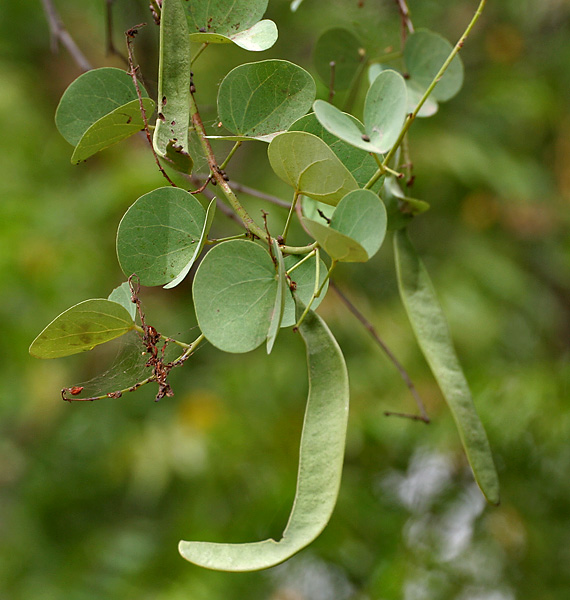
Its leaves are 15–20 centimetres long and broad, rounded, obcordate, and bilobed at both the base and apex.[3]
Its conspicuous flowers are bright pink or white, measure 5–7 centimetres in diameter, and have five petals. Its pollen grains are approximately 75 microns long.[4][5]
Habitat
Orchid tree inhabits dry and moist broadleaf forests, including rainforests. It occurs in tropical and subtropical regions, including the Himalayan foothills.[6][7]
Behaviour
Orchid tree can become naturalised and invasive in some areas because its abundant seedpods can self-sow.[8]
Reproduction and life cycle
Its fruits are seedpods measuring 20–30 centimetres in length and containing 10–15 seeds each.[9]
Mature seedpods dry on the tree and twist into a helix or corkscrew shape. They open explosively with an audible clack to disperse their seeds.[10][11]
Conservation
Orchid tree is regarded as potentially invasive in some areas.[12]
Uses
The tree is used as a food source in many South Asian cuisines. Its edible flower buds are known by local names including Kachnar, Kovidara, Koiralo, and Kanchan in the Indian subcontinent, and are used as ingredients in recipes across the region.[13][14][15]
Its edible buds are used to prepare traditional kachnar curry with yogurt, onions, and native spices. They are also eaten as a stir-fried vegetable and used to prepare pickles in parts of the Indian subcontinent.[16][17]
In Nepal, the plant is called koiralo and its flower is called koiralo ko phool. The flowers and buds are used to prepare a traditional style of pickle, which is an important part of the meal served during Nepal's Ghode Jatra festival.[18][19][20]
The tree is considered sacred in Hinduism and is called Kovidara. It is symbolically depicted on the Dharma Dhwaja flag.[21][22]
Orchid tree is reported to have medicinal properties and to exhibit antioxidant and anticancer activity. Its root is described as having carminative properties, and its flowers are described as having laxative properties.[23][24][25][26]
Classification of the Orchid Tree
| Kingdom | Plantae |
|---|---|
| Subkingdom | Pteridobiotina |
| Phylum | Tracheophyta |
| Class | Magnoliopsida |
| Order | Fabales |
| Family | Fabaceae (Bean) |
| Genus | Bauhinia (Orchid Trees) |
| Species | Bauhinia variegata L. |
Where the Orchid Tree is found
Checklists and occurrence records place Bauhinia variegata in 67 countries across Africa, Asia, Europe, North America, Oceania and South America. GBIF holds 4,339 georeferenced records of it.
Countries where it is native or its origin is not stated
- Bangladesh 7
- Belize 7
- Bhutan 32
- Brazil 1,054
- Costa Rica 37
- El Salvador 17
- Guadeloupe 6
- Guatemala 27
- Honduras 19
- Hong Kong 195
- India 329
- Indonesia 27
- Israel 15
- Jamaica 8
- Laos 14
- Macao 45
- Malaysia 3
- Maldives 3
- Martinique 6
- Myanmar 64
- Nepal 37
- Nicaragua 16
- Pakistan 73
- Panama 8
- Philippines 5
- Saint Barthelemy 6
- Saint Martin 6
- Taiwan 52
- Thailand 105
- Vietnam 11
Countries where it has been introduced
- Argentina 15
- Australia 194
- Bahamas 10
- Bolivia 9
- Cambodia
- China 300
- Colombia 117
- Comoros
- Cuba 30
- Democratic Republic of the Congo 22
- Dominican Republic 13
- Ethiopia 6
- French Polynesia 19
- Ghana
- Greece 26
- Haiti 2
- Iraq 9
- Kenya 24
- Malawi 60
- Mexico 266
- Mozambique 23
- New Caledonia 20
- Nigeria 11
- Portugal 26
- Puerto Rico 28
- Sierra Leone 6
- South Africa 243
- Spain 46
- Sri Lanka 5
- Tanzania 20
- Trinidad and Tobago 5
- Uganda 2
- United States 467
- Vanuatu 11
- Venezuela 9
- Zambia 35
- Zimbabwe 26
Regions and cities with the most records
- Tsuen Wan, Hong Kong 169
- Mei Foo, Hong Kong 167
- Mei Foo Sun Chuen, Hong Kong 167
- Tsing Yi Town, Hong Kong 167
- Discovery Park, Hong Kong 166
- Hoi Lai Estate, Hong Kong 164
- Kwai Chung, Hong Kong 164
- So Uk, Hong Kong 164
- So Uk Estate, Hong Kong 164
- Tai Wo Hau, Hong Kong 164
- Ting Kau, Hong Kong 164
- Un Chau Estate, Hong Kong 164
- Shek Lei, Hong Kong 163
- Fu Cheong Estate, Hong Kong 159
- Nam Cheong, Hong Kong 158
- Sham Shui Po, Hong Kong 158
- Shek Kip Mei Estate, Hong Kong 157
- Florida, United States 155
- Keng Hau, Hong Kong 155
- Shek Kip Mei, Hong Kong 155
- Olympic, Hong Kong 154
- Pak Tin Estate, Hong Kong 154
- Tai Wai, Hong Kong 154
- San Tin, Hong Kong 152
- Sham Tseng, Hong Kong 152
- Wong Tai Sin, Hong Kong 152
- Sha Tin, Hong Kong 151
- Tai Kok Tsui, Hong Kong 151
- Chuk Yuen, Hong Kong 150
- Chuk Yuen North Estate, Hong Kong 150
- Kadoorie, Hong Kong 150
- Mount Davis, Hong Kong 150
- Pok Hong, Hong Kong 150
- Sha Tin Wai, Hong Kong 150
- Sun Tin Wai, Hong Kong 150
- Wo Che, Hong Kong 150
20 more countries have a few records outside this range
These countries hold a few records of Bauhinia variegata but lie outside the range the checklists give for it. Such records are often zoo or garden specimens, museum material or vagrants, so the species is not counted as occurring there.
A number beside a place is its count of GBIF occurrence records. A place without a number comes from a checklist alone. Records show where a species has been observed or collected, which can include escapes and vagrants.
Common names
English
- Orchid Tree
- Camel's Foot Tree
- Mountain Ebony
- Mountain-ebony
- Orchidtree
Names in 25 other languages
- Afrikaans
- Orgideeboom, orgideëboom
- Arabic
- شجرة الأوركيد, شجرة قدم الجمل
- Bengali
- কাঞ্চন
- Burmese
- ဘွဲ့ချဉ်
- Chinese
- 宫粉羊蹄甲, 宮粉羊蹄甲, 洋紫荆, 白花树, 白花羊紫荊, 羊蹄甲, 羊蹄甲叶, 羊蹄甲树皮
- Czech
- bauhinie pestrá
- Finnish
- kirjobauhinia
- French
- Arbre à fleurs d'orchidées, arbre de Saint-Thomas
- German
- Orchideenbaum, buntfarbene Bauhinie
- Hebrew
- בוהיניה מגוונת
- Hindi
- kachnar
- Japanese
- ソシンカ, フイリソシンカ
- Lithuanian
- Margasis pupūnas
- Malay
- Akbar Tapak Kerbau
- Marathi
- कांचन
- Polish
- Bauhinia zmienna
- Portuguese
- Casco-de-vaca-lilás, árvore-de-São-Thomaz
- Russian
- Баугиния пёстрая
- Slovak
- bauhínia pestrá
- Spanish
- Orquídea de pobre, Pata asiática de vaca
- Swedish
- orkidébauhinia
- Telugu
- కంచనార
- Thai
- เสี้ยวดอกขาว
- Turkish
- Orkide Ağacı
- lao
- ບານ
Synonyms
3 other scientific names have been used for this species and are now treated as synonyms of Bauhinia variegata.
- Bauhinia variegata var. purpurascens Voigt
- Perlebia variegata (L.) A.Schmitz
- Phanera variegata (L.) Benth.
Subspecies and varieties
- Bauhinia variegata var. candida variety
- Bauhinia variegata var. variegata variety
Related species
-
 Hong Kong OrchidtreeBauhinia × blakeana
-
 Bidi Leaf TreeBauhinia racemosa
-
 Orchid TreeBauhinia purpurea
-
 Dwarf White BauhiniaBauhinia acuminata
-
 Pride of de KaapBauhinia galpinii
-
 Pink BauhiniaBauhinia monandra
-
 Yellow BauhiniaBauhinia tomentosa
-
 Brazilian Orchid TreeBauhinia forficata
Compare
Questions and answers
What is the scientific name of the Orchid Tree?
The scientific name of the Orchid Tree is Bauhinia variegata. Written with its author, the full name is Bauhinia variegata L..
Which family does the Orchid Tree belong to?
Bauhinia variegata belongs to the family Fabaceae, in the order Fabales and the class Magnoliopsida.
Where is the Orchid Tree found?
Checklists and occurrence records place Bauhinia variegata in 67 countries, including Brazil, India, Hong Kong, Thailand, Pakistan and Myanmar.
What is the conservation status of the Orchid Tree?
The IUCN Red List category recorded for Bauhinia variegata is Least Concern (LC).
What other names does the Orchid Tree have?
Bauhinia variegata is also known in English as Camel's Foot Tree, Mountain Ebony, Mountain-ebony and Orchidtree.
Is the orchid tree invasive?
Orchid tree can become naturalised and invasive in some areas because its abundant seedpods can self-sow. It is regarded as potentially invasive in some areas.[8][12]
How big does an orchid tree get?
Orchid tree can reach 15 metres in height and 50 centimetres in diameter.[2]
Sources
Passages the profile rests on
- Bauhinia variegata is a small to medium-sized deciduous tree. Source passage: “Bauhinia variegata is a small to medium-sized tree growing to 15 metres (49 ft) tall and 50 centimetres (20 in) in diameter, deciduous in the dry season.” — English Wikipedia
- The tree can reach 15 metres in height and 50 centimetres in diameter. Source passage: “growing to 15 metres (49 ft) tall and 50 centimetres (20 in) in diameter” — English Wikipedia
- Its leaves are 15–20 centimetres long and broad, rounded, obcordate, and bilobed at both the base and apex. Source passage: “The leaves are 15–20 centimetres (5.9–7.9 in) obcordate shaped, long and broad, rounded, and bilobed at the base and apex.” — English Wikipedia
- Its conspicuous flowers are bright pink or white, measure 5–7 centimetres in diameter, and have five petals. Source passage: “The flowers are conspicuous, bright pink or white, 5–7 centimetres (2.0–2.8 in) diameter, with five petals.” — English Wikipedia
- The pollen grains are approximately 75 microns long. Source passage: “Pollens are elongated, approximately 75 microns in length.” — English Wikipedia
- The species inhabits dry and moist broadleaf forests, including rainforests. Source passage: “They inhabit in dry broadleaf forests, moist broadleaf forests (including rainforests)” — English Wikipedia
- The species occurs in tropical and subtropical regions, including the Himalayan foothills. Source passage: “in tropical, subtropical, including in Himalayan foothills.” — English Wikipedia
- The species can become naturalised and invasive in some areas because its abundant seedpods can self-sow. Source passage: “in some areas it has become naturalised and invasive as the tree can produce abundant seed pods that may self-sow” — English Wikipedia
- Its fruits are seedpods measuring 20–30 centimetres in length and containing 10–15 seeds each. Source passage: “The fruit is a seedpod 20–30 centimetres (7.9–11.8 in) long, containing 10–15 seeds each.” — English Wikipedia
- Mature seedpods dry on the tree, twist into a helix or corkscrew shape, and explosively release their seeds. Source passage: “The seedpod dries completely on the tree, and when mature begins to twist into a helix or corkscrew shape” — English Wikipedia
- The mature seedpods open explosively with an audible clack to disperse their seeds. Source passage: “ultimately exploding open—with a very audible "clack"—to deliver its seeds into the environs.” — English Wikipedia
- The species is regarded as potentially invasive in some areas. Source passage: “therefore regarded as potentially invasive.” — English Wikipedia
- The tree is used as a food source in many South Asian cuisines. Source passage: “also used as a food item in many South Asian cuisines.” — English Wikipedia
- Its edible flower buds are known by local names including Kachnar, Kovidara, Koiralo, and Kanchan in the Indian subcontinent. Source passage: “Kachnar, Kovidara, Koiralo, Kanchan are local names in the Indian subcontinent for the edible buds collected from the tree” — English Wikipedia
- Its flower buds are used as ingredients in recipes across the Indian subcontinent. Source passage: “it is widely used as an ingredient in many subcontinent recipes.” — English Wikipedia
- The edible buds are used to prepare traditional kachnar curry with yogurt, onions, and native spices. Source passage: “Traditional kachnar curry is prepared using kachnar buds, yogurt, onions and native spices.” — English Wikipedia
- Its buds are eaten as a stir-fried vegetable and used to prepare pickles in parts of the Indian subcontinent. Source passage: “Kachnar buds are also eaten as a stir-fried vegetable and used to make achaar, a pickle in many parts of the Indian sub-continent.” — English Wikipedia
- In Nepal, the plant is called koiralo and its flower is called koiralo ko phool. Source passage: “In Nepal, the plant is known as koiralo and the flower is known as koiralo ko phool in Nepali language.” — English Wikipedia
- In Nepal, the flowers and buds are used to prepare a traditional style of pickle. Source passage: “The flower and the buds are used to make Nepalese style achaar.” — English Wikipedia
- The pickle made from the plant is an important part of the meal served during Nepal's Ghode Jatra festival. Source passage: “The achar is important part of the meal served during the Ghode Jatra festival.” — English Wikipedia
- The tree is considered sacred in Hinduism and is called Kovidara. Source passage: “The tree is considered very sacred in Hinduism, it is called Kovidara” — English Wikipedia
- The tree is symbolically depicted on the Dharma Dhwaja flag. Source passage: “it is symbolically depicted on the Dharma Dhwaja flag.” — English Wikipedia
- The species is reported to exhibit antioxidant and anticancer activity. Source passage: “It shows a good antioxidant and anticancer activity.” — English Wikipedia
- The species is reported to have medicinal properties. Source passage: “Orchid tree exhibits medicinal properties.” — elgintexas.gov
- The root is described as having carminative properties. Source passage: “Its root is carminative” — elgintexas.gov
- The flowers are described as having laxative properties. Source passage: “flowers are laxative” — elgintexas.gov
- The species occurs in South Central China, Southeast Asia, and South Asia. Source passage: “It is distributed across South Central China, Southeast Asia, South Asia.” — English Wikipedia
Data
- Catalogue of Life, 2026-10-16 XR cc by
- Global Biodiversity Information Facility CC BY 4.0
- Wikidata CC0
- GeoNames CC BY 4.0
- Wikimedia Commons per image; credit shown with each image
- Within the Catalogue of Life, this name comes from The World Checklist of Vascular Plants (WCVP): Fabaceae cc by
References
- Sp. Pl.: 375 (1753) where the name was published
This species in other databases
Page built on 28 November 2026. See how the catalog is made and all sources and licences.
Cite this page
ScientificNames.org. (2026). Bauhinia variegata (Orchid Tree). Retrieved November 28, 2026, from https://scientificnames.org/species/bauhinia-variegata
“Bauhinia variegata (Orchid Tree).” ScientificNames.org, 2026, scientificnames.org/species/bauhinia-variegata. Accessed 28 Nov. 2026.
ScientificNames.org. “Bauhinia variegata (Orchid Tree).” Accessed November 28, 2026. https://scientificnames.org/species/bauhinia-variegata.
@misc{scientificnames_bauhinia_variegata_orchid_tree,
  author = {{ScientificNames.org}},
  title = {Bauhinia variegata (Orchid Tree)},
  year = {2026},
  url = {https://scientificnames.org/species/bauhinia-variegata},
  note = {Accessed 2026-11-28}
}