Species · Flowering plants
Elegant Pronaya Billardiera fraseri
The scientific name of the Elegant Pronaya is Billardiera fraseri. It is a species of flowering plant in the family Pittosporaceae (cheesewood family), order Apiales.
- Scientific name
- Billardiera fraseri (Hook.) F.Muell.
- Common name
- Elegant Pronaya
- Genus
- Billardiera
- Family
- Pittosporaceae (Cheesewood Family)
- Order
- Apiales
- Class
- Magnoliopsida
- Recorded in
- 1 country
- Name status
- accepted in the Catalogue of Life

Overview
Elegant pronaya is a climbing shrub in the family Pittosporaceae, order Apiales and class Magnoliopsida. It grows on coastal plains and cliffs in south-western Western Australia. It is distinguished by deep purple or pink petals that fade as they age and a mature cylindrical berry approximately 20 mm long.
Written 27 November 2026 from the sources listed below. Each statement was checked against the passage it cites; statements that could not be supported were removed.
Appearance
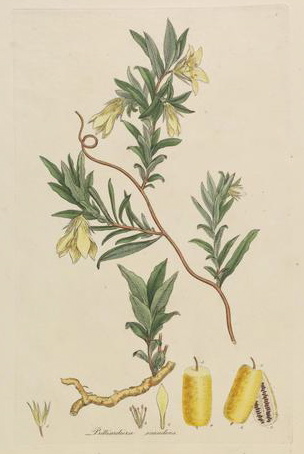
Elegant pronaya is a climbing plant with densely silky-haired new shoots, leaves and flowers. Its adult leaves are narrowly elliptic with downward-curving edges and measure 22–28 mm long and 3–5 mm wide.[1][2][3]
The flowers are arranged in sessile groups with leaf-like bracts at their base. The bracts are 7–9 mm long, and the sepals are narrowly triangular and measure 6–12 mm long.[4][5][6][7]
The petals are deep purple or pink, fade as they age and measure 12–16 mm long. The mature fruit is a cylindrical berry approximately 20 mm long.[8][9][10]
Habitat
Elegant pronaya grows on coastal plains and cliffs, on limestone, sand and gravel. It grows primarily in the subtropical biome.[11][12][13]
Reproduction and life cycle
Elegant pronaya flowers from December to February.[14]
Classification of the Elegant Pronaya
| Kingdom | Plantae |
|---|---|
| Subkingdom | Pteridobiotina |
| Phylum | Tracheophyta |
| Class | Magnoliopsida |
| Order | Apiales |
| Family | Pittosporaceae (Cheesewood Family) |
| Tribe | Billardiereae |
| Genus | Billardiera (Apple-berries) |
| Species | Billardiera fraseri (Hook.) F.Muell. |
Where the Elegant Pronaya is found
Checklists and occurrence records place Billardiera fraseri in 1 country across Oceania. GBIF holds 453 georeferenced records of it.
Countries
Regions and cities with the most records
Range as the checklists state it
Australia (Western Australia)
A number beside a place is its count of GBIF occurrence records. A place without a number comes from a checklist alone. Records show where a species has been observed or collected, which can include escapes and vagrants.
Common names
English
- Elegant Pronaya
Synonyms
8 other scientific names have been used for this species and are now treated as synonyms of Billardiera fraseri.
- Billardiera elegans (Endl.) F.Muell.
- Campylanthera frasei (Hook.) Hook.
- Campylanthera fraseri (Hook.) Hook.
- Pronaya elegans Hügel
- Pronaya elegans var. minor Benth.
- Pronaya fraseri (Hook.) E.M.Benn.
- Pronaya fraseri var. minor (Benth.) E.M.Benn.
- Spiranthera fraseri Hook.
Related species
-
 Apple BerryBillardiera scandens
-
 Western Australian Bluebell CreeperBillardiera heterophylla
- Purple Apple-berryBillardiera longiflora
-
 Australian BluebellBillardiera fusiformis
- Common Apple-berryBillardiera mutabilis
-
 White-Flowered BillardieraBillardiera floribunda
- Mountain Apple-berryBillardiera macrantha
- Single-flower Apple-berryBillardiera uniflora
Compare
Questions and answers
What is the scientific name of the Elegant Pronaya?
The scientific name of the Elegant Pronaya is Billardiera fraseri. Written with its author, the full name is Billardiera fraseri (Hook.) F.Muell..
Which family does the Elegant Pronaya belong to?
Billardiera fraseri belongs to the family Pittosporaceae, in the order Apiales and the class Magnoliopsida.
Where is the Elegant Pronaya found?
Checklists and occurrence records place Billardiera fraseri in 1 country: Australia.
Where is elegant pronaya found?
It is endemic to south-western Western Australia and occurs from near Yanchep and Muchea to North Bannister. It occurs in the Avon Wheatbelt, Geraldton Sandplains, Jarrah Forest and Swan Coastal Plain bioregions.[15][16][17]
When does elegant pronaya flower?
It flowers from December to February.[14]
Sources
Passages the profile rests on
- Billardiera fraseri is a climbing plant with densely silky-haired new shoots, leaves and flowers. Source passage: “It is a climber with densely silky-hairy new shoots, leaves and flowers.” — English Wikipedia
- The adult leaves are narrowly elliptic with downward-curving edges. Source passage: “The adult leaves are narrowly elliptic with the edges turned down” — English Wikipedia
- The adult leaves measure 22–28 mm long and 3–5 mm wide. Source passage: “22–28 mm (0.87–1.10 in) long and 3–5 mm (0.12–0.20 in) wide” — English Wikipedia
- The flowers are arranged in sessile groups with leaf-like bracts at their base. Source passage: “The flowers are arranged in sessile groups with leaf-like bracts 7–9 mm (0.28–0.35 in) long at the base.” — English Wikipedia
- The leaf-like bracts at the base of the flower groups are 7–9 mm long. Source passage: “leaf-like bracts 7–9 mm (0.28–0.35 in) long at the base.” — English Wikipedia
- The sepals are narrowly triangular. Source passage: “The sepals are narrowly triangular” — English Wikipedia
- The sepals measure 6–12 mm long. Source passage: “6–12 mm (0.24–0.47 in) long” — English Wikipedia
- The petals are deep purple or pink and fade as they age. Source passage: “the petals are deep purple or pink, fading as they age” — English Wikipedia
- The petals measure 12–16 mm long. Source passage: “12–16 mm (0.47–0.63 in) long” — English Wikipedia
- The mature fruit is a cylindrical berry approximately 20 mm long. Source passage: “the mature fruit is a cylinderical berry about 20 mm (0.79 in) long.” — English Wikipedia
- Billardiera fraseri grows on coastal plains and cliffs. Source passage: “grows on the coastal plain and cliffs” — English Wikipedia
- The species grows on limestone, sand and gravel. Source passage: “on limestone, sand and gravel” — English Wikipedia
- The species grows primarily in the subtropical biome. Source passage: “grows primarily in the subtropical biome.” — powo.science.kew.org
- Billardiera fraseri flowers from December to February. Source passage: “Flowering occurs from December to February” — English Wikipedia
- Billardiera fraseri is endemic to south-western Western Australia. Source passage: “is endemic to the south-west of Western Australia.” — English Wikipedia
- The species occurs from near Yanchep and Muchea to North Bannister. Source passage: “from near Yanchep and Muchea to North Bannister” — English Wikipedia
- The species occurs in the Avon Wheatbelt, Geraldton Sandplains, Jarrah Forest and Swan Coastal Plain bioregions. Source passage: “in the Avon Wheatbelt, Geraldton Sandplains, Jarrah Forest and Swan Coastal Plain bioregions” — English Wikipedia
- The specific epithet fraseri honours the collector of the type specimen. Source passage: “The specific epithet (fraseri) honours the collector of the type specimen.” — English Wikipedia
- The specimens used for the original description were collected in the Swan River Colony by Charles Fraser. Source passage: “from specimens collected in the Swan River Colony by Charles Fraser.” — English Wikipedia
Data
- Catalogue of Life, 2026-10-16 XR cc by
- Global Biodiversity Information Facility CC BY 4.0
- Wikidata CC0
- GeoNames CC BY 4.0
- Wikimedia Commons per image; credit shown with each image
- Within the Catalogue of Life, this name comes from Synonymic Checklists of the Vascular Plants of the World cc by
References
- F.Muell. (1862). Pl. Victoria 1: 78 (1862). where the name was published
This species in other databases
Page built on 28 November 2026. See how the catalog is made and all sources and licences.
Cite this page
ScientificNames.org. (2026). Billardiera fraseri (Elegant Pronaya). Retrieved November 28, 2026, from https://scientificnames.org/species/billardiera-fraseri
“Billardiera fraseri (Elegant Pronaya).” ScientificNames.org, 2026, scientificnames.org/species/billardiera-fraseri. Accessed 28 Nov. 2026.
ScientificNames.org. “Billardiera fraseri (Elegant Pronaya).” Accessed November 28, 2026. https://scientificnames.org/species/billardiera-fraseri.
@misc{scientificnames_billardiera_fraseri_elegant_pronaya,
  author = {{ScientificNames.org}},
  title = {Billardiera fraseri (Elegant Pronaya)},
  year = {2026},
  url = {https://scientificnames.org/species/billardiera-fraseri},
  note = {Accessed 2026-11-28}
}