Species · Flowering plants
Pale Apple Berry Billardiera versicolor
The scientific name of the Pale Apple Berry is Billardiera versicolor. It is a species of flowering plant in the family Pittosporaceae (cheesewood family), order Apiales.
- Scientific name
- Billardiera versicolor F.Muell. ex Klatt
- Common name
- Pale Apple Berry
- Genus
- Billardiera
- Family
- Pittosporaceae (Cheesewood Family)
- Order
- Apiales
- Class
- Magnoliopsida
- Recorded in
- 1 country
- Name status
- accepted in the Catalogue of Life
Overview
Billardiera versicolor occurs in western New South Wales, the western half of Victoria, South Australia's Eyre Peninsula and South Australia's Flinders Ranges. It has white, cream-coloured or pale yellow flowers that develop mauve-red blotches as they age, and green berries containing many seeds.
Written 27 November 2026 from the sources listed below. Each statement was checked against the passage it cites; statements that could not be supported were removed.
Appearance
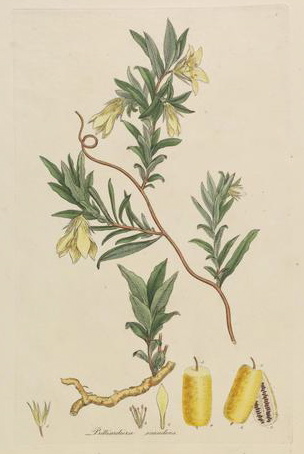
Pale apple berry is a robust, shrubby plant that grows as a twiner or scrambler. Its stems can grow to several metres long.[1][2]
The adult leaves are narrowly egg-shaped to narrowly elliptic and more or less sessile. They measure 25–60 mm in length and 4–15 mm in width.[3][4][5][6]
The flowers are white, cream-coloured or pale yellow, developing mauve-red blotches that spread as they age. The sepals are yellowish-green and measure 2–3 mm in length, while the petals measure 10–12 mm in length.[7][8][9][10][11]
The flowers are arranged in sessile groups, each containing approximately five to twelve flowers. Each flower is borne on a pedicel measuring 10–12 mm in length.[12][13][14]
The mature fruit is a green berry measuring 13–15 mm in length.[15][16]
Habitat
Pale apple berry mainly grows in mallee vegetation and also occurs in woodland.[17][18]
Reproduction and life cycle
Flowering mainly occurs between September and December. The mature berries contain many seeds.[19][20]
Classification of the Pale Apple Berry
| Kingdom | Plantae |
|---|---|
| Subkingdom | Pteridobiotina |
| Phylum | Tracheophyta |
| Class | Magnoliopsida |
| Order | Apiales |
| Family | Pittosporaceae (Cheesewood Family) |
| Tribe | Billardiereae |
| Genus | Billardiera (Apple-berries) |
| Species | Billardiera versicolor F.Muell. ex Klatt |
Where the Pale Apple Berry is found
Checklists and occurrence records place Billardiera versicolor in 1 country across Oceania. GBIF holds 850 georeferenced records of it.
Countries
Regions and cities with the most records
- South Australia, Australia 590
- New South Wales, Australia 138
- Victoria, Australia 81
- Mount Barker, Australia 35
- Adelaide, Australia 11
- Adelaide Hills, Australia 11
- Bacchus Marsh, Australia 11
- Bendigo, Australia 3
Range as the checklists state it
Australia (South Australia, New South Wales)
A number beside a place is its count of GBIF occurrence records. A place without a number comes from a checklist alone. Records show where a species has been observed or collected, which can include escapes and vagrants.
Common names
English
- Pale Apple Berry
- Sweet Appleberry
Names in 1 other language
- Chinese
- 白果莓
Synonyms
One other scientific name has been used for this species and is now treated as a synonym of Billardiera versicolor.
- Pronaya muelleriana Turcz.
Related species
-
 Apple BerryBillardiera scandens
-
 Western Australian Bluebell CreeperBillardiera heterophylla
- Purple Apple-berryBillardiera longiflora
-
 Australian BluebellBillardiera fusiformis
- Common Apple-berryBillardiera mutabilis
-
 White-Flowered BillardieraBillardiera floribunda
- Mountain Apple-berryBillardiera macrantha
- Single-flower Apple-berryBillardiera uniflora
Compare
Questions and answers
What is the scientific name of the Pale Apple Berry?
The scientific name of the Pale Apple Berry is Billardiera versicolor. Written with its author, the full name is Billardiera versicolor F.Muell. ex Klatt.
Which family does the Pale Apple Berry belong to?
Billardiera versicolor belongs to the family Pittosporaceae, in the order Apiales and the class Magnoliopsida.
Where is the Pale Apple Berry found?
Checklists and occurrence records place Billardiera versicolor in 1 country: Australia.
What other names does the Pale Apple Berry have?
Billardiera versicolor is also known in English as Sweet Appleberry.
Sources
Passages the profile rests on
- Billardiera versicolor is a robust, shrubby plant that grows as a twiner or scrambler. Source passage: “It is a robust, shrubby twiner or scrambler” — English Wikipedia
- The stems of Billardiera versicolor can grow to several metres long. Source passage: “stems up to several metres long.” — English Wikipedia
- The adult leaves are narrowly egg-shaped to narrowly elliptic. Source passage: “narrowly egg-shaped to narrowly elliptic” — English Wikipedia
- The adult leaves measure 25–60 mm in length. Source passage: “25–60 mm (0.98–2.36 in) long” — English Wikipedia
- The adult leaves measure 4–15 mm in width. Source passage: “4–15 mm (0.16–0.59 in) wide.” — English Wikipedia
- The adult leaves are more or less sessile. Source passage: “The adult leaves are more or less sessile” — English Wikipedia
- The flowers are white, cream-coloured or pale yellow. Source passage: “the petals white, cream-coloured or pale yellow” — English Wikipedia
- The flowers develop mauve-red blotches that spread as they age. Source passage: “with mauve-red blotches that spread as the flower ages.” — English Wikipedia
- The sepals are yellowish-green. Source passage: “The sepals are yellowish-green” — English Wikipedia
- The sepals measure 2–3 mm in length. Source passage: “2–3 mm (0.079–0.118 in) long” — English Wikipedia
- The petals measure 10–12 mm in length. Source passage: “10–12 mm (0.39–0.47 in) long” — English Wikipedia
- The flowers are arranged in sessile groups. Source passage: “The flowers are arranged in sessile groups” — English Wikipedia
- Each flower group contains approximately five to twelve flowers. Source passage: “groups of about five to twelve” — English Wikipedia
- Each flower is borne on a pedicel measuring 10–12 mm in length. Source passage: “each flower on a pedicel 10–12 mm (0.39–0.47 in) long.” — English Wikipedia
- The mature fruit is a green berry. Source passage: “the mature fruit is a green berry” — English Wikipedia
- The mature berries measure 13–15 mm in length. Source passage: “13–15 mm (0.51–0.59 in) long” — English Wikipedia
- Billardiera versicolor mainly grows in mallee vegetation. Source passage: “This species of Billardiera mainly grows in mallee” — English Wikipedia
- Billardiera versicolor also grows in woodland. Source passage: “but also in woodland” — English Wikipedia
- The mature berries contain many seeds. Source passage: “containing many seeds.” — English Wikipedia
- Flowering mainly occurs between September and December. Source passage: “Flowering mainly occurs from September to December” — English Wikipedia
- Billardiera versicolor was first formally described in 1857 by Friedrich Wilhelm Klatt. Source passage: “Billardiera versicolor was first formally described in 1857 by Friedrich Wilhelm Klatt” — English Wikipedia
- Billardiera versicolor is an accepted scientific name according to the Atlas of Living Australia. Source passage: “Billardiera versicolor F.Muell. ex Klatt accepted” — bie.ala.org.au
Data
- Catalogue of Life, 2026-10-16 XR cc by
- Global Biodiversity Information Facility CC BY 4.0
- Wikidata CC0
- GeoNames CC BY 4.0
- Within the Catalogue of Life, this name comes from Synonymic Checklists of the Vascular Plants of the World cc by
References
- F.Muell. ex Klatt. (1858). Linnaea 28: 751 (1858). where the name was published
This species in other databases
Page built on 28 November 2026. See how the catalog is made and all sources and licences.
Cite this page
ScientificNames.org. (2026). Billardiera versicolor (Pale Apple Berry). Retrieved November 28, 2026, from https://scientificnames.org/species/billardiera-versicolor
“Billardiera versicolor (Pale Apple Berry).” ScientificNames.org, 2026, scientificnames.org/species/billardiera-versicolor. Accessed 28 Nov. 2026.
ScientificNames.org. “Billardiera versicolor (Pale Apple Berry).” Accessed November 28, 2026. https://scientificnames.org/species/billardiera-versicolor.
@misc{scientificnames_billardiera_versicolor_pale_apple_berry,
  author = {{ScientificNames.org}},
  title = {Billardiera versicolor (Pale Apple Berry)},
  year = {2026},
  url = {https://scientificnames.org/species/billardiera-versicolor},
  note = {Accessed 2026-11-28}
}