Species · Flowering plants
Gypsum Grama Bouteloua breviseta
The scientific name of the Gypsum Grama is Bouteloua breviseta. It is a species of flowering plant in the family Poaceae (turf), order Poales.
- Scientific name
- Bouteloua breviseta Vasey ex J.M.Coult.
- Common name
- Gypsum Grama
- Genus
- Bouteloua
- Family
- Poaceae (Turf)
- Order
- Poales
- Class
- Liliopsida
- Recorded in
- 2 countries
- Name status
- accepted in the Catalogue of Life
Overview
Gypsum grama is a perennial grass in the family Poaceae, order Poales, and class Liliopsida. It is native to the Chihuahuan Desert, including New Mexico and Texas in the United States and Chihuahua in Mexico. It reproduces mainly through budding and sometimes through seeds.
Written 27 November 2026 from the sources listed below. Each statement was checked against the passage it cites; statements that could not be supported were removed.
Appearance
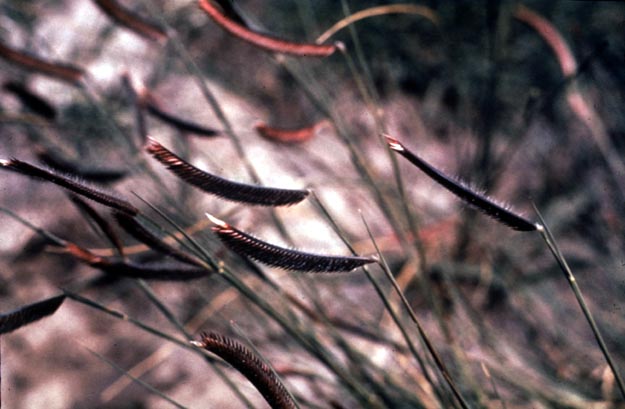
Gypsum grama is a perennial grass that sometimes develops rhizomes. Its stems have tough bases and can reach 40 centimeters in height.[1][2][3][4]
Its leaf blades are generally only a few centimeters long. Its inflorescence measures 2 to 4 centimeters in length.[5][6]
Reproduction and life cycle
Gypsum grama reproduces mainly through budding and sometimes through seeds.[7][8]
Uses
Gypsum grama is used for grazing and can be included in hay mixtures.[9][10]
Habitat
Gypsum grama can establish itself in poor growing conditions and in places where other grasses cannot grow.[11][12]
Conservation
Gypsum grama does not tolerate overgrazing well.[13]
Classification of the Gypsum Grama
| Kingdom | Plantae |
|---|---|
| Subkingdom | Pteridobiotina |
| Phylum | Tracheophyta |
| Class | Liliopsida |
| Order | Poales |
| Family | Poaceae (Turf) |
| Genus | Bouteloua (Grama) |
| Species | Bouteloua breviseta Vasey ex J.M.Coult. |
Where the Gypsum Grama is found
Checklists and occurrence records place Bouteloua breviseta in 2 countries across North America. GBIF holds 519 georeferenced records of it.
Countries
Regions and cities with the most records
- New Mexico, United States 133
- Texas, United States 70
- Coahuila, Mexico 23
- Chihuahua, Mexico 17
- Durango, Mexico 10
- Roswell, United States 7
- Carlsbad, United States 6
- Alamogordo, United States 4
- Arizona, United States 4
A number beside a place is its count of GBIF occurrence records. A place without a number comes from a checklist alone. Records show where a species has been observed or collected, which can include escapes and vagrants.
Common names
English
- Gypsum Grama
Names in 1 other language
- Spanish
- Chino grama
Synonyms
One other scientific name has been used for this species and is now treated as a synonym of Bouteloua breviseta.
- Chondrosum brevisetum (Vasey ex J.M.Coult.) Clayton
Related species
-
 Blue GramaBouteloua gracilis
-
 Sideoats GramaBouteloua curtipendula
-
 Black GramaBouteloua eriopoda
-
 Hairy GramaBouteloua hirsuta
-
 Needle GramaBouteloua aristidoides
-
 Sixweeks GramaBouteloua barbata
-
 Slender GramaBouteloua repens
-
 Red GramaBouteloua trifida
Compare
Questions and answers
What is the scientific name of the Gypsum Grama?
The scientific name of the Gypsum Grama is Bouteloua breviseta. Written with its author, the full name is Bouteloua breviseta Vasey ex J.M.Coult..
Which family does the Gypsum Grama belong to?
Bouteloua breviseta belongs to the family Poaceae, in the order Poales and the class Liliopsida.
Where is the Gypsum Grama found?
Checklists and occurrence records place Bouteloua breviseta in 2 countries: United States and Mexico.
Sources
Passages the profile rests on
- Bouteloua breviseta is a perennial grass. Source passage: “Bouteloua breviseta is a perennial grass that is sometimes rhizomatous.” — English Wikipedia
- The grass sometimes develops rhizomes. Source passage: “sometimes rhizomatous.” — English Wikipedia
- Its stems have tough bases. Source passage: “The stems are tough at the bases” — English Wikipedia
- Its stems can reach 40 centimeters in height. Source passage: “grow up to 40 centimeters tall.” — English Wikipedia
- Its leaf blades are generally only a few centimeters long. Source passage: “The leaf blades are generally just a few centimeters long.” — English Wikipedia
- Its inflorescence measures 2 to 4 centimeters in length. Source passage: “The inflorescence is 2 to 4 centimeters long” — English Wikipedia
- The species reproduces mainly through budding. Source passage: “The grass mainly reproduces by budding” — English Wikipedia
- The species sometimes reproduces through seeds. Source passage: “and sometimes by seed.” — English Wikipedia
- The grass is used for grazing. Source passage: “This grass is used for grazing” — English Wikipedia
- The grass can be included in hay mixtures. Source passage: “it may be added to a hay mix.” — English Wikipedia
- The species can establish itself in poor growing conditions. Source passage: “it is adaptable to poor conditions” — English Wikipedia
- The species can establish in places where other grasses cannot grow. Source passage: “it can take hold where other grasses cannot grow.” — English Wikipedia
- The species does not tolerate overgrazing well. Source passage: “It does not stand up to overgrazing” — English Wikipedia
Data
- Catalogue of Life, 2026-10-16 XR cc by
- Global Biodiversity Information Facility CC BY 4.0
- Wikidata CC0
- GeoNames CC BY 4.0
- Within the Catalogue of Life, this name comes from The World Checklist of Vascular Plants (WCVP) cc by
References
- Contr. U.S. Natl. Herb. 1: 58 (1890) where the name was published
This species in other databases
Page built on 29 November 2026. See how the catalog is made and all sources and licences.
Cite this page
ScientificNames.org. (2026). Bouteloua breviseta (Gypsum Grama). Retrieved November 29, 2026, from https://scientificnames.org/species/bouteloua-breviseta
“Bouteloua breviseta (Gypsum Grama).” ScientificNames.org, 2026, scientificnames.org/species/bouteloua-breviseta. Accessed 29 Nov. 2026.
ScientificNames.org. “Bouteloua breviseta (Gypsum Grama).” Accessed November 29, 2026. https://scientificnames.org/species/bouteloua-breviseta.
@misc{scientificnames_bouteloua_breviseta_gypsum_grama,
  author = {{ScientificNames.org}},
  title = {Bouteloua breviseta (Gypsum Grama)},
  year = {2026},
  url = {https://scientificnames.org/species/bouteloua-breviseta},
  note = {Accessed 2026-11-29}
}